Your Guide to the Spotify Revenue Calculator
Finally understand your Spotify earnings. This practical guide to the Spotify revenue calculator helps artists estimate income and maximize streaming royalties.
January 5, 2026
Music Marketplace Advisor
Buying & SellingIf you want to build a useful Spotify revenue calculator, you need to get one thing straight: it's not just a numbers game. It’s about understanding how Spotify actually pays artists. The big secret is that Spotify doesn't have a fixed, flat rate for every stream. Instead, your earnings come from a complex "pro-rata" system based on your share of a massive, constantly changing pool of money.
Understanding How Spotify Royalties Actually Work
Before you can even begin to guess what you might earn, you have to throw out the myth of a single, universal "pay-per-stream" rate. Spotify’s model is far more dynamic than that. It’s not as simple as taking your stream count and multiplying it by a number like $0.004.
Here’s a better way to think about it: every month, in every country, Spotify generates a giant pool of money. This pool comes from two places: Premium subscription fees and the ad revenue they earn from free listeners.
Your payout is determined by how big of a slice of that pie your music earned. The industry term for this is the pro-rata system. In short, your earnings are calculated based on your "streamshare"—that's the percentage of total streams your music got within a specific revenue pool for a given month.
The Myth of a Fixed Per-Stream Rate
Let's say your music accounted for 1% of all streams in the US for June. In that case, you'd get 1% of the total US revenue pool for that month. But here's the catch: if the total number of streams on Spotify grows faster than the revenue in that pool, the value of each individual stream actually goes down. This is precisely why your effective per-stream rate is always in flux.
Several key variables are constantly shifting the size of that revenue pool and, by extension, what your streams are worth. These factors are why a simple Spotify revenue calculator can often give you a misleading picture if it doesn't account for them.
To illustrate just how much these rates can vary, here's a quick breakdown of the main factors at play.
Key Factors Influencing Your Spotify Payout Rate
| Influencing Factor | Impact on Revenue | Example |
|---|---|---|
| Listener's Location | Streams from countries with higher subscription fees (e.g., USA, UK) are worth more than those from countries with lower fees. | A stream from a fan in Switzerland might pay out 3-4x more than a stream from a fan in India. |
| Subscription Type | Spotify Premium streams generate significantly more revenue than streams from free, ad-supported listeners. | The revenue from a single Premium listener can be worth dozens of streams from a free user. |
| Distributor's Agreement | Spotify pays your distributor, not you. The deal your distributor has with Spotify can affect the final payout rate. | Some distributors may negotiate slightly better terms, leading to a marginally higher rate passed on to you. |
As you can see, where your listeners are and how they're listening makes a huge difference.
Key Takeaway: Your Spotify income isn't based on a fixed rate. It's determined by your music's share of a fluctuating monthly revenue pool, which is influenced by where your listeners are and what subscription plan they have.
The Scale of the Spotify Ecosystem
The sheer size of Spotify's operation really puts this complexity into perspective. The platform pulled in a staggering €15.67 billion in total revenue for 2024, which was an 18.26% jump from the year before. Roughly 88% of that cash comes from Premium subscriptions, highlighting just how crucial it is to convince listeners to become paying fans.
And while Spotify paid out a record-breaking $10 billion to the music industry in 2024, this money is divided according to that streamshare model. Today, over 10,000 artists are earning more than $100,000 a year from the platform alone, a stat you can explore further on Backlinko.
For independent artists, this pro-rata system means that streaming is just one piece of the career puzzle. A smarter approach is often to see Spotify as a discovery engine—a tool to build a fanbase that you can then monetize through other, more direct income streams. Check out our guide on how independent artists make money from music to explore revenue opportunities beyond just streaming.
Getting a handle on this foundation is the first real step toward forecasting your income and making smarter decisions for your music career.
Crunching the Numbers on Your Spotify Earnings
Alright, now that we've peeled back the curtain on how Spotify’s payout system works, let's get down to the brass tacks: figuring out what you can actually expect to earn. While you'll never get a perfect prediction down to the last penny, you can absolutely build a solid estimate. The trick is to look past the raw stream count and use a more realistic per-stream rate that reflects your specific situation.
For an independent artist, a good starting point for the average per-stream rate is somewhere in the ballpark of $0.003 to $0.005. This isn't a number Spotify publishes; it's more of a hard-won industry average that's emerged from artists comparing royalty statements over the years. Just think of this range as your initial baseline, not the final word.
This average already blends free and Premium streams together, but it doesn't account for one of the biggest variables: where in the world your listeners are. Your real mission is to fine-tune this number to match your unique audience.
Dialing in Your Per-Stream Rate
The truth is, your earnings are incredibly sensitive to where your streams originate. A listen from a country with high subscription fees and a booming ad market is simply worth more.
For instance, a stream from a fan in the United States might pay out around $0.0039, but a stream from Portugal could be closer to $0.0018. If you know a huge chunk of your audience is in a high-payout territory, you can confidently nudge your average rate upward. On the flip side, if your music is blowing up in a region with lower payouts, you'll need to adjust downward to keep your forecast grounded in reality.
You can find all this geographical gold right inside your Spotify for Artists dashboard. Just head to the "Audience" tab. This data is the key to transforming a generic guess into a genuinely useful financial projection.
A Quick Pro Tip: Don't just blindly accept the $0.003-$0.005 range. Dive into your Spotify for Artists stats. If 80% of your streams are coming from places like the US, UK, and Germany, your real-world rate is probably hanging out at the higher end of that spectrum. If your listeners are mostly in developing markets, it's going to be lower.
The Basic Revenue Formula
Once you have a more personalized rate in mind, the core formula for estimating your gross revenue is refreshingly simple. This calculation tells you the total amount Spotify will pay out before your distributor or anyone else gets their piece of the pie.
Here it is:
Gross Revenue = Total Streams x Adjusted Per-Stream Rate
This number is your foundation—the total pot of money your music generated on Spotify over a certain time. It's the first and most critical step in building any kind of reliable revenue calculator for yourself.
Let's Run Through an Example
To make this tangible, let's walk through a real-world scenario. Imagine you're an indie artist who just had a killer month, racking up 100,000 streams on your new single.
You’ve checked your Spotify for Artists data and see most of your listeners are in North America and Western Europe. Based on that, you decide to use an adjusted per-stream rate of $0.004, which feels like a solid, realistic average for your audience.
Here’s how the math breaks down:
- Total Streams: 100,000
- Adjusted Per-Stream Rate: $0.004
100,000 streams x $0.004/stream = $400
This $400 is your estimated gross revenue. It’s the total amount earned before your distributor, publisher, co-writers, or a label (if you have one) takes their cut. This is your starting line for truly understanding how your music performs financially on the platform.
From here, the next job is to factor in all the real-world deductions that determine what actually hits your bank account.
Factoring in Real-World Deductions and Splits
That gross revenue figure is a great starting point, but it isn't what lands in your bank account. To get a realistic picture of your earnings, you have to account for the various hands that take a piece of the pie before it gets to you.
Think of your gross earnings as the whole pizza; now we need to see how many slices are already spoken for.
This is where many artists get tripped up, but it's just a standard part of the music business. The money flows from Spotify to your distributor, who then pays you the master recording royalties after taking their cut. Completely separate from that, your songwriting royalties are collected and paid out by publishing entities.
This flowchart maps out the basic journey from streams to your initial gross revenue figure.
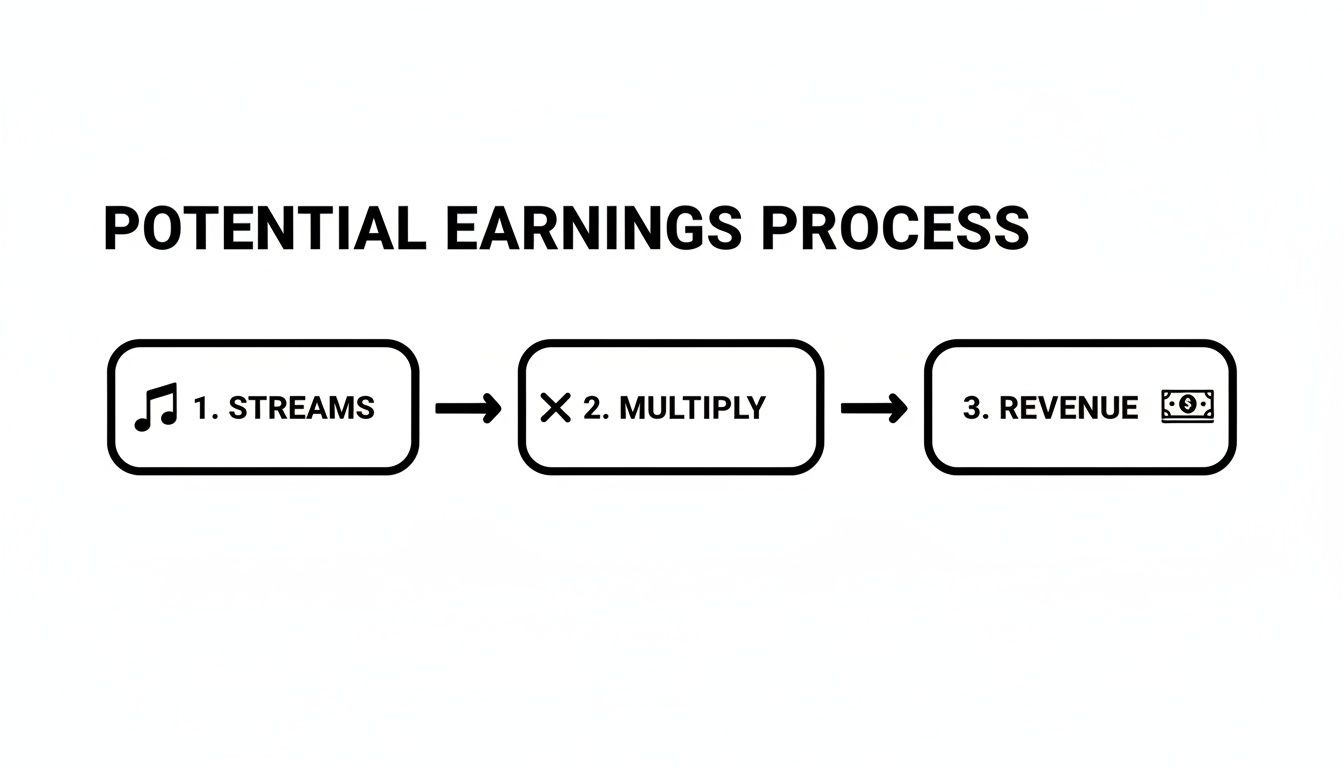
While that shows the simple multiplication to get your starting number, the road to your actual take-home pay has a few more stops.
Understanding the Master vs. Publishing Split
Every song you release has two distinct sets of rights attached to it: the master recording (the actual finished sound file) and the composition (the underlying melody and lyrics). Spotify pays royalties for both.
As an independent artist, you almost always own your master recordings. This is good news because it means the majority of the money—the master royalties—flows to you through your distributor.
The smaller portion, the publishing royalties, is for the songwriters. If you wrote the song yourself, you’re entitled to this too, but it’s collected and paid out through a different channel, usually a publisher or a Performing Rights Organization (PRO) like ASCAP or BMI.
Key Insight: Spotify pays out roughly 70% of its revenue to rights holders. That pot of money is then split between the master owners (you and your label, if you have one) and the publishers/songwriters. Your distributor is the one handling the master side of this equation for you.
The Role of Your Distributor
Your digital distributor is your essential partner for getting music onto Spotify, and they take a fee for their services. This is one of the most significant deductions from your master royalties, and how they charge you can make a huge difference to your bottom line.
There are two main models you'll run into:
- Commission-Based: Some services take a percentage of your earnings.
- Flat-Fee: Others, like DistroKid, charge a single annual fee for unlimited uploads and let you keep 100% of your earnings. TuneCore also offers plans where you keep 100% of your revenue in exchange for an annual fee per release.
Let's go back to our indie artist with 100,000 streams and $400 in gross revenue. If they use a distributor that takes a 15% commission, that’s a $60 deduction right off the top. Their take-home amount from the distributor is now $340. This is exactly why choosing the right distributor is such a critical business decision.
Bringing It All Together: A Worked Example
Let’s trace the money from start to finish for our indie artist.
They start with $400 in gross revenue from their 100,000 streams. Let's say their distributor takes a 10% commission. That’s a $40 fee ($400 x 10%), leaving them with $360 that the distributor will pay out for the master royalties.
But what if our artist co-wrote the song?
If they have a 50/50 split with a collaborator on the master, that $360 gets divided again. Each of them would receive $180. As you can see, your final profit is shaped heavily by the deals you make.
This entire ecosystem is growing at an incredible pace, which means more opportunities for artists. Spotify's subscriber base has exploded from just 18 million premium users in 2015 to a projected 281 million by 2025. For independent artists, this growth is a huge deal, as Spotify often accounts for over half of their total streaming income. You can dive deeper into these Spotify statistics and trends to see just how massive the scale of opportunity has become.
By carefully factoring in these deductions, you can build a Spotify calculator that gives you a much clearer, more accurate picture of your actual earnings.
How to Build Your Own Spotify Earnings Estimator
Knowing the theory behind Spotify payouts is great, but building a tool to forecast your own earnings is a total game-changer for your music business. Instead of trying to guess what you’ll make each month, you can create a simple but powerful revenue calculator in a program you already use, like Google Sheets or Microsoft Excel. This is how you turn abstract numbers into a real financial planning tool.
The idea is to set up a straightforward spreadsheet. You’ll plug in a few key numbers—your streams, your splits—and instantly see a realistic earnings projection. Don't worry, this doesn't involve complex coding. It’s all about organizing the formulas we've been talking about into a system that works for you.
Setting Up Your Calculator Template
The best way to get started is with a clean, organized template. Just open a new spreadsheet and create dedicated cells for your inputs. These are the variables that are likely to change from month to month. Structuring it this way keeps your calculations neat and makes updates a breeze.
Your core input fields should be:
- Total Monthly Streams: The raw number of plays you got in a given period.
- Adjusted Per-Stream Rate: Your personalized estimate (for example, $0.004) based on where your listeners are.
- Distributor Fee (%): The cut your distributor takes. This might be 15% for a commission-based deal or 0% if you're on a flat-fee plan.
- Co-writer/Band Split (%): The share of the master royalties you personally keep after paying out your collaborators.
When you separate these inputs, you can easily tweak any single one—like a new per-stream rate or a different distributor fee—and watch your entire bottom line update automatically.
A well-built spreadsheet becomes more than just a calculator; it's a financial dashboard for your music career. You can use it to set stream goals, budget for new projects, and see exactly how a different distribution deal might affect your income.
Plugging in the Formulas
Once your input cells are ready, it's time to add the formulas that will do the math for you. I recommend creating separate cells for each step of the calculation. This makes it really easy to follow the money from the gross revenue all the way down to your net payout.
Here’s a simple structure you can follow to build out your own calculator, showing the formula to place in each output cell.
Sample Spreadsheet for Your Revenue Calculator
This table gives you a blueprint for setting up your own revenue estimation tool. It lays out the inputs, formulas, and outputs in a logical flow, turning raw stream counts into a clear financial picture.
| Line Item | Example Value / Formula | Description |
|---|---|---|
| Gross Revenue | = (Total Streams * Adjusted Per-Stream Rate) |
This calculates your total earnings before any deductions. |
| Distributor Deduction | = (Gross Revenue * Distributor Fee %) |
This calculates the dollar amount your distributor will take. |
| Revenue After Distribution | = (Gross Revenue - Distributor Deduction) |
This shows what your distributor will pay out for the masters. |
| Your Final Take-Home | = (Revenue After Distribution * Your Split %) |
This is your net profit after accounting for your collaborators. |
By laying out the calculations step-by-step, you demystify the entire payment process. It takes your earnings from a vague idea to a concrete number you can actually use for financial planning.
Case Study: An Indie Band Budgets for a Music Video
Let’s see how this works in the real world. Imagine an indie band, "Static Bloom," just had a great month and hit 250,000 streams. They want to know if they’ve earned enough to fund a $500 music video they've been planning.
They open their custom Spotify revenue calculator and plug in their numbers:
- Total Monthly Streams:
250,000 - Adjusted Per-Stream Rate:
0.0038(they got this from their Spotify for Artists analytics) - Distributor Fee (%):
10% - Band Split (%):
25%(since there are four members, each gets an equal share)
The spreadsheet does the work instantly. Gross Revenue comes out to $950 (250,000 * $0.0038). The distributor takes their $95 (10%) cut, which leaves $855. After splitting that four ways, each band member’s take-home share is $213.75.
The band’s total net profit is $855, which easily covers the music video budget with some cash left over.
This simple tool empowers them to make an informed business decision, backed by their own data. It’s a perfect illustration of the financial reality for modern artists. Even with a lot of streams, it’s the final take-home pay that truly matters. And with Spotify holding 31.7% of the global market share and paying out $10 billion to artists in 2024, understanding your slice of that pie is essential. As the platform hits its first annual net profit, knowing how to calculate what you're owed has never been more critical. You can learn more about Spotify's recent financial performance and statistics to stay on top of industry trends.
Strategies to Actively Grow Your Spotify Revenue
A good Spotify revenue calculator is more than just a reporting tool; it’s a compass showing you where you stand right now. The real question is, how do you change the numbers you're plugging into it for the better? It's time to shift from passively watching your stream count to actively making it grow.
Serious artists know streams don't just happen by magic. Real growth comes from a smart, deliberate strategy that blends on-platform tactics with savvy promotion outside of Spotify. It all starts with making your music impossible to ignore.
Landing on High-Impact Playlists
On Spotify, playlists are the engine of music discovery. Everyone dreams of landing on a huge editorial playlist curated by Spotify's internal team, and that's a massive win. But don't sleep on the power of user-generated playlists. These are often curated by dedicated fans, bloggers, and influencers who can drive thousands of loyal listeners your way.
Start by digging around. Find playlists that perfectly match your genre, vibe, and sound. A quick search on Spotify can uncover playlists with thousands of followers. Look for the curator's contact info—it’s often in the playlist description or linked in their social media profiles. When you reach out, be personal and polite; a genuine connection goes a lot further than a generic email blast.
To really get the ball rolling, you need a solid promotional game plan. Check out these essential tips for modern artists to promote music online that can directly boost your Spotify numbers.
Using Spotify’s Promotional Toolkit
Spotify has built-in tools to help artists reach new ears. If you're not using them, you're leaving money on the table. For artists with a bit of a budget, two of the most powerful options are Marquee and Discovery Mode.
- Marquee: Think of this as a sponsored, full-screen notification about your new music. It gets pushed directly to listeners who already like your sound, making sure your existing fans don’t miss your latest release.
- Discovery Mode: This tool helps your music get algorithmically placed in personalized sessions, like Spotify Radio and Autoplay. You don't pay upfront. Instead, Spotify takes a commission on the royalties earned from streams generated specifically through this feature.
Both tools are designed to put your tracks in front of people who are likely to love them, which naturally leads to more saves, follows, and long-term fans.
Key Takeaway: Your Spotify for Artists profile is your digital storefront. Keep it polished. Use professional photos, write a compelling bio, and always link to your socials and merch store. A great profile can convert a casual listener into a dedicated fan.
Building a Business Beyond Streaming
While growing your stream count is important, the most successful artists I've seen use Spotify as just one piece of the puzzle—a discovery tool at the top of their sales funnel. A sustainable music career isn't built on streaming royalties alone. The real goal is to turn those listeners into direct supporters.
Let’s break it down. A fan who streams your song 1,000 times might generate $3 to $5. But if that same fan buys a $25 t-shirt directly from you, you’ve made significantly more from one single transaction. You need to build a bridge from Spotify to your own world, where you control the relationship and keep more of the revenue.
This is exactly where platforms like OohYeah come in, giving you the power to sell merch, exclusive content, and fan subscriptions without a middleman taking a massive slice. By directing your listeners to your own channels, you create a much more resilient business that doesn't live or die by the fluctuating per-stream payout.
For more on this, take a look at our guide on tips for increasing music streams and earnings.
Common Questions About Spotify Earnings
It’s completely normal to feel like you're navigating a maze when it comes to streaming royalties. Getting a handle on how the money works is the first step toward building a real strategy, so you can stop guessing and start focusing on your music.
Let's break down a few of the questions I hear from artists all the time.
Why Does My Per-Stream Payout Change Every Month?
This is, without a doubt, the most common source of confusion. The simple answer is that Spotify doesn't have a fixed, per-stream rate. Instead, they use a pro-rata system.
Think of it like this: all the revenue from a specific country (say, the U.S.) and a specific subscription tier (like Premium) gets thrown into one big pot for the month. Your payout is your music’s slice of that particular pie.
If total streams on the platform suddenly spike—maybe during the holidays when everyone's playing Christmas playlists—but the revenue in that pot doesn't grow at the same speed, the value of each individual stream actually goes down. This is why any simple calculator using a single, static rate will never be truly accurate.
The Bottom Line: Your per-stream rate is a moving target. It’s always tied to the total revenue and total streams happening in a specific month and region.
How Long Does It Take to Get Paid From Spotify?
Here’s a key detail many artists miss: Spotify doesn't send money directly to you. They pay your distributor, and your distributor then pays you. That extra step adds a built-in delay.
You can typically expect to see your earnings two to three months after the streams actually happened. So, the money you earned in January will likely be processed and sent to your distributor sometime in late February or March. After that, it’s up to your distributor’s specific schedule and payout minimums. Be sure to check their policies so you know what to expect.
Can Artists Really Make a Living From Spotify Alone?
It’s possible, but it’s incredibly rare. Spotify has shared that over 10,000 artists earned more than $100,000 in a year from the platform, but that requires a staggering volume of streams—we’re talking tens of millions, consistently. For most independent artists, that's just not a realistic goal for a primary income.
A much healthier way to think about it is to see Spotify as a discovery engine. It's the very top of your sales funnel, not your entire business model.
The real path to a sustainable career is using that Spotify audience to drive more valuable revenue streams. We cover this in-depth in our guide on how artists make money from streaming services. The goal is to turn listeners into true supporters through things like:
- Live shows and ticket sales
- High-margin merchandise
- Direct-to-fan subscriptions
These are the channels where you keep a much bigger piece of the pie and build a resilient career that isn't at the mercy of ever-changing stream rates.
Ready to take full control of your music business? OohYeah provides the tools you need to sell merch, offer exclusive content, and connect directly with your fans—all in one place. Stop leaving money on the table and start building a career on your own terms. Learn more at OohYeah.