Master Spotify Playlist Curation: Tips to Grow & Engage
Discover expert strategies for Spotify playlist curation. Learn how to build, promote, and grow playlists that attract listeners and boost your influence.
August 14, 2025
Music City Media
Effective Spotify playlist curation is a delicate dance between artistic intuition and hard data. It’s not just about slapping songs together; it's about crafting an experience that builds a real, dedicated audience. Think of it as telling a story or setting a mood that truly connects with listeners, turning a simple list into a powerful engine for music discovery.
The Real Strategy Behind Influential Playlists
Let's get one thing straight: influential playlists aren't just random collections of songs. The best curators build a brand around a specific sound, mood, or activity. This is the bedrock principle you need to grasp if you want to turn a personal playlist into a platform that can steer the listening habits of thousands.
Every great playlist serves a purpose. It might be for a "Late Night Drive," a "Productive Morning," or that perfect "Indie Coffeehouse" vibe. The most successful playlists absolutely own their niche, becoming the go-to source for a specific feeling. This requires tapping into a bit of listener psychology—what are they doing right now, and what’s the perfect soundtrack for that moment?
Understanding Different Playlist Types
The Spotify ecosystem is massive, and it's filled with different kinds of playlists, each with its own role. To find your place, you first need to understand the terrain. The platform hosts over 8 billion user-created playlists, a staggering number that shows just how vital curation is to the entire listening experience.
Of course, the heavy hitters are often Spotify's own editorial lists. A behemoth like "Today's Top Hits" pulls in over 35.16 million followers. But that's just one piece of the puzzle. Independent curators, brands, and even algorithms all play a part.
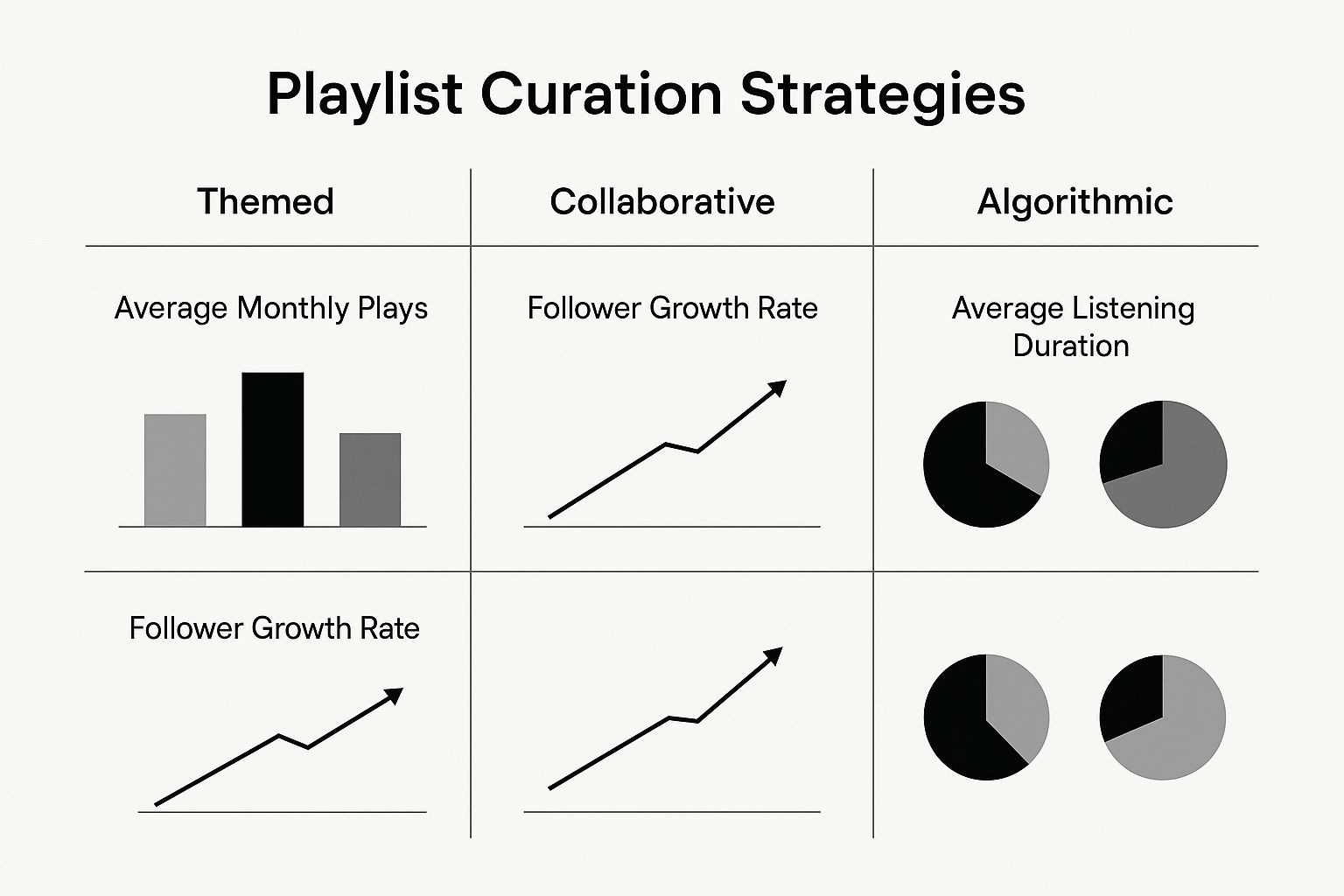
The data here tells an interesting story. While algorithmic playlists might rack up high play counts, it's the carefully themed, human-curated playlists that often build a more loyal, long-term follower base. People come back because they trust the curator's taste.
A great playlist is more than a list of songs; it’s a trusted companion. Your goal as a curator is to become that reliable source for a specific sound, earning listener trust one track at a time.
To navigate this landscape, it helps to break down the main categories you'll encounter.
Spotify Playlist Types and Their Strategic Value
Each type of playlist on Spotify offers a unique opportunity for curators to connect with listeners and achieve different goals.
| Playlist Type | Primary Curator | Key Characteristics | Strategic Goal for Curators |
|---|---|---|---|
| Editorial Playlists | Spotify's Music Editors | High visibility, massive follower counts. Professionally curated around genres, moods, and cultural moments. | Securing a placement is the ultimate goal for artists seeking major exposure. |
| Algorithmic Playlists | Spotify's Algorithm | Personalized for each user (e.g., Discover Weekly, Release Radar). Driven by listening habits and data. | Artists aim to get their music on these to reach highly targeted, engaged listeners. |
| Independent/User Playlists | Individuals, Influencers | Niche-focused, built on personal taste and expertise. Ranges from a few followers to millions. | Build a loyal community, establish tastemaker status, and create a platform for new artists. |
| Brand/Label Playlists | Companies, Record Labels | Curated to reflect a brand's identity or a label's roster. Often used for marketing and promotion. | Align with a brand's audience or get noticed by a label's A&R team. |
Understanding these distinctions allows you to focus your energy where it will have the most impact, whether you're trying to grow your own playlist or get your music placed on others.
Leveraging Curation for Growth
For artists, a well-curated playlist isn't just a side project; it's a powerful strategic tool. By building playlists that feature your own music alongside tracks from similar, more established artists, you're giving your sound context. This does more than just introduce your work to new listeners—it also sends clear signals to Spotify's algorithm about who your sonic peers are.
This approach creates a natural discovery path for potential fans. When someone comes to your playlist for a popular artist they already love, they're far more likely to give your track a spin. That kind of organic exposure is priceless, and we dive deeper into these kinds of strategies in our guide on getting your music heard.
Ultimately, your playlist becomes a magnet, attracting the exact type of listener who is primed to connect with your music.
Defining Your Playlist Concept and Identity

Every great playlist begins long before you add the first song. It starts with a solid, specific concept. This is the single most important step, the one that separates a playlist that builds a real following from just another random collection of songs. Anyone can make a "chill vibes" or "workout mix," but that's not what gets you noticed. Effective spotify playlist curation is about creating an identity.
Your mission is to carve out a space that attracts a dedicated, niche audience. Think about it: there are thousands of playlists called "Chill Beats." But a playlist named "Lofi Coding Session: Late Night Focus" speaks directly to a specific person with a specific need. That kind of focus is your biggest advantage. It not only makes your playlist findable for the right listeners but also gives Spotify's algorithm clear signals about who to show it to.
Finding Your Niche
So, how do you find that unique angle? It comes down to a bit of research. Instead of guessing what people might like, you need to find actual gaps in the market.
Start by digging into existing playlists in a genre or mood you're passionate about. What are the most common themes you see over and over? Take note of where the space is crowded. Now, start thinking about what's missing. For example, the world is full of "Summer BBQ" playlists. But what about "Rainy Day Grilling" for the hardcore enthusiasts who fire up the smoker no matter the weather?
Here are a few ways to think about pinpointing an audience that isn't being served:
- Activity-Based: Build playlists around things people actually do. Think "Sourdough Starter Sunday," "Apartment Gardening," or "Pre-Dawn Trail Run."
- Hyper-Specific Moods: Go way beyond "happy" or "sad." How about "Bittersweet Nostalgia for 90s Kids" or "Victorious Post-Presentation Drive Home"? These create an instant connection.
- Unique Genre Fusions: Try mashing up two unexpected styles that work surprisingly well together. Something like "Folk-Funk Fusion" or "Cinematic Glitch Hop" is bound to grab attention.
Your playlist's identity is its promise to the listener. A strong concept delivers on that promise consistently, building trust and encouraging followers to return week after week for a reliable, curated experience.
Crafting a Magnetic Title and Description
Once you've nailed down your concept, your title and description become your best marketing tools. They're what reel people in, and they're also critical for getting discovered through Spotify search. A killer title is both creative and clear, instantly telling someone what your playlist is all about.
Your description is where you double down on this. It should support the title and be packed with keywords that your ideal listener might be searching for. For that "Lofi Coding Session" playlist, your description should include words like "focus," "concentration," "instrumental," "study," and "deep work." This is exactly how you help Spotify connect your playlist with the right people. Even Spotify's own "Daylist" feature, with its dynamic, quirky titles like "thrillwave" and "happy dance," shows how much creative naming matters.
Finally, don't sleep on the cover art. It’s the very first impression you make and has to visually capture the feeling of your playlist. Your cover, title, and description all need to work together to tell one cohesive story. Getting this groundwork right is what makes a playlist not just discoverable, but truly memorable and worth that follow.
Curating Your Playlist for Perfect Flow
Alright, you've got your concept and a killer brand identity. Now for the fun part: actually building the playlist. This is where the art of spotify playlist curation comes into play. It's more than just dumping songs into a list; you're crafting an experience, a journey that feels intentional from the first track to the last.
The secret sauce is a delicate balance between familiarity and discovery. You need those big, recognizable "anchor tracks" right away—the songs people already know and love. They’re like familiar landmarks that build immediate trust. Once you’ve hooked them with a hit, you can start weaving in those incredible new artists and hidden gems that fit the vibe. This is what makes a playlist sticky; listeners come for the comfort of a favorite song but stay for the thrill of finding their next favorite song.
Building Your Playlist's Narrative Arc
Stop thinking of your playlist as a simple list. Think of it as a story. It needs a beginning, a middle, and an end. The order of your songs—the sequence—is arguably just as important as the songs themselves. A great sequence creates a narrative arc that guides the listener's mood and energy.
Your "bookend" tracks are absolutely crucial here. The first song has one job: to perfectly deliver on the promise of the playlist's title and grab the listener within the first 15-30 seconds. A weak opener is an invitation to skip. Likewise, your final track should feel like a satisfying conclusion, leaving a lasting impression that makes someone want to smash the replay button or save it to their library.
Great playlist flow is invisible. Listeners don't notice the transitions or the sequencing; they just feel the consistent vibe and find themselves completely immersed in the experience.
This kind of thoughtful arrangement is what separates the amateur lists from the truly influential ones. It's the difference between a playlist that gets a single listen and one that becomes a core part of someone's daily routine.
The Art of the Seamless Transition
To keep listeners locked in, you have to maintain a consistent energy level. Abrupt, jarring shifts in tempo or mood will break the spell you're trying to cast. The goal is to make each song feel like it was meant to follow the one before it.
Here are a few tricks I’ve learned for creating those buttery-smooth transitions:
- Match the BPM: Keep an eye on the beats per minute (BPM) of songs you place next to each other. A huge jump from a slow-burner to a high-energy banger can feel like whiplash unless that's a specific, intentional effect you're going for.
- Harmonic Mixing: If you want to get really pro with it, consider the musical key of your songs. Tracks in the same or compatible keys just blend together seamlessly. It creates a musically cohesive journey, almost like a professional DJ set.
- Use Bridge Tracks: Got two powerful, vocal-heavy songs you want to separate? Stick an instrumental or a more atmospheric track between them. These "bridges" give the listener's ear a moment to breathe and reset before the next big moment.
Focusing on these details will elevate your spotify playlist curation from a hobby to a craft. This meticulous attention to flow is what ensures listeners don't just play your list—they save it, they share it, and they actually look forward to your next update. That's how you build a real, loyal audience.
Promoting Your Playlist for Authentic Growth
You’ve done the hard work. You’ve researched, sequenced, and polished your playlist until it’s perfect. That’s a huge win, but it’s only half the job. Now, you have to get people to actually listen to it.
This is where smart, genuine promotion comes in. We're not talking about sketchy shortcuts or paying for a bunch of fake followers. We’re talking about finding real communities of music fans who are already looking for the exact vibe you’ve just created.
Tap Into Social Communities
Your future listeners are already gathered online. You just need to find them and share your work in a way that feels helpful, not spammy.
- Reddit: This is a goldmine if you do it right. Check out subreddits like r/SpotifyPlaylists, r/makemeaplaylist, or dive into genre-specific hubs like r/indieheads and r/hiphopheads. The key is not to just drop your link and disappear. Stick around. Comment on other posts, join conversations, and only share your playlist when it’s a perfect fit for a request or discussion.
- TikTok & Instagram Reels: Short-form video is perfect for capturing a playlist's mood. If you made a "Rainy Day Coffee Shop" list, film a cozy shot of a steaming mug by the window while your playlist sets the scene. Using trending audio from one of your key tracks can give your video a serious visibility boost.
When you show up as a passionate member of the community, people are far more likely to trust your taste and give your playlist a listen.
The best promotion never feels like an ad; it feels like a recommendation from a friend. Find online spaces you actually enjoy, participate, and your playlist will grow because people recognize your passion.
Navigating the World of Playlist Submissions
As your playlist starts to get some attention, artists will begin sending you their music. This is a great sign! But you need to be careful. The playlist marketing scene can be tricky, with some "curators" using bots to fake their numbers. This not only wastes artists' time but can even put their music at risk of being removed from Spotify for suspicious activity.
When you get a submission, your only criteria should be quality and fit. Does this track genuinely make your playlist better for your listeners? That’s all that matters. And a crucial point: never, ever charge for placement. It's a direct violation of Spotify's rules and completely destroys the authentic reputation you're building.
Building Your Network
Long-term, sustainable growth comes from relationships. Start by finding other curators who operate in your niche or in genres that complement yours. Don't just see them as competition—see them as potential collaborators.
Follow their playlists. Share their work on your socials. Leave a real comment on their posts. Once you've built a little rapport, you can start talking about cross-promotion. Maybe you shout each other out on Instagram, or you feature one another's playlists in your Spotify profile descriptions.
This is a powerful way to tap into new, highly relevant audiences. By collaborating, you both win. This strategy is also a fantastic method for building a loyal following, something we dive into deeper in our guide to attracting fans to your music profiles.
Keeping the Momentum Going and Getting Noticed
Think of your playlist less like a finished product and more like a living, breathing thing. The best spotify playlist curation isn't a one-and-done deal; it's about tending to your creation so it can grow and stay relevant. This is where you shift from just adding songs to thinking like a data-savvy manager.
Success leaves breadcrumbs, and you can find them in your playlist data. If you’re an artist, your Spotify for Artists dashboard is a goldmine. Otherwise, third-party analytics tools can pull back the curtain. Pay close attention to listener locations, skip rates, and which tracks get the most saves. This isn't just data; it's a direct line into what your audience wants more of.
Keep Your Playlist Fresh and Engaging
I get asked this all the time: "How often should I update my playlist?" There's no magic number, but the real key is consistency. You're essentially training your followers, teaching them when to expect new music.
Your update schedule really comes down to the playlist's core idea.
- Topical or Trending Playlists: If you're running something like a "New Music Friday" or a seasonal list, you've got to be on it. A weekly update is pretty much non-negotiable to stay current.
- Mood or Activity Playlists: For evergreen concepts like "Deep Focus" or "Sunday Morning," you can breathe a little. A refresh every two to four weeks works perfectly. It keeps things interesting without jarring the core vibe that people subscribed for in the first place.
When you refresh a playlist, you're not just swapping songs. You're refining the entire listening experience. It’s your chance to prune tracks that aren't hitting the mark and to tighten up the overall flow.
Make your schedule known! A simple note like "Fresh tracks added every Friday" in the playlist description does wonders. It sets clear expectations and gives people a real reason to circle back. Stick to that rhythm, and you'll find your own workflow becomes smoother, too.
How to Catch the Eye of Spotify's Editors
Let's be real—the holy grail for many is getting a track onto an official Spotify editorial playlist. While there’s no secret handshake, I can tell you what the editors are looking for: playlists that show real, organic engagement and have a strong, unique identity.
Editorial playlists are still the giants of the platform, driving a massive chunk of all streams. In fact, 2025 data showed they accounted for about 65% of all streams. But a placement isn't a guaranteed ticket to stardom. One study found that an artist who got 580,000 streams from an editorial feature only saw 0.09% of those listeners convert into actual followers. This just proves that building a real fanbase is what truly matters.
To even be in the running for that kind of visibility, your playlist needs to demonstrate its value. That means steady follower growth, high save rates, and low skip rates. Focus on building a genuine community around your playlist's unique angle. Editors don't just notice popular playlists; they notice playlists that have a dedicated, passionate audience.
Ultimately, strong engagement metrics are the best pitch you can possibly make. And as you build that audience, you can find even more ways to grow with our tips for increasing music streams and earnings.
Common Questions About Playlist Curation
Once you start getting serious about building playlists on Spotify, you'll quickly run into a few recurring questions. I've seen these come up time and time again, so let's tackle the big ones head-on so you can curate with confidence.
What Is The Ideal Playlist Length?
There's no magic number, but I've found the sweet spot is usually somewhere between 20 and 100 songs.
If you're just launching a new playlist, starting lean is the way to go. A tight, killer list of 20-30 tracks feels substantial enough to be worth a listen without overwhelming a new potential follower.
As your audience grows, you can start building it out. A good rule of thumb is to keep the total listening time between one and three hours. If it's too short, people might not bother saving it. If it's too long, it can feel unfocused, and listeners might bail before they ever hear some of your best picks.
The thing to remember is that the Spotify algorithm cares most about real human engagement. Your goal should be to grow followers who actually listen, which means getting a high save rate (people hitting that heart icon) and a low skip rate. That's what tells Spotify you've got something good.
How Often Should I Update My Playlist?
Consistency is everything. The real question is what kind of consistency your playlist concept demands.
- Weekly Updates: This is pretty much standard for any playlist built around "new music" or trending genres. Your followers will expect new stuff, and they'll expect it regularly.
- Bi-Weekly or Monthly Updates: If you're curating a timeless, mood-based playlist—think "Deep Focus" or "Sunday Morning Chill"—updating every couple of weeks or once a month is totally fine.
The key is to set expectations. Just add a simple line to your playlist description, like "Fresh tracks added every Friday!" This little detail tells followers when to come back for more.
Is Charging Artists For Placement Okay?
Let me be crystal clear on this one: absolutely not.
Charging an artist a fee to place their song on your playlist is a direct violation of Spotify's terms of service. People who get caught in these "pay-for-play" schemes risk serious consequences, from having their playlist taken down to getting their entire account suspended. It's just not worth it.
Your energy is much better spent building an authentic audience around great music. If you want to monetize your curation skills down the line, you could offer separate services like providing artists with track feedback or promotional advice. But never, ever tie a payment to a guaranteed spot on your list. It kills your credibility and undermines all your hard work.