How to Sell Music Beats Online in 2026
Learn how to sell music beats online with this end-to-end 2026 guide covering pricing, licensing, storefronts, SEO, and launch checklists.
August 17, 2026
Music Marketplace Advisor
Buying & SellingYou've finished a batch of beats, exported a few previews, and opened three browser tabs trying to decide where they should go. One marketplace promises discovery, another offers control, and a personal store sounds professional until you realize you still need to bring buyers there. Meanwhile, every beat raises practical questions about file formats, tags, license terms, payment, delivery, and what happens if two artists want the same exclusive.
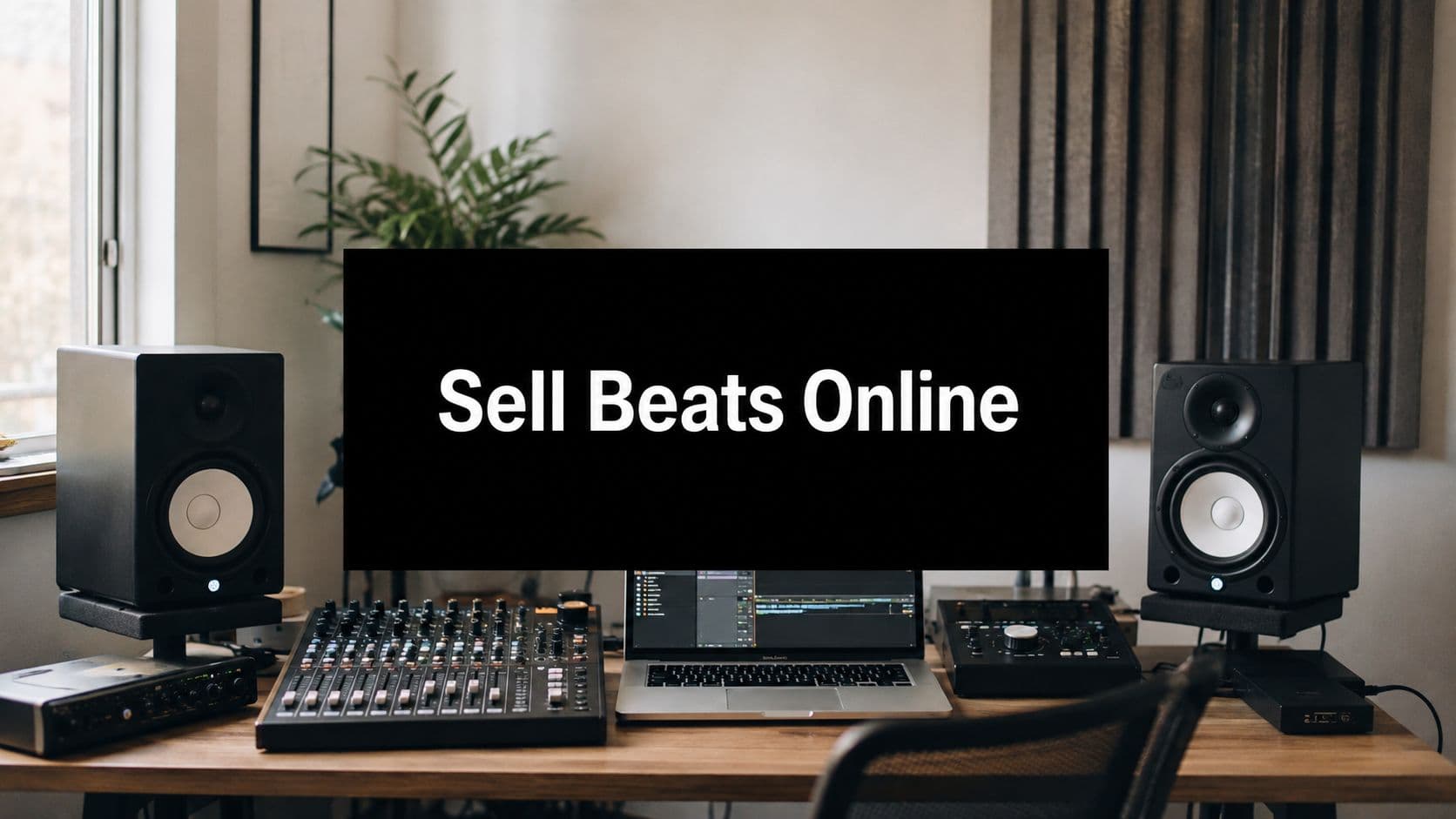
To sell music beats online consistently, treat each beat as a digital product rather than a loose audio file. The product needs a clear identity, searchable metadata, a license that matches the buyer's use, and a sales channel that fits your current audience. The independent music economy already operates at substantial scale. In 2023, independent music publishing reached €2.57 billion globally, while independent publishers held 26.3% of the global market, according to MIDiA's analysis of the independent music economy. Digital infrastructure is what makes that market accessible to an individual producer with a laptop and a catalog.
Why Selling Beats Online Is a Different Game in 2026
A beat folder on your hard drive isn't a store. It's inventory without packaging, search data, checkout, or a defined usage policy. The producer who wins the sale often isn't the person with the most files. It's the person who makes the buyer's decision easy.
The market now supports direct digital delivery, rights management, and cross-border transactions as normal parts of music commerce. MIDiA collected revenue data from more than 5,500 companies totaling $10.6 billion in recorded-music revenue in its independent music economy research, a useful indication of how broad and fragmented creator-led music commerce has become. The same infrastructure supports beats, loops, and production services.

The practical workflow has several connected parts:
- Prepare the asset: Export clean previews, MP3 and WAV files, and stems where appropriate.
- Make it searchable: Use accurate BPM, key, genre, mood, instrumentation, and artist-reference tags.
- Choose the rights model: Decide whether the beat can be leased repeatedly, sold exclusively, or offered through both paths.
- Build the transaction: Connect payment, automated delivery, license documents, and post-sale status changes.
- Select the channel: Use a marketplace for discovery, a direct storefront for control, or both when each serves a distinct purpose.
- Promote with intent: Send buyers from searchable content and social clips to a listing that answers their questions quickly.
The major mistake is treating these as separate chores. A vague title weakens search visibility, an unclear lease creates support problems, and a missing exclusivity rule can turn one sale into a rights dispute. Your catalog should behave like a well-organized product line from the moment you upload the first file.
Preparing and Tagging Your Beats for Maximum Discoverability
Buyers search by sound and use case, not by the folder name on your computer. Before listing a beat, create a consistent product package that tells an artist what the track is, how it feels, and what they'll receive after checkout.
Start with the audio. Keep a clean, untagged master for licensed delivery, then create a watermarked or voice-tagged preview for public listening. Export an MP3 for quick playback and a WAV for buyers who need higher-quality production files. If you're selling a premium tier, prepare tracked-out stems from the same final session, label every stem clearly, and check that the files begin at the same point so the artist can import them without alignment work.
Build metadata buyers can actually use
Record the information in a spreadsheet or catalog template before you upload:
- Tempo: Enter the exact BPM, not a rounded guess.
- Key: Use a consistent notation, such as C minor or F-sharp major.
- Genre: Choose the primary category first, then add a related subgenre only when it's accurate.
- Mood: Use terms an artist might type, such as dark, triumphant, intimate, aggressive, or melodic.
- Instrumentation: Identify prominent elements, including piano, guitar, synth bass, choir, strings, or sampled textures.
- Vocal space: Mention whether the arrangement leaves room for verses, a hook, or ad-libs.
- Reference language: Use “type beat” phrasing carefully and avoid implying endorsement by an artist.
Your filename should remain readable outside the platform. A structure such as dark-trap-piano-140bpm-cmin.wav helps you identify the asset months later. The listing title can be more audience-facing, while the internal filename should prioritize organization.
For platform-specific guidance on presenting music to artists, the OohYeah artist resource can sit alongside your own upload checklist. Don't copy the same keyword into every field. Repetition that doesn't describe the beat makes the listing look careless and can attract the wrong buyer.
Test the product before publishing
Listen through the preview on headphones and ordinary speakers. Confirm that the tag doesn't cover the hook, the waveform starts cleanly, the cover image matches the title, and every promised file opens correctly. A buyer should know the BPM, key, license options, included formats, and delivery method without sending you a message first.
Choosing Between Exclusive and Non-Exclusive Licensing
The choice between an exclusive and a non-exclusive license determines how a beat earns over its lifespan. It also changes what the buyer expects, how much urgency exists, and whether the piece remains available after a transaction.
A non-exclusive lease lets multiple artists use the same beat within defined terms. It usually has a lower entry price, which makes it suitable for developing artists who need a professional recording without purchasing sole control. For you, the advantage is repeatable catalog revenue. The trade-off is that several artists may release songs built on the same underlying beat, and each buyer must understand the limits of their license.
An exclusive license gives one buyer the agreed exclusive rights. You remove the beat from sale when the transaction is complete, so the sale can command more money, but the catalog loses the possibility of future leases. The buyer expects stronger control and clearer documentation, not merely a different download button.

Match the model to the beat
| Situation | More suitable option | Reason |
|---|---|---|
| The beat has broad appeal and attracts several types of artists | Non-exclusive lease | You can serve more than one buyer while keeping the asset active |
| A buyer has a serious release plan and needs sole control | Exclusive license | The buyer's use case may justify a higher-value, one-time transaction |
| The beat is already associated with multiple leased releases | Continue leases or offer a clearly defined upgrade | Existing buyers need protection from ambiguous rights changes |
| You're testing a new sound with uncertain demand | Non-exclusive first | You can learn whether the beat attracts buyers before removing it from sale |
| A buyer requests stems, custom edits, or a buyout | Exclusive or negotiated custom agreement | The added work and reduced future availability require careful terms |
Don't make every beat exclusive by default. That approach can produce a clean-looking catalog but limits the number of ways a strong beat can generate revenue. Don't make every beat endlessly leasable either. A producer who never offers a meaningful upgrade leaves money and buyer demand unaddressed.
Practical rule: Lease a beat when accessibility and repeat use matter. Reserve exclusivity for a buyer and price that justify taking the beat out of circulation.
The most reliable catalog usually contains both models, with the license decision made at the beat level. A melodic piece built for broad search demand may work well as a lease. A distinctive custom arrangement, or a beat tied to a committed artist project, may make more sense as an exclusive sale.
Pricing Tiers, Contract Clauses, and Format Premiums
Pricing should communicate what the buyer receives and what they're allowed to do. Copying another producer's price menu rarely works because the value depends on audio quality, arrangement, deliverables, buyer type, and rights scope.
A sensible structure separates format premiums from rights premiums. An MP3 lease serves a buyer who needs a usable track for writing or a low-cost release. A WAV lease gives the artist a stronger production file. Stems add control over the mix, which can matter more than the difference between two compressed audio formats. Exclusivity changes the economic relationship entirely because you're giving up future sales of that beat.
The infographic below contains example prices and terms. Treat those figures as illustrative packaging, not verified market standards. Your own prices should reflect your catalog, buyer demand, service level, and the rights you're granting.

Define the product at every tier
- MP3 lease: Deliver the tagged or untagged MP3 specified in the agreement. State whether commercial release is allowed and identify any usage limits.
- WAV lease: Deliver the WAV alongside the permitted MP3 files. Make clear whether the buyer receives stems, because WAV and stems aren't interchangeable.
- Tracked-stem tier: Include individually labeled audio files, starting from the same timeline position. State whether minor arrangement edits are permitted.
- Exclusive license: Identify exactly what transfers, what remains yours, and when the beat is removed from public sale.
The contract should answer practical questions before they become support tickets. Include the territory, term, permitted media, stream or sales caps if any, credit requirements, stems and file delivery, content restrictions, payment status, and whether the buyer can register or monetize the resulting song. Don't use “exclusive” casually. Define whether it means exclusive use of the beat, transfer of copyright, exclusive master rights, or another narrower arrangement.
The brief's central revenue risk is underpricing. A cheap lease may attract attention, but it can also signal an unfinished product and force you to depend on transaction volume that your audience can't support. Higher-value tiers let you earn more from buyers who need production control, rather than asking every customer to pay for rights they don't need. Guidance on selling beats and structuring licenses also emphasizes that license terms, delivery, and pricing need to work together.
Use a plain-language license summary
Add a short summary above the full agreement:
License summary: Buyer receives [format] for [permitted use]. The license is [exclusive or non-exclusive], applies in [territory], lasts for [term], and includes [stated limits or permissions]. Producer retains [reserved rights]. Exclusive purchases remove the beat from future sale after cleared payment.
Have a qualified music lawyer review your final agreement for your jurisdiction and business model. A template can organize your offer, but it can't resolve ownership questions involving samples, co-producers, interpolations, or uncleared material.
Payment, Delivery, and Rights Management Workflows
A sale isn't complete when the payment notification arrives. It's complete when the correct files, license document, receipt, and rights status reach the buyer without manual confusion.
Set up the workflow in this order:
- Create separate products for each rights tier or use controlled variable pricing. The checkout should never leave the buyer guessing which file package they purchased.
- Connect a reliable payment processor. Confirm that the processor supports your location, currency, refunds, tax handling, and digital goods policy.
- Automate delivery. Send a secure download link after payment clears, with the exact MP3, WAV, or stem package attached to that tier.
- Generate the license PDF automatically. Populate the buyer name, beat title, order date, license type, and transaction reference.
- Log the transaction. Keep the order, license, delivered files, and any later revisions together.
- Trigger rights changes. When an exclusive order is paid and verified, mark the beat unavailable for new leases and remove it from marketplace listings.
Prevent the double-sale
The most serious operational error is selling the same exclusive to two buyers. A spreadsheet can help at small scale, but it shouldn't be the only control once multiple channels are active.
Maintain one source-of-truth catalog with a status field such as Available, Lease Only, Pending Exclusive, Exclusive Sold, or Hold. Every marketplace and storefront listing should reference that status. If an exclusive checkout is pending, pause new purchases until payment confirmation or the reservation expires under a clearly stated policy.
Keep a dated export of the catalog and license records. If a buyer asks whether a beat remains available, check the central record rather than relying on memory or a marketplace page that may not have refreshed.
For customer-facing questions about downloads, accounts, and marketplace use, point buyers to the OohYeah FAQ when that platform is part of your workflow. Test the full path yourself, including a failed payment, a successful purchase, a mobile download, and a license email. Broken delivery turns a straightforward sale into a support exchange, and delayed support weakens trust precisely when the buyer is deciding whether to purchase again.
Marketplaces vs Your Own Storefront
A producer with no established audience may need marketplace search to make the first sale. A producer already sending listeners from videos, referrals, or email may be paying a third party to handle demand they created themselves. Marketplaces and owned storefronts solve different channel problems, so the right choice depends on where buyers discover you and what you need to control.
A marketplace provides exposure beyond your name, along with built-in browsing and checkout. Its fee can function as customer-acquisition cost when it brings buyers you could not reach directly. The trade-off is less control over presentation, customer communication, purchase data, and the path to a repeat sale.
Your own storefront gives you more control over pricing, product pages, buyer records, and follow-up. It still needs traffic, and it will not correct weak titles, poor previews, or unclear licenses. Platforms such as OohYeah can support direct music downloads and marketplace sales. See the OohYeah marketplace comparison. Tools built for broader digital-product delivery may also suit producers who sell templates, stems, or other files. This selling digital goods online guide provides useful background on that model.
Use the channel mix that fits your stage
| Producer Stage | Primary Channel | Secondary Channel | Why This Mix |
|---|---|---|---|
| No established audience | Marketplace | Social profiles and a simple landing page | Borrow discovery while learning which sounds attract attention |
| Growing search and social traffic | Marketplace plus direct storefront | Email capture and artist outreach | Compare marketplace acquisition with owned conversions |
| Repeat buyers and recognizable brand | Direct storefront | Selected marketplaces | Keep returning customers in an owned environment while retaining targeted discovery |
| Custom production and professional clients | Direct storefront or inquiry-led site | Marketplace catalog | Present higher-touch services without forcing every buyer through a generic listing |
Track each channel instead of choosing permanently by instinct. Record the buyer's source, selected tier, platform deduction, support time, refund activity, and later purchases. That record separates a traffic problem from a checkout problem and shows whether a marketplace fee is buying useful discovery.
A storefront does not require a large audience to test. It does require a clear destination for people who already know your work, while marketplaces remain useful when search behavior introduces new buyers.
Assign each channel one job. Use marketplaces for targeted discovery and your store for owned conversion, repeat purchases, and higher-touch offers. Reassess the mix as buyer sources and repeat behavior change.
SEO and Promotion Tactics That Actually Drive Beat Sales
Beat promotion works best when every piece of content points to a clear buying path. A YouTube upload can capture search demand, a short-form clip can create recognition, and an email can bring a previous buyer back to a new release. None of those assets should send the listener to a dead-end profile with no license information.
Start with the words artists use. Combine sound, genre, mood, tempo, and intended artist type in a natural title. Long-tail phrases such as “hard trap beat type” can describe a specific search intent, but only use a phrase when the beat matches it. The same rule applies to marketplace tags. Accurate metadata helps qualified buyers find you; irrelevant tags create clicks that don't convert.

Build a repeatable discovery loop
YouTube: Upload a visualizer or performance-style beat video with the core keyword near the beginning of the title. Put BPM, key, license options, and the purchase link in the description, then use chapters or pinned comments when they improve navigation.
Short-form video: Cut moments that show the hook, transition, bass entry, or arrangement change. Post to TikTok and Instagram Reels, but vary the framing. One clip can show the beat-making process, another can show an artist writing to it, and another can compare the clean preview with the final arrangement.
Email: Ask interested listeners to join a list through a useful offer, such as early access to a beat pack or a clear notification about new releases. Segment artists who bought leases from people who only streamed previews. Their needs and likely next purchases aren't identical.
Collaboration: Give vocalists, engineers, and artists a reason to share the beat. A co-created writing clip often carries more credibility than a generic “new beat out now” post because the audience can hear how the beat works in context.
Paid promotion comes after the listing and tracking are ready. For a practical introduction to Meta advertising for digital products, focus on audience setup, creative testing, landing-page alignment, and measurement rather than boosting every post indiscriminately. A paid click can't rescue a confusing license menu.
Use a 30-day launch sequence
Week one: Select the strongest catalog, complete clean exports, create previews, standardize filenames, and choose marketplace-only or marketplace-plus-storefront as your starting model.
Week two: Publish the first batch of listings, attach accurate tags, finalize license documents, configure payment, and test every delivery path. Keep a central availability record before enabling exclusives.
Week three: Publish search-focused videos, short-form clips, and direct outreach. Link each piece of promotion to the specific beat it features, not just to a general homepage.
Week four: Review purchases, abandoned checkouts, buyer questions, traffic sources, and tier selection. Improve the listings that attract attention but fail to convert, and make more of the sounds that draw qualified inquiries.
Before uploading, make one decision: will your first customers come primarily from marketplace discovery, or will you begin building an owned storefront from day one? That choice determines where you send links, how you collect buyer information, and how you measure each promotion channel. You can change the mix later, but you shouldn't leave the channel strategy undefined.
OohYeah gives producers a direct option for selling beat files, music downloads, merchandise, and subscription offerings while retaining control over pricing and distribution. If you're ready to test an owned sales channel alongside your marketplace listings, visit OohYeah and set up the storefront workflow your catalog can support.