A Guide to Royalties on Spotify for Independent Artists
Confused about royalties on Spotify? Our guide explains how streaming payouts work, how to collect your earnings, and how to maximize your income as an artist.
January 23, 2026
Music Marketplace Advisor
Buying & SellingWhen your music gets played on Spotify, you don't earn a fixed amount for every listen. Instead, you're claiming your share of the platform's overall revenue. Picture a giant pool of money filled with all the cash Spotify brings in from subscriptions and ads each month—your earnings are your slice of that pool, and the size of your slice depends on how many streams you racked up compared to everyone else.
How Spotify Royalties Actually Work
Let's unpack how Spotify's payment system really functions. Forget the idea of a digital piggy bank that pays out a few cents every time someone hits play. The reality is a "pro-rata" or "streamshare" system, which is much more fluid.
Here’s a simple way to think about it: every month, Spotify collects all the revenue from Premium subscriptions and ad placements into one massive global pot. This is the total amount of money available to pay out to rights holders. Your payment is then calculated based on your music's percentage of the total streams for that month. So, if your tracks accounted for 0.01% of all streams on the platform, you're entitled to 0.01% of that pot.
This is why there's no single, universal "per-stream rate." The value of a single stream is always changing, depending on how much money is in the pot and how many total streams happened that month. After pouring your heart into a track, you'll find that each play typically nets you somewhere between $0.003 to $0.005. That means a million streams could translate to roughly $3,000–$5,000, though this figure is influenced by many factors, as detailed in this breakdown of Spotify royalty calculations.
The Two Fundamental Royalty Types
Every song you hear has two distinct copyrights attached to it—think of them as two sides of the same coin. Both sides generate money on Spotify, and knowing the difference is the key to collecting every dollar you've earned.
The royalty system can feel a bit tangled at first, but it boils down to these two core types. Each covers a different aspect of the music and funnels money to different people.
| Royalty Type | What It Covers | Who Gets Paid |
|---|---|---|
| Recording Royalties | The specific audio file of the song (the master recording). | The owner of the master recording (typically the artist, band, or record label). |
| Publishing Royalties | The underlying musical work (the melody, lyrics, and chords). | The songwriter(s) and their publisher. |
As you can see, an artist who also writes their own songs is entitled to both types of royalties. However, the money for each flows through completely different channels, and you have to set things up correctly to capture both streams of income.
A common mistake for new artists is assuming their distributor collects everything. In reality, distributors primarily handle recording royalties, leaving publishing royalties on the table unless you take additional steps to claim them.
Tracing Your Money from Listener to Bank Account
Ever wonder what actually happens when a fan hits 'play' on your song? It's easy to imagine a direct line from their listen to your wallet, but the reality is far more complex. The path your money takes is less of a straight shot and more like a winding river, with various tributaries and gatekeepers along the way. Getting a handle on this financial pipeline is the first step to truly understanding your royalties on Spotify.
Let's follow the money. When someone streams your track, the revenue from their subscription fee (or the ads they heard) gets pooled into a massive pot of money Spotify collects each month. Before anyone else gets paid, Spotify takes its share right off the top, which is generally around 30%.
The remaining 70% is what gets paid out to all the rights holders. But even this giant chunk doesn't head straight to you. It first gets divided up based on who owns what.
This flow chart gives you a bird's-eye view of how that initial pool of money is divided and distributed.
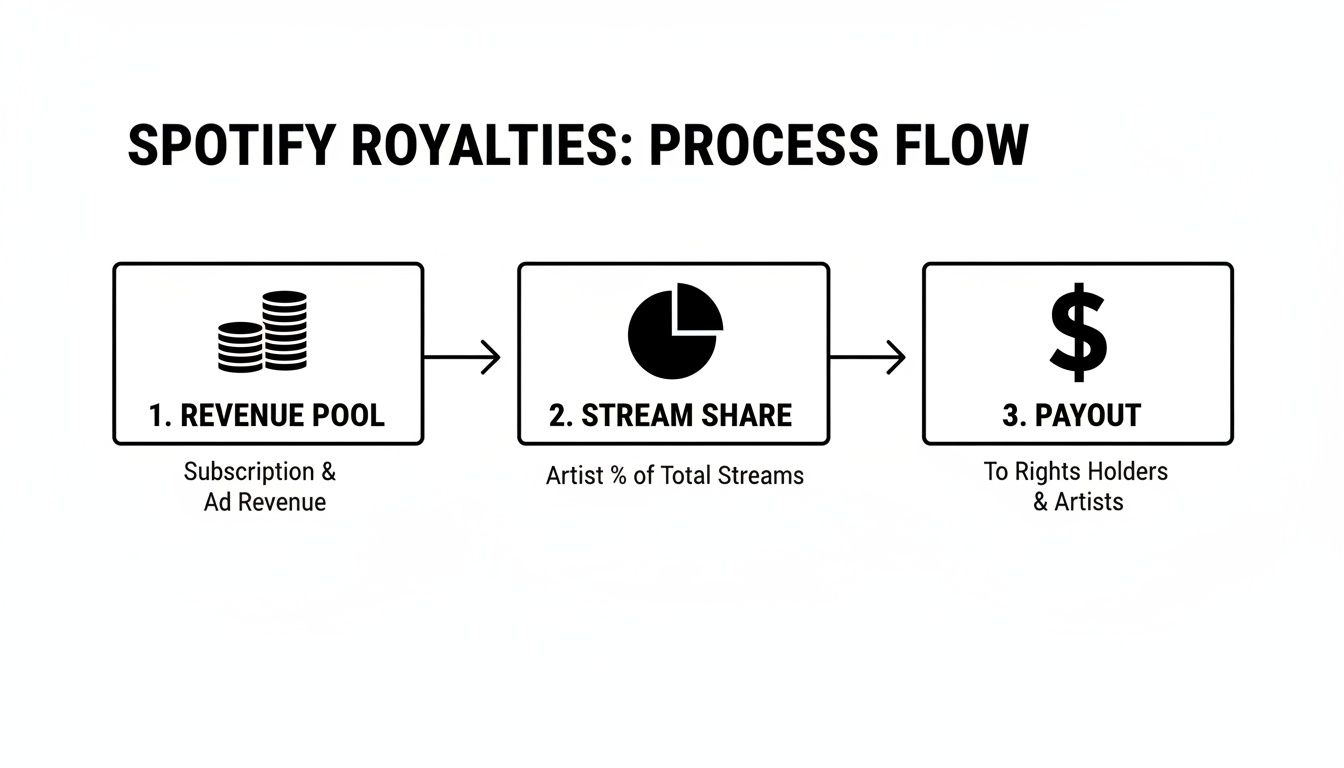
As you can see, the revenue gets sliced up according to each artist's share of total streams before it's paid out. This is a key reason why your payout is just a small fraction of the total money your music helps generate.
The Great Divide: Master vs. Publishing Royalties
That huge pot of money leaving Spotify is immediately split into two, based on the two distinct copyrights that exist in every single song: the master recording and the underlying composition.
Master Recording Royalties: This is the payment for using the specific audio file of your song—the "master." The money goes to whoever owns that recording, which, for most independent artists, is you. However, it's not paid to you directly; it first goes through your digital distributor.
Publishing Royalties: This is the payment for using the song itself—the melody and lyrics you wrote. This slice of the pie gets divided even further into performance and mechanical royalties, each collected by different organizations.
This fundamental split is why your final payout feels so much smaller than the initial revenue. There are several hands in the pot, and each one takes a small administrative cut before the rest makes its way to you.
Who Collects What for You
Here’s a hard truth: you can't just rely on one company to collect everything you're owed. Each type of royalty is handled by a different kind of organization. If you aren't signed up with the right ones, that money simply sits there, unclaimed. It's a massive issue in the industry—some estimate that nearly $1 billion in royalties goes unclaimed every year just because creators haven't registered properly.
Think of it like building a team. You need these players in your corner:
Digital Distributor (e.g., DistroKid, TuneCore): This is your partner for getting paid on the master recording. They collect those royalties from Spotify and deposit them into your account, typically after taking a small fee or commission.
Performing Rights Organization (PRO) (e.g., ASCAP, BMI): Your PRO is in charge of collecting your performance royalties on the composition side. They track every time your song is publicly "performed"—and yes, a stream counts as a performance—and pay the songwriters and publishers.
Publishing Administrator (e.g., Songtrust, CD Baby Pro Publishing): This is the one most artists miss. A pub admin is essential for collecting your mechanical royalties, which are generated every time your song is reproduced (which includes being streamed). They register your songs globally and chase down that money for you.
SoundExchange: This non-profit collects a very specific type of digital royalty for "non-interactive" streams, like when your song plays on Pandora Radio or SiriusXM. If you own your masters, you have to register with them twice—once as the artist and once as the rights owner—to get the full 100% of what you're owed from those sources.
Let’s break it down simply: Your distributor handles the master recording money. Your PRO and publishing administrator handle the songwriting money. Each plays a totally separate but vital role in making sure you get paid everything you've earned from your royalties on Spotify.
By mapping out this flow, you can see why being both the recording artist and the songwriter means you have to wear a few different administrative hats. It might seem like a puzzle at first, but fitting the pieces together is the only way to ensure no part of your hard-earned income gets left on the table.
Why Your Per-Stream Payout Is Never the Same
One of the biggest myths I see artists fall for is the hunt for a fixed "per-stream rate" on Spotify. They're constantly searching for that one magic number, hoping to multiply it by their streams and predict their income. But I have to be blunt: that number doesn't exist.
The truth is, a stream isn't just a stream. Its value is incredibly fluid, shifting based on a handful of powerful factors. This is exactly why 100,000 streams one month can pay you a wildly different amount the next. Getting a grip on these factors is the key to building a real career, moving past vanity metrics and understanding what each listen is actually worth.
So, what's really driving these changes? Let's break down the three main variables that determine how much money you see from each spin.
H3: The Listener's Subscription Plan
By far, the biggest factor is how the listener is using Spotify. A stream from someone with a Premium subscription is always worth more—often significantly more—than a stream from someone on the free, ad-supported plan.
It’s simple economics. Premium users pay a monthly fee that goes directly into the royalty pot. In contrast, revenue from free listeners is funded by whatever ads they hear. That ad income is less consistent and, on a per-user basis, much smaller than a subscription fee.
Think of it like this: a Premium user's listen is backed by their direct cash contribution, while a free user's listen is funded by unpredictable ad sales. That fundamental difference is the main reason your per-stream payout is always in flux.
H3: Where Your Listeners Live
You might be surprised by how much geography impacts your earnings. Spotify's subscription prices and ad rates are not the same everywhere; they vary dramatically from country to country, which directly changes the value of each region's royalty pool.
A single stream from a fan in a high-income country like the United States, Norway, or Switzerland will generate more money than a stream from a developing market. In those markets, subscription fees are lower to match the local economy.
- High-Value Markets: Places like the US, UK, and much of Western Europe have higher subscription costs and stronger ad markets. This means higher per-stream payouts for you.
- Lower-Value Markets: Regions in Latin America or Southeast Asia often have lower subscription fees to make the service accessible. This results in a lower per-stream value, even if you’re getting tons of plays there.
This is a perfect example of why focusing on where your audience is can be a smarter strategy than just chasing the highest possible stream count.
H3: The Fine Print in Your Distribution Deal
Finally, the deal you have with your digital distributor plays a huge part in how much money actually hits your bank account. Spotify pays out roughly 70% of its revenue to rights holders (like you), but it doesn't pay you directly. That money first goes to your distributor.
Every distributor has its own business model. Some take a percentage commission from your earnings. Others charge a flat annual fee and let you keep 100% of what you make. The terms you agreed to directly slice into your net income.
To see just how much these variables matter, check out the table below.
What Changes Your Payout for Each Stream
| Influencing Factor | Impact on Royalty Rate | Example Scenario |
|---|---|---|
| Listener Subscription | High | A listen from a Spotify Premium user in the US generates a much higher royalty payment. |
| Listener Subscription | Low | A listen from an ad-supported user generates a lower payment funded by ad revenue. |
| Listener's Country | High | A stream from a country with high subscription fees, like Switzerland, has a higher value. |
| Listener's Country | Low | A stream from a country with lower local pricing, like India, has a lower value. |
| Distribution Deal | High Net Payout | Your distributor charges a flat annual fee, letting you keep 100% of your earnings. |
| Distribution Deal | Lower Net Payout | Your distributor takes a 15-20% commission on all royalties collected on your behalf. |
As you can see, the context behind the stream is everything.
Let's put this into a real-world scenario. Imagine two artists who both get exactly 100,000 streams in one month.
- Artist A: Their streams are mostly from Premium subscribers in the United States. Their distributor takes a 15% cut. This artist might see around $400 before the distributor's commission.
- Artist B: Their streams come from ad-supported listeners in a country with much lower subscription rates. Their distributor charges a flat fee. This artist might only earn $70 for the exact same number of streams.
This massive difference shows why the raw stream count is only a tiny part of the story. Once you understand who is listening, where they are, and how your money is being handled, you can stop chasing empty numbers and start building a real strategy to grow your income on Spotify.
How Thousands of Artists Are Actually Earning a Living
After digging into the weeds of per-stream payouts, it's easy to get discouraged. The numbers can feel tiny, and the road to a real income can seem impossibly steep. But if you zoom out, a much more encouraging picture comes into focus—one that’s creating real opportunities for independent artists.
While the value of a single stream goes up and down, the total pot of money Spotify is paying out is getting bigger every year. As the platform pulls in more subscribers around the world, the financial pie available to creators is growing right along with it. This isn't just wishful thinking; it's a trend we can see in the rapidly growing number of artists hitting serious financial milestones.
The whole idea of "making it" in music is changing. It's no longer just about the handful of superstars at the top. A genuine middle class of musicians is taking shape, building sustainable careers directly from their streaming income.
More Money in the System Than Ever Before
The most powerful evidence for this shift is the sheer volume of cash flowing from Spotify to artists. In 2024, the platform paid out a record-shattering $10 billion in royalties to music rights holders. That massive number points to a healthy, expanding digital music economy where more and more artists are getting their share.
This isn't just a victory for the major labels. The data shows that success is spreading out, with thousands of independent artists now earning a living wage—and often much more—from their music.
This growth trickles down to artists at every level. According to recent reports, the number of creators earning a significant income from Spotify is climbing fast. For instance, the annual earnings for the 10,000th highest-paid artist on the platform have jumped nearly 4x in just the last few years, now sitting at a cool $131,000. You can see a full breakdown in this in-depth analysis of Spotify's royalty payouts.
Redefining What Success Looks Like
Maybe the most inspiring part of this story is who is finding this success. In the last year, nearly 1,500 artists earned over $1 million from Spotify alone. When you factor in other income sources, that number likely translates to over $4 million in total earnings for each of them.
But here’s the kicker: 80% of these new music millionaires never once landed on Spotify's Global Daily Top 50 chart. That stat is proof that you don't need a viral, chart-topping smash to build a lucrative career. Real success is being built on consistent work and the ability to connect with a dedicated audience, no matter the size.
Here’s what that means for you:
- Niche is Powerful: Forget trying to appeal to everyone. Building a loyal following in a specific genre or community can be incredibly profitable.
- Consistency Pays Off: Releasing music steadily and engaging with your fans creates long-term value that builds on itself over time.
- Global Reach Matters: Artists are making more money from listeners in other countries than ever before, turning a worldwide audience into a reliable stream of income.
The data paints a clear picture: a sustainable career in music is more achievable today than at any other point in history. If you're still curious about the bottom line, you might want to read our thoughts on if artists can truly make money from streaming services.
Of course, once you start earning real money from your music, you'll need to get a handle on the tax side of things, including learning how to report royalty income on IRS Schedule E. But the first step is recognizing that the opportunity is real, it’s growing, and it’s well within reach for artists who are ready to put in the work.
An Artist's Checklist to Collect All Your Royalties
Knowing how Spotify royalties work is one thing, but actually getting that money into your bank account is a whole different ballgame. The music industry’s payment system can feel like a maze, forcing you to sign up with several different organizations just to collect every dollar you've earned. If you miss a step, you're literally leaving money on the table.
Think of yourself as a business owner who has to send separate invoices to different departments for the same project. It’s messy. You need a system. This checklist is that system—a clear playbook to make sure your hard-earned royalties travel from Spotify’s servers directly to you.
Follow these steps carefully to build your royalty collection machine. Each registration plugs a potential leak in your income stream, ensuring you capture every cent you're owed as both an artist and a songwriter.
Step 1: Choose a Digital Distributor
First things first, you need a digital distributor. This is your on-ramp to Spotify, Apple Music, and all the other major platforms. More importantly, your distributor is who collects and pays out your master recording royalties—the money generated by your specific recording of a song.
Services like DistroKid, TuneCore, or CD Baby are the middlemen that handle the money from Spotify for you. They collect the lump sum for your streams and pass it on to you, usually in exchange for a yearly fee or a small commission. Bottom line: without a distributor, your music isn't on Spotify, and you have no way to get paid.
Step 2: Affiliate with a Performing Rights Organization (PRO)
Next up are your performance royalties. These are earned every time your song's composition (the melody and lyrics) is publicly performed. And yes, a stream on Spotify absolutely counts as a public performance. This is a completely separate bucket of money from your master recording royalties, and it's collected by a Performing Rights Organization (PRO).
In the U.S., your main choices are ASCAP and BMI. As a songwriter, you can only join one.
- ASCAP (American Society of Composers, Authors and Publishers): A member-owned PRO that’s been around forever, collecting and distributing performance royalties.
- BMI (Broadcast Music, Inc.): The other major player, offering very similar services for songwriters and music publishers.
Once you join, you register your songs with them. The PRO then tracks plays across Spotify, radio, TV, and even live concerts, collecting the money owed to you as the songwriter. If you write your own music, skipping this step means you’re missing a huge, distinct revenue stream.
Crucial Tip: When you sign up with a PRO as a songwriter, go the extra mile and also register a "vanity" publishing company for yourself (e.g., "My Awesome Songs Publishing"). This is a simple step that allows you to collect both the songwriter's and the publisher's share of performance royalties, which are typically split 50/50.
Step 3: Sign Up with a Publishing Administrator
This is where so many independent artists unknowingly leave a ton of money behind. On top of performance royalties, every stream also generates mechanical royalties. These are for the reproduction of your song's composition. Your PRO, like ASCAP or BMI, does not collect these for you.
This is where a publishing administrator like Songtrust or CD Baby Pro Publishing becomes your best friend. They handle the nitty-gritty work of:
- Registering your songs with collection societies all around the globe.
- Collecting mechanical royalties from both streams and downloads, everywhere.
- Making sure you get paid for plays in over 150+ countries—a job that's basically impossible to do on your own.
Without a pub admin, any mechanical royalties you earn internationally will just sit there, unclaimed. This is an absolutely critical piece of the puzzle if you want to maximize your royalties on Spotify from a global fanbase.
Step 4: Register with SoundExchange
Okay, one last stop. You need to register with SoundExchange. This U.S. nonprofit collects and distributes digital performance royalties from "non-interactive" services. Think Pandora, SiriusXM, and the radio-style features built into other streaming apps.
SoundExchange pays out royalties for the master recording, but it splits the payment in a very specific way:
- 45% goes to the featured artist on the track.
- 50% goes to the owner of the master recording (which, for an indie artist, is probably you).
- 5% is set aside for non-featured musicians (like your session drummer or backup vocalist).
To get everything you're owed, you have to register with SoundExchange twice: once as the Artist and again as the Sound Recording Copyright Owner. It's a small but easily missed detail that ensures you get 95% of the earnings from these platforms, not just the artist’s 45%.
Going through this checklist turns a confusing web of paperwork into a straightforward process. Just as important as these registrations is making sure your song's metadata is perfect. You can learn more about how to optimize your music metadata for streaming to prevent your cash from getting lost in the system.
Thinking Beyond Streams to Maximize Your Income
Getting bogged down in the per-stream payout math is a trap. While you absolutely need to understand how royalties on Spotify work, the real money and career longevity come from seeing the platform for what it truly is: a powerful engine for building a real, dedicated audience.
Think of your streaming data as a treasure map. It shows you exactly where your biggest fans live, which songs hit the hardest, and who might be willing to support your music more directly. The goal isn't just to rack up streams; it's to build a sustainable business around your art.
Turning Listeners into Lifelong Supporters
Your Spotify profile is the top of your funnel—it's often the first place someone stumbles upon your music. Your job is to then guide those casual listeners deeper into your world, into an ecosystem where you have a direct relationship with them and control the revenue. This is the shift from passive streaming income to active, high-margin revenue streams.
You're essentially capturing more value from the audience you've already won over. Spotify's own 2024 data shows this model is working. They reported that 22,100 artists earned over $50,000 from royalties alone, a staggering 200% increase from 2017. What's more, over half of these artists' earnings came from listeners outside their home country, proving the power of a global fanbase.
This is where platforms built for direct-to-fan monetization come into play. For instance, independent artists on a platform like OohYeah! can create direct merchandise storefronts, offer fee-free downloads, or build a community with exclusive content—all of which turn a passive listener into an active supporter, no complex royalty splits required.
Building Your Artist-Owned Business
At the end of the day, Spotify is just one piece of a much larger puzzle. It's an incredibly effective launchpad, but a sustainable career can't rely on stream counts alone.
Use that momentum to build out other parts of your business. Here are a few ideas that put you in the driver's seat:
- High-Margin Merchandise: When you sell merch directly to fans, you keep nearly all of the profit. It's a world away from royalty splits.
- Exclusive Content Subscriptions: Give your core fans a reason to pay you monthly for behind-the-scenes access, early releases, or bonus content.
- Direct Digital Sales: Offer high-quality downloads or special edition digital albums straight from your own site.
- Fan Clubs & Communities: Build a dedicated space where your biggest supporters can connect with you and each other.
Artists are even branching out into other media. For example, some have learned how to monetize a podcast with early access, using Spotify's platform to create entirely new revenue streams. By adopting this entrepreneurial mindset, you can truly get the most out of your presence on Spotify and build a career that lasts.
For more practical strategies, be sure to check out our guide on tips for increasing music streams and earnings.
Answering Your Top Spotify Royalty Questions
As we've seen, the world of Spotify royalties can be complex. Let's tackle some of the most common questions artists have about the nitty-gritty details of getting paid.
How Long Does It Actually Take to Get Paid?
This is probably the number one question on every artist's mind. The short answer? Expect a delay of about two to three months from the moment someone streams your song to when Spotify sends the money to your distributor.
But the journey doesn't end there. Your distributor then has its own processing time and payout schedule. So, if your song was streamed in January, you might not see that money in your bank account until April or May. It feels like a long time, but this lag is crucial for Spotify to accurately tally up global revenue, figure out all the complex royalty splits, and process payments to millions of rights holders.
Think of it like a global financial supply chain. The time lag isn't just a delay; it's the time required for accurate accounting across a massive ecosystem of artists, labels, and publishers worldwide.
What if Someone Listens for Less Than 30 Seconds? Do I Still Get Paid?
Unfortunately, no. For a stream to be considered "payable" and earn you a royalty, the listener needs to stick around for at least 30 seconds.
If they skip your track before hitting that 30-second mark, it doesn't count toward your royalty payments. This is an industry-standard rule, and it really highlights how important it is to hook your listener right from the start.
Can I Use My Spotify for Artists Data to Figure Out My Earnings?
While your Spotify for Artists dashboard is an amazing resource, it's not a financial tool. It gives you incredible insights into your raw stream counts, who your listeners are, and how your songs are performing on playlists—all essential for understanding your audience.
But those numbers don't translate directly into dollars and cents. As we've covered, the actual cash you receive from a single stream depends on a ton of variables, including:
- Where your listeners are: A stream from a fan in a premium market like Switzerland pays more than one from a developing market.
- Their subscription plan: A stream from a Premium subscriber is worth significantly more than a stream from someone on the free, ad-supported tier.
- Your distribution deal: The specific commission or fees your distributor takes from your earnings will affect your final payout.
The only way to see your true earnings is by looking at the official royalty statements from your distributor. Those reports are the final word, showing you exactly what you've earned after all the complicated math is done.
Ready to take full control of your music business beyond just streams? With OohYeah, you can sell merchandise, offer exclusive downloads, and build a direct connection with your fans—all on one commission-free platform. Stop leaving money on the table and start building a sustainable career today at https://oohyeah.app.