A Guide to Royalties From Spotify for Independent Artists
Finally understand royalties from Spotify. This guide breaks down how artists get paid, how to calculate your earnings, and strategies to increase your income.
January 28, 2026
Music Marketplace Advisor
Buying & SellingGetting your first Spotify royalty statement can feel like trying to read a foreign language. The numbers are tiny, the terms are confusing, and the final payout is often a shock. Let’s cut through the noise.
The big number everyone talks about is the per-stream rate, which typically hovers between $0.003 to $0.005 per stream. But here’s the most important thing to understand: Spotify doesn't just send you a check. That money snakes its way through a complex network of distributors, publishers, and collection societies before it ever lands in your bank account.
Decoding Your Spotify Royalty Statement
For a lot of artists, that first royalty statement is a real wake-up call. It's supposed to be a moment of validation, but it often just creates more confusion. Why are the numbers so low? What do all these categories even mean?
To make sense of it, you have to ditch the idea that Spotify pays a fixed amount every time someone hits play. It doesn't work like that. Instead, their system is built on a model called pro-rata distribution, which is just a fancy way of saying everyone gets a piece of a giant, shared pie.
The Royalty Pool Pie Analogy
Think of it this way: every month, Spotify takes all the money it made from subscriptions and ads and throws it into one massive pot. This is the "royalty pool."
Before any artist or songwriter gets a dime, Spotify takes its own slice off the top—usually around 30%—to run the business. The remaining 70% is what gets paid out to all the music rights holders on the platform. Your payment isn't a simple calculation of streams x rate. It's your share of that massive pot, and that share is determined by a concept called "streamshare."
What is Streamshare? Streamshare is simply your music's percentage of the total streams across the entire platform for a specific month. If your songs made up 0.001% of all streams in May, you're entitled to 0.001% of the royalty pool for May.
This is exactly why the per-stream rate is always changing. If total revenue goes up but the number of streams goes up even faster, the value of each individual stream actually drops. It’s a collective system, not a simple per-transaction sale.
Two Royalties from a Single Stream
Here’s where it gets a little more complex. Every single stream actually generates two completely separate royalties that go to different people.
Recording Royalties: This is the payment for the master recording—the actual audio file that people listen to. This money goes to the owner of the master, which could be a record label or, if you're independent, you. It gets to you through your digital distributor like TuneCore or DistroKid.
Publishing Royalties: This payment is for the underlying song—the lyrics and melody. These royalties are for the songwriters and publishers and are split even further into "mechanical" and "performance" royalties.
If you wrote and recorded the song yourself, you’re owed both types of royalties. The catch is that they flow through entirely different channels and have to be collected separately. To get a bigger picture of this financial ecosystem, check out our guide on whether artists can truly make money from streaming services.
So, what does this look like in the real world? Let's look at some quick numbers.
Spotify Royalty Payouts at a Glance
This table gives you a ballpark idea of what you can expect, but remember that these are just estimates before anyone else takes their cut.
| Metric | Typical Range | Potential Earnings Example (1M Streams) |
|---|---|---|
| Per-Stream Rate | $0.003 - $0.005 | N/A |
| Gross Payout | N/A | $3,000 - $5,000 |
After a million streams, seeing a gross figure of $3,000 to $5,000 can be sobering, especially when you realize that's before your distributor, publisher, co-writers, or label (if you have one) gets paid. It's also critical to remember your financial responsibilities; understanding concepts like artist income tax in Australia is essential for managing your career from day one.
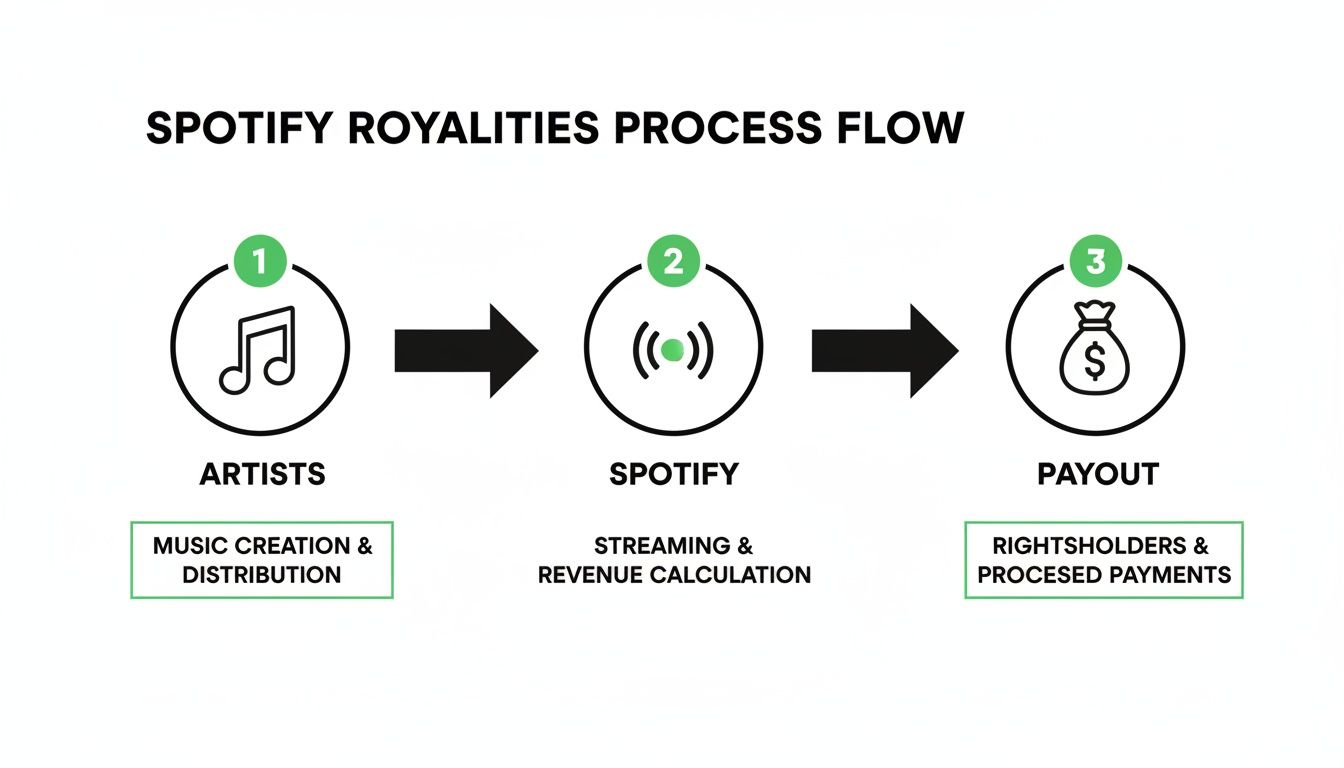
Tracing the Journey of a Single Stream
Ever wonder what happens the second someone hits play on your track? The path that money takes from a listener's subscription fee to your wallet is a long and winding one, with a few crucial pit stops. It’s far from a direct deposit; think of it more as a complex supply chain with multiple players, each taking a piece of the pie.
Imagine every stream as a tiny sliver of revenue. When a listener plays your song—either through a paid subscription or by hearing an ad—that money gets tossed into Spotify’s massive monthly revenue pool. Before that pool gets divided, Spotify takes its cut, which is generally about 30%. The other 70% is what gets sent out to the rights holders.
This is where things get interesting and, honestly, a little complicated. That 70% isn't just one payment. It’s immediately split between the owner of the master recording (the actual "record button" sound file) and the owner of the composition (the underlying song—lyrics, melody, and all). This fundamental split is why tracking down every penny you're owed can feel like a full-time job.
The Key Players in the Payout Chain
To really get a handle on where your money is going, you first need to know who has their hand out waiting for it. Each of these organizations plays a specific, non-negotiable role in getting you paid.
Your Digital Distributor: This is your partner for getting paid on the master recording side. Companies like DistroKid or TuneCore receive your share of the recording revenue directly from Spotify. They then take their fee or commission and pass the rest on to you.
Performance Rights Organizations (PROs): Think ASCAP or BMI in the U.S. Their job is to collect performance royalties for the composition. Believe it or not, every single stream is legally considered a "public performance," and these organizations track them to pay songwriters and publishers.
Mechanical Rights Organizations (MROs): For streams in the U.S., The Mechanical Licensing Collective (The MLC) is the big one. They collect mechanical royalties from digital platforms like Spotify. These royalties are earned any time a composition is reproduced (which a stream also counts as) and are paid out to publishers and songwriters.
As you can see, there are quite a few intermediaries involved, and each one takes a small percentage before the money ever finds its way to you.
Following the Money to Your Bank Account
Let's walk through it. A fan in New York City streams your new single. Spotify pools the fraction of a cent generated from that stream with all the other revenue for the month. At month's end, Spotify calculates your total "streamshare" and sends out the gross payment.
The bigger chunk of that money—the master recording royalty—goes straight to your distributor. They process it, deduct any fees based on your plan, and deposit the rest into your account. This is the payment most independent artists are familiar with seeing.
A Critical Distinction: Your distributor only handles the money for the master recording. They do not and cannot collect the royalties owed to you as the songwriter.
At the same time, the smaller publishing royalty portion is sent off to your PRO and the MLC. These groups process those payments, take their administrative fees, and then send the remaining balance to you and your publisher (if you have one). This happens on a completely separate payment cycle. If you aren't affiliated with these organizations, that money just sits there, waiting to be claimed. This whole intricate process is exactly why the per-stream rate you hear about is so different from what you actually see in your bank account.
Mastering the Two Types of Music Royalties
To really get a handle on how Spotify royalties work, you have to think of every single stream as a source of two completely separate types of income. These aren't just line items on a statement; they're distinct revenue streams that travel through different pipes, get collected by different groups, and belong to different rights. These are mechanical royalties and performance royalties.
Let's use an analogy. Think of your song as a building project. The composition—the melody, lyrics, and harmony you wrote—is the original blueprint. The master recording—the final, polished audio file people hear on Spotify—is the finished building. Both of these assets have value, and both generate their own unique streams of cash.
Every time someone streams your track, it’s legally considered both a "reproduction" (like making a copy of the blueprint) and a "public performance" (like showing off the finished building). This distinction is the absolute bedrock of music publishing and the secret to making sure you collect every dollar you've earned.
Unpacking Mechanical Royalties
At their core, mechanical royalties are paid out whenever your composition is reproduced. Back in the day, this was easy to track—a royalty was paid for every vinyl record pressed or CD manufactured. In today's digital world, a stream is legally counted as a reproduction, which means a mechanical royalty is generated with every play.
This money belongs to the songwriter and their publisher. In the U.S., Spotify sends these royalties to a central clearinghouse called The Mechanical Licensing Collective (The MLC). From there, The MLC pays the publishers and any self-published songwriters. If your songs aren't correctly registered with them, your mechanical royalties can end up in a black box, unclaimed.
Understanding Performance Royalties
Next up are performance royalties, which, as the name suggests, are earned when your song is performed in public. This covers everything from radio play and TV commercials to live gigs and, most importantly for us, every single stream on Spotify.
These royalties are gathered by Performance Rights Organizations (PROs) like ASCAP and BMI. Spotify pays a chunk of its revenue to these organizations, who then do the work of tracking plays and paying the songwriters and publishers on their roster. If you wrote the song, you absolutely must be signed up with a PRO to see this money.
Key Takeaway: As a songwriter, you are owed both mechanical and performance royalties for your composition. Your distributor does not collect this money for you; it must be collected through organizations like The MLC and a PRO.
The Overlooked Third Royalty: Digital Performance
Here’s where a ton of independent artists leave a significant income stream on the table. Beyond the two publishing royalties tied to the composition, there’s also a digital performance royalty for the master recording.
This royalty was originally created for non-interactive digital streams—think Pandora stations or satellite radio. However, it also applies to certain parts of interactive streaming services like Spotify. The most important thing to know is that this money is not collected by your distributor or your PRO.
Instead, a dedicated organization called SoundExchange handles it. They collect these specific digital performance royalties from platforms and pay them out to two parties:
- The owner of the master recording (that’s you, the independent artist).
- The featured performing artists on that track.
This is a completely separate pipeline of money from what you get from your distributor or your PRO. If you aren’t registered with SoundExchange as both the rights owner and the artist, you are literally leaving money behind.
Properly navigating these different revenue streams is a fundamental part of the music business, just like knowing how music licensing can boost your revenue in other areas. By mastering these distinctions, you ensure every stream contributes its full financial potential to your career.
Practical Strategies to Maximize Your Spotify Earnings
Understanding how the royalty checks are calculated is one thing, but making them bigger is the real goal. Growing your royalties from Spotify isn't about getting lucky; it's about building a smart, consistent strategy. You have to stop seeing Spotify as just a place to host your music and start treating it as a dynamic engine for growing and engaging your audience.
The secret sauce is making Spotify's algorithm work for you, not against you. The algorithm's one and only job is to keep people listening. When your music helps it do that, you get rewarded with more visibility on playlists and recommendations. This kicks off a powerful cycle: more visibility leads to more streams, and more streams directly translate to higher royalty payments.
Master Your Spotify for Artists Profile
Think of your Spotify for Artists dashboard as your mission control. It’s loaded with invaluable data on who's listening, where they live, and how they found you. These aren't just numbers to brag about; they are direct clues that should shape your entire career strategy.
Is a city you've never heard of suddenly blowing up your listener map? Maybe it's time to book a gig there. Did an old track from your first EP start getting traction? That's your cue to build a new playlist around it or give it a shout-out on social media.
Beyond the data, your profile is your digital storefront. A polished, complete profile builds instant credibility and makes listeners want to stick around and explore your entire catalog.
- Artist Pick: This is your billboard. Use it to pin your new single, a curated playlist you're proud of, or an album you want to push. It's the first thing fans see.
- Bio and Photos: Keep your bio fresh with your latest news and make sure your photos are high-quality and current. You only get one chance to make a first impression.
- Canvas: Add a short, looping video to your tracks. Spotify's own data shows that tracks with a Canvas get way more engagement—more shares, more playlist adds, and more saves.
The Power of Playlists
If there's one silver bullet for boosting streams and royalties, it's getting your music onto playlists. Playlists are today's radio. They can introduce your sound to thousands of new listeners who are already primed to like your genre.
You should be aiming for all three types:
- Editorial Playlists: These are the big ones, curated by Spotify's own team (like RapCaviar or Today's Top Hits). Landing one of these is a career-defining moment.
- Algorithmic Playlists: Spotify creates these for each user (think Discover Weekly and Release Radar). They're fueled by listener habits, so every save and share from your fans helps you land here.
- User-Curated Playlists: Don't sleep on these. Playlists created by influencers, bloggers, and even dedicated fans can have enormous followings and drive serious traffic.
Pitching to Spotify's editors is a must-do for every new release. You can submit your track directly through your Spotify for Artists account, but make sure you do it at least seven days before it goes live. A thoughtful pitch that nails your track's genre, mood, and vibe can make all the difference.
The Financial Cost of Bad Metadata
Finally, let's talk about something that can quietly drain your bank account: messy metadata. Metadata is the digital DNA of your music. It includes everything from the song title and songwriter credits to publisher information and ISRC codes.
Getting this wrong isn't a minor clerical error—it's lost money. If your song isn't properly registered with all the correct information, the royalties you've earned can end up in a "black box," a massive pool of unattributed money that is incredibly difficult to claim later.
This is about more than just getting credit; it's about getting paid. Every single stream generates multiple royalty payments, and if the data trail is broken, that money can't find its way back to you. Before you hit "submit" on any release, double- and triple-check every field with your distributor. As you button up your metadata, you should also look for other practical tips for increasing music streams and earnings.
To help you prioritize, here’s a look at how different growth strategies stack up against one another.
Royalty Growth Strategies Comparison
| Strategy | Effort Level | Potential Royalty Impact | Key Action |
|---|---|---|---|
| Optimize Spotify for Artists | Low | Medium | Regularly update your bio, photos, and Artist Pick. Use Canvas. |
| Editorial Playlist Pitching | Medium | High | Submit every new track at least 7 days pre-release with a detailed pitch. |
| Engage with Fan Playlists | Medium | Medium-High | Identify and build relationships with independent playlist curators in your niche. |
| Promote on Social Media | High | Medium | Consistently share direct Spotify links and encourage fans to save/share your music. |
| Ensure Flawless Metadata | Low | High | Verify all songwriter, publisher, and track information with your distributor before release. |
Each of these actions contributes to the bigger picture. A well-maintained profile makes you look more professional to curators, while clean metadata ensures that when the streams do come in, the money follows.
The indie artist movement on Spotify is stronger than ever. In 2024, over $5 billion in royalties went to independent artists and labels, which is nearly half of the platform's total payouts. For an emerging artist, hitting 10,000 monthly listeners can mean around $16,500 a year from Spotify alone. Just remember this is before navigating the platform's pro-rata system and programs like Discovery Mode, where labels or distributors might take a 30% cut for promotional placement. You can find more data on how artist payouts are changing at Molodtsov.me.
Building a Career Beyond Streaming Royalties
If you want to build a sustainable music career, you have to make a critical mindset shift. Stop trying to make a living from Spotify. Start using it to make a living with your music.
Relying on those fractions of a penny from each stream is a surefire path to frustration. The real strategy is to see Spotify for what it is: an incredible, top-of-funnel marketing tool.
This is where discovery happens. Spotify is your stage for capturing attention, building a following, and introducing your sound to the world. But it's the starting point, not the finish line. The goal is to turn those casual listeners into a dedicated community that wants to support you directly.
Instead of chasing millions of streams for a meager payout, you can focus on guiding your most passionate fans off the platform and into your own ecosystem, where their support actually makes a financial difference.
From Streams to Sustainable Income
The entire streaming model is built on massive volume and razor-thin margins. A direct-to-fan model, on the other hand, is built on genuine connection and much higher-value transactions. This is how you take back control.
Let's put it in perspective. To earn $100, you might need roughly 25,000 streams on Spotify. That takes a lot of people.
Or, you could sell just five t-shirts to your core fans and pocket a much larger share of the profit. This direct approach is simply a more resilient and predictable way to run your music business.
Platforms like OohYeah are built specifically for this. They give you the tools to create your own world, offering fans more ways to support you than just hitting "play."
- Digital Downloads: Let fans own high-quality audio files of your music.
- Merchandise Sales: Sell everything from t-shirts and posters to limited-edition vinyl.
- Fan Subscriptions: Offer exclusive content, early access, and community perks for a recurring monthly fee.
The big idea is to use Spotify’s incredible reach to build an audience, then bring them somewhere you control the relationship and the revenue. You're turning passive listeners into active supporters who are invested in your journey.
Building Your Direct-to-Fan Funnel
Creating this funnel isn't as complicated as it sounds. It starts with consistently reminding your Spotify audience that there are other ways to connect.
Use your Spotify for Artists profile to your advantage. Link directly to your merch store, your website, or your OohYeah page. Put it in your bio. Use the "Artist Pick" feature to spotlight a new t-shirt or a link to join your fan club.
To truly build a sustainable career, artists often need to look beyond streaming royalties. Exploring avenues like selling physical merchandise can significantly boost earnings. You can find out more about profitable band merch ideas that fans will actually want to buy.
When you diversify your income, you protect yourself from the volatility of streaming payouts. You’re no longer at the mercy of algorithms or fluctuating per-stream rates. You're building a real, fan-supported business, and those Spotify royalties become just one piece of a much bigger, more stable financial puzzle.
Your Spotify Royalty Questions, Answered
Let's be honest, figuring out how you get paid from Spotify can feel like trying to solve a puzzle in the dark. The system has a lot of moving parts, and the details aren't always crystal clear. Here are some straightforward answers to the questions I hear most often from artists trying to make sense of their streaming income.
How Often Does Spotify Pay, and Where's My Money?
Spotify cuts the checks every month, but there's a catch: they don't pay you directly. The money takes a bit of a journey first. Typically, there's a lag of about 60 to 90 days from when someone streams your song to when the money starts moving.
So, if you had a great month in January, don't expect to see that cash until March or even April.
Spotify sends the royalties to the rights holders who represent you. Think of them as your collection agents:
- Your Distributor: This is who you use to get your music on Spotify, like TuneCore or DistroKid. They collect the royalties for the master recording.
- Your Publisher or PRO: These are the folks who handle the songwriting side of things—organizations like ASCAP, BMI, and The MLC collect the mechanical and performance royalties.
Once your distributor and publisher get the money from Spotify, they take their cut based on your agreement, and then deposit what's left into your account. Keep in mind, they have their own payment schedules and often have minimum thresholds you have to meet before they pay out. The best way to know for sure is to log into your distributor’s dashboard and check their specific payout policies.
Why Does My Per-Stream Payout Seem to Change Every Month?
This is one of the most common points of confusion, and it trips up a lot of artists. You look at your statement one month and see a certain per-stream rate, and the next month it’s different. This is totally normal, and it's because Spotify doesn't have a fixed rate per stream.
The whole system is based on a "pro-rata" model. The easiest way to think about it is like a giant pizza party. Every month, Spotify takes all the money it made from subscriptions and ads and puts it on the table. That’s the pizza. Your payout isn't a fixed price per slice; it's your share of the whole pizza, based on how many streams (slices) you got compared to every other artist on the platform.
This rate is always in flux because of a few key things:
- Revenue vs. Streams: If the total number of streams on Spotify grows faster than the revenue in a given month, the value of each stream goes down. More people are eating, but the pizza didn't get any bigger.
- Where Your Listeners Are: A stream from a Premium subscriber in the United States is worth more than a stream from someone on a free, ad-supported account in a country with lower advertising rates.
- What Plan They're On: Plays from family plans, student discounts, and free accounts all contribute different amounts of money to that monthly pool.
Because this mix of listeners and revenue changes every single month, your effective per-stream rate will never be a static number.
What Are the Biggest Royalty Mistakes I Should Avoid?
It's a painful truth, but a lot of artists leave money on the table without even realizing it. A few common, and totally avoidable, oversights are usually to blame.
The absolute biggest mistake is submitting incomplete or inaccurate metadata. Your song’s metadata is its DNA. It’s how the money finds its way back to you. If the songwriter credits, publisher info, or your ISRC/ISWC codes are wrong when you upload a track, the trail goes cold. Those royalties end up in a "black box" and become incredibly difficult, sometimes impossible, to claim later.
A simple typo in a songwriter's name or forgetting to list your publishing affiliation can mean lost income for years. Double and triple-checking your data before you hit "submit" on a release is one of the most important things you can do for your bottom line.
Another classic error is not really understanding your distribution deal. Do you know the exact percentage your distributor takes? Are there annual fees? Hidden bank transfer charges? It's not the most exciting reading, but you have to go through your agreement with a fine-tooth comb.
Finally, a shocking number of artists never register with SoundExchange. This is a big one. SoundExchange collects a specific type of digital performance royalty for the master recording that your PRO and distributor don't touch. If you're not registered with them, you're literally just forfeiting an entire revenue stream that belongs to you as the artist and owner of the recording.
Can I Actually Make a Full-Time Living Just From Spotify?
For the overwhelming majority of artists, the answer is no. While a handful of global superstars might pull it off, trying to live off Spotify streams alone is an unrealistic goal. The number of plays required to earn a sustainable income is astronomical—we’re talking hundreds of millions per year.
To put it in perspective, even with her massive global success, Taylor Swift's 2023 earnings from Spotify reportedly averaged out to around $0.0038 per stream. For an independent artist, that math is pretty sobering.
This is why successful artists don’t view Spotify as their primary paycheck. They treat it as what it is: the most powerful music discovery and marketing tool on the planet. They use its incredible reach to find and build a loyal fanbase, and then they connect with that audience off the platform.
The real money is made by guiding those fans toward higher-margin income streams where you’re in control:
- Selling merchandise like t-shirts, vinyl, and posters.
- Offering exclusive content through a fan club or subscription.
- Driving ticket sales for live shows and virtual concerts.
- Selling high-quality digital downloads directly.
The smartest artists don't try to live from Spotify; they use Spotify to build a career that can thrive beyond it.
Ready to take control of your music career and build a sustainable income beyond streaming? With OohYeah, you can sell digital downloads, merchandise, and fan subscriptions directly to your audience—all in one place, with you in control. Start building your fan-supported business today at OohYeah.