A Guide to Royalties for Spotify for Independent Artists
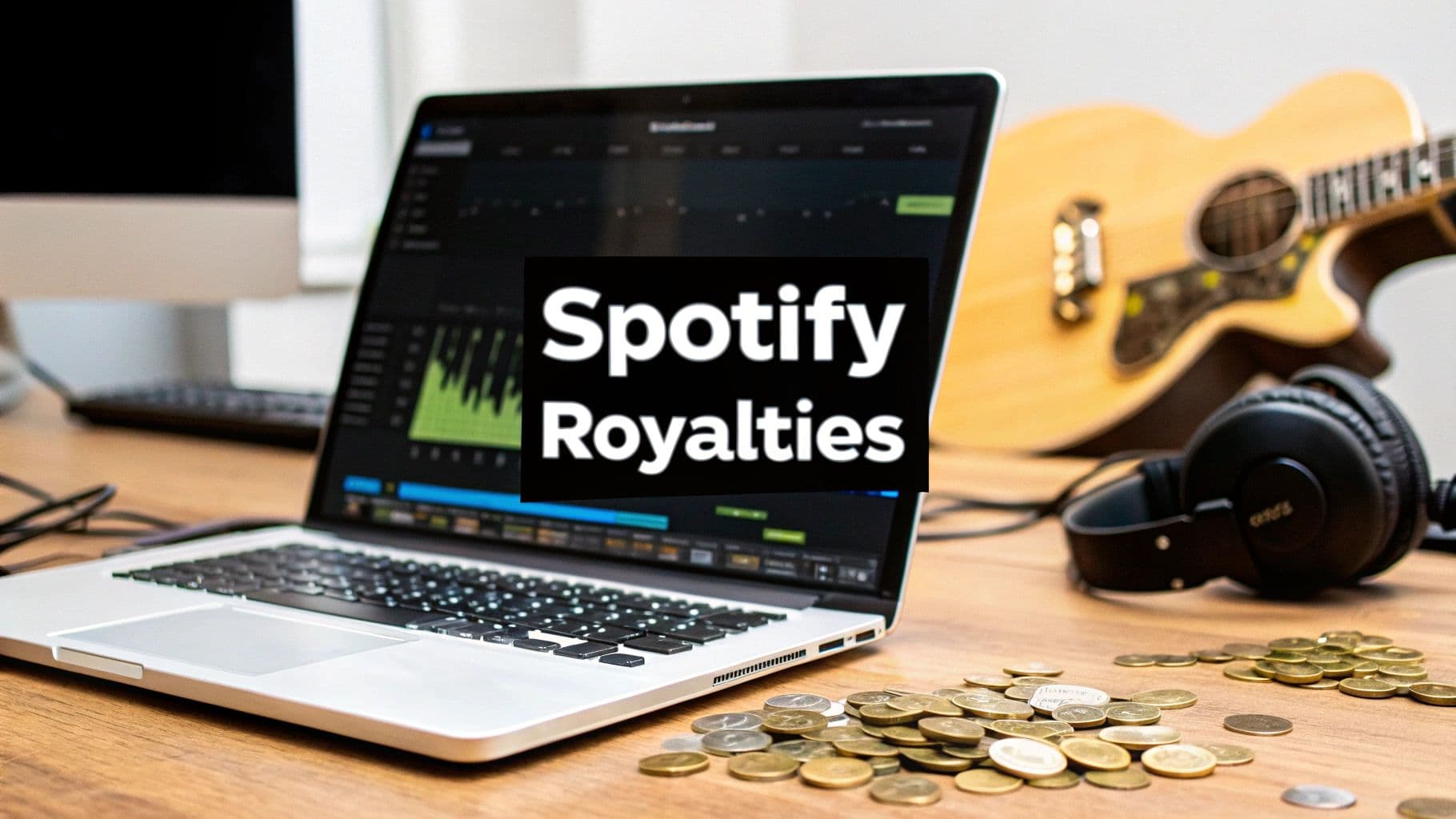
Understand how royalties for Spotify actually work. This guide breaks down payouts, collection methods, and strategies to maximize your streaming income.
January 8, 2026
Music Marketplace Advisor
Buying & SellingFor a lot of independent artists, getting a handle on Spotify royalties can feel like trying to piece together a puzzle without all the pieces. It’s not an impossible system, but with all the distributors, rights organizations, and shifting pay rates, it’s easy to get lost. This guide is here to clear the fog.
Decoding Your Spotify Royalties
To really understand your streaming income, you have to get past the industry jargon and build a simple, practical roadmap for collecting every cent you're owed. The first thing to know is that Spotify doesn't pay artists directly. Instead, they pay rights holders—the people and companies that own the master recordings and the underlying song compositions.
That single distinction is the key to everything. One stream actually triggers several different royalty payments, and they all travel down different paths before landing in your bank account. If you haven't registered your music in the right places, a huge chunk of that money can just sit there, unclaimed. In fact, it's estimated that nearly $1 billion in royalties never makes it to its rightful owner each year, which shows just how crucial a proper setup is.
Building Your Financial Foundation
It helps to think of your music career like a business. Just like any business needs a way to track its money, you need an infrastructure to manage your earnings. We're going to give you that blueprint, breaking down exactly how Spotify's payment model works and the steps you need to take to get paid.
We’ll dig into:
- The Royalty Pool: How Spotify gathers revenue and divvies it up.
- Master vs. Publishing: The two core types of royalties your songs earn.
- Collection Agencies: The key organizations you must work with to claim your money.
- Realistic Payouts: Real-world examples of what you might actually earn.
This isn't just about getting a paycheck; it's about taking charge of your financial destiny. When you truly grasp the mechanics of Spotify royalties, you can build a more stable and predictable career on your own terms.
We'll also touch on how platforms like OohYeah can work alongside your streaming strategy. By creating direct-to-fan sales channels for your music and merch, you take back control and build a career that doesn't rely entirely on the whims of per-stream payouts.
Where the Money Actually Comes From
To really get a grip on your royalties for Spotify, you have to throw out the idea of a simple, fixed payment for every listen. It just doesn't work that way. Instead, the whole system is built on what's called the pro-rata system, or more simply, the "shared pool" model.
Picture this: every month, Spotify collects all the money it makes from every possible source—Premium subscriptions, ads played for free listeners, you name it. All of that cash gets dumped into one giant, global pot of money.
This is the net revenue pool. Your payout isn't a direct transaction from a fan to you; it's your slice of this massive, collective pie. The size of your slice is determined by your "streamshare"—basically, your percentage of the total streams across the entire platform for that month. So, if your tracks made up 0.001% of all streams in July, you get 0.001% of July's revenue pool.
Why Per-Stream Rates Are Never Fixed
This shared pool concept is the exact reason why there's no such thing as a consistent, fixed per-stream rate on Spotify. The value of a single stream is a moving target, and it changes every single month based on a few key factors.
Think of it this way: if Spotify's revenue goes up but the total number of streams across the platform goes up even faster, the value of each individual stream actually drops. It’s a constant balancing act between the size of the pie and how many people are trying to get a piece.
Here are the main variables that mess with the final value of your streams:
- Listener's Subscription Type: This is a big one. A stream from a paying Premium subscriber is worth a lot more than a stream from someone on the free, ad-supported plan. Why? Because Premium users contribute more money to that monthly revenue pot.
- Listener's Geographic Location: Money isn't worth the same everywhere. Subscription fees and ad rates are wildly different from country to country. A listen from someone in a high-cost market like the U.S. or Switzerland will put more money in your pocket than one from a region with lower subscription prices.
Putting the Numbers in Perspective
This model is why you'll often hear that artists earn somewhere between $0.003 and $0.005 per stream. That range translates to roughly $3,000 to $5,000 for every million streams. But remember, that's just an average. The real amount you see depends entirely on who is listening and where they're listening from.
Key Takeaway: Your Spotify royalty isn't a direct payment for a stream. It's your proportional cut of a massive, fluctuating monthly revenue pool, calculated based on your total streamshare.
Getting this fundamental concept down is the first real step to making sense of your royalty statements. It’s not just about racking up more streams; it’s about understanding the value of those streams.
Of course, streaming is just one piece of the puzzle. It's vital for artists to build several income sources. To get the full picture, you can learn more about how independent artists make money from music in our guide. This knowledge lets you read your data correctly and set financial goals for your career that are actually achievable.
Master vs. Publishing: The Two Sides of Your Royalties
When your song gets a spin on Spotify, it doesn't just trigger one single payment. Every single stream actually opens up two separate and distinct royalty pipelines. Getting a handle on this split is probably the single most important thing you can do to make sure you're collecting all the money your music has earned.
I find it helps to think of your song like a house. The master recording is the physical house itself—the finished product with walls, a roof, and windows that people can actually see and experience. The publishing, on the other hand, is the architectural blueprint—the original design, the lyrics, and the melody that brought the house into existence.
Spotify pays for the use of both the house and the blueprint. These are called master royalties and publishing royalties. Crucially, they flow through entirely different channels and are collected by completely different organizations. Lumping them together is a very common and costly mistake.
The Master Recording Royalty
The master royalty is a payment for using a specific, recorded version of a song. This is the royalty most artists know best because it's what they see coming from their digital distributor, whether that's OohYeah, DistroKid, or TuneCore.
When you upload your music, you’re basically giving Spotify the green light to play your specific audio file. The money generated from those plays belongs to whoever owns that sound recording.
- Who owns it? If you're an independent artist and you funded your own recording, you are the owner. If you're signed to a record label, the label typically owns the master recording.
- Who gets paid? Spotify carves out a chunk of its revenue and pays it to rights holders. This money goes to your distributor, who then takes their fee or commission and passes the rest on to you.
This is the side of royalties for Spotify that feels the most straightforward, but it's only about half of the total revenue your music is actually generating.
The Publishing Royalty: The Songwriter's Share
While the master royalty pays for the recording, the publishing royalty pays for the song itself—the composition. This is the money owed to the songwriter(s) and their publisher for coming up with the melody and lyrics.
Even if you wrote, performed, and recorded everything yourself, you're wearing two hats: the "artist" and the "songwriter." That means you're owed both types of royalties. The catch is, publishing royalties don't just show up in your distribution account; you have to go out and collect them separately.
Publishing royalties are split even further into two main types:
- Performance Royalties: These are earned anytime your song is performed "publicly," and yes, that includes being streamed on Spotify. This money is tracked and collected by Performance Rights Organizations (PROs) like ASCAP, BMI, and SESAC.
- Mechanical Royalties: These are earned from the reproduction of your song. In the streaming world, every single play is legally considered a "reproduction," which generates a mechanical royalty. In the U.S., these are collected by The Mechanical Licensing Collective (The MLC).
Let this sink in: Without registering your songs with a PRO and The MLC, you cannot collect your full publishing royalties. This money doesn't automatically find you; it sits waiting to be claimed through the right channels.
It's a complex system, no doubt, but understanding it is non-negotiable for a modern artist. If you're only looking at the master payments from your distributor, you are leaving a significant portion of your earnings on the table.
How to Collect Every Cent You Are Owed
So, you understand the difference between master and publishing royalties—that’s a huge first step. Now for the most important part: setting up the right infrastructure to actually collect all the different streams of money your music generates on Spotify.
Leaving this to chance isn't an option. Each type of royalty requires you to register with a specific organization. Failing to do this is like running a store with three cash registers, but you only collect the money from one. The cash just piles up in the other two, and you never see a dime of it. You have to build the pathways for that money to flow from Spotify back to you.
This diagram is a great way to visualize it. It shows how one song splits into two fundamental pieces—the master and the publishing—each with its own royalty stream you need to track.
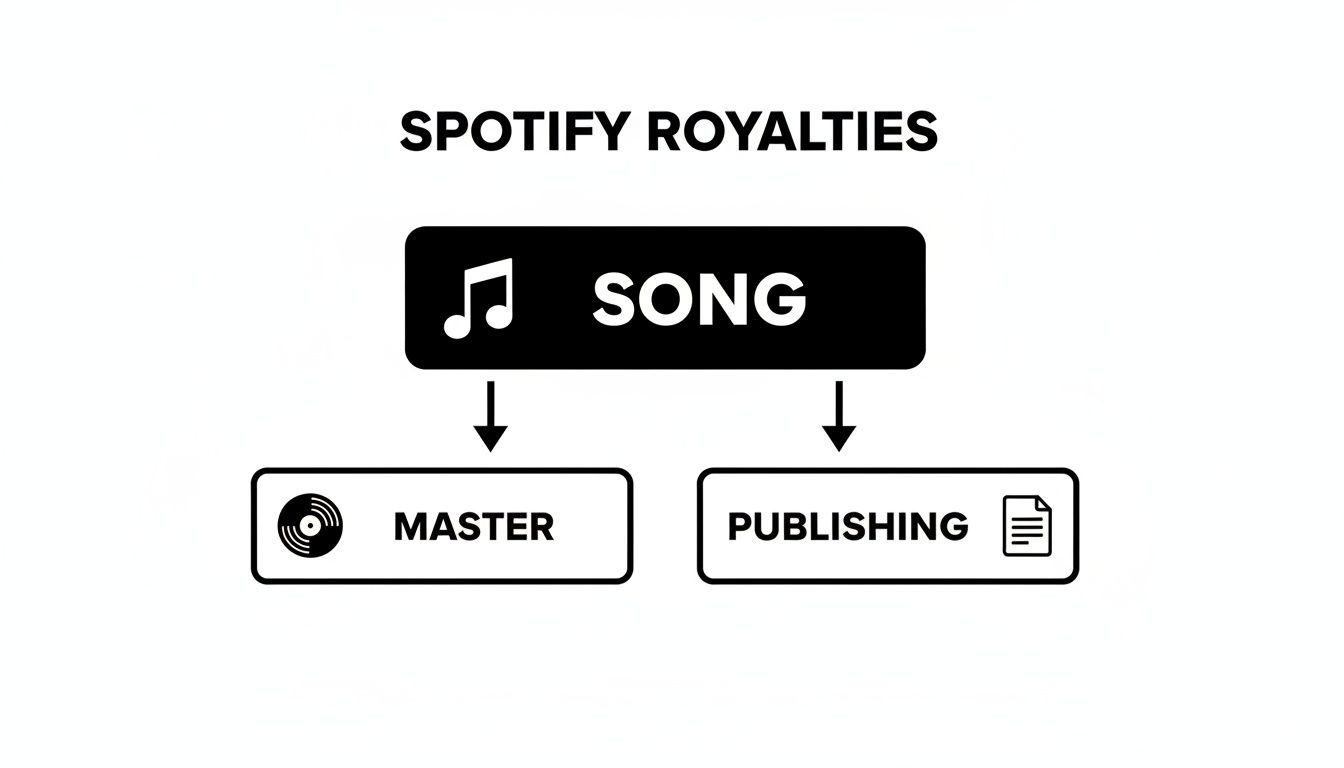
As you can see, your work is both a physical recording (the master) and a piece of intellectual property (the song itself). Each one needs its own collection strategy.
Step 1: Get Your Master Royalties with a Digital Distributor
Your first and most essential partner is a digital distributor. Think of them as the logistics company for your music. They’re the ones who get your actual audio files from your hard drive onto Spotify, Apple Music, and hundreds of other platforms.
More importantly, they collect the master recording royalties from these services on your behalf. When Spotify divvies up its revenue pool for sound recordings, that money goes straight to your distributor. They take their cut and then put the rest into your account. Simple as that.
For independent artists, some popular choices include:
- OohYeah: A great platform that pairs distribution with a direct-to-fan marketplace.
- DistroKid: Well-known for its flat-fee annual model, letting you upload unlimited music.
- TuneCore: One of the originals, offering a variety of pricing tiers.
Bottom line: without a distributor, you have no way to get your music on Spotify or collect the single largest slice of your streaming income. This is a non-negotiable first step.
Step 2: Claim Your Publishing Royalties with a PRO and MRO
This is where so many artists drop the ball. Master royalties are just one half of the equation. To get the money you’re owed as a songwriter, you have to register with the organizations that handle publishing rights.
Remember, even if you wrote and recorded everything yourself, you wear two hats: the "artist" and the "songwriter." You have to collect these two income streams separately.
First up, you need to join a Performance Rights Organization (PRO). These groups collect performance royalties, which are generated anytime your song is publicly performed—and yes, that includes every single stream on Spotify.
- In the United States, your main options are ASCAP and BMI. You only need to join one of them.
- PROs work with their international counterparts (like PRS in the UK or SOCAN in Canada) to make sure you get paid for your performance royalties from all over the world.
Second, you have to register your songs with a Mechanical Rights Organization (MRO). In the U.S., that’s The Mechanical Licensing Collective (The MLC). The MLC was created specifically to collect mechanical royalties from streaming services. Every stream is legally considered a "reproduction" that generates a mechanical royalty, and The MLC is the only organization that collects this money in the States.
If you aren't signed up with a PRO and The MLC, your publishing royalties will literally go unclaimed. It’s estimated that hundreds of millions of dollars are sitting in so-called "black box" accounts for this exact reason. Don't let your money be part of that pile.
Step 3: Capture Digital Performance Royalties with SoundExchange
There's one last, crucial piece to this puzzle: SoundExchange. This organization collects a very specific type of royalty that’s often confused with PRO payments but is entirely separate.
SoundExchange handles royalties for the master recording when it's played on non-interactive digital streams. This means services like Pandora Radio, SiriusXM, and even the radio-style features within platforms like Spotify.
What’s really important here is how SoundExchange pays out this money:
- 45% goes directly to the featured artist on the track.
- 50% goes to the owner of the sound recording (if you’re independent, that’s you!).
- 5% is set aside for non-featured musicians, like your session drummer or backup vocalist.
By registering with SoundExchange as both the artist and the rights owner, you ensure you collect the full 95% you’re owed from these digital radio plays. Skipping this step means leaving a significant and growing revenue stream on the table.
To make this crystal clear, here’s a simple checklist breaking down who you need to register with and why. This is your roadmap to getting paid everything you've earned.
Essential Royalty Collection Checklist for Independent Artists
| Royalty Type | What It Pays For | Collected By | Who Needs to Register |
|---|---|---|---|
| Master Royalties | The use of your sound recording (the master track). | Digital Distributor (e.g., OohYeah, DistroKid) | The owner of the master recording (you). |
| Performance Royalties | The public performance of your song's composition. | PRO (e.g., ASCAP, BMI) | The songwriter(s) and publisher(s). |
| Mechanical Royalties | The reproduction of your song's composition. | MRO (e.g., The MLC in the U.S.) | The songwriter(s) and publisher(s). |
| Digital Performance Royalties | The digital "radio" performance of your master track. | SoundExchange | The master rights owner AND the featured artist. |
Following these steps and registering with each of these entities is the only way to build a complete system for your music income. It takes some initial setup, but once it's done, you'll have peace of mind knowing you’re not leaving any of your hard-earned money behind.
A Realistic Look at Spotify Earnings
Alright, so we've pulled back the curtain on how royalties for Spotify work. But knowing the mechanics is one thing; understanding what that actually means for your bank account is another entirely. It’s time to get real and move past the viral success stories to see what artists are actually making.
Let’s be clear: the dream of uploading a track and waking up a millionaire is just that—a dream. For the vast majority of artists, building a career on Spotify is a marathon, not a sprint. It’s about steady growth, cultivating a loyal following, and setting realistic financial goals along the way.
The Spectrum of Spotify Payouts
To get a grounded perspective, we can look directly at Spotify's own "Loud & Clear" report. It gives us a fascinating, unfiltered view into the platform’s financial ecosystem. The numbers reveal a classic pyramid: a growing middle class of artists are earning real money, but the top is a very exclusive club.
The 2023 data showed that over 103,400 artists earned at least $5,000 from Spotify alone. Moving up the ladder, 20,500 artists cleared $50,000 or more, and an impressive 11,600 generated $100,000 or more. These figures prove that building a sustainable career is absolutely possible, but they also underscore just how fierce the competition is. You can dig deeper into these Spotify earning statistics for 2025 for a more complete breakdown.
And the peak of that pyramid? It’s incredibly narrow. A tiny cohort of just 170 artists crossed the $5 million mark in annual streaming revenue. This is a crucial lesson: Spotify can be a fantastic revenue stream, but thinking of it as your only income source is a risky bet.
The Monetization Threshold for New Tracks
For anyone just starting out, there’s a new gate you have to pass through before you see a single cent. In a move to clean up the royalty pool and shut down artificial streaming, Spotify rolled out a major policy change.
Now, a track has to get at least 1,000 streams within a 12-month window just to become eligible to earn royalties. If your song doesn't hit that number, the micro-pennies it would have earned are simply funneled back into the main royalty pot and paid out to all the other eligible tracks.
This isn't just a minor rule change; it fundamentally shifts the strategy for new artists.
- Promotion is Non-Negotiable: You can't just upload and hope for the best anymore. You need a game plan to get those first 1,000 listens.
- Quality Beats Quantity: It's far better to release one or two tracks with a solid promotional push than to drop an entire album that gets lost in the noise.
- Build Your Audience First: This policy highlights how vital it is to have an engaged fanbase ready to stream your music the day it drops.
Think of this threshold as your first clear target for any new song. Your initial goal isn't just to get streams; it's to get at least 1,000 streams to even start the engine on that track's earnings.
From Streams to Yearly Income
So, let's put some real-world numbers to this. How do stream counts translate into annual income? Using a rough average payout of $0.0035 per stream, we can sketch out a few scenarios. It’s an estimate, of course, but it helps frame your goals.
- 10,000 monthly streams: That’s 120,000 streams a year, which works out to about $420.
- 100,000 monthly streams: Now we’re at 1.2 million annual streams, generating around $4,200.
- 500,000 monthly streams: Hitting this level means 6 million streams a year, bringing in roughly $21,000.
These numbers drive home why a diverse income strategy is so critical for musicians. While $21,000 from one platform is significant, it's rarely enough to support a full-time career on its own. This is exactly why it's so important to focus on strategies that move the needle. You can find some great ideas in our guide with tips for increasing music streams and maximizing your earnings. When you combine your streaming income with merch, live shows, and direct-to-fan sales, you build a much stronger and more reliable financial foundation.
Building a Career Beyond Streaming
While it's crucial to get a handle on how Spotify royalties work, banking on streaming as your only paycheck is a risky game. With per-stream rates always in flux and new payout rules popping up, a truly sustainable music career needs a business model that's more diverse, more resilient, and—most importantly—one you actually control.
The best way to think of Spotify is as the top of your marketing funnel. It's a fantastic engine for discovery, introducing your music to new listeners across the globe through its powerful playlists and algorithms. But the real goal? That’s to guide those casual listeners from a platform you're essentially renting to a community you own.
Owning Your Fan Relationships
The single most valuable asset you can build as an artist is a direct line to your audience. When you turn a passive Spotify listener into an engaged fan, you open up income streams that dwarf the fractions of a penny you earn from a single stream. This is exactly where artist-first platforms come into play.
A platform like OohYeah, for example, gives you a commission-free space to sell your music, merch, and exclusive content straight to the people who want to support you. Think about it: when a fan buys your digital album or a t-shirt from your OohYeah profile, you keep 100% of that money. This simple change in mindset—from chasing millions of streams to connecting with a few hundred true fans—can completely transform your financial reality.
From Streams to Sales: A Practical Funnel
Your Spotify profile isn't just a place for your songs to live; it’s a launchpad. You need to use every feature available to point listeners toward the channels where you can make a real living.
Here are a few simple but effective ways to do just that:
- Tweak Your Spotify Bio: Use your artist bio to send fans directly to your OohYeah profile. A clear call-to-action works wonders: "For exclusive tracks, merch, and more, support me directly at [Your OohYeah Link]."
- Get Creative with Canvas: Make short, looping videos for your tracks that double as ads. You can visually plug your latest merch drop or a new digital download available on your direct-to-fan store.
- Use Your Artist Pick: Pin a track, album, or playlist to the top of your profile. In the description, add a quick note telling fans where they can find exclusive items and support your work.
The smartest independent artists see streaming platforms for what they are: incredible discovery tools, not the end-all-be-all. Their real business is built on platforms where they set the prices, sell the products, and own the fan relationships.
Beyond streaming royalties, there are other ways to fuel your creative work, including grants specifically for independent music artists. By blending the wide reach of streaming with direct sales, merch, and other funding sources, you build a financial foundation that isn’t at the mercy of unpredictable payout rates.
You can dig into more strategies for building a career beyond streaming in our dedicated guide. Ultimately, this approach puts you back in the driver's seat, letting you build a stable, long-term career on your own terms.
Your Top Spotify Royalty Questions, Answered
When you're first diving into the world of streaming royalties, a few practical questions always pop up. Let's clear up some of the most common points of confusion for independent artists.
How Long Does It Take to Get Paid by Spotify?
Don't expect your streaming income to hit your bank account overnight. There’s a standard delay of about 2-3 months from the time someone streams your song to the moment you actually see the money.
So, if your track was getting a lot of love in January, Spotify will likely finalize those numbers and send a report to your distributor sometime in March. Your distributor then has to process that payment according to their own schedule. This lag is just part of the process, giving Spotify and all the middlemen (like distributors and PROs) the time they need to crunch the numbers.
Can I Make Money By Streaming My Own Music?
Technically, yes, a stream is a stream. But—and this is a big one—don't even think about it. Spotify's systems are incredibly smart and are built to sniff out this kind of "artificial streaming."
Trying to game the system by looping your own tracks is a fast track to getting penalized. If you're caught, Spotify might withhold your royalties, pull your music from the platform completely, or even hit you with financial penalties. Your energy is much better spent building a real fanbase.
Why Did My Payout Rate Change From Last Month?
It's completely normal for your per-stream rate to go up and down each month. It’s not a fixed number. This is because Spotify operates on a "pro-rata" model, where all the money is pooled together and then divided up.
Your specific rate can change based on a few key factors:
- Where people are listening: A stream from a fan in a country with a high subscription cost (like Switzerland or the US) is worth more than a stream from a country with lower fees.
- What plan they have: A stream from a Premium subscriber pays out significantly more than a stream from someone on the free, ad-supported tier.
- How much music was streamed globally: That month's total revenue pool gets divided by the total number of streams across the entire platform.
Because of this, your payout rate will always be tied to these bigger, constantly shifting global trends. For any artist just starting out, it's crucial to treat your music like a business from day one. If you're in the UK, a great first step is learning how to register as self-employed to manage your earnings professionally.
Ready to take control of your music career and keep 100% of your earnings? Join OohYeah today and build a direct connection with your fans on a commission-free platform designed for artists. Sign up now and start owning your future