Music Subscription Plans Explained for Artists and Fans
Understand music subscription plans, tier structures, and pricing models. Learn how artists build sustainable fan subscriptions on creator-first platforms.
October 16, 2026
Music Marketplace Advisor
Buying & SellingYou're comparing a monthly price, checking whether your favorite artist has released something exclusive, or staring at a royalty report that doesn't seem to match your listener numbers. The same question sits underneath each situation: what does a recurring music payment buy, and who benefits from it?
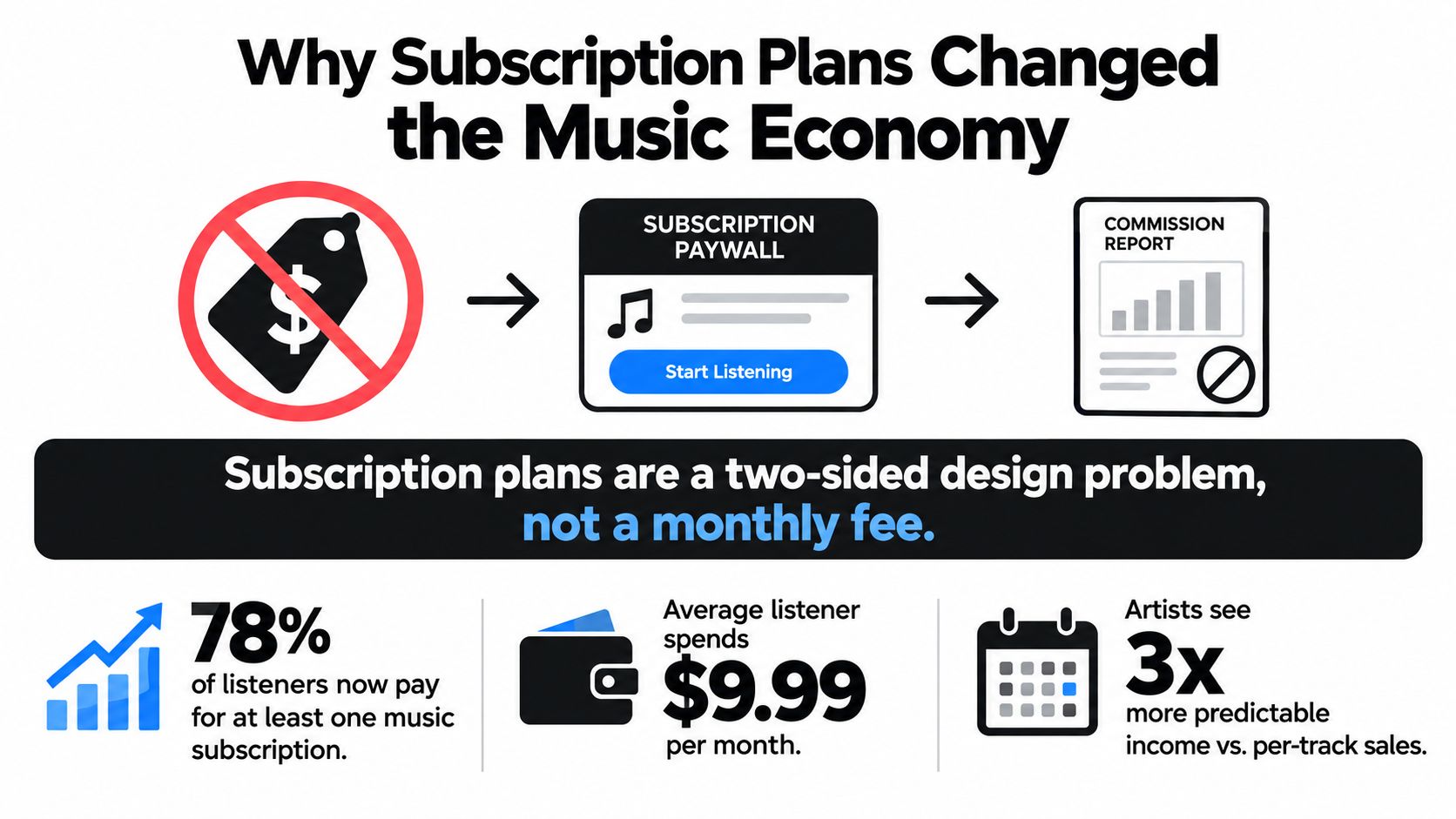
Music subscription plans aren't cheaper ways to access a large catalog. They're a two-sided design problem. Fans need a reason to keep paying, while artists need benefits they can deliver consistently without turning every month into an unsustainable production schedule.
Why Subscription Plans Changed the Music Economy
The scale of recurring music payments is no longer theoretical. According to the International Federation of the Phonographic Industry's global report, paid music subscription accounts worldwide grew 10.6% year over year to 752 million in 2024. Subscription streaming revenue rose 9.5%, making paid plans the principal driver of recorded-music expansion.
That changes how both sides should think. A fan isn't only buying access to songs. The fan is choosing an ongoing relationship with a service, a creator, or both. An artist isn't only uploading tracks. The artist is deciding which benefits can turn attention into recurring support.
Start with the exchange
A useful way to evaluate any plan is to separate the promise into two questions:
- What does the fan receive repeatedly? That could be uninterrupted listening, offline playback, early releases, private updates, direct interaction, merchandise access, or a stronger connection to a favorite artist.
- What can the creator sustain repeatedly? A monthly voice note may be realistic. A new fully produced exclusive album every month probably isn't.
The strongest plan connects those answers. A fan gets a benefit that remains meaningful after the first payment, and the artist builds a delivery routine that fits the actual creative workload.
Practical rule: A subscription succeeds when its recurring promise is clearer than its cancellation reason.
The market's growth also explains why a general catalog service and a direct artist membership shouldn't be judged by the same standard. A catalog service optimizes breadth, convenience, discovery, and playback features. An artist membership optimizes closeness, exclusivity, and direct support.
You can find further music-business guidance and creator resources through the OohYeah magazine, but the central test remains simple: does the payment create durable value for the fan and workable income for the artist?
How Subscription Revenue Reaches Artists
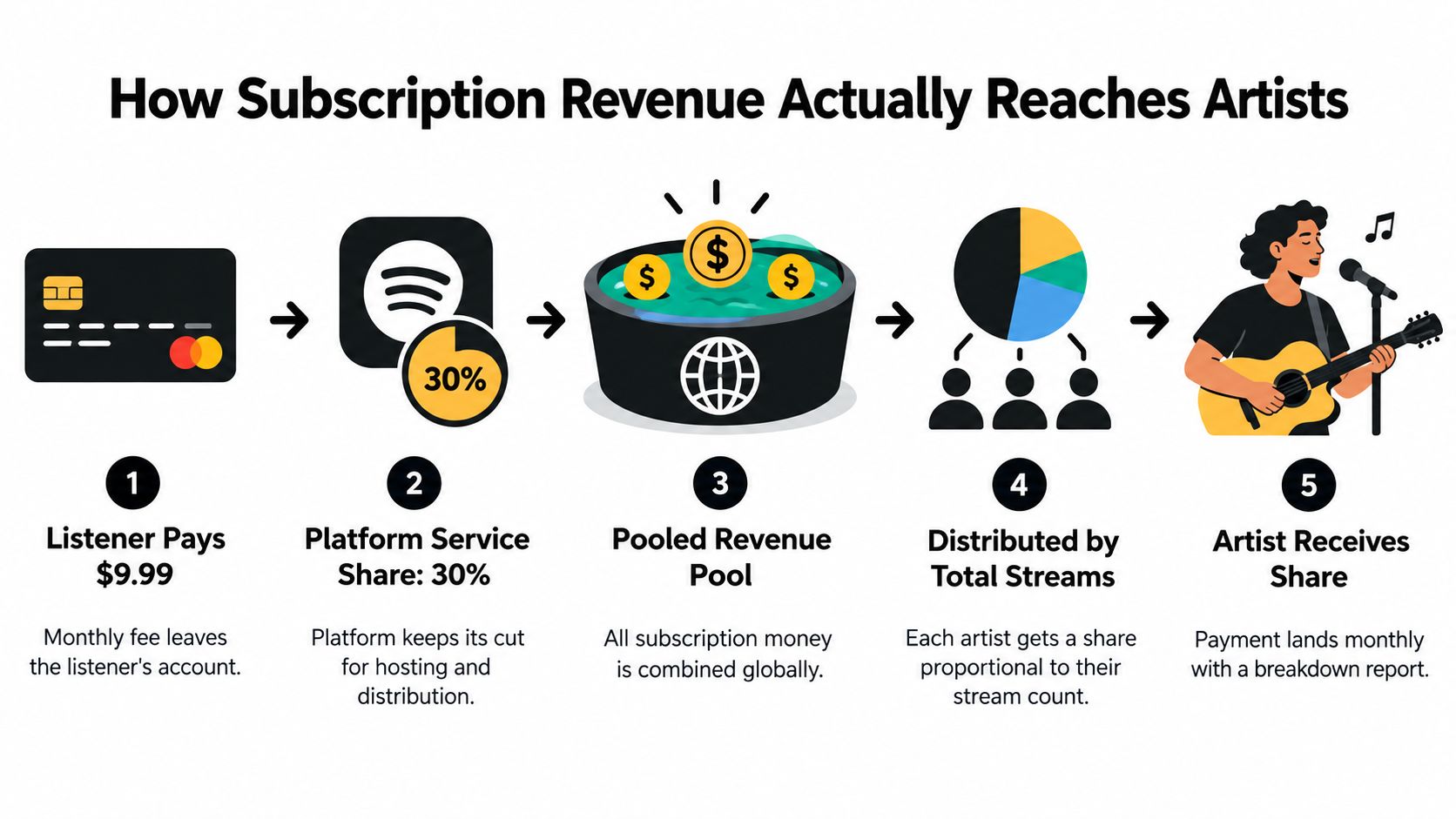
A listener's payment for a general streaming plan usually does not travel straight to the artist whose song was played. The platform combines subscription revenue, keeps a service share, and distributes the remainder through an allocation model. Labels, publishers, distributors, and other rights holders may receive the money before the performing artist receives their contractual share.
A peer-reviewed analysis of streaming economics describes a common pooled model in which platforms retain roughly 30% of subscription revenue and distribute about 70% to rights holders. Under a pro-rata approach, an artist's portion depends on that artist's share of total streams within the relevant pool.
The pooled model in plain language
Thousands of listeners may pay the same service during one billing period. The platform combines eligible revenue, applies its service share, measures listening activity, and allocates the rights-holder pool. A track with more streams receives a larger portion.
This arrangement supports a large catalog, yet it weakens the link between one fan's payment and one artist. A listener may mean to support a particular musician, while the subscription still contributes to a broader pool. A user-centric alternative would allocate each subscriber's payment according to that person's listening behavior instead of combining everyone's activity first.
Three terms clarify where the money goes:
- Platform payout: Money the service sends onward after applying its operating share.
- Rights-holder revenue: Money received by a label, publisher, distributor, or other rights administrator.
- Artist net income: The amount the performing artist keeps after contractual splits, recoupment, commissions, taxes, and other costs.
These amounts are different. Anyone studying intellectual property for musicians should also understand that ownership and payment routing can affect the final result as much as the number of plays.
Direct subscriptions address that attribution gap. A supporter's payment can connect to a specific creator and a defined benefit rather than entering a broad platform pool. The final economics still depend on platform terms, taxes, payment processing, and fulfillment costs, so artists need to read the agreement carefully. The practical advantage is clearer accounting: the artist can identify who paid, what that supporter received, and what delivery work remains.
That makes direct membership a two-sided design problem. Fans need a benefit they willingly renew, while artists need a promise they can deliver without exhausting their creative capacity. OohYeah for artists can serve as the bridge between those requirements, giving creators a place to examine tools for structuring that exchange and comparing its terms with pooled streaming economics.
The Major Tier Archetypes and What Each One Buys
Most music subscription plans fit into a small set of recognizable archetypes. Once you identify the archetype, the trade-off becomes easier to understand.
| Tier | Typical Price | Key Access | Artist Impact |
|---|---|---|---|
| Ad-supported free | No recurring payment | Broad catalog access with advertising and possible playback limits | Maximizes reach, but advertising-supported revenue generally provides less direct value per listener than paid support |
| Individual standard | Monthly paid plan | Personal listening, fewer interruptions, and commonly stronger playback controls | Adds recurring subscription revenue to the wider rights-holder pool |
| Family or multi-user | Higher monthly plan shared across eligible users | Separate profiles or access for multiple household members | One paying plan supports several users, so the payment isn't a one-to-one artist contribution |
| Student | Discounted eligibility-based plan | Many standard features at a reduced rate | Lowers the barrier to paid access while producing less revenue per plan than a full individual tier |
| Premium or lossless | Higher-feature paid plan | Better audio options, offline playback, or other enhanced features where available | Can increase the value of paid listening, although allocation still follows the service's payout structure |
| Direct artist membership | Creator-set recurring payment | Exclusive music, community access, direct messages, merchandise, or events | Concentrates the supporter's payment on a defined creator and promised benefits |
The United States shows how central paid access has become. The Recording Industry Association of America reported that paid streaming subscriptions averaged 100 million in 2024, generating $11.7 billion. Paid plans represented 79% of U.S. streaming revenue and nearly two-thirds of total U.S. recorded-music revenue.
Those figures measure plans, not necessarily individual people. Multi-user or family plans count as one subscription, and limited-tier services are excluded from the subscription count. That measurement detail matters when you compare the size of a plan with the number of listeners who can access it.
The direct artist tier is the outlier because it sells a relationship rather than utility alone. A catalog plan answers, “What can I listen to?” A membership answers, “What do I receive from this creator, and what does my payment help make possible?” Fans comparing that difference can explore the fan tools on OohYeah alongside traditional catalog services.
Choosing a Catalog Subscription Without Losing Money or Meaning
A low monthly price doesn't automatically mean a plan offers better value. The actual cost includes the features you use, the restrictions you tolerate, the people sharing the account, and the purchases the subscription might replace.
Start with the listening experience you have, not the feature list on the sales page. If you commute without reliable connectivity, offline playback may matter more than a larger catalog. If you listen critically with compatible equipment, audio quality may matter more than social playlists. If several people use the account, calculate the value for the household rather than judging the fee as one person's expense.
Use a total-value checklist
- Compare real total cost: Include the recurring fee, applicable taxes, add-ons, and any separate purchases needed for the experience you want.
- Check downgrade friction: Ask whether moving to a cheaper tier removes offline access, playback control, catalog availability, or other features you use every day.
- Evaluate family-plan splits: Divide the plan's cost across the people who use it, then consider whether the sharing rules fit your household.
- Assess catalog depth: Search for the artists, labels, recordings, and regional releases you care about before switching.
- Review cancellation terms: Confirm when billing stops, what access remains, and whether the service makes it easy to leave.
The artist-support question deserves its own line on the checklist. A general subscription can be excellent for discovery and listening convenience, but it usually doesn't tell you how much of your payment reaches a particular performer. If direct support is your priority, combine catalog listening with a purchase, membership, ticket, merchandise order, or other creator-controlled option.
Price increases make perceived value even more important. Luminate reported that paid usage for Apple Music and Amazon Music remained below their 2022 to 2023 levels in 2025 despite repeated price increases since October 2022. The lesson isn't that higher prices always fail. It's that subscribers renew when the additional cost produces a benefit they notice.
Designing a Subscription Offering as an Independent Artist
An independent artist shouldn't begin by copying a large streaming service. Start with the smallest membership that creates a clear reason to join and a manageable routine for delivery.
Choose the structure before the perks
Two or three tiers are usually easier to explain and operate than a crowded ladder. Give each level a distinct job:
- Entry tier: Converts a casual supporter with early access, private updates, or a small exclusive.
- Core tier: Deepens the relationship through regular behind-the-scenes content, voice notes, community posts, or direct conversation.
- High tier: Serves a smaller group that values physical goods, personal access, or special experiences.
The lowest tier should feel easy to understand, not disposable. The highest tier should feel meaningfully different, not like the same digital feed with a decorative label. Pricing should reflect the benefit's perceived value and your delivery cost, not a royalty rate from a general catalog service.

Put the sustainable promise behind the paywall
Choose benefits you can produce during busy periods, not only when inspiration is high. Early access to a finished track is operationally simple. A monthly studio diary can work if you already document sessions. A weekly custom video for every member can quickly consume the time you need for making music.
Set the cadence in plain language. “One private update each month” is easier to maintain than “constant access to me.” Tell members what happens during release months, touring periods, and quiet creative stretches. Artists looking beyond subscriptions can also find practical tips from Dirt Cheap Headwear about artist presentation and audience-building work.
Measure behavior, not vanity
Track which tier converts, which benefits receive attention, when members cancel, and whether subscribers later buy tickets or merchandise. A large follower count doesn't prove that a membership works. A smaller group that renews, responds, and purchases can provide better evidence that the offer matches fan intent.
Commission-free infrastructure can improve the underlying economics because the creator keeps more of each payment than under a model with a platform commission. The artist still has payment processing, taxes, fulfillment, and production costs, but the subscription can connect revenue to a known supporter instead of a distant stream pool.
A Realistic Launch Scenario for a Tiered Membership
An independent artist with a few thousand engaged fans across social channels, email, and live shows opens a membership without treating every follower as a likely subscriber. The offer has to satisfy two sides at once: fans need a clear reason to pay, while the artist needs benefits that fit a sustainable workload. OohYeah can serve as the bridge by organizing those offers without turning the artist into a catalog streamer.
The $3 supporter tier provides early access to new tracks and a monthly supporter shoutout. It suits listeners who want to contribute without frequent personal interaction. Delivery stays manageable because the promise is narrow: members hear selected releases first and receive recognition.
The $9 inner-circle tier adds monthly voice notes, behind-the-scenes posts, and access to a private community conversation. It becomes the core offer because it gives members a recurring reason to return without demanding a new premium production every month. The artist can maintain the relationship through a repeatable rhythm rather than constant availability.
The $25 patron tier includes a signed physical bundle and quarterly video calls. Membership is capped so packing, shipping, and personal access remain within the artist's available time. Scarcity here protects delivery quality rather than creating artificial urgency.
Make the launch measurable
Before enrollment opens, the artist prepares a delivery calendar:
- Release weeks: Early track access and context about the recording.
- Regular months: One voice note, one behind-the-scenes post, and one community prompt.
- Patron cycle: Physical fulfillment according to a stated schedule and a quarterly call.
- Every month: Review conversions, cancellations, engagement, support requests, and fulfillment costs.
The first launch is a test of the promises, not a guaranteed result. If fans choose the entry tier but avoid the core tier, the offer may need clearer value rather than a lower price. If patrons join and fulfillment becomes exhausting, the artist should narrow the bundle or reduce the access promised.
Research on more than 10,000 streaming users found that premium subscribers showed greater willingness to pay for live events, as described in coverage of the finding on premium subscriptions and live-event willingness to pay. The artist should therefore track ticket and merchandise behavior after members join. Those purchases will show whether the membership strengthens the wider fan relationship, rather than leaving that connection to assumption.
Why Direct Fan Subscriptions Often Outperform Catalog Streaming for Artists
A listener may discover an artist through a playlist, stream several tracks, and still contribute little predictable income. Catalog streaming supports reach, but it usually requires substantial listening volume before the result becomes dependable. Duetti's analysis of independent artists found an average of $3.41 per 1,000 streams globally, while niche genres generated approximately 8% more per stream than mainstream genres, according to coverage of the analysis.
That figure is an average, not a guaranteed rate. Territory, service, rights ownership, contracts, listener type, and reporting period all affect the amount credited. Stream totals therefore provide an incomplete picture of both incoming revenue and the share left after intermediaries.
Spotify states on its Loud & Clear site that it pays roughly two-thirds of music revenue to artists' and songwriters' rights holders. That payment may not reach the performing artist directly. Rights splits, contracts, and other intermediaries can leave the artist with a much smaller final amount.
Direct membership addresses a different part of the problem. The artist can identify the paying supporter, define the promised benefit, and see whether that supporter renews. On a commission-free platform, a larger share of the payment can remain with the creator, subject to the platform's terms and ordinary business costs.
The design challenge has two sides: fans must find the offer worth paying for, while artists must be able to deliver it repeatedly. OohYeah can bridge those needs by connecting recurring support with releases, merchandise, tickets, and private interaction, rather than treating the artist as another catalog.
Streaming and direct subscriptions work best together. Catalog services introduce music to potential fans. A direct membership gives a committed listener a clear way to support its creator, whether through an early release, a signed edition, or a private studio update.
Putting It Together on an Artist-First Platform
A workable decision model has five parts.
- Name the fan outcome. Don't sell “premium content” as an abstract label. Sell early access, private context, direct conversation, physical goods, or a defined community experience.
- Price the outcome. The right price reflects what the benefit means to the supporter and what it costs you to deliver. Stream rates shouldn't set the price of a relationship-based offer.
- Match delivery to capacity. A modest promise delivered every month is stronger than an ambitious promise that disappears after launch.
- Pair digital access with tangible value. Voice notes, exclusive downloads, merchandise, event access, and direct messages can serve different supporter motivations.
- Review the numbers and the conversations. Monitor conversion, churn, engagement, support requests, fulfillment costs, and downstream purchases. Then ask members what they value.
OohYeah brings these mechanics together through commission-free downloads, exclusive-content distribution, direct messaging, voice notes, community posts, and analytics. That gives an artist a way to connect a recurring offer with the content and interactions behind it, while fans can choose support based on a specific creator relationship rather than catalog access alone.
The best music subscription plans make the exchange visible. Fans know what they receive and why the payment matters. Artists know what they must deliver, what the offer costs to run, and which supporters want a deeper connection. Start this week by selecting one audience, defining one sustainable benefit, and writing the delivery schedule before you set the price.
If you're an artist, OohYeah gives you tools for exclusive content, commission-free downloads, direct fan interaction, and subscription-based support in one place. Create a simple tier your audience can understand, publish the promise clearly, and use the resulting engagement data to improve what you deliver.