Music Streaming Data: The Independent Artist's Guide
Master music streaming data analytics. Learn to interpret streams, completion rates, and saves to build a winning release strategy for independent artists.
October 14, 2026
Music Marketplace Advisor
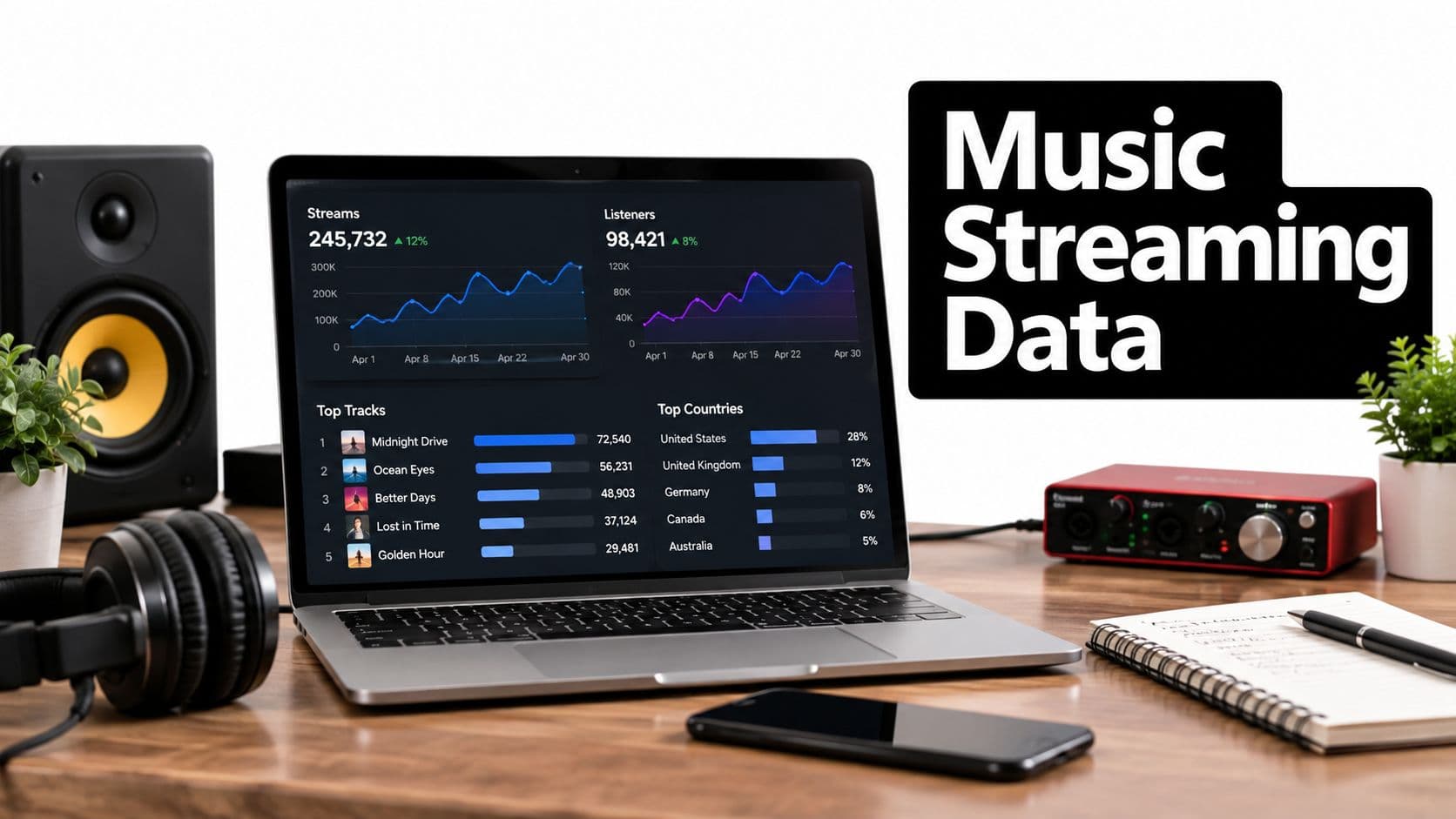
Buying & Selling88% of tracks received fewer than 1,000 streams in 2025, so raw play counts alone can't tell you whether your music is reaching the right people. Useful music streaming data shows the difference between casual exposure, repeat listening, and genuine fan intent.
A release can collect plays without building a career. Another track can attract fewer listeners but generate more saves, registrations, purchases, and conversations. As an independent artist, your job isn't to chase the largest number on a dashboard. It's to identify quality-adjusted reach, the share of attention that comes from real listeners and leads to meaningful action.
Why Your Music Streaming Data Matters More Now
88% of tracks received fewer than 1,000 streams in 2025, while platforms hosted more than 253 million tracks and received approximately 106,000 new songs per day. These figures come from reporting on the independent artist discovery crisis. In that environment, a low play count does not by itself indicate weak music. It may show that an artist lacks enough information to see where attention stops.
A stream is only the beginning of the listener journey. The useful questions are who listened, whether they finished the song, whether they returned, and whether they saved it, followed the artist, joined a community, or bought something.
Why reach needs a quality filter
Foot traffic outside a venue matters, but it does not tell you who entered, stayed for the set, bought a shirt, or came back for the next show. A smaller audience with strong engagement can create more career value than a large audience that disappears after one accidental play.
Quality-adjusted reach combines exposure with intent. Track the path from impression to play, completion, repeat listening, save, follow, registration, subscription, download, or purchase. The available signals differ by platform, yet the principle remains consistent: a play becomes strategically useful when it reveals a listener relationship or helps deepen one.
This approach also helps separate genuine growth from suspicious activity. A rising stream count without completion, repeat listening, or downstream action deserves closer examination. Healthy reach leaves a pattern of continued interest.
Streaming sits at the center of the recorded-music economy. Global recorded-music streaming revenue reached US$20.4 billion in 2024, representing 69.0% of total global recorded-music revenue, according to the IFPI Global Music Report 2025. Streaming data therefore matters because it can connect audience size with audience quality. A stream remains a signal, not a complete assessment of momentum.
A&R rule: Read every stream alongside what the listener did next. That follow-up action shows whether reach became intent.
Core Metrics Explained, Streams, Listeners, and Beyond
A stream is a play. A listener is a unique person or account counted by the relevant platform. A fan is someone whose behavior shows continuing interest. These labels describe different stages of quality-adjusted reach, so a larger stream total does not automatically indicate stronger growth.
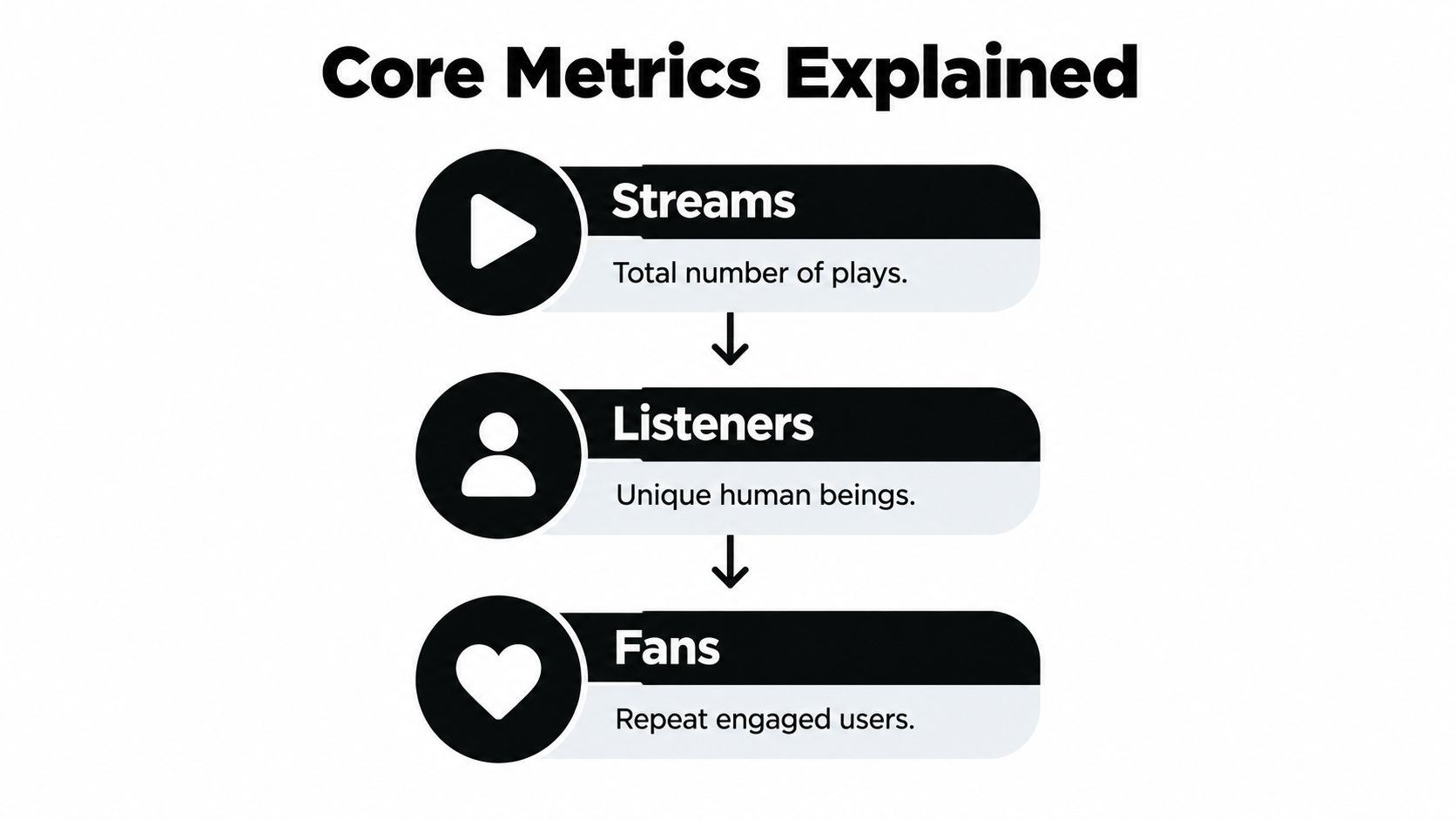
The metrics that answer different questions
| Metric | What It Measures | Why It Matters |
|---|---|---|
| Streams | Total plays | Shows consumption volume, but not loyalty by itself |
| Listeners | Unique individuals or accounts | Reveals the size of the reached audience |
| Completion rate | The share of a play that reaches the end | Helps identify whether the track holds attention |
| Saves | Listeners who store the track for later | Signals stronger intent than a passing play |
| Playlist adds | Listeners placing the track into a personal or platform playlist | Indicates future listening potential |
| Repeat listeners | People who return to the music | Helps separate curiosity from retention |
| Follows | Listeners choosing to receive more from the artist | Connects one release to future discovery |
| Fan actions | Registrations, subscriptions, downloads, purchases, or messages | Shows whether attention becomes a relationship |
Counting plays without saves, repeats, and purchases is like judging a shop only by footsteps at the entrance. Volume shows exposure; follow-up behavior shows whether that exposure has value.
Read ratios, not isolated totals
Two songs can reach the same stream total while producing very different audiences. One may attract many one-time listeners. The other may reach fewer people who return, save the track, and follow the artist. The second release may offer a stronger foundation for a follow-up campaign because it demonstrates higher intent.
Compare completion with skips, saves with listeners, and repeat behavior with discovery sources. For platform-specific definitions, check the OohYeah FAQ, then apply the habit that matters: connect each metric to a decision you will act on.
Paid and free listening also need separate treatment. Global paid streaming subscription accounts reached 752 million in 2024, up 10.6%, while subscription streaming grew 9.5% and combined ad-supported formats grew 1.2%, according to IFPI's 2024 global recorded-music figures. A paid listener and an ad-supported listener can both produce a stream, but their listening context and conversion possibilities may differ. Use that context to assess reach quality, not to dismiss either audience.
A useful working question is simple: what should happen after this metric rises? If the answer is unclear, the number needs more context before it guides a release decision.
Reading the Listener Journey, The Conversion Funnel
A listener rarely becomes a committed fan in one action. The journey usually starts with an impression, moves to a first play, and then reveals its quality through what happens next.
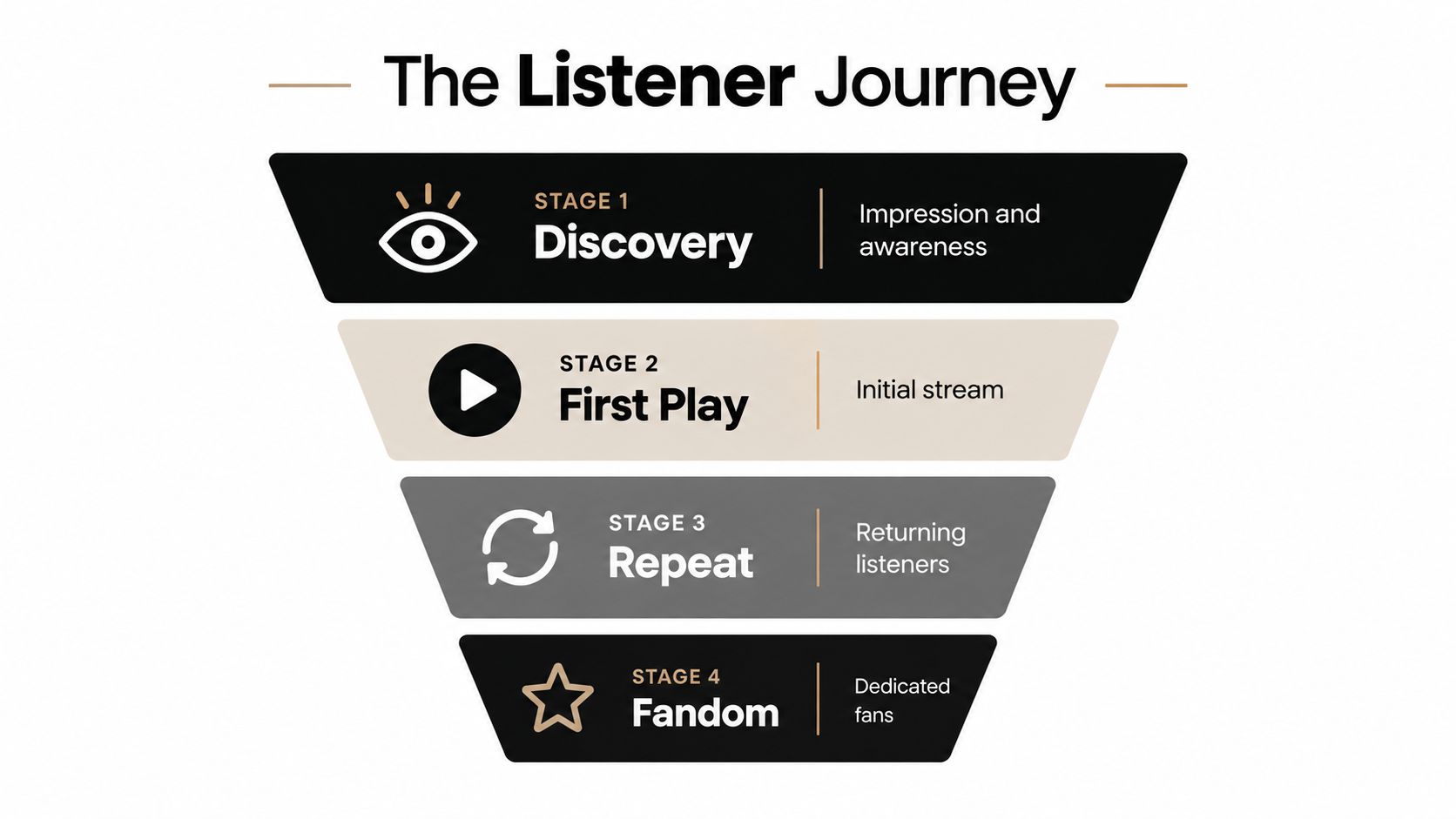
Four points where attention can weaken
Discovery is the visibility layer. A listener may encounter a playlist placement, search result, recommendation, social post, video, live performance, or message from another fan. If impressions are strong but first plays remain weak, examine the artwork, title, preview, positioning, and audience fit before blaming the track.
First play confirms that the listener crossed the first threshold. At this stage, completion and early skips matter because they show whether the introduction earns continued attention. A strong impression with weak listening behavior points to a mismatch between promise and experience.
Repeat listening is the first clear sign of retention. A returning listener has made a choice beyond the initial discovery. Compare repeat behavior by track, source, location, and audience segment where your platform makes those dimensions available.
Fandom appears when listeners take an action that extends beyond playback. They may follow, save, join your community, register, subscribe, download, buy merchandise, attend an event, or send a message. Those actions give you a more durable connection than rented attention on a third-party feed.
Diagnose the leak before changing the campaign
A release with high discovery and low first-play conversion needs better presentation or targeting. A release with strong first plays and weak completion may need attention to the opening, arrangement, mix, or audience expectation. A release with good completion but little repeat listening may need a clearer reason for the listener to return.
Streaming economics reinforce the need to distinguish stages. In the United States, paid music-streaming subscriptions averaged 100 million in 2024, while paid subscription services generated US$11.7 billion and represented 79% of U.S. streaming revenue, according to the RIAA 2024 Year-End Revenue Report. Those figures describe a market, not an artist's personal funnel, but they show why access type and conversion context belong in serious analysis.
A stream is an entry point. A repeat listener is evidence of retention. A direct action is evidence that the relationship has value.
The Truth About Fake Streams and AI Fraud
A high stream count can signal reach while concealing limited human interest. Streaming farms and AI-generated catalogs can create activity intended to collect royalties, so raw volume provides an incomplete picture of audience growth. For an independent artist, the useful question is whether those plays produce quality-adjusted reach, meaning attention from listeners who show meaningful intent.

Synthetic supply is changing how platform totals should be read. Deezer estimated that AI-generated content represented 18% of daily uploads in April 2025 and 28% of all delivered music by September 2025, as reported by WIPO Magazine on AI-generated songs and streaming farms. More uploads do not automatically create more genuine discovery. They can make real attention harder to separate from automated activity.
Patterns that deserve investigation
One unusual result is a prompt for review, not proof of manipulation. Look for several signals together:
- Geographic concentration: A sudden cluster of plays from an area with no matching audience history, promotion, or personal connection warrants closer examination.
- Weak listener depth: Large play totals combined with very low saves, follows, completion, or repeat activity suggest limited intent.
- Unusual timing: Repeated bursts at odd intervals, especially without a related campaign, may indicate automated activity.
- Poor commercial alignment: Streams that produce no registrations, downloads, subscriptions, messages, or sales deserve less strategic weight than plays leading to those actions.
Platform enforcement can also alter historical totals. Apple reported that manipulated streams fell 30% after an initial anti-fraud program and another 20% after a later update, according to reporting on Apple's anti-fraud measures. A revised total does not necessarily mean legitimate listeners vanished. Detection may have improved.
For creator-focused coverage and practical industry context, visit OohYeah's music industry magazine.
Measure first. Suspicion without evidence can produce wrong conclusions and damage fan relationships. Compare streaming data with direct messages, community activity, sales, subscriptions, and repeat engagement. If those signals do not support the stream count, reduce its influence on planning and preserve the evidence if a platform asks about unusual activity.
Using Data to Inform Your Release Strategy
Analytics become useful when they change what you do next. Before a release, define the listener action you want to improve. You might prioritize completed plays for a new single, repeat listening for a catalog track, or registrations and purchases for a campaign built around a tour or product.
Build the release around evidence
Start with your existing audience. Which tracks produce the highest completion? Which locations generate repeat listening? Which sources send listeners who save or follow rather than leave immediately? The answers can shape your creative assets, promotion, and sequencing.
Use geography as a decision tool, not decoration. If a city repeatedly sends engaged listeners, tailor local outreach, live-event promotion, or community messaging there. If a playlist produces many first plays but little retention, treat it as an awareness channel rather than proof that the audience fits your music.
Genre data also needs context. A track can perform well because the audience already expects its sound, or because a particular release source is introducing it to a compatible group. Compare related songs, traffic sources, and listener actions before deciding that a single genre label explains the result.
Turn the dashboard into a test plan
Plan one variable at a time where possible. Change the opening asset, promotional audience, release message, or call to action, then watch how listener behavior responds. Don't promise yourself that a bigger play count proves the test worked. Look for better completion, more repeat listening, stronger saves, and movement toward owned fan actions.
A practical release review can include:
- Before launch: Record your current baseline for listeners, completion, saves, follows, repeat behavior, and direct conversions.
- During discovery: Identify which sources deliver first plays and which sources deliver meaningful engagement.
- After release: Compare early attention with later return behavior rather than judging the track from its first spike.
- At campaign review: Keep the channels that produce quality-adjusted reach and revise the ones that produce volume without intent.
Global paid subscription accounts reached 837 million in 2025, up from a restated 764 million in 2024, while paid-subscription revenue accounted for 52.4% of worldwide recorded-music income, according to IFPI's Global Music Report 2026. That market context supports a practical conclusion for artists: separate free listening, trials, paid memberships, and direct purchases in your own reporting whenever the available data allows it.
Beyond Plays, Building Direct Fan Relationships
A stream is rented attention. A registration, direct message, subscription, download, or purchase gives you a clearer relationship with a listener. Streaming still matters because it can introduce your work, but durable careers need a path beyond the platform's reporting layer.
Compare the outcomes
| Legacy view | Quality-adjusted view |
|---|---|
| Total streams | Streams connected to listener depth |
| Monthly listeners | Unique listeners who return |
| Playlist exposure | Exposure that produces saves or follows |
| Social likes | Actions that lead to contact or conversion |
| Platform revenue | Combined streaming and direct income |
| Audience size | Audience you can reach and serve directly |
Direct relationships also improve interpretation. If a track receives attention and then generates messages, downloads, subscriptions, merchandise purchases, or community participation, you have evidence that listeners value more than passive access. If the stream count rises without any corresponding action, keep the exposure in your records but don't let it dominate your next investment decision.
OohYeah provides an example of this broader approach. Its artist platform supports streaming, selling, marketing, subscriptions, direct messaging, and artist-facing analytics that include sales, subscribers, profit, followers, comments, likes, and shares. Those categories help place playback beside outcomes that an independent artist can use for planning and monetization.
Make your dashboard answer business questions
Ask which release creates the most valuable listeners, not merely which release creates the most plays. Ask which source produces subscribers, which location supports an event, which track drives merchandise interest, and which audience segment responds to direct communication.
Audio quality can also belong in that analysis. Guidance from the Audio Engineering Society's technical document on loudness practices supports examining integrated loudness, short-term loudness, loudness range, and true peak rather than assuming that louder mastering wins. A creator dashboard can connect those technical measurements with skips, completion, and repeat listening, helping artists test whether clarity and dynamics serve listeners better than aggressive level.
The aim isn't to reject streaming. It's to place streaming in a healthier system. Use platforms for discovery, use analytics to identify intent, and use direct tools to build the relationship you can't afford to lose when an algorithm changes.
OohYeah gives independent artists tools for streaming, direct fan engagement, subscriptions, sales, and performance analytics in one music-focused ecosystem. Visit OohYeah to connect your music streaming data with the fan actions that can support a sustainable career.