Music Sales Tracking That Actually Pays You Back
Master music sales tracking across platforms with practical steps, real analytics tactics, and attribution strategies indie artists use to grow income in 2026.

October 17, 2026
Music Marketplace Advisor
Buying & SellingThe release has a good week: streams climb, a playlist adds the track, and the sales dashboard looks busy. Then the distributor statement arrives, the store fees come out, manufacturing and shipping take their share, and the campaign costs are still sitting in a separate spreadsheet. The release can look successful on one screen and disappointing on the profit-and-loss sheet.
That gap is why music sales tracking should do more than count activity. It should connect a sale to its source, show what remains after costs, and help you decide whether the growth can last. If a metric doesn't change what you do next, it's probably not the metric you need.
Why Sales Tracking Often Feels Useless (And What to Track Instead)

A familiar release review starts with three tabs open. One shows a stream spike, another shows downloads, and a third shows store orders. The artist feels the momentum, but the accounts don't yet show whether the release covered its costs, which channel brought buyers, or whether the same fans are likely to return.
That's not a dashboard problem alone. Platforms and stores report different parts of the business, and gross activity can conceal deductions, delayed payments, refunds, and campaign costs. A large audience number may be encouraging, but it doesn't answer the question an artist manager has to answer: what did the release earn, and what did it cost to earn it?
For independent artists, the useful view is less like a highlight reel and more like a working ledger. A 2026 ecommerce analytics guide can help frame the broader discipline of connecting customer activity to commercial outcomes. In music, the same principle applies, but the journey may run from a short video to a stream, then a message, then a direct purchase somewhere else.
Four questions worth answering
A practical tracking system should make these questions easy to answer:
- How much came in? Separate gross transactions, refunds, deductions, and net receipts.
- Where did it come from? Identify the DSP, retailer, store, campaign, territory, or event that generated the activity.
- What did it cost? Include payment processing, platform commissions, manufacturing, shipping, promotion, and collaborator splits where relevant.
- Who bought? Distinguish first-time buyers from returning supporters without collecting more personal information than you need.
These questions shift the focus from a stream count to margin and durability. A track can attract attention without producing meaningful income; a smaller group of repeat buyers may contribute more to a release's economics. Tracking is useful when it helps you make a concrete choice, such as whether to reprice a bundle, pause an unprofitable promotion, or invest in a channel that brings fans back.
Practical rule: Don't celebrate a gross sales figure until you know what was deducted and what costs remain outside the report.
Building the Tracking Foundation That Survives Audits
Start with identifiers, not charts. Each distinct sound recording needs its own ISRC, while each release product needs an ICPN/UPC. Luminate's methodology and identifier guidance describes how identifiers and metadata connect recordings, products, and release groups. Clean identifiers let you join reports that use different names or formats without relying on guesswork.

Set up a usable transaction record
You don't need custom software to begin. A spreadsheet can work if every imported report is mapped to the same set of fields:
| Field | What to record |
|---|---|
| Transaction details | Date, reporting period, territory, retailer or DSP |
| Identifiers | Product identifier and recording identifier |
| Sale details | Format, quantity, gross value, deductions, currency |
| Reconciliation | Provider reference, imported date, notes or exception status |
Keep the original report alongside the normalized version. Convert currencies and time zones consistently before comparing periods, and deduplicate using a stable combination of the provider's record ID and transaction line. Then reconcile the total against the provider statement. If the totals don't agree, investigate the discrepancy before using the data to calculate artist-level performance.
A common source of broken reporting is identifier drift. Reusing an ISRC for a remaster, changing artist or title metadata without updating the catalog record, or assigning conflicting UPCs to the same product can split activity across records. Put questionable rows in an exception queue instead of merging them. Flag missing identifiers, conflicting release dates, duplicate ISRCs, invalid UPC structure, and artist-name mismatches.
Track whether the pipeline stays healthy
Monitor match rate, unmatched revenue, duplicate rate, and reconciliation variance. These aren't vanity metrics. They tell you whether your records can support decisions and whether money may be missing from the view.
Platform reports also aren't always a complete census. Luminate notes that some retail sources don't report directly and that modeling may be used for missing independent-retail data. That means you should label observed transactions separately from modeled estimates, rather than presenting both as equally certain. For a small team building a direct-to-fan operation, OohYeah's artist platform is one place to manage music and fan-facing sales activity, but the same identifier and reconciliation discipline still matters.
Reading Platform Reports Without Getting Misled
A DSP royalty statement, a download store receipt, a vinyl order export, and a sync license report aren't measuring the same thing. Treating them as interchangeable is how a release acquires a convincing total that no one can reconcile.
| Channel | Revenue Streams Visible | Common Hidden Items | Reporting Cadence |
|---|---|---|---|
| Streaming DSP | Recording-side usage and payable royalties as reported by the provider | Publishing income, performance royalties, deductions, delayed adjustments | Set by DSP or distributor |
| Download retailer | Track or album purchases and related payable amounts | Refunds, taxes, platform fees, publishing collection | Set by retailer or distributor |
| Direct-to-fan store | Orders, downloads, subscriptions, and merchandise sales handled by the store | Payment processing, chargebacks, fulfillment, tax, collaborator splits | Set by the store |
| Physical retailer or distributor | Reported product sales or shipments, depending on the statement | Returns, discounts, unsold inventory, freight, retailer allowances | Set by retailer or distributor |
| Sync license | License income for the composition, recording, or both, as specified in the deal | Separate rights, agency fees, territory or usage limits, later royalty collection | Set by agreement and licensee |
| Merchandise marketplace | Product orders and sales value | Manufacturing, platform commission, shipping, refunds, tax | Set by marketplace |
Keep recording income and composition income separate
A stream or download can involve more than one right. The recording-side royalty isn't the same as the composition's publishing income, and performance or mechanical royalties may be collected through separate organizations or agreements. Before adding amounts together, check what each statement covers and whether the amount is gross, payable, or already net of deductions.
The same caution applies to sales value. IFPI defines trade value as record-company revenue from licensing or selling recorded music to DSPs and retailers, net of specified adjustments; it isn't the same as what a fan pays at checkout. Its 2024 methodology also describes how market estimates can account for non-reporting independent labels and DIY artists. So don't compare a wholesale trade figure with retail consumer spend or combine either with a stream-equivalent metric unless you document the conversion.
A clean report says what it measures, what it leaves out, and whether the total is observed or estimated.
For each export, write down its scope, territory, currency, period, revenue basis, and coverage. Keep refunds and chargebacks visible as their own fields. That simple discipline makes it easier to compare channels without inflating one or undervaluing another.
Connecting Discovery to the Sale That Actually Happened
The hardest question often isn't how many streams a track earned. It's whether a particular playlist, short video, live show, message, or offer contributed to a purchase that happened elsewhere.
Discovery is fragmented across streaming services, social platforms, recommendations, short-form video, and film or soundtrack placements. IFPI's 2026 global music report describes the crowded release environment, including the challenge of interpreting raw stream volume as a signal of commercial traction. A stream spike can indicate attention, but it doesn't prove that a campaign generated income.
Give campaigns a traceable path
Use a consistent campaign tag on links you control. Give a tour poster, a short-video post, a newsletter, and a direct-message campaign distinct links or landing pages. Promo codes can help connect an offline event to an online order, while a campaign-specific product page can show which offer the fan chose.
For example, suppose a short video points to a landing page with a download and a physical bundle. Track visits, completed purchases, refunds, and net receipts for that tagged path. If fans listen first and buy later through a separate channel, the original tag may disappear. Record that limitation rather than claiming certainty. A matched code or a fan's optional response can provide context, but neither should be treated as a perfect record of every influence.
Read attribution as evidence, not proof
Keep the model privacy-conscious: use campaign tags and aggregate results instead of trying to identify every listener across services. Compare channels using the same outcome, such as net purchases or repeat purchases, and note the period and assumptions behind each comparison. If one source has few tracked purchases, describe the result as uncertain instead of presenting it as a precise ranking.
A creator's marketplace options can be part of that path when an offer links discovery to a direct transaction. The useful question is not just which post drew the most clicks. It's which channel brought buyers who completed an order, what remained after costs, and whether those buyers returned.
Here's a short visual on the attribution journey and where tracking can lose the thread:
Measuring Whether Growth Is Worth the Effort
Revenue growth can still be fragile. If most income depends on one DSP, one territory, one product, or one promotional moment, a strong month may not represent a durable business. The stream-first view can miss that concentration, as well as costs that turn busy activity into thin margins.
Global recorded-music revenue reached US$29.6 billion in 2024, with streaming representing 69.0% of the total, according to the IFPI's 2024 revenue report. That market context makes clear why streaming matters, but a global mix doesn't tell an individual artist which channel is profitable. Your own decision should be based on your own receipts and costs.

Measure revenue quality, not just scale
For each release, calculate net revenue after platform and payment fees, manufacturing, shipping, refunds, collaborator splits, and marketing costs. Then look at contribution margin by product and, where you can do it responsibly, by buyer group. A direct purchase may show a clearer path from order to receipt, while a streaming report may require more care to connect activity to the costs of promotion.
Track whether income is recurring or one-off, and whether buyers return or purchase across categories. A one-time physical order and an ongoing subscription aren't equivalent signals of durability. Neither is automatically better, but they answer different questions about retention and workload.
Flag concentration before it becomes a surprise
Use a simple revenue-quality scorecard rather than a falsely precise universal formula. Rate each release as healthy, watch, or fragile across:
- Margin: Does net income remain after the full cost of the offer?
- Retention: Are buyers returning, renewing, or purchasing another category?
- Concentration: Does one platform, territory, or product dominate receipts?
- Repeatability: Can you identify a channel that brought buyers more than once?
Treat heavy reliance on one playlist placement or short-lived promotion as a warning to investigate, not as proof that the campaign failed. Likewise, rising streams without corresponding net receipts may mean the track is building an audience, but you need another measure before calling it a commercial win. The best metric is the one that helps you decide whether to repeat, revise, or stop an activity.
A Weekly Tracking Review That Actually Changes Decisions
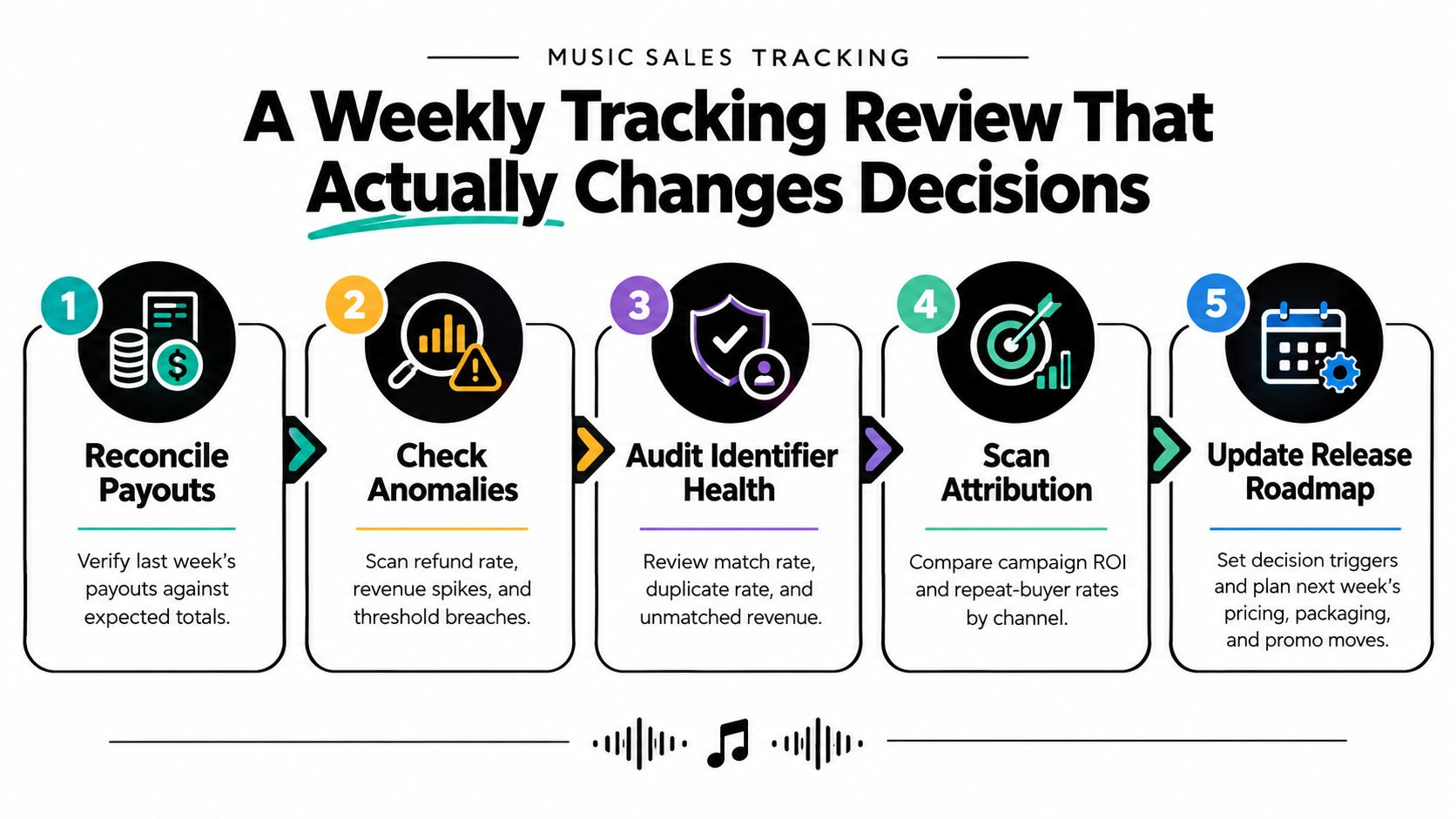
A weekly review should end with a decision, not a prettier dashboard. Set a recurring appointment and work from the latest reconciled reports, marking estimates and delayed statements clearly so you don't confuse a reporting lag with a change in demand.
Use the same review sequence
- Reconcile payouts: Compare reported totals with expected and received amounts. Note missing statements, adjustments, and unresolved differences.
- Check anomalies: Review refunds, chargebacks, abrupt revenue changes, and any threshold you've set for investigation.
- Audit identifier health: Check match rate, duplicate records, and unmatched revenue. Fix metadata problems before they spread across later reports.
- Scan attribution: Compare campaign results by channel, including net receipts and returning buyers where available.
- Update the roadmap: Decide whether to change pricing, packaging, promotion, or the next release's timing and format.
The review can be brief if the data is prepared, but don't rush past a mismatch just to finish the checklist. A platform payment that arrives later than expected isn't necessarily lost income; an unexplained discrepancy that repeats deserves a closer look.
Set triggers that lead to action
Write down what would make you pause a campaign or change an offer. If a promotion produces orders but leaves little margin after costs, reduce spend or test a different package. If a channel brings returning buyers and the margin holds, consider investing more carefully, while watching for concentration risk. When attribution is uncertain, run a small, trackable test rather than committing your whole release budget.
Decision test: Before acting on a chart, ask what you'll change if the number moves. If there's no answer, keep it as context, not a success metric.
A repeatable review turns reports into operating knowledge. It also gives collaborators a shared basis for decisions about offers and promotion, instead of a debate over which screenshot looks most impressive.
Closing the Loop Between Data and the Next Release
Good music sales tracking creates a loop: release, record transactions, reconcile, connect campaigns to purchases, and use the result to shape the next offer. That can influence bundle design, tour routing, pricing, and direct-to-fan messaging, as long as you separate observed sales from estimates and keep costs in view.
There's a useful historical precedent. In the United States, Billboard adopted SoundScan for its album chart in May 1991 and incorporated its sales data into the Hot 100 in November 1991, replacing much of the earlier reliance on retailer-submitted reporting with electronic point-of-sale data (Billboard chart history). The lesson for an independent artist is practical: consistent transaction capture beats anecdotes when you need to know what people bought.
Keep identifiers clean, read statements according to what they measure, tag campaigns you control, and review net revenue alongside retention and concentration. A platform such as OohYeah's music offering can support direct sales and downloads, while the decision-making still comes from disciplined records. Ignore numbers that don't alter a choice, and carry the useful ones into the next release.
OohYeah gives artists a place to offer music, merchandise, and subscriptions directly to fans, alongside sales and download analytics. If you're building a clearer picture of where purchases come from and what you keep after costs, visit OohYeah to explore the platform.