Music Networking Platform Guide for Independent Artists
Learn what a music networking platform does, how to choose one, and how to turn connections into real reach and revenue as an independent creator.

September 26, 2026
Music Marketplace Advisor
Buying & SellingYou post a collaboration request in a Discord server, send the demo by direct message, follow up by email, and lose track of which producer has the latest version. Meanwhile, a promising beat credit disappears beneath a stream of new posts. You have access to other musicians, but access alone doesn't move a song from introduction to release.
That gap defines the modern music networking platform. The useful question isn't which app has the biggest audience. It's which workflow helps you discover the right person, verify that the project fits, agree on terms, finish the work, and connect the result to listeners and revenue.
Why Independent Artists Are Rethinking How They Connect
Independent artists now work across a wide, distributed creator economy. A 2026 industry summary reported that more than 10.4 million independent artists actively release music worldwide, while independent repertoire represents 34.6% of global on-demand streams. The same summary estimated $11.4 billion in global independent music revenue and reported $420 million generated for indie artists through direct-to-fan platforms such as Bandcamp and Patreon. These figures come from the 2026 independent artist statistics summary, and they explain why collaboration infrastructure has become a serious product category rather than a niche convenience.
The problem isn't a shortage of places to meet people. It's that each place handles only part of the job. Instagram may help you notice a vocalist, Discord may support conversation, email may carry a contract, a file-transfer service may hold stems, and a separate marketplace may handle payment. The artist has to act as the project manager, rights administrator, archivist, and follow-up system.
From cold outreach to structured handoffs
Traditional networking often relied on cold emails, backstage introductions, local scenes, and one-off studio sessions. Those channels still matter, but remote work has changed the sequence. A producer in another city can hear your demo today, send a revision tomorrow, and expect a clean handoff without ever entering the same room.
Social platforms aren't designed around that workflow. They optimize for public attention, short interactions, and fan engagement. A working artist needs more than visibility. They need a profile that shows relevant credits, a way to filter collaborators by role and style, a private project space, and a clear record of what each person agreed to deliver.
Practical rule: A connection becomes valuable when both sides can identify the next action, the owner, the deadline, and the commercial terms.
That shift also reflects how artists promote themselves. In a 2025 report, 82.2% of independent artists used Instagram, 75.6% used YouTube, 71.1% used TikTok, 68.9% used Facebook, and 44.4% used X, according to the independent music industry report. Networking, discovery, and promotion now overlap across consumer platforms, but overlap isn't integration. A dedicated music networking platform exists to make the handoff between those activities easier to manage.
What a Music Networking Platform Actually Is
Think of a music networking platform as a trade show floor for working artists. A small manufacturer doesn't attend a trade show only to collect business cards. They look for suppliers, inspect examples, discuss terms, and arrange follow-up. Musicians need the same sequence, adapted for demos, credits, sessions, rights, releases, and audiences.
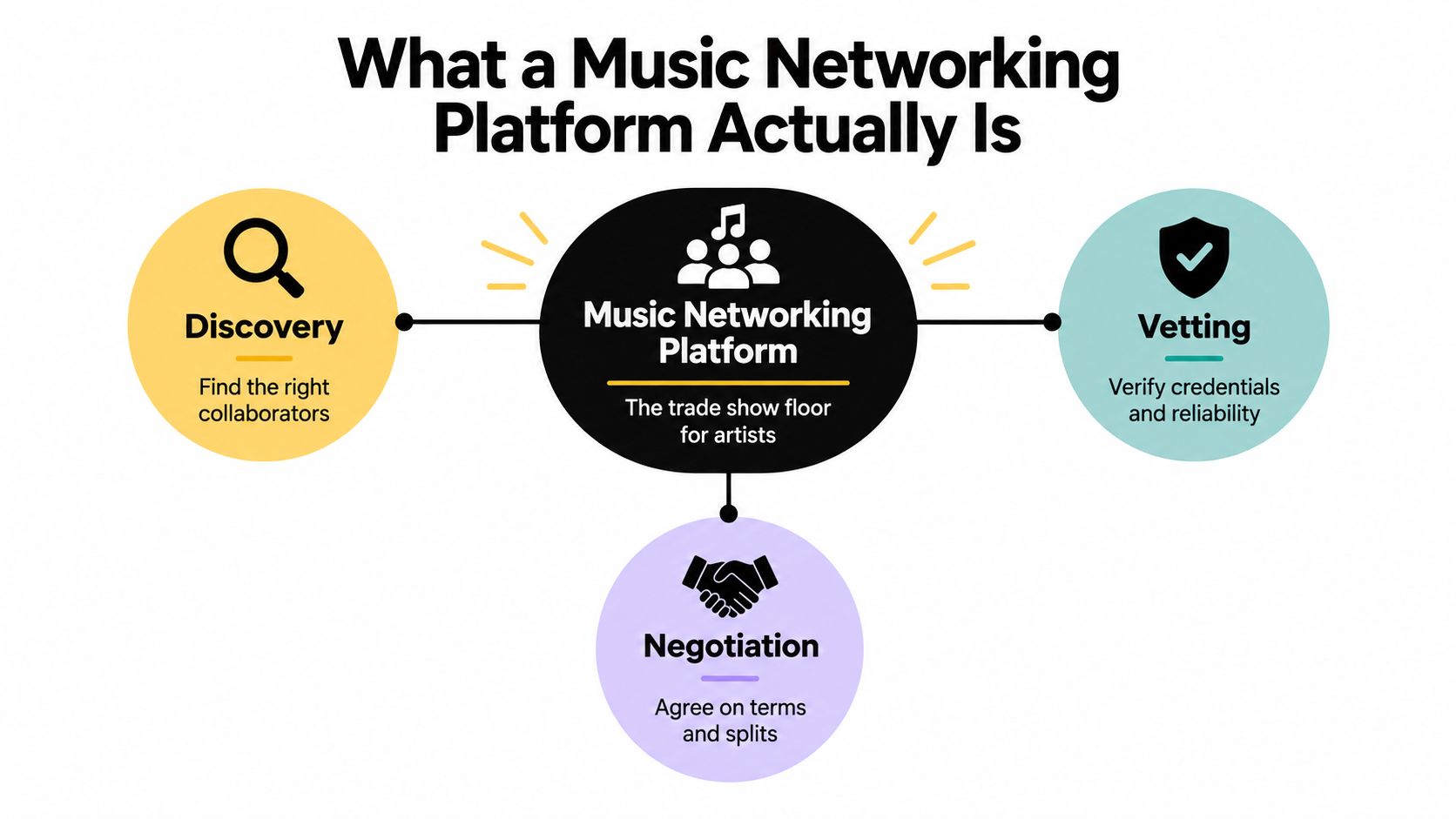
A serious platform usually combines several layers:
- Identity and portfolio: A profile shows your role, genres, credits, availability, services, and selected work. The point isn't to list everything. It's to help the right person decide whether a conversation makes sense.
- Discovery and matching: Search, tags, recommendations, and project briefs help a producer find a vocalist for a specific track rather than browse an undifferentiated social feed.
- Collaboration rooms: Participants can keep demos, stems, notes, revisions, and decisions in one project space. Version control matters because “final_v7_really_final.wav” isn't a reliable system.
- Rights and credits: A useful workflow records writers, producers, performers, ownership discussions, and approval steps before release. It doesn't replace legal advice, but it reduces ambiguity.
- Monetization: Licensing, tips, subscriptions, merchandise, paid services, and split payments connect creative work to a transaction.
- Analytics: Lightweight reporting shows which projects attract attention, which collaborators respond, and which activity produces meaningful listener or buyer action.
This category is not just a social feed with music attached. It is not only a finished-beat marketplace. A marketplace can help you buy a beat, while a networking platform should help multiple people move from a first message to a completed, credited, and potentially monetized track.
The distinction is practical. If you can't tell who owns the latest file, what each person owes, or how the finished work will reach an audience, you have a collection of communication tools, not a complete working environment.
The Core Workflow From Discovery to Income
Consider an independent vocalist with a private demo. She uploads it, keeps it hidden from the public, and labels the project with useful information such as genre, tempo, collaboration role, and whether she's seeking production or licensing. A producer can discover the demo through those filters instead of relying on a lucky post appearing in a crowded feed.
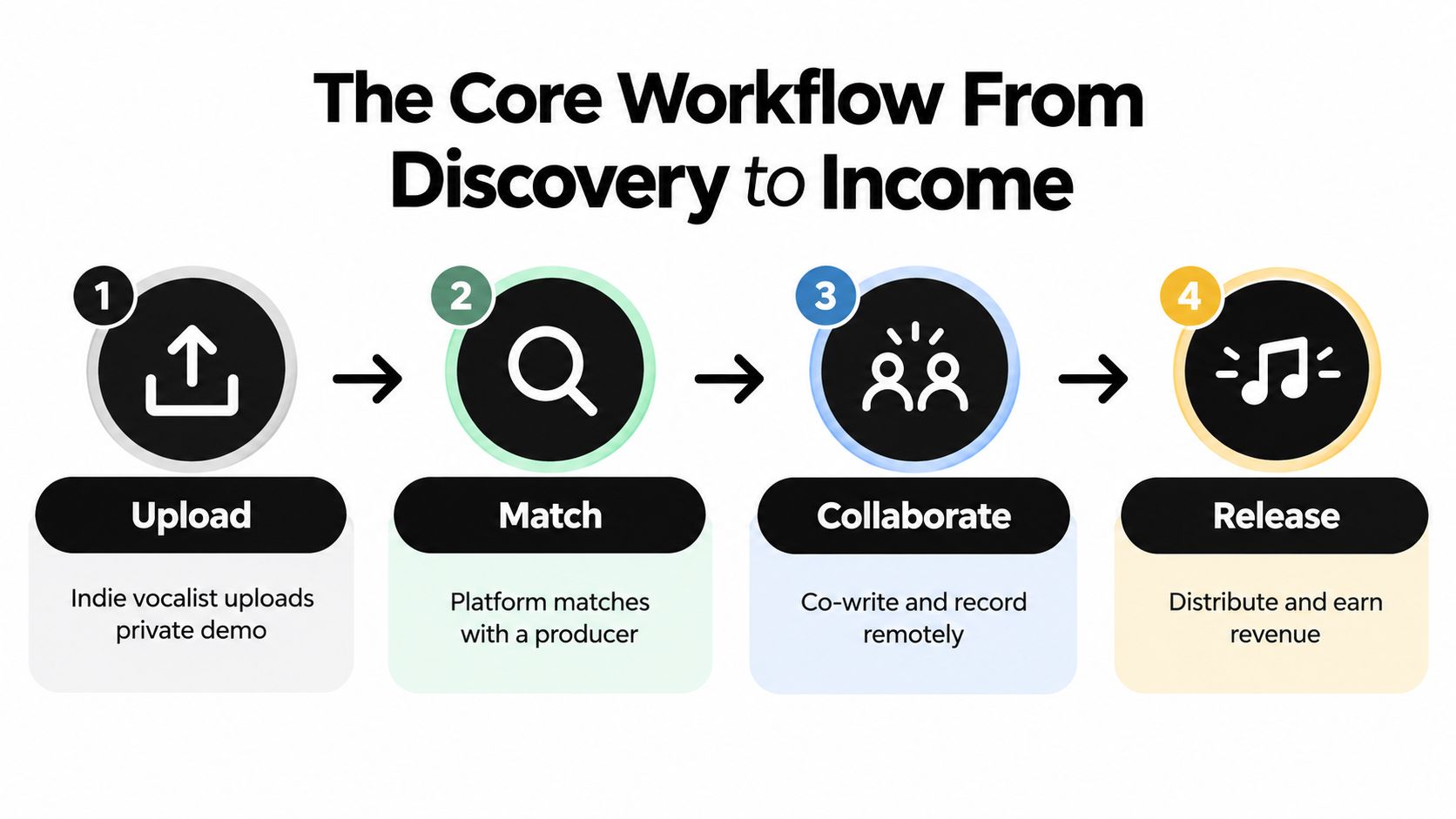
The producer sends a structured request. It identifies the proposed contribution, attaches a reference or stem, and gives the vocalist enough context to accept, decline, or ask for changes. That small amount of structure prevents the familiar exchange where someone writes “let's work” and neither person knows what happens next.
The project room carries the work
Once both creators agree, the conversation moves into a project room. The producer uploads a new beat, the vocalist adds a vocal take, and comments stay attached to specific versions. Notes can refer to a bar, lyric, or section instead of forcing everyone to search through a long message thread.
The room should also surface a draft credit and split discussion early. Rights don't become simpler because collaborators met online. A clear record of proposed ownership, approvals, and contributor roles gives everyone a chance to resolve questions before promotion begins.
Release and commerce close the loop
After approval, the same workflow can support a pre-save campaign, a split-paid royalty pool, and a tip jar. The exact tools vary by platform, but the principle stays constant: the relationship shouldn't end when the file is exported. The release should give listeners a path to stream, support, buy, subscribe, or contact the creators.
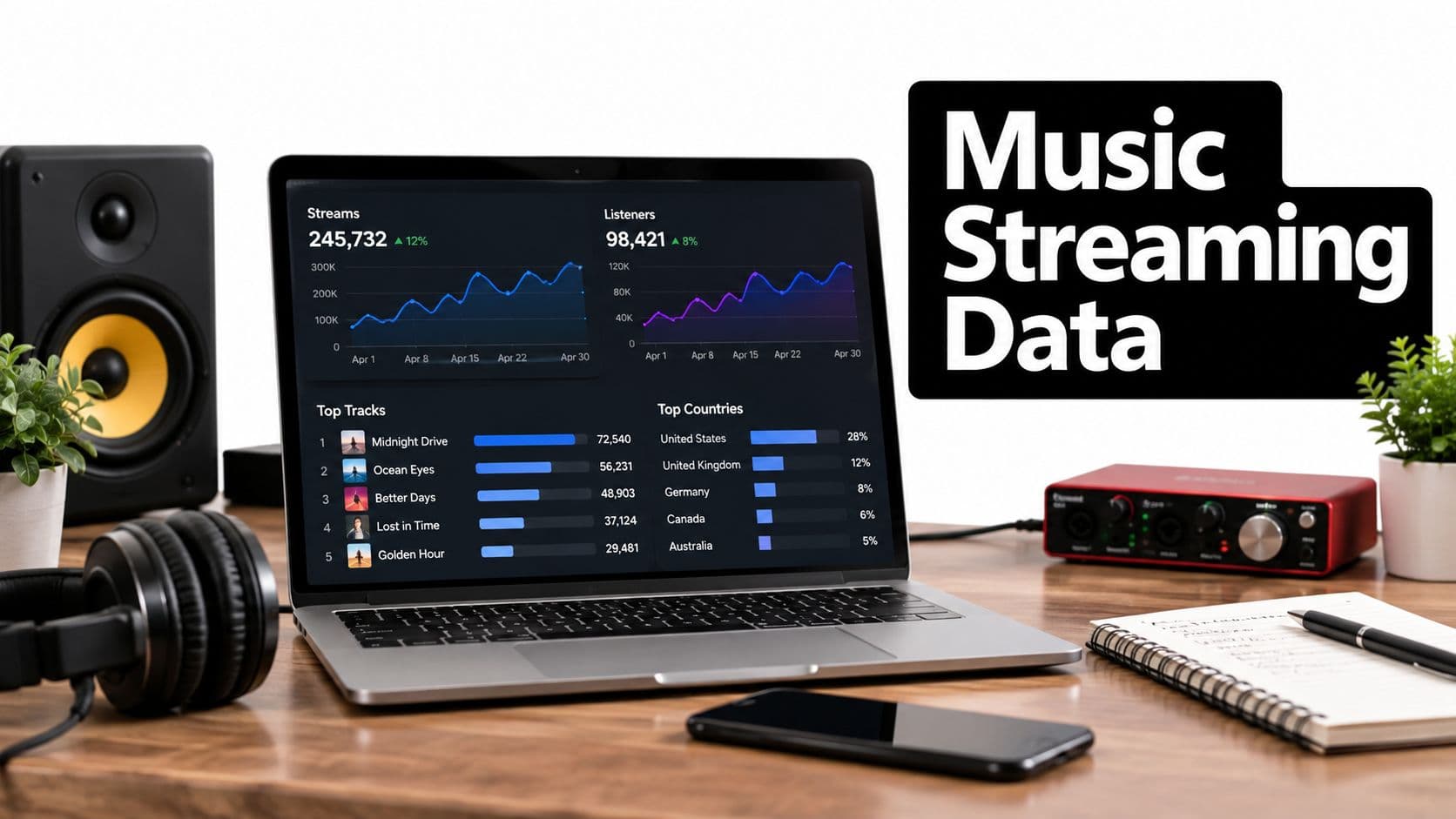
Analytics then connect activity to decisions. The team can review who streamed the track, who shared it, which collaborator generated meaningful saves, and which audience segment responded to the release. Cross-channel measurement matters because independent-music analytics tools increasingly combine streaming and social signals. One industry report says tools such as Chartmetric track more than 40 streaming and social platforms, and it identifies artists and managers as 21.4% of demand in the music data analytics market, as described in the music data analytics market report.
That sequence turns four disconnected tasks into one operating loop:
- Discovery finds a relevant person or project.
- Collaboration gives the team a controlled place to create.
- Commerce connects the finished work to payment.
- Analytics informs the next release or outreach decision.
A platform earns its place in your stack when it preserves that continuity.
Main Types of Platforms Creators Use Today
Most artists don't choose between platforms in the abstract. They choose based on the bottleneck in front of them. The four archetypes below make that decision clearer.
| Archetype | Core Promise | Best For | Main Weakness |
|---|---|---|---|
| Distribution-first | Put music in front of listeners through streaming and discovery channels | Artists with finished releases who need reach | Audience interaction and collaboration may remain shallow |
| Collaboration-first | Help creators exchange ideas, files, feedback, and sessions | Producers, writers, vocalists, and remote teams | A finished project may still need separate promotion and commerce tools |
| Community-first | Create conversation, belonging, and informal discovery | Artists seeking feedback, peers, and long-term relationships | Serendipity doesn't guarantee reliable delivery, rights clarity, or payment |
| Commerce-first | Turn music, services, products, or access into transactions | Creators selling licenses, merchandise, downloads, memberships, or services | A transaction can happen without creating a durable creative network |
Distribution-first platforms
These platforms prioritize delivery, reach, playlist exposure, and listener access. They make sense when your primary task is releasing completed music and understanding how listeners respond. They're less useful when the main problem is finding a co-writer, managing revisions, or agreeing on credits.
Collaboration-first platforms
These tools treat the creative process as the center of the product. You may find project briefs, producer matching, feedback systems, stem sharing, or remote session features. They fit a creator whose next milestone is a finished track, but they may not carry that track into fan conversion.
Community-first spaces
Discord servers, subreddits, forums, and private groups can produce strong relationships because members return for conversation rather than a single transaction. They're valuable when you need a sounding board or want to become known within a scene. Their weakness is operational. Chat can generate trust, but it rarely creates a complete record of deliverables, splits, and payment by itself.
Commerce-first platforms
These platforms focus on selling something, from a beat license to merchandise, a subscription, or a paid service. They suit creators who already know what they're offering. Direct-to-fan models can improve control, but a 2025 academic study of one million Bandcamp sales found highly concentrated purchasing and earnings, with many artists discounting aggressively, as reported in the study of Bandcamp's marketplace. Commerce works better when discovery and analytics help creators reach appropriate buyers and understand pricing behavior.
Your current stack probably occupies one or two boxes. The right next platform should close the gap between them, not duplicate what already works.
How to Choose the Right Platform for Your Goals
Start with one outcome, not a feature list. “Grow my network” is too broad to evaluate. “Find a producer for one release,” “secure paid mixing work,” or “sell a first licensing package” gives you a testable standard.
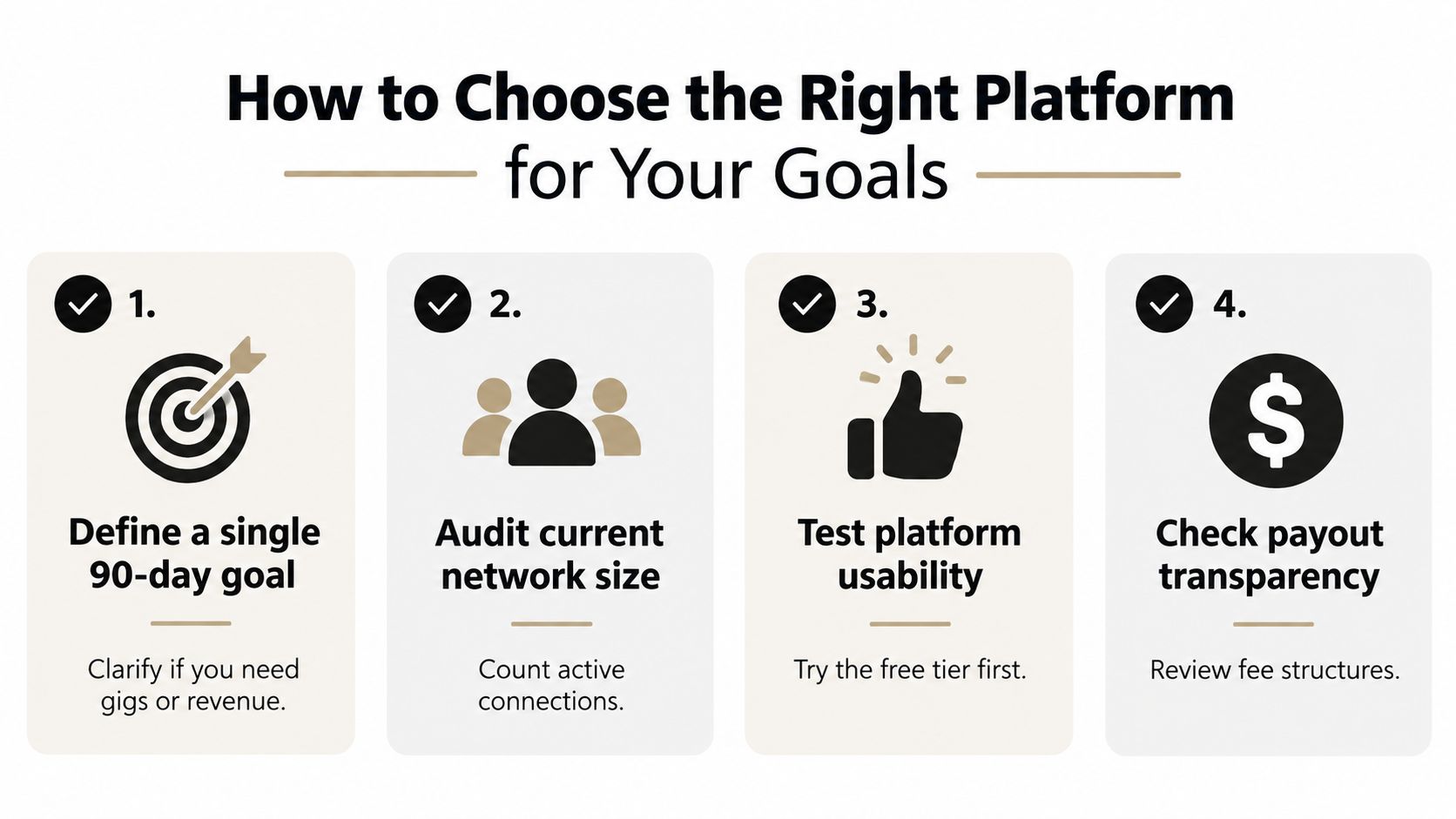
Use four filters
- Define a single 90-day goal. Decide whether you need a collaborator, a release audience, a paid booking, or a direct sale. A platform that excels at one job may be distracting for another.
- Audit your existing stack. List where you currently discover people, exchange files, discuss rights, collect payment, and measure results. Mark every handoff where information gets lost.
- Score workflow fit, retention, and payout clarity. Ask whether a candidate platform supports the work after the introduction, gives people a reason to return, and explains how money reaches the creator.
- Run a two-week test. Use a real brief, not an empty profile exercise. Invite relevant people, publish a small offer, or manage one project. Keep your best content private until the workflow proves useful.
A candidate should answer practical questions. Can you see analytics that change your next action, or only impressions? Can collaborators discuss credits and splits inside the project? Can a customer move from discovering your work to buying it without leaving the experience? If you leave, can you export your contacts, content, and customer relationships?
Choose the platform that removes your most expensive handoff, not the one that offers the longest feature list.
For an artist who wants discovery, direct engagement, selling, and industry connections in one music-focused environment, OohYeah for artists is one option to evaluate. Its stated product scope includes artist profiles, streaming, direct sales, subscriptions, messaging, promotional tools, analytics, and access to music professionals. Treat it like any other candidate: test it against the specific outcome you defined.
Turning Connections Into Real Outcomes
A larger follower count doesn't automatically produce more releases, bookings, or income. The creator may have plenty of contacts and still lack a clear brief, a deadline, an agreed split, or a reason for the other person to return.
The post-intro problem is therefore a workflow and retention problem. A music networking platform should make the second interaction easier than the first, because the second interaction is where a loose connection becomes a project.
Replace vague requests with usable briefs
Don't write, “Want to work?” Give the recipient enough information to make a decision:
- Role: “I need a producer to reshape the chorus and final arrangement.”
- Reference: “The demo leans toward a spacious electronic pop sound.”
- Deliverable: “Please send one rough arrangement and one revision.”
- Timing: “I'm targeting a release window after the mix is approved.”
- Terms: “Let's confirm credits, ownership, and payment before recording.”
A structured prompt respects the other person's time and filters out mismatched interest. It also creates a record that can guide the project if the conversation moves quickly.
Give the network a reason to return
A release cadence doesn't have to mean dropping a complete single every time. Short feedback windows, remix exchanges, vocal challenges, behind-the-scenes clips, and private previews can keep a relationship active while the main project develops. Each activity should lead somewhere specific, such as a review request, a collaboration invitation, or a release action.
Attach one next step to every interaction. That might be a pre-save link for a listener, a paid stem pack for a producer, or a booking inquiry for a promoter. OohYeah's music marketplace is designed around profiles, music-related offers, professional connections, and transactions, giving a creator one place to present an offer instead of scattering the path across messages and storefronts.
The test is simple: after someone replies, can both sides identify what happens next without opening another app? If not, the platform is helping you collect contacts, not build outcomes.
Measuring Whether the Platform Is Working for You
You don't need a complex dashboard to judge a networking platform. Start with four measures you can record in a small weekly log:
- Profile-to-message rate: How often does a relevant profile visit lead to a message?
- Qualified responses within 14 days: How many replies come from people who fit the role, genre, or commercial need?
- Collaborations that produce a released track: Count completed releases, not promising conversations.
- Revenue from platform-sourced leads: Record income from a person or buyer who found you through the platform.
Track these measures over a rolling 90-day window. The window helps you avoid judging the platform from one quiet week or one unusually active release period. Follower and impression counts can provide context, but they're vanity metrics until they connect to conversations, completed work, or money.
Two tests for a serious decision
The network effect test asks whether the platform begins producing inbound interest without constant manual outreach. The practical benchmark in the plan is three inbound inquiries weekly within three months, but treat it as a diagnostic target rather than a universal promise. If you aren't approaching it, examine profile clarity, offer specificity, and the relevance of your discovery settings.
The financial test asks whether platform-sourced income can cover the subscription within six months. If your goal isn't direct revenue, replace that test with a release or collaboration target. The point is to compare the platform with the job it was hired to do.
| Failure mode | First metric to inspect | Likely adjustment |
|---|---|---|
| Low response rate | Qualified responses within 14 days | Narrow the brief and improve portfolio evidence |
| Collaborations stall | Completed tracks | Add milestones, version rules, and an approval deadline |
| Paid work is missing | Revenue from platform-sourced leads | Clarify the offer and add a direct next action |
Your Next Step in the Music Networking Stack
A music networking platform isn't valuable because it resembles a busy meet-and-greet. Its value comes from connecting discovery, collaboration, monetization, and measurement in a workflow that people can repeat.
Five principles should guide your decision:
- Treat networking as a transaction system. The objective is a completed creative or commercial outcome.
- Judge continuity, not isolated features. Discovery matters more when it leads into a project room, a clear agreement, and a release or sale.
- Use the four archetypes to locate the bottleneck. Distribution-first, collaboration-first, community-first, and commerce-first tools solve different problems.
- Test workflow before committing content. A two-week trial with a real brief reveals more than a polished product tour.
- Keep the measurement honest. Review qualified replies, completed releases, and sourced revenue across a rolling 90-day period.
If you need a collaborator this month, shortlist two collaboration-oriented platforms and run a defined trial. If you need reach, choose a distribution workflow that combines audience access with actionable analytics. If you need revenue, prioritize clear contracts, split payments, direct offers, and a route from audience discovery to checkout.
For creators who want to examine an integrated music ecosystem rather than add another isolated tool, start with OohYeah. Before you sign up, write one sentence naming the collaboration outcome you want within 30 days, one sentence identifying the workflow gap blocking it, and one sentence naming the platform archetype that should close that gap. Then measure whether the tool helps you move from hello to a finished, credited, and paid result.
OohYeah brings artist profiles, streaming, direct sales, subscriptions, messaging, marketplace activity, professional discovery, and analytics into a music-focused ecosystem. Visit OohYeah to test whether its workflow can turn your next music connection into a clear collaboration or commercial outcome.