Music Industry Contract Templates Explained
Navigate your music career with our guide to music industry contract templates. Understand key agreements, clauses, and legal best practices before you sign.
October 4, 2025
Music Marketplace Advisor
Buying & SellingMusic industry contracts can feel intimidating, loaded with legal jargon that seems designed to confuse. But at their core, these templates are simply standardized agreements that map out the rights, responsibilities, and—most importantly—the money between artists, labels, producers, and everyone else involved.
Think of them less as restrictive paperwork and more as the essential blueprint for your professional music career.
Why Music Contract Templates Are Your Career Blueprint
Trying to build a career in music without solid contracts is like hitting the road for a cross-country tour without a GPS. You might get somewhere, but you’ll probably get lost, run out of gas, and end up in some very strange places. Music contract templates provide that critical direction, spelling out the exact terms of every professional relationship you form.
These documents are the bedrock of your business. They protect your creative output, make sure you get paid fairly, and set clear expectations for how you’ll work with others.
But here’s the crucial part: a template is just a starting point. Grabbing a generic agreement off the internet and signing it without a second thought is a massive gamble. Every deal has its own quirks, and a one-size-fits-all contract can lock you into bad terms on royalties, ownership, or long-term commitments. The real power is knowing how to take that blueprint and tailor it to your specific project.
Building a Foundation for Success
Your contracts are the framework of your career. Just like a builder wouldn't pour a foundation without a solid architectural plan, you shouldn't release a single note without a well-defined agreement in place. This guide will walk you through the most common contracts and their key components, giving you the knowledge to build a career that lasts.
Getting comfortable with these documents is about more than just legal CYA; it's about developing serious business savvy. It gives you a real-world understanding of how the music industry works, from how royalties are actually collected to who owns what.
A great song can make you a star, but a great contract can ensure you have a career. Understanding the terms of your agreements is non-negotiable for long-term success and financial security in the music world.
To get a better feel for how these documents are structured, it's helpful to look at legal agreements in a broader context. You can see some strong examples in roundups of the 10 best templates for legal documents, which cover a range of professional and personal situations. Once you recognize the core building blocks of any legal template, you'll be much better prepared to tackle the specifics of music industry deals and make sure every signature pushes your career forward.
The Four Core Music Contracts You Need to Know
Diving into the music business can feel like trying to read a foreign language, especially when legal documents are involved. But don't let that intimidate you. At the end of the day, most deals come down to just four foundational types of contracts. Getting your head around these is the first real step toward protecting your music and building a career that lasts.
Think of these agreements like tools in a toolbox. Each one is built for a specific job. You wouldn't use a wrench to hammer a nail, and you wouldn't use a publishing contract to hire a manager. Knowing which tool to grab for the right situation gives you a massive leg up in any negotiation.
1. The Recording Agreement
This is the big one—the contract most artists dream of signing. A Recording Agreement, or "record deal," is the legal handshake between an artist and a record label. Its whole purpose is to lay out how the label will fund, create, distribute, and promote your actual sound recordings (the “masters”).
In return for their investment of time and money, the label typically takes ownership of those master recordings, sometimes for a specific term, but often forever. The artist gets a slice of the profits called a royalty, but here's the catch: you won't see a dime until the label has made back all the money it spent on you (the advance). It's the cornerstone document that decides how your recorded music is made and gets out into the world.
2. The Publishing Agreement
A recording agreement is all about the recording of a song. A Publishing Agreement, on the other hand, deals with the song itself—the underlying melody and lyrics, which is legally known as the “composition.” This contract is between a songwriter and a music publisher.
The publisher’s role is to find ways to make money from that composition. This includes:
- Securing placements in films, TV shows, games, and commercials (this is called sync licensing).
- Collecting royalties every time the song is played on the radio, streamed online, or performed live.
- Pitching the song to other artists to record their own cover versions.
The songwriter gives the publisher a percentage of their copyright in exchange for these services, often getting an advance against future earnings. For any songwriter, this is an absolutely essential agreement to understand.
This infographic breaks down the core components that you'll find in almost any music industry contract.
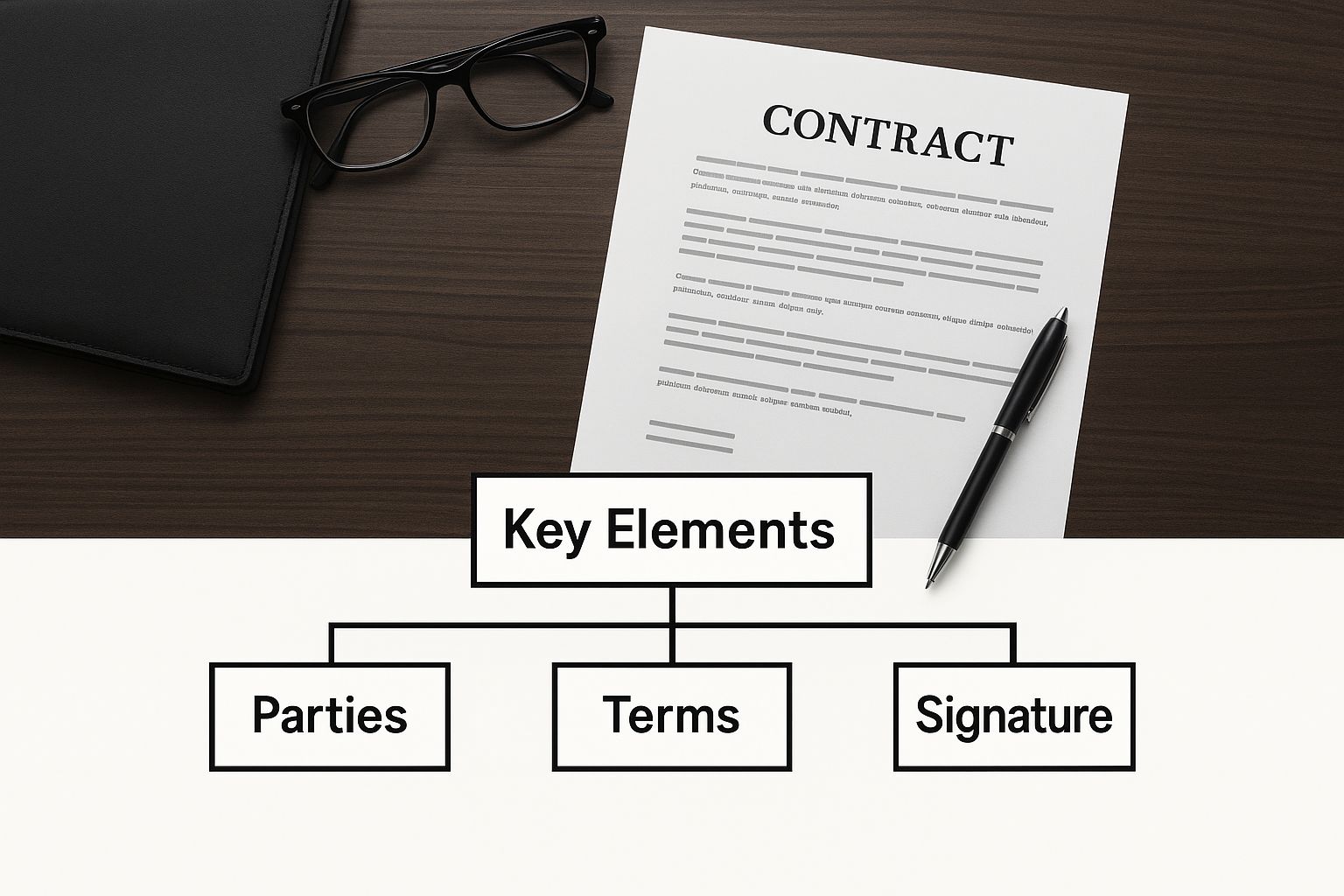
While the specifics change from deal to deal, you can see that fundamental ideas like clear terms, payment structures, and rights ownership are the universal building blocks.
3. The Management Agreement
If you're an artist, your manager is essentially the CEO of your career. The Management Agreement makes that critical partnership official. It spells out exactly what the manager is expected to do and how they get paid—usually a commission of 15-20% of the artist's gross income from all entertainment-related activities.
A great manager is more than just a booking agent; they are a strategic partner who helps you make smart career moves, builds your professional team, and chases down new opportunities. This contract needs to be crystal clear about how much authority they have and how long the deal lasts.
4. The Producer Agreement
Last but not least, we have the Producer Agreement. This contract governs the relationship between an artist and their record producer. It details the producer's creative responsibilities, the deadlines for delivering the finished tracks, and—most importantly—how they get paid.
Producers typically get compensated in two ways: a flat fee upfront and a small percentage of the artist's royalties, known as "points." This agreement is also where the crucial negotiation over who owns the master recordings happens, ensuring the creative force behind the soundboard gets their fair share.
How Advances and Royalties Actually Work
Let's pull back the curtain on the financial engine that drives most recording contracts. At the very core of nearly every record deal, you’ll find two terms that can make or break an artist's career: advances and royalties. Getting a handle on how these two concepts dance with each other is absolutely essential for your long-term financial survival.

Think of an advance as a business loan the record label extends to you. It’s not a gift. It’s a pre-payment against your future earnings, handed to you upfront to cover things like recording costs, marketing, tour support, and sometimes even just to help you pay rent while you create.
The single most important word you need to burn into your memory here is recoupable. Every single dollar the label spends on you—from paying the producer to funding that flashy music video—gets added to a running tab. You won't see a dime in royalty payments until your share of the music's revenue pays back this entire "loan."
The Recoupment Process Explained
This is where the dream can get a little messy. It’s entirely possible to have a song all over the radio and be playing to sold-out crowds every night, yet still be technically in debt to your label. If your royalty earnings haven't "recouped" that initial advance plus all the other associated project costs, the money isn't flowing to you yet.
Royalties are the percentage of income you earn from sales and streams. The exact rate is always a huge point of negotiation, but you have to look beyond the headline number. A 15% royalty might sound fantastic, but it's often calculated after the label has deducted a whole laundry list of expenses from the gross income.
A hit album doesn't automatically mean a rich artist. If a label sinks $500,000 into launching your record, your royalty checks are first used to chip away at that $500,000 balance before any money ever finds its way to your bank account.
How Advances Scale with Success
This financial structure is woven into the history of the music business. In a classic record deal, an artist gets an advance to make a record, and that money must be paid back from future royalties. For instance, a deal might offer a $50,000 advance for a debut album, with that figure climbing to $85,000 by the fourth album, but only if the previous records performed well.
The system is designed to tie future investment directly to past performance. The label won't fund your next project until your royalty earnings have surpassed 100% of the previous advance. It’s a built-in incentive for artists to generate enough revenue to get back in the black.
If that first album doesn't recoup, the label may be unwilling to fund a second, which can stall a career before it even gets going. But when you understand these mechanics, you can negotiate smarter terms and make better decisions to build a sustainable career. This is all closely tied to other income streams, too; you can learn more by reading our guide on understanding music licensing and how it can boost your revenue.
Understanding Your Royalties in the Streaming Era
The way we listen to music has completely transformed, and your contract needs to reflect that reality. Old-school agreements were built for a world of physical products—CDs, vinyl, and tapes. Today, your money comes from a dizzying number of streams and downloads, which makes the fine print in your music industry contract templates more critical than ever.
It really boils down to one crucial difference in how your contract defines a transaction. You'll either see a traditional "Records Sold" clause or a more modern "Masters Licensed" clause. This might seem like a tiny detail buried in legal jargon, but the impact on your bank account is enormous.
Records Sold vs. Masters Licensed
Think of a "Records Sold" clause as a holdover from the past. It treats every digital transaction as if it were a physical sale, typically paying the artist a royalty rate of 12-20% of the net revenue. It’s a model built for a product leaving a warehouse shelf, not a file being streamed across the globe.
A "Masters Licensed" clause, on the other hand, gets it right for the digital age. It correctly views a stream or download as what it actually is: a license for a service like Spotify or Apple Music to use your master recording. With this language, the artist’s split of the net receipts is often much, much higher—frequently 50%.
This isn't just a minor footnote in your contract; it's a career-defining negotiation. The simple choice between the words "licensed" and "sold" can literally cut your digital income in half.
A famous lawsuit involving Eminem brought this issue into the spotlight. His early contracts had a "Records Sold" clause that paid his production company just 12-20% on physical sales. But a different "Masters Licensed" provision in the same agreement entitled them to a 50% split when masters were licensed to third parties—like for downloads on iTunes. You can dive into the specifics of this landmark legal battle in this in-depth case study.
Why This Language Is a Game-Changer
When a single track can generate revenue from hundreds of different sources, you have to make sure your contract uses licensing language for digital uses. A download isn't a "sale" in the traditional sense; it's a license for someone to use a digital copy of your work. A stream isn't a sale at all; it's a temporary license for a public performance.
Your agreement has to get this right. Without the correct wording, you’re practically guaranteed to leave a huge amount of money on the table. Scrutinizing this part of any music industry contract template is one of the most important things you can do to protect your financial future.
The Critical Contract Clauses You Can't Afford to Skim
It's easy to get fixated on the big numbers—the advance, the royalty split. While those are obviously important, the real make-or-break details of any music deal are buried in the less glamorous clauses. Think of these as the engine of the contract; they dictate how everything actually works long after the ink is dry.
These are the operational rules of the road for your partnership. They cover the who, what, when, where, and how of your relationship with a label, publisher, or manager. Getting a handle on them is how you turn a standard agreement into a deal that genuinely protects your career.
Term and Territory
First up are two of the most foundational pieces of any agreement: the Term and the Territory. The Term is simply the length of the contract. How long are you committed? Is it a fixed number of years? Or is it tied to delivering a certain number of albums or projects? You need to watch out for language that gives the other party the sole power to extend the term over and over.
The Territory clause defines the geographical reach of the deal. In our hyper-connected world, most major labels will want a "worldwide" or even "universe" territory. That makes sense, but you need to be crystal clear on what that scope means for your music, where it can be sold, and how royalties will be collected from different regions.
Controlled Composition and Key Person Clauses
Now for a clause that directly hits your wallet as a songwriter: the Controlled Composition Clause. This one can be a bit tricky, but it's crucial. In short, it often lets a record label reduce the mechanical royalties they pay you for songs you wrote or co-wrote on your own album. For example, it's common to see a label pay only 75% of the full statutory mechanical royalty rate. They might also cap the number of songs they'll pay royalties on, often limiting it to just ten tracks per album.
Another clause that acts as a career safety net is the Key Person Clause. Imagine the A&R exec who believed in you, signed you, and championed your project suddenly leaves the label. What happens then? This clause protects you by giving you the option to leave the contract if that specific "key person" is no longer in your corner.
Your right to audit is your power to hold your partners accountable. It ensures that the accounting statements you receive are a true reflection of your earnings, giving you the ability to verify the numbers and claim any unpaid royalties.
Audit Rights and Legal Language
Finally, never, ever sign a contract that doesn't include strong Audit Rights. This is your right to bring in an accountant to go over the company's books and make sure their royalty statements are accurate. Without it, you have no real way to dispute what they send you, even if you suspect errors or underpayment. These clauses are fundamental for how to protect your music rights online and in the physical world.
Ultimately, getting comfortable with contract language is a skill that will serve you your entire career. Understanding how to read the fine print in all sorts of legal documents, even something as standard as general terms and conditions, makes you a much better advocate for yourself. The more you know, the more power you have to shape a standard template into a blueprint for your own success.
When to Customize a Template or Hire a Lawyer

A music industry contract template is an excellent starting point, but that's all it is—a start. Think of it like a quality, off-the-rack suit. It provides a solid foundation, but you’d never wear it to a major event without getting it tailored to fit you perfectly. Customization is how you turn a generic document into a shield that truly protects your career.
Before you even think about signing, you need to zero in on the key points that will shape your creative freedom and your bank account. Don't ever be afraid to ask for better terms.
From my experience, these areas almost always have some wiggle room:
- Royalty Bumps: Can you negotiate a higher percentage once you hit certain sales or streaming numbers? This is a common way to reward success.
- Creative Control: Who has the final say on the album art, the tracklist, or the music video concepts? Your art is your brand, so you need to protect it.
- Marketing Commitments: What is the label actually committing to? A specific marketing budget or a detailed promotional plan is far better than a vague promise.
- Ownership Reversion: This is a big one. Is it possible for the rights to your masters to return to you after a set number of years?
Knowing When to Call in the Pros
Look, for a simple collaboration agreement with a friend, you might get by with a carefully customized template. But there are very clear moments when trying to go it alone becomes incredibly dangerous. Navigating a major record deal without a lawyer is like performing surgery on yourself—it’s a terrible idea that almost never ends well.
An attorney's fee isn't just an expense; it's an investment in the long-term health of your career. They're not just reading the words on the page. They're looking for what isn't there and protecting you from the traps you can't see yet.
You absolutely need a lawyer when the stakes get high. Here are the non-negotiable situations:
- A significant advance is on the table. Any deal involving serious money requires a professional to make sure the recoupment terms are fair and won't bury you in debt.
- You're signing away ownership. Handing over the copyright to your masters or publishing is a massive, often permanent decision. You need someone who understands the full gravity of that choice.
- The contract has a long term. If you're committing to multiple albums or a period of several years, you need an expert to build in protections, performance clauses, and potential exit strategies.
A seasoned music attorney has seen it all. They know the industry standards inside and out and can spot a bad clause from a mile away, ensuring the blueprint for your career is built on solid rock, not sand.
Your Top Questions About Music Contracts, Answered
If you're diving into the world of music contracts, you're bound to have some questions. It's a complex area, and getting clear on the fundamentals is the best way to protect your art and your career. Think of this as your starting point for making smarter decisions.
Let's break down some of the most common questions artists ask when they're faced with one of these agreements.
Can I Use a Free Music Contract Template?
The short answer is yes, but you have to be incredibly careful. A free template you find online can be a decent starting point—it helps you get familiar with the basic structure and terminology of a music deal. But that's where its usefulness ends.
These documents are one-size-fits-all, which means they fit no one perfectly. They often miss crucial details specific to your genre, your location's laws, or the unique aspects of your agreement. Using one as-is is a massive gamble. It might be missing key protections or include language that could hurt you down the road.
Treat a free template as a study guide, not the final exam.
What's the Single Biggest Mistake Artists Make?
It's simple: signing a contract without understanding every single word. It happens all the time. An artist gets excited about the advance or the royalty percentage and completely glosses over the rest.
They don't dig into the term length, the controlled composition clause, or their rights to audit the label's books. This is a critical error that can lead to you losing control of your masters, being stuck in a bad deal for a decade, or leaving a ton of money on the table. Every sentence is there for a reason.
Never forget that a "standard" contract is standard for the label, not for you. It's written to protect their interests first. Your job—or better yet, your lawyer's job—is to push back and revise it to protect yours.
How Much Does a Music Lawyer Actually Cost?
There's no single price tag, as legal fees can vary quite a bit. Many experienced music attorneys bill by the hour, with rates anywhere from $250 to over $1,000, depending on their reputation and location.
Another common arrangement is for a lawyer to take a percentage of the deal itself, usually around 5% of your advance. Sometimes it’s a mix of both. It might feel like a big upfront cost, but a sharp lawyer almost always pays for themselves by negotiating better terms, a bigger advance, or a more favorable royalty structure.
How Do I Get Out of a Bad Recording Contract?
Getting out of a recording contract is notoriously tough. These are ironclad legal documents for a reason—the label is protecting its financial investment in you.
Your main way out is to prove the label has breached the agreement. For instance, did they fail to release your album as promised? Or have they not paid you the royalties you're owed? Some contracts might also have a "Key Person" clause, where you can leave if the executive who signed you departs.
Barring a clear breach like that, your only real option is to negotiate an exit, which is a battle you absolutely do not want to fight without a seasoned attorney in your corner.
Ready to build your music career on your own terms? OohYeah gives you the platform to sell your music, merchandise, and fan subscriptions directly to the people who matter most, all commission-free. Sign up at OohYeah today and start taking control.