Mastering Music Distribution Deals for Artists
Unlock your music's potential with this guide to music distribution deals. Learn how to navigate terms, choose partners, and secure the best deal.
October 7, 2025
Music Marketplace Advisor
Buying & SellingSo, you’ve poured your heart and soul into creating your music. The tracks are mixed, mastered, and ready to go. Now what? How do you get your songs from your studio computer into the ears of listeners around the world?
This is where music distribution deals come in. Think of them as the essential bridge connecting your finished art to a global audience. Without a distribution partner, your music is stuck on your hard drive. These agreements are the engine that gets your tracks onto platforms like Spotify and Apple Music, and they handle the complicated business of collecting the money you earn.
Breaking Down Music Distribution Deals

At its most basic, a distribution deal is the logistics network for your music. Let's use an analogy: imagine you’ve just created a brilliant new hot sauce in your kitchen (your studio). You know people will love it, but you need a way to get it onto the shelves of every grocery store and restaurant in the country (Spotify, Apple Music, etc.). A distributor is the company with the trucks, the connections, and the know-how to pick up your sauce, make sure it’s labeled correctly, and deliver it to all those different stores.
In the music business, this "delivery" is more than just a simple upload. Distributors are responsible for formatting your audio files and artwork to meet the strict technical specs of each individual platform. They also manage all the metadata—the critical behind-the-scenes info like artist name, track title, ISRC codes, and genre tags—that ensures your music shows up correctly and gets discovered by the right fans.
The Financial Side of Distribution
One of the most crucial jobs a distributor has is collecting and paying out your royalties. Every time your song gets streamed, a tiny fraction of a cent is generated. That doesn't sound like much, but a good distributor aggregates all those micropayments from hundreds of different services all over the world and puts them into your bank account. This financial relationship is exactly why choosing the right deal can make or break your ability to build a sustainable career.
The digital music world is a massive, multi-billion dollar industry, but it's also incredibly crowded. The global music streaming market is projected to hit $62.3 billion in the next year, and Spotify alone is expected to pay out over $9 billion to rights holders. The tough reality, however, is that an estimated 90% of those royalties go to just the top 5% of artists. This highlights just how important it is to have a strategy. You can discover more insights about music streaming statistics to get a clearer picture of the market you're stepping into.
A music distribution deal isn't just a service; it's a foundational partnership for your career. It determines not only where your music is heard but also how—and if—you get paid for your art.
Core Components You Need to Understand
Before you start comparing different types of deals, you need to get a firm grip on the basic building blocks. Understanding these key terms will give you the power to properly evaluate any offer that comes your way and make a decision that’s right for you.
To help you out, here’s a breakdown of the most important parts of any distribution deal.
Key Components of a Music Distribution Deal at a Glance
| Component | What It Means for You | Why It's Critical |
|---|---|---|
| Reach | The network of stores and streaming platforms (DSPs) where the distributor can send your music. | Wider reach means more potential listeners, but you need to ensure it includes the platforms your target audience uses. |
| Royalties | The split of earnings. It defines the percentage you keep versus what the distributor takes as a fee or commission. | This directly impacts your income. A "good" deal can range from a flat annual fee to a 15-20% commission, so know the numbers. |
| Rights | Who owns the master recordings of your songs. | This is non-negotiable for most independent artists. You should always retain 100% of your rights. If a deal asks for them, it's likely a label deal in disguise. |
| Term | The length of the contract and the specific conditions for ending the agreement. | You need to know how long you're locked in and what the process is for leaving if the partnership isn't working out. Look for flexibility. |
Getting comfortable with these four pillars is your first step toward confidently navigating the world of music distribution deals. Each one carries serious weight and will shape both your creative freedom and your financial future.
What Kind of Distribution Deal is Right for You?
Trying to figure out music distribution deals can feel like picking a car for a road trip. Are you looking for a simple, reliable ride that you drive yourself, or do you need a full-on tour bus with a professional driver and crew? Both get you where you're going, but the experience, the cost, and the amount of help you get along the way are worlds apart.
It’s the same with getting your music out there. No two deals are exactly alike, and the best fit for you hinges on where you are in your career, what you want to achieve, and how much you can invest. Let's break down the main options so you can make a smart move for your music.
The DIY Aggregator Model
Think of a DIY aggregator as the self-serve option. This is the world of companies like DistroKid, TuneCore, and CD Baby, and it's the most common starting point for independent artists. Their job is pretty straightforward: take your music and get it onto hundreds of streaming services and online stores, from Spotify to Apple Music, for a simple, flat fee.
This whole model is built for artists who need an easy, affordable way to get started. You usually pay either a yearly subscription for unlimited uploads or a small fee for each release. The biggest perk? You almost always keep 100% of your royalties.
What to expect from a DIY aggregator:
- Low Cost: They’re very budget-friendly, often just a flat annual fee or a small one-time charge per single or album.
- Total Control: You’re in the driver’s seat. You handle your own releases, upload your artwork, and manage all the details.
- Keep Your Earnings: You get to keep all, or nearly all, of the money your music makes from streams and sales.
- Hands-Off Support: This is a transactional service. They deliver your music efficiently, but you shouldn't expect them to help with marketing, playlist pitching, or career advice.
This route is perfect for new artists who just want to get their music out into the world without breaking the bank. It lets you build your catalog and learn the business while keeping full ownership of your work.
Full-Service and Label Services Distribution
Once you start getting some real momentum, you might find you need more than just basic delivery. That's where full-service or label services distributors step in. Companies like AWAL or The Orchard are in this category, and they operate more like strategic partners than a simple self-serve platform.
Getting a deal with one of these distributors isn't automatic. They're selective. You'll need to show them you have an established track record, a growing fanbase, and real potential to succeed commercially. In return for their expertise and hands-on support, they take a percentage of your royalties—typically somewhere around 15-20%.
Think of this model as a true partnership. A full-service distributor invests their time, team, and industry connections into your success, because when you make money, they make money. It’s a completely different relationship.
These deals come with powerful extras you won’t find with a DIY aggregator:
- Real Marketing and Promotion: You get access to a team that can help with digital ad campaigns, social media strategy, and building a proper release plan.
- Playlist Pitching: They have direct lines to the editorial curators at major streaming services, giving your music a legitimate shot at landing on big playlists.
- Sync Licensing Opportunities: Their teams actively work to place your music in movies, TV shows, commercials, and video games.
- Deeper Analytics: You get access to sophisticated data that helps you truly understand your audience and pinpoint opportunities for growth.
This approach is tailor-made for artists who have built a solid foundation and are ready to scale up, all while staying independent. If you want to explore this path further, our guide covers the best strategies for independent music distribution in much more detail.
The massive rise of independent artists has supercharged this part of the industry. The global Music Distribution Services market is on track to hit around $3705 million in the next few years, a huge leap from its recent valuation of $2528.73 million. This boom is driven by artists like you who are looking for powerful ways to connect with fans around the world on their own terms. You can dig into more data on the growth of the music distribution market to see just how fast things are changing.
Decoding The Terms Of Your Agreement
Let's be honest, staring at a contract filled with dense legal jargon can be intimidating. But your music distribution deal is one of the most foundational documents you'll sign in your career. Getting a handle on its core components isn’t just a good idea—it's absolutely essential for protecting your art and your income.
Think of the agreement as the official rulebook for your new partnership. It lays out the expectations, financial splits, and what happens to your music once it's in their hands. Skimming over a single clause can have ripple effects for years, so let's break down the most critical terms into plain English.
Grasping The Core Contract Clauses
Every distribution agreement, whether it's a simple one-click signup on a DIY platform or a thick document from a major partner, hinges on a few key concepts. These are the terms that define the scope—and the limits—of your deal.
- Term Length: This is simply how long the contract lasts. It dictates the period your distributor has the right to manage your music. Terms can be as short as one year or stretch for several, and you have to watch out for auto-renewal clauses that lock you in again if you don't give proper notice.
- Territory: This clause specifies where in the world the distributor can release your music. Most digital distributors work on a "worldwide" basis, but it's always smart to double-check, especially if you have a regional strategy in mind.
- Exclusivity: An exclusivity clause is standard practice, and it just means you can't use another distributor for the same music during the agreed-upon term and territory. You just need to be fully aware of what you're committing to before you sign on the dotted line.
Be extremely wary of the word "perpetuity." If you see this in your term length, it means the distributor has the rights to your music forever. This is a massive red flag in any modern distribution deal and should be a deal-breaker.
This infographic gives you a great visual snapshot of how different deal structures stack up in terms of fees and what you can expect to keep.
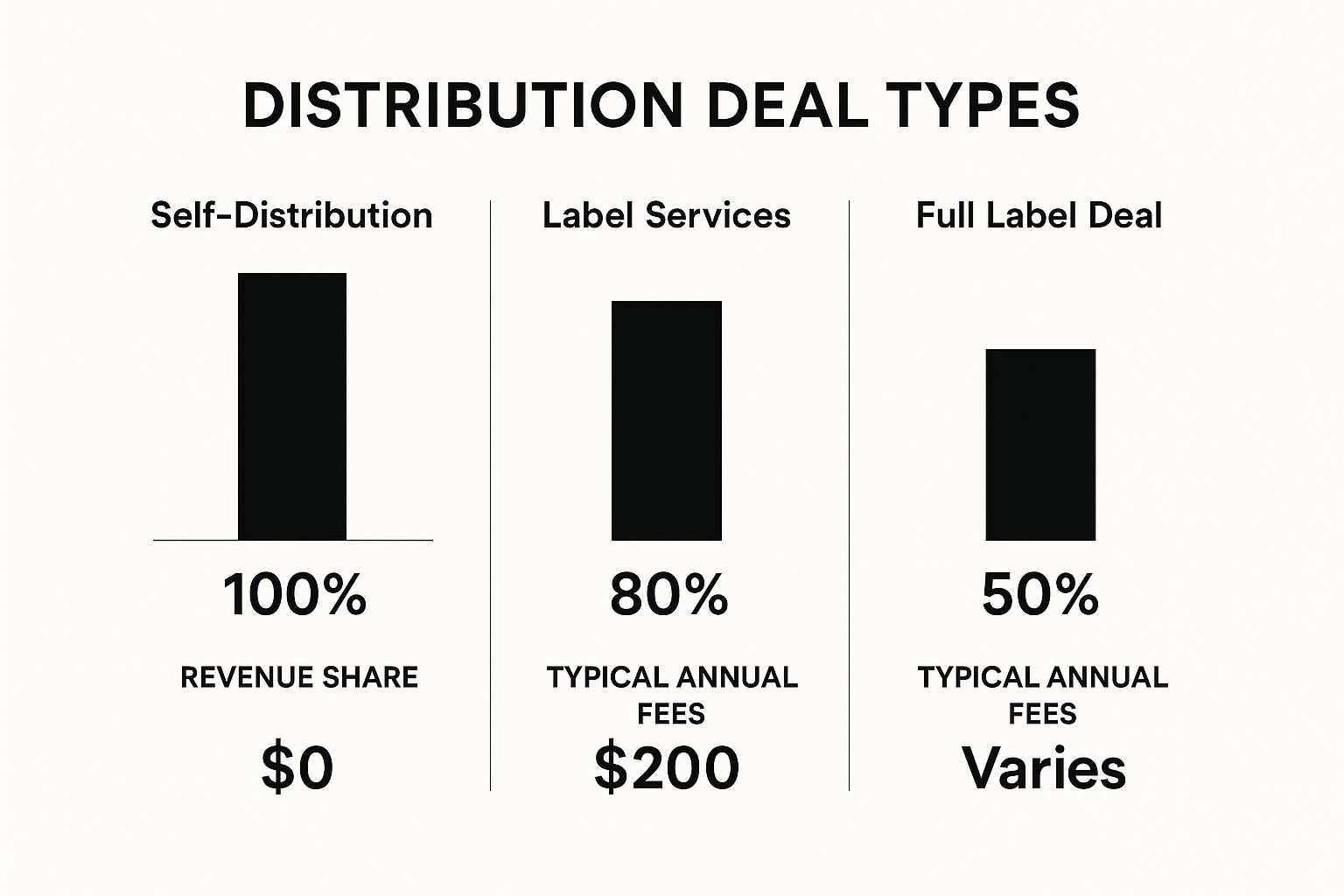
As you can see, it's a classic trade-off. Self-distribution models let you keep 100% of your revenue for a small fee, whereas a full-service or label deal provides a lot more support in exchange for a hefty slice of your income.
Unpacking Royalty Splits And Fees
This is the part that directly impacts your bank account. The royalty split is the nuts and bolts of how revenue gets divided between you and your distributor. The structure of these splits can vary wildly across different music distribution deals.
A DIY service might let you keep 100% of your royalties for a flat annual fee. On the other end of the spectrum, a label services deal will take a commission—typically between 15-30%—in return for their industry connections, marketing muscle, and hands-on guidance.
But the headline percentage is only half the story. You have to be a detective and hunt for the hidden fees that can quietly chip away at your earnings.
Comparing Common Royalty Splits and Fee Structures
To give you a clearer picture, I've put together a table that breaks down the typical financial structures you'll encounter. It's a quick way to see how the numbers usually shake out for each type of deal.
| Deal Type | Typical Upfront Fee | Typical Royalty Split (Artist/Distributor) | Hidden Costs to Watch For |
|---|---|---|---|
| DIY Aggregator | $10 - $50 per year | 100% / 0% | Takedown fees, banking fees, add-on service costs |
| Distributor Plus | $0 - $100+ (or none) | 80% / 20% | Statement processing fees, marketing campaign costs |
| Label Services | $0 (often involves an advance) | 70% / 30% | Marketing/promo deductions, high banking fees, misc. admin fees |
| Record Label | $0 (involves a larger advance) | 50% / 50% or less | Recoupable expenses (video, promo, etc.), packaging deductions |
This table is just a guide, of course. The specific numbers will vary, but it highlights the importance of looking beyond the royalty split alone. Those "hidden costs" can really add up, turning a seemingly great deal into something far less profitable.
Your Rights And How To Protect Them
Beyond the money, your agreement spells out the rights you're granting the distributor. The most important one? Ownership of your master recordings.
In a pure distribution deal, you should always retain 100% ownership of your masters. You are simply giving the company a license to distribute them for a set amount of time. If a deal asks you to sign over master ownership, it's not a distribution deal—it's a record deal, and that's a completely different conversation.
Another key area is music licensing. Your distribution agreement usually covers the royalties from streams and downloads, but it may not touch sync licensing—which is when your music gets placed in TV shows, films, video games, or ads. To get a better handle on this, check out our guide on understanding music licensing and how it can boost your revenue. It's a separate and potentially lucrative income stream you don’t want to sign away by mistake.
Ultimately, digging into your agreement is about empowerment. When you understand these key terms, you can confidently compare different music distribution deals, ask the right questions, and find a partner who is genuinely aligned with your goals. And if you’re ever in doubt, spending a little money on a consultation with a music lawyer is one of the smartest investments you can make in your career.
Understanding Publishing in Your Distribution Deal

Here’s a critical—and costly—mistake many artists make: assuming their music distribution deals cover all their potential earnings. They don't. Your distributor is focused on one side of the coin: getting your master recordings onto platforms and collecting royalties from those specific sound files.
But every song actually has two copyrights, and your distributor is only handling one of them. The other one, tied to the underlying composition, is a whole separate world of income.
Think of it like a book. The master recording is the audiobook version—a specific, final performance. The composition, however, is the actual story itself—the words, melody, and structure you wrote down. Your distributor collects money when someone streams the audiobook. A separate entity, your publisher, collects money whenever the story itself is used in any form.
Ignoring this distinction means leaving a huge pile of money on the table. These are called publishing royalties, and they’re generated every time the song you wrote is reproduced or performed publicly.
The Two Halves of Your Song's Copyright
To really get a handle on this, you need to see your music as two separate assets that make money in different ways:
- The Master Recording (Phonogram ©): This is the final audio file you upload to your distributor. It’s that one specific performance captured in the studio. Your distributor’s job is to collect royalties from streams and downloads of this recording.
- The Composition (Work ©): This is the song's DNA—the lyrics, melody, and chords. It’s the intellectual property that exists even without a recording. Publishing royalties are generated from this asset.
This second copyright makes money from sources your distributor usually won't touch. We're talking about things like radio play, live concerts, every single stream (which generates a mechanical royalty), and when your music gets used in TV shows, films, or ads (sync licensing).
Music publishing is a massive business. The global market was recently valued at €9.8 billion, and independent publishers hold a solid 26.3% of that. This shows you just how much value is locked away in the compositional side of your music. For a deeper dive, you can check out the full global market view of independent music publishing.
Should You Bundle Publishing with Distribution?
Many distributors now offer publishing administration services as an add-on, which can seem like a simple solution. But is it the right move for you?
A distribution deal handles the 'what'—the final track. A publishing deal handles the 'how'—the foundational song itself. Confusing the two is like selling tickets to a movie but forgetting to collect royalties from the screenplay.
Let's break down the pros and cons to help you decide.
Bundling Publishing with Your Distributor:
- Pros: It’s incredibly convenient. Often, it’s just a matter of checking a box in your dashboard. This is a fantastic starting point for artists who are new to publishing and want an easy way to start collecting mechanical royalties from streams.
- Cons: These services are generally passive. They are great at administration—collecting the money that comes in—but they typically won't be out there actively pitching your music for sync licenses or other creative opportunities. They are administrators, not creative partners.
Seeking a Separate Publisher:
- Pros: A dedicated publisher is a proactive partner in your career. Their team will actively pitch your compositions for placements in film and TV, hunt for opportunities for other artists to cover your songs, and work to maximize your song's reach across the globe.
- Cons: Landing a deal with a traditional publisher is much, much harder. They are extremely selective and will want to see that your music already has significant traction and earning potential before they'll even consider signing you.
For most independent artists, the best first step is to use your distributor's publishing admin service. It’s a simple way to make sure you’re not leaving foundational royalties behind. Then, as your career builds momentum, you can start looking for a dedicated publisher to really take your songwriting income to the next level.
How to Choose the Right Distribution Partner
Picking a partner for your music distribution isn't just a technical step; it's like choosing a co-pilot for your entire career. It’s not about just getting your music from point A to point B. It’s about finding someone who gets your vision, understands your flight plan, and has the right gear to help you navigate the often-turbulent music industry.
A great partner can put the wind at your back, while the wrong one can leave you stuck on the runway.
This decision is deeply personal and hinges entirely on where you are right now and where you want to go. The perfect distributor for a brand-new bedroom producer is a world away from the ideal partner for an established indie band with a die-hard following.
To make the right call, you need to look past the flashy marketing promises and dig into the practical, day-to-day reality of working with them. It all comes down to asking the right questions to make sure their services truly line up with your art and your ambitions.
Assess Your Current Career Stage
Before you even start browsing distributor websites, take a moment for an honest self-assessment. Where are you really at in your journey? Answering this question will immediately filter your options and point you in the right direction.
Let’s imagine two different artists to see how this works in practice:
The Emerging Producer, "Alex": Alex is just getting started, making killer electronic tracks in a home studio. They have a small but dedicated social media following and the main goal is simple: get music onto streaming platforms quickly and cheaply. Alex wants to build a catalog and see what sticks. For Alex, a DIY aggregator offering unlimited uploads for a low annual fee is the perfect launchpad. Access and speed are the priorities here, not white-glove marketing support.
The Established Band, "The Nomads": The Nomads have been grinding it out for years, touring regionally and building a loyal fanbase. They have thousands of monthly listeners and a proven knack for selling merch. They need more than just basic delivery; they need a partner who can pitch them to playlist editors, provide real marketing muscle, and hunt for sync licensing opportunities. For them, a selective, full-service distributor that works on commission is the logical next step.
Knowing where you stand helps you avoid the classic mistakes: paying for premium services you'll never use, or settling for a basic plan when you're ready to level up.
Key Questions to Ask Potential Distributors
Once you've zeroed in on the right type of distributor, it's time to vet the specific companies. Treat this process like an interview, because that's what it is. You're hiring them to manage a critical piece of your business.
Here are the non-negotiable questions you need to ask.
What is your full network reach? Of course, they need to cover the big ones like Spotify and Apple Music. But dig deeper. Ask about niche platforms relevant to your genre or key territories. If you have a strong fanbase in Asia, for instance, a distributor with deep connections there is worth its weight in gold.
What do your analytics and reporting tools look like? Don't just take their word for it—ask for a demo or at least some screenshots. You need more than a simple stream count. A great partner gives you detailed data on listener demographics, where your music is hot, and how your tracks are performing on playlists. This is the information that helps you make smarter decisions.
What level of customer support can I expect? This is a big one. When something goes wrong with a release—and it will—you need help, fast. Find out their average response time. Is support just a faceless email address, or do they offer live chat or phone options? Hunt down reviews from other artists that specifically mention their customer service experience.
Choosing a distributor is a strategic career decision, not just an upload service. Your partner should provide tools and support that grow with you, turning data into opportunities and streams into a sustainable career.
To get the attention of the best distribution partners, you also need to have your own house in order. That means building a strong digital presence. Tools like the best website builder for musicians can help you create a professional hub for your music, bio, and brand, making a powerful first impression.
Finally, think about the long game. The right choice is a partner that not only solves your problems today but can scale with you tomorrow. For a deeper dive, our detailed guide on how to choose the right music distribution service breaks down the top players in the industry. Putting in the research now will pay off for years to come.
Negotiating Your Deal Like a Professional

So, you’ve got a distribution contract in your hands. It’s a huge moment, but don't just sign on the dotted line. Think of this as the real start of the process, not the end. This is where you put on your business hat and make sure the deal actually works for you. Your power here doesn't just come from your music; it comes from knowing your worth.
Before you even glance at the legalese, you need to understand your own leverage. Distributors are betting on artists who already have an audience, no matter how small. The data you've been generating—every stream, every follow, every share—is your single most powerful bargaining chip.
Walk into that conversation prepared. Have your key stats ready: monthly listener counts, how quickly your new tracks gain traction, and how your fans engage on social media. This isn't about bragging; it's about shifting the conversation from a subjective "we love your sound" to an objective "here's the business potential."
Turn Your Data Into a Better Deal
Your analytics are the proof behind your pitch. Let’s say a distributor offers a standard 80/20 royalty split. That’s a common starting point. But if you can show them you're already pulling 50,000+ streams a month and growing, you have a solid case to push for a better split, maybe 85/15.
This applies to more than just royalties. Got a viral TikTok video or a super-engaged Instagram following? Use that to negotiate for a dedicated marketing budget or a commitment to pitch your tracks to top-tier playlists. You’re not just asking for a favor; you're showing them why investing more in you is a smart move.
Negotiation isn't about fighting for every last scrap. It's about confidently demonstrating your value with hard evidence. The best deals happen when you can prove that better terms for you will lead to better results for them.
Key Clauses That Are Usually on the Table
While some contract language is set in stone, many of the most important terms are surprisingly flexible. Knowing where you can push can make a massive difference in your career without scaring off a potential partner.
Here's where to focus your energy:
- Royalty Split: This is the big one. Even a few percentage points can add up to thousands of dollars over time. It’s almost always worth a discussion.
- Term Length: If they're asking for a multi-year commitment, see if you can start with a shorter term, like one year, with an option to renew. This gives you an exit strategy if the partnership isn't what you hoped for.
- Marketing Commitment: Don't settle for vague promises like "marketing support." Ask for specifics. Get them to commit to a certain number of playlist pitches per release or a defined ad spend.
- Exit Clause: How do you part ways? Make sure the terms for leaving are crystal clear and fair. You might be able to negotiate for lower (or zero) fees to take down your catalog once the deal is over.
A major red flag is a company that shuts down any attempt to discuss these points. A good partner wants a deal that works for both sides. If they’re totally rigid, it might mean they see you as just another number on a spreadsheet.
Know When to Call in a Lawyer
Finally, you need to be honest about what you don't know. You can handle the business side of the conversation, but an experienced music attorney is your best friend for reviewing the final contract. They’re trained to spot the tricky phrasing, hidden clauses, and long-term traps you’d never see coming.
Bringing in a lawyer isn't a sign of distrust—it’s just smart business. They're there to protect your future, ensuring the agreement you sign today is one you can still live with years from now. The cost of a few hours of their time is nothing compared to the peace of mind you get from a solid, fair deal.
Common Questions About Music Distribution Deals
Even with a solid grasp of the basics, a few specific questions always seem to pop up when you're digging into distribution deals. Let's tackle some of the most common ones artists run into.
Can I Switch Music Distributors?
Yes, you can—but it’s not always as simple as flipping a switch. Your ability to move your music all comes down to the terms of your current contract.
Look for two key things in your agreement: the "term" (how long you're locked in) and the "exclusivity" clause. If your term is up, you’re a free agent and can take your catalog to a new partner. If you’re still in the middle of a contract, you’ll likely have to wait it out unless you can negotiate an early exit, which might come with a fee.
Before you sign anything, always read the termination clause. Understand exactly what it takes to leave the partnership if it isn't working out. This will save you major headaches and prevent your music from disappearing from stores while you make the switch.
What Are UPC and ISRC Codes?
Think of these as the digital fingerprints for your music. They’re absolutely essential for tracking every single stream and sale across the globe.
- UPC (Universal Product Code): This is the barcode for your entire release. An album gets one UPC, an EP gets one UPC, and a single gets one UPC.
- ISRC (International Standard Recording Code): This is the unique serial number for an individual song. Every single track you release needs its own ISRC.
You can buy these codes yourself, but honestly, almost every modern distributor will generate them for you as part of their service. And if you’re switching distributors, you can (and should) bring your existing ISRCs with you to keep all your streaming data and playlist placements intact.
What’s the Difference Between a Distributor and a Publisher?
This is a big one, and getting it wrong can cost you money. They handle two completely different copyrights that generate two completely different royalty streams.
A distributor deals with your master recordings—the actual finished audio file of your song. Their job is to get that specific recording onto platforms like Spotify and Apple Music and collect the money it earns.
A publisher, on the other hand, works with the underlying composition—the music and lyrics you wrote. They collect publishing royalties anytime that song is used, whether it's played on the radio, performed live, or even covered by another artist. While some companies do both, distribution and publishing are two separate jobs.
Ready to take full control of your music, merchandise, and fan relationships? OohYeah provides the tools you need to build a sustainable career on your own terms, letting you sell directly to your audience without commissions. Start building your independent music business today at https://oohyeah.app.