A Guide to Mechanical Rights in Music
Understand mechanical rights in music and learn how to collect the royalties you've earned from streams, downloads, and physical sales. Start here.
January 12, 2026
Music Marketplace Advisor
Buying & SellingEver wonder how songwriters get paid when their music is copied, downloaded, or streamed? It all comes down to a crucial, and often misunderstood, concept: mechanical rights.
Think of your song's composition—the melody and lyrics—as an architectural blueprint. Mechanical rights are what give someone permission to build a house from that blueprint, whether that "house" is a vinyl record, a digital download, or even a stream.
Basically, every time a copy of your song is made, a mechanical royalty is owed to the songwriter.
Understanding the Blueprint of Your Music
Every song has two sides to its copyright: the composition (the song itself, as written) and the master recording (a specific recorded version of that song). Mechanical rights are tied exclusively to the composition. They get triggered anytime that underlying song is reproduced, making sure the creator gets paid for their work.
Let’s say you write a killer track. A record label decides to press 10,000 vinyl LPs featuring it. For every single one of those 10,000 copies, a mechanical royalty must be paid to you as the songwriter. This same principle now applies across the digital world, too.
How "Reproduction" Works Today
The idea of what a "reproduction" is has expanded far beyond the factory floor. While it once just meant physical products, it now covers the digital formats that drive most artists' careers. Knowing where these royalties come from is the first step to actually collecting them.
Here are the key moments when mechanical rights kick in:
- Physical Sales: Every CD, vinyl record, or cassette tape manufactured generates a mechanical royalty.
- Digital Downloads: When a fan buys your song on a platform like iTunes, that purchase counts as a reproduction.
- Interactive Streaming: This is the big one. Every time someone streams your song on-demand on services like Spotify or Apple Music, a temporary reproduction is created on their device. That click on the play button triggers a mechanical royalty.
That last point is a game-changer. Streaming is the dominant force in music today, accounting for about 69% of all recorded music revenues globally. But while the potential is huge, a staggering 77.8% of independent artists still make less than $15,000 a year from their music, even with publishing royalties becoming a bigger piece of the pie. You can dive deeper into streaming's industry impact over on Spotify's newsroom.
It's easy to get these mixed up, so let's clarify the difference between the two main types of songwriting royalties.
Mechanical Rights vs Performance Rights: A Quick Comparison
| Royalty Type | What Triggers Payment | Examples | Who Collects It |
|---|---|---|---|
| Mechanical | The reproduction of a song in a physical or digital format. | Vinyl pressings, CD manufacturing, digital downloads, on-demand streams. | The MLC, Harry Fox Agency (HFA), Music Reports (MRI) |
| Performance | The public broadcast or performance of a song. | Radio airplay, TV shows, live concerts, music played in a bar or store. | Performing Rights Organizations (PROs) like ASCAP, BMI, SESAC |
Understanding this distinction is key to tracking your money. They are two completely different income streams, collected by different organizations.
Why This Matters for Independent Artists
For an indie artist, mechanical rights aren't just industry jargon—they're the financial foundation of your career. If you write your own songs, you are the publisher. That means you're the one entitled to collect these royalties.
If you don't know they exist or how to register your work, you're simply leaving your own money on the table. It's that simple.
Think about it: if another artist wants to record a cover of your song, they'll need your permission. Our guide on how to get a mechanical license to cover a song breaks down that whole process, showing just how serious the legal and financial duties are. By understanding your rights, you can make sure you get paid every time someone uses your musical blueprint.
The Evolution from Piano Rolls to Digital Streams
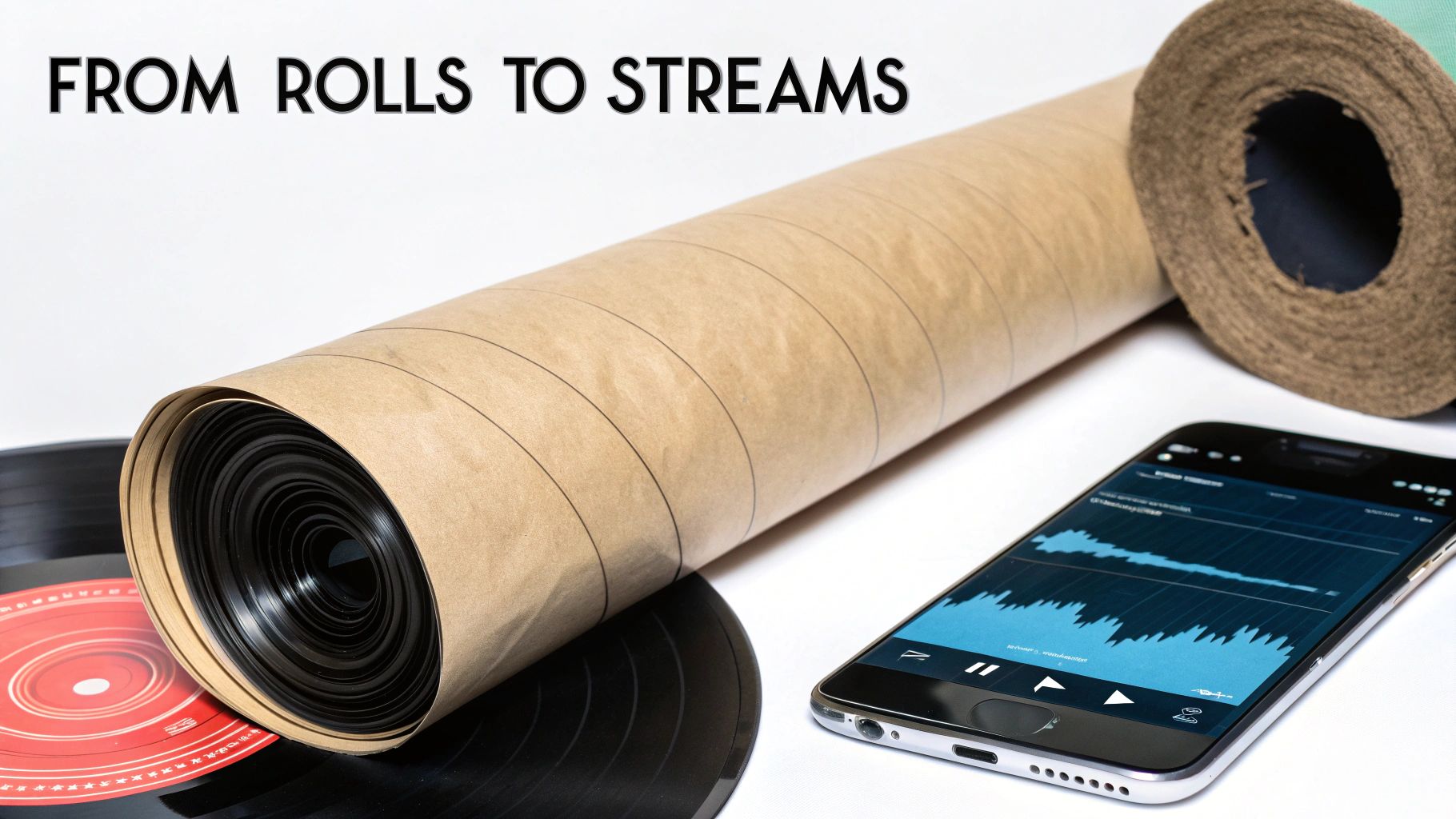
To really get a grip on mechanical rights in music, you have to go way back. Forget streaming, forget MP3s, even forget radio. The whole story starts over a century ago with a technology that was quite literally "mechanical": the player piano.
In the early 1900s, player pianos were the peak of home entertainment. These incredible machines used perforated paper rolls to play songs automatically. It didn't take long for songwriters to realize that every time a company punched out one of these rolls, they were making a copy of a composition—and not paying a dime for it.
This early tech disruption forced a major legal shift, leading directly to the U.S. Copyright Act of 1909. For the first time, the law created a "mechanical license," making sure composers got paid when their work was mechanically reproduced on these piano rolls. And just like that, the mechanical royalty was born.
A "mechanical" right was born from a literal machine. It established a simple but powerful principle: if you make a copy of a songwriter's work, you owe them a royalty for using their intellectual property.
This one idea has been the foundation of music copyright for over a hundred years. The only thing that’s changed is the technology; the definition of a "copy" just kept evolving.
From Grooves to Lasers
As technology marched on, so did the application of this core right. When record labels started pressing vinyl albums and, later, manufacturing cassette tapes, they had to pay a mechanical royalty for every single unit. It was a pretty straightforward system based on the number of physical copies they made.
Then came the compact disc. Even though the technology was different—lasers reading digital code instead of a needle in a groove—the legal principle was the same. Every CD that came off the production line generated a mechanical royalty for the songwriter and their publisher. The system worked because it was tangible and easy to track.
The Digital Revolution and Compulsory Licensing
Things got really interesting with the internet. When Apple launched the iTunes Store, the very idea of a "copy" changed forever. Instead of a physical object, people were now buying a permanent digital file.
But a copy is a copy. Each time a user clicked "buy" to download a track, it was considered a reproduction, triggering a mechanical royalty. This era also cemented the importance of the compulsory license in the U.S. This is a crucial rule that says once a song has been released, anyone can record and sell their own version (a cover), as long as they pay the government-set mechanical rate for every copy they distribute.
The economics of mechanical rights in music have come a long way from the player piano days. Music publishing in the U.S. has exploded into an industry with an estimated $8.7 billion in annual revenue, and mechanicals are now the biggest piece of that pie. You can get a better sense of the scale by checking out this overview of the U.S. music publishing industry on ibisworld.com.
Finally, this old legal framework had to adapt one last time for the biggest shift of all: streaming. Believe it or not, an on-demand stream on Spotify or Apple Music is legally considered a temporary reproduction. A tiny, "ephemeral" copy of the song is created on your device so you can hear it, and that simple act generates a mechanical royalty. It's how a century-old law connects directly to every tap of the play button today.
How Mechanical Royalties Are Actually Calculated
Knowing you’re owed a mechanical royalty is one thing. Understanding how the money is actually counted is where you gain real control over your career.
The math changes depending on whether someone is buying a record, downloading a file, or streaming your song. Let's dig into the specific rules for each format.
For physical products like vinyl and permanent downloads in the United States, things are pretty straightforward. The rates are set by a panel of judges called the Copyright Royalty Board (CRB). These are known as statutory rates—in other words, they are mandated by law.
This system creates a clear, predictable formula for anyone pressing a CD or selling a download of your composition. It takes the guesswork out of the equation and guarantees songwriters are paid a consistent, legally defined amount for every copy made.
The Math Behind Physical Sales and Downloads
The statutory mechanical royalty rate is the bedrock of these calculations. Following the latest CRB ruling, the rate for physical formats and permanent downloads (think the iTunes Store) is 12.4 cents per track. If a song is over five minutes long, the rate is 2.38 cents per minute of playing time, whichever amount is greater.
Let’s run a quick example. Imagine an indie band presses 1,000 vinyl records of their new album. The album has ten songs, and they're all under five minutes.
- Calculation: 10 songs × 12.4 cents/song = $1.24 per album
- Total Owed: $1.24/album × 1,000 records = $1,240 in mechanical royalties
That $1,240 is owed to the songwriters and their publishers for the right to reproduce those ten songs. This is entirely separate from manufacturing costs or profits from record sales. Getting these calculations right is a core part of music licensing, and it’s a must for anyone serious about their revenue. For a deeper look, check out our guide on understanding music licensing and how it can increase your income.
Calculating Royalties for Streaming
Streaming royalties are a whole different beast. They aren't based on a simple per-unit payment. Instead, the calculation starts with a percentage of the streaming service’s revenue.
In the U.S., digital service providers (DSPs) like Spotify and Apple Music pay a percentage of their revenue into a massive royalty pool dedicated to songwriters.
For 2024, the headline rate that interactive streaming services must pay to publishers and songwriters in the U.S. is 15.25% of their total revenue. This pool of money is then divided among all rightsholders based on their share of total streams.
This "pro-rata" system means your royalty per stream is never a fixed number. It fluctuates every single month based on two huge factors:
- The service's total revenue: More subscribers and ad money mean a bigger royalty pool for everyone.
- The total number of streams: Your song's streams are just a drop in an ocean of billions of other streams on the platform.
Your final payment is your slice of that giant pie. A song with one million streams in a high-revenue month will earn more than the same song with a million streams in a lower-revenue month.
Who Collects and Distributes the Money?
Once these royalties are calculated, they don't just magically appear in your bank account. A whole chain of organizations exists to get the money from the user (the record label or streaming service) to you, the songwriter.
For physical and download mechanicals, this is often handled by an agency like the Harry Fox Agency (HFA) or negotiated directly between a label and a publisher.
But for U.S. streaming mechanicals, there’s one main player: The Mechanical Licensing Collective (The MLC). The MLC is the sole organization responsible for collecting these royalties from DSPs and paying them out to publishers and self-published songwriters. Your publisher or publishing administrator works directly with these groups to register your songs, claim the money you've earned, and make sure it all lands in your pocket accurately.
Essential Collection Societies You Need to Know
Knowing you're owed mechanical royalties is the first step, but who actually gets that money from the music user to you? You don’t get a check directly from Spotify or a record label for these specific rights. Instead, specialized groups called collection societies are the critical link in the chain.
Think of them as highly-focused accountants working just for songwriters. Their entire job is to track billions of song reproductions across countless platforms, collect the tiny bits of money owed for each one, and then funnel those royalties to the correct creators. Without them, trying to collect what you’re owed from around the world would be an impossible, full-time job.
For anyone writing songs in the United States, one name has become absolutely essential for getting paid from streaming: The Mechanical Licensing Collective (The MLC).
The MLC: Your Gateway to US Streaming Royalties
Created by the game-changing Music Modernization Act of 2018, The MLC is a nonprofit organization designated by the U.S. Copyright Office. In simple terms, it issues a single, "blanket" mechanical license to streaming services like Spotify, Apple Music, and Amazon Music for their U.S. operations. The services pay The MLC, and The MLC pays you.
Registering your works directly with The MLC is non-negotiable if you want to collect your U.S. streaming mechanicals. If you don't, your earnings become "unmatched royalties"—money that sits in a holding account waiting to be claimed. If that money sits for too long, it can eventually be distributed to other publishers based on market share, meaning you miss out for good.
The MLC has quickly become a pillar of the music industry's financial plumbing. Since it began full operations in January 2021, it has processed more than $3.9 billion in total royalties and paid out over $3.3 billion to songwriters and publishers. Its public database now holds information for over 50 million songs, and its royalty match rate is nearing an impressive 92%—a vital sign that creators are getting paid more accurately than ever before. You can read more about The MLC's financial impact on Music Business Worldwide.
Navigating the Global Royalty Landscape
While The MLC has you covered for streaming in the U.S., your music has a passport. It gets played everywhere. Every country or major region has its own mechanical rights organization (MRO) handling collections in that territory, and trying to sign up with dozens of them would be an administrative nightmare.
This is where reciprocal agreements save the day. These are basically hand-shake deals between collection societies in different countries. For example, The MLC works with its international partners to collect royalties for its members when their songs are streamed overseas, and vice-versa.
Key Takeaway: You don’t need to join every society worldwide. By aligning with a primary society or, even better, a publishing administrator, you plug into a global network that chases down your mechanical royalties from nearly every corner of the globe.
While you don't need to join them all, it’s smart to know the major international players. A solid global strategy depends on understanding who controls the money in key markets.
Here's a quick look at some of the most important mechanical rights societies around the world.
Key Mechanical Royalty Collection Societies
| Organization | Territory | Primary Role |
|---|---|---|
| The MLC | United States | Collects and distributes streaming mechanical royalties from DSPs. |
| MCPS | United Kingdom | Manages mechanical rights for the UK, often working alongside PRS for Music. |
| AMCOS | Australia | Administers mechanical rights in Australia and New Zealand. |
| GEMA | Germany | A powerful society covering mechanical and performance rights in Germany. |
| SACEM | France | Manages mechanical and performance rights for creators in France. |
So, what’s the move for most independent artists? The most straightforward and effective path is to partner with a publishing administrator. These companies handle all the tedious registrations with The MLC and other global societies for you, ensuring your songs are properly documented and ready to earn money wherever they’re played.
Your Step-By-Step Guide to Collecting Royalties
Alright, let's move from theory to action. Knowing what mechanical royalties are is one thing, but actually getting that money into your bank account is a whole different ball game. This is your practical playbook for setting up a collection system that actually works.
But before we dive in, let’s be crystal clear about the single most important piece of this puzzle: clean, accurate metadata. Getting this wrong is the fastest way to leave money on the table.
First Things First: Master Your Metadata
Think of your song's metadata as its DNA or its digital fingerprint. It’s all the identifying information that tells the global music system who wrote the song, who owns the rights, and most importantly, where to send the checks. If it's messy, your royalties get lost. Simple as that.
Before you even dream of registering a track anywhere, lock down these details:
- Correct Song Title: This sounds basic, but you’d be surprised. Is it "The Best Song" or "The Best Song (Radio Edit)"? Consistency is everything.
- Accurate Writer Splits: Get the ownership percentages for every single contributor documented and agreed upon—in writing—before the song ever sees the light of day. This prevents massive headaches later.
- Publisher Information: Are you your own publisher? You'll need an official publishing entity name. Using a publishing administrator? Have their exact info ready.
- ISWC Code: The International Standard Musical Work Code is like a Social Security Number for your song's composition. It's a unique identifier that follows your work everywhere. Your PRO or publishing administrator will help you secure this.
Nailing down these details is a crucial part of protecting your work. For a deeper look into this, check out our guide on how to protect your music rights online.
Register Your Compositions with the Right Organizations
Once your data is airtight, it’s time to start registering your songs with the organizations that hold the keys to your money. For any songwriter in the U.S., your first and most critical stop for streaming mechanicals is The Mechanical Licensing Collective (The MLC).
The entire global collection process is a network, with money flowing from digital services to collection societies and finally to you.
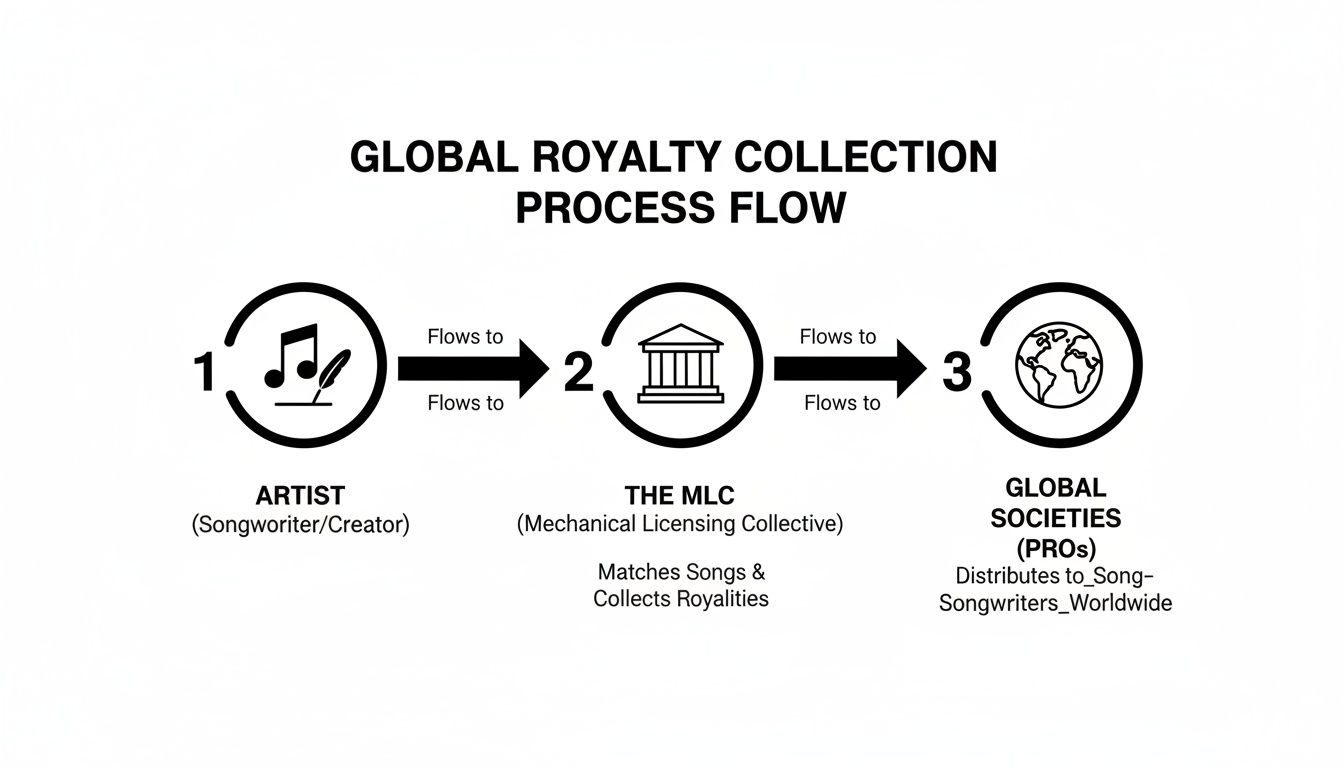
This flowchart gives you a bird's-eye view. Organizations like The MLC are the central hubs that connect your music to a worldwide web of societies, making sure you get paid no matter where your music is played.
Here’s your checklist for getting set up properly.
Join a Performing Rights Organization (PRO). Your first move should be signing up with a PRO like ASCAP or BMI. While their main job is collecting performance royalties, they are a foundational part of your publishing setup. They’ll issue you the writer and publisher numbers (IPI/CAE numbers) you need for pretty much every other registration.
Create an Account with The MLC. Head over to The MLC's website and register as a self-administered songwriter or publisher. I can't stress this enough: this step is non-negotiable if you want to collect your U.S. digital streaming mechanical royalties. You'll use that pristine metadata you prepared to register each and every one of your songs in their portal.
Consider a Publishing Administrator. Let's be honest—for most indie artists, chasing down royalties from dozens of countries is a full-time job. This is where a publishing administrator (think Songtrust or CD Baby Pro Publishing) comes in. They’ll handle the registrations with The MLC and societies all over the globe on your behalf. They take a commission, sure, but the value they provide in simplifying this ridiculously complex process is immense.
Register Songs Before You Release Them. This is a rookie mistake that costs artists a fortune. Register your work with your PRO and The MLC before your track hits Spotify. This ensures that from day one, any royalties generated can be accurately matched and paid out to you.
Pro Tip: When you're in The MLC portal, double- and triple-check that your publisher information is correct. If you're publishing your own work, you'll list your own publishing entity. If you've hired an administrator, you must list them as your publisher to avoid conflicts that will freeze your payments.
Building this administrative backbone is fundamental to a sustainable career. For a wider view on turning your creative work into revenue, it's worth exploring different content monetization strategies. By taking these steps, you’re not just making music—you’re building a catalog of valuable assets that can earn you income for years to come.
Frequently Asked Questions About Mechanical Rights
Even after you've got the basics down, the world of mechanical rights can still throw some curveballs. Let's tackle some of the most common and often confusing questions that pop up for independent artists and songwriters.
Do I Earn Mechanicals from Radio Plays or Pandora?
You'd think so, but no—not directly. Traditional radio (AM/FM) and non-interactive streaming services like Pandora’s free radio feature generate performance royalties, not mechanicals.
The deciding factor here is choice. A mechanical royalty is triggered when a listener actively chooses to play your song, which creates a temporary "reproduction" or copy. Since you can't pick the next song on the radio, it's legally considered a "public performance," which falls under a different royalty category collected by PROs like ASCAP and BMI.
What Happens If I Forget to Register My Songs with The MLC?
This is one mistake you really don't want to make. If your songs aren't registered with The Mechanical Licensing Collective (The MLC) in the U.S., any mechanical royalties from streaming services like Spotify and Apple Music simply can't get to you.
That money goes into a holding account as "unmatched" royalties. After a certain period, if it's still unclaimed, it gets distributed to other publishers based on their market share. For an indie artist, that’s your hard-earned money being given away. Timely registration is absolutely essential.
This pool of unclaimed money is what the industry often calls "black box" royalties. It represents a huge and entirely preventable loss of income for creators who haven't handled their business.
Do I Owe Myself Mechanicals on My Own Vinyl Records?
It sounds a bit strange, but technically, yes. This is a perfect example of the different hats you wear as an indie artist. Your "record label" (which is you) owes your "publisher" and "songwriter" (also you) a mechanical royalty for every single record you press.
While it feels like you're just moving money from one pocket to another, it's a crucial accounting step. If you have any co-writers, this process ensures they get their correct share of the mechanicals from physical sales. It keeps everything clean, legal, and fair for everyone involved.
Can I Collect My International Royalties Myself?
The short answer is: you really wouldn't want to. While you technically could try, it's a logistical nightmare. You would have to individually register your work with dozens of different collection societies all over the world, each with its own language, rules, and currency. It’s an administrative black hole.
This is exactly why publishing administrators exist. They have a global network of partnerships already in place to collect these royalties for you, taking a small commission in exchange for handling an immense amount of work. For more in-depth discussions and ongoing updates related to music rights, you can often find valuable content on industry blogs like the Copycat247 blog for additional articles.
Ready to take full control of your music and connect directly with your fans? At OohYeah, we provide the tools for you to stream, sell, and market your work on your own terms. Start building your artist-first business today