Listen to Music Offline on Any Device in 2026
Learn how to listen to music offline on iPhone, Android, and desktop. Covers downloads, caches, storage, and subscription tradeoffs that actually matter.
September 4, 2026
Music Marketplace Advisor
Buying & SellingYou're halfway through a flight, the cabin Wi-Fi isn't working, and your music stops with the progress bar frozen mid-track. Your phone shows 38% battery, the cellular signal is gone, and the album you thought you downloaded now displays a greyed-out play button.
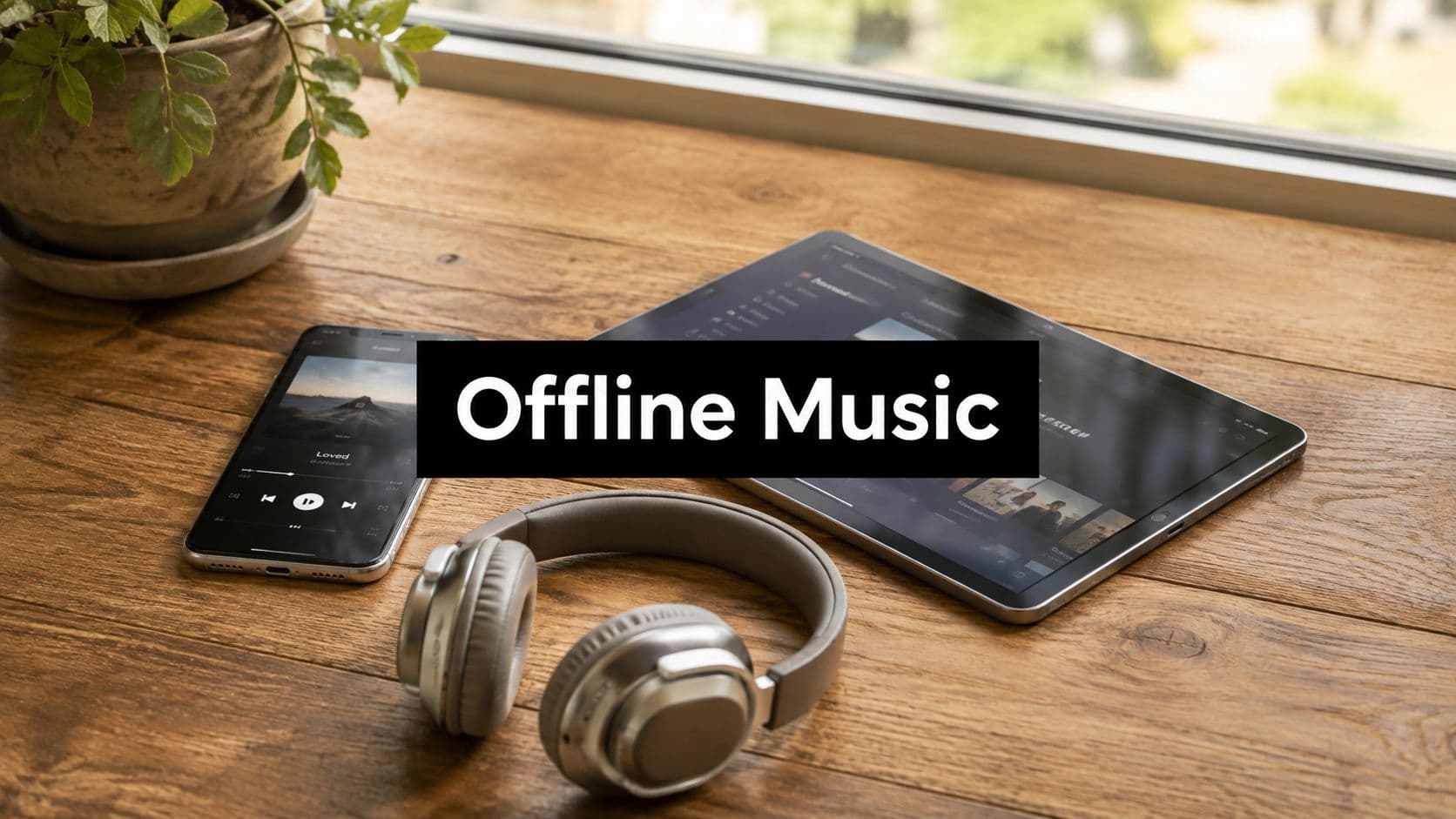
That failure feels random, but it usually isn't. To listen to music offline reliably, an app must have the audio stored locally, permission to play it without contacting its servers, and a playback system that works under airplane mode, low storage, and background restrictions. A download icon only confirms part of that process.
Why Offline Listening Is a Workflow, Not a Button
At altitude or underground, streaming has no room for recovery. A connected player can request the next audio segment, refresh an account token, or confirm that a subscription remains active. An offline player has to make every important decision before the signal disappears.
Three things must work together
First, the service needs an offline license. In DRM-enabled systems, the saved package generally contains the media and a persistent license obtained while the device is online. Without that license, the file may exist but still refuse playback after the connection drops, as described in this technical explanation of offline download playback.
Second, the audio has to be physically present on local storage. A stream that merely sits in a temporary cache isn't the same as a track deliberately saved for offline use. Cache cleanup, an app reinstall, storage pressure, or an operating-system refresh can remove it without making the failure obvious.
Third, the application's playback engine has to survive the device's offline conditions. Background refresh may be disabled, a license renewal may be overdue, or the app may insist on a fresh login. That's why a track can appear in a library and still fail in airplane mode.
Practical rule: Never trust the download badge alone. Test the exact device and app in airplane mode before you leave reliable Wi-Fi.
The wider listening market makes this workflow increasingly important. The IFPI's 2023 snapshot reported that 74% of listeners use subscription audio streaming, while people spent an average of 20.7 hours per week listening to music in 2023, up from 20.1 hours in 2022. Those figures come from the Sound of Data global audio report, and they help explain why offline playback has become a standard extension of streaming rather than a specialist feature.
Built-In Offline Options on iPhone, Android, and Desktop
The most dependable setup starts with the platform's own download controls, then adds a short offline test. Menu names can change between app versions, but the underlying sequence stays consistent: choose content, save it while connected, confirm local availability, and only then disconnect.
iPhone workflow
In Apple Music, open Settings > Music and review cellular download permissions before saving a large library. Inside the app, use the library's Downloaded Music area to confirm what's stored on the phone rather than relying on the general library view. Download albums or playlists while on Wi-Fi, then open one of them with cellular data and Wi-Fi disabled.
Apple Music downloads are tied to the account and service permissions that created them. Purchased, non-DRM files behave differently from subscription tracks, so don't assume every item in one playlist has identical offline rights.

Android workflow
YouTube Music and Spotify both expose download controls inside albums, playlists, and track menus. Spotify also has an offline setting in its app preferences, useful when you want the player to stop attempting network playback. With local-file players such as Poweramp and VLC, the equivalent is different: place the files in a stable music folder, scan that folder, and use pinning or favorites to keep important albums easy to reach.
Android can interfere when battery optimization pauses background downloads. Start downloads with the phone charging, keep the app open until the progress indicators finish, and verify the files from the app's offline or local-library view.
Desktop workflow
Spotify and Apple Music manage their own cached or downloaded data on Windows and macOS, but those files aren't generally interchangeable with another player. Don't copy an app's protected cache expecting a folder of ordinary MP3s. For owned music, use a clearly named library folder and back it up to an external drive instead.
Windows 11 users who keep owned MP3s in OneDrive can use folder synchronization across devices, although that's a file-management workflow, not subscription offline playback. If you're building a playlist for a video, podcast, or livestream, a curated source of royalty-free background music for 2026 can also avoid licensing surprises later.
A useful starting point for the OohYeah ecosystem is its mobile app entry point. Whatever platform you choose, the silent failure points are similar: unfinished downloads, expired account authorization, unavailable regional rights, and files that were cached rather than permanently saved.
Downloading Tracks Inside the OohYeah Mobile Apps
The OohYeah iOS and Android apps use a straightforward track-level workflow, but the storage choice matters. Open the app, find a track, playlist, or album, tap its three-dot menu, and select Download. Keep the app connected until the download indicator confirms completion.

Pick quality based on the trip
The Quality picker offers three practical choices:
- Standard, about 1.2 MB per minute, suits speech-heavy listening, casual playlists, and devices with limited free space.
- High, about 2.4 MB per minute, is the sensible default for most music listeners who want a fuller file without a large storage footprint.
- Lossless, about 5 to 7 MB per minute, makes sense when your headphones and listening environment justify the extra storage.
Those figures are app-specific operating guidance supplied for this workflow. Treat them as planning estimates, because an album's final size depends on track length and file packaging.
Choose Save when the trip matters
OohYeah's Cache and Save choices serve different purposes. Cache holds streamed material temporarily while the app is active. Save writes a durable offline copy that remains available after a force restart, which is the option to use for a flight, commute, or rural drive.
You can review cache use and clear it from Settings > Storage without deleting saved songs. Re-downloading over cellular is blocked by default, so whitelist OohYeah in the relevant iOS or Android cellular-data settings only when you deliberately want that behavior. For fans building a personal offline collection, the OohYeah fan experience provides the right place to manage that library.
Before leaving home, force-close the app, enable airplane mode, reopen it, and play a saved track. If it starts immediately, you've tested the complete path, not just the download screen.
Cached Playback Versus Permanent Downloads Versus Owned Files
Offline audio reaches your ears through three distinct systems. Confusing them is the reason people discover, often at the worst moment, that “available in my library” doesn't mean “available without a connection.”
| Method | Lifespan | License Requirement | Best For |
|---|---|---|---|
| Cached playback | Temporary and controlled by the app | Usually requires the service to validate access | Short, flexible listening while connected most of the time |
| Permanent download | Remains until removed or access ends | Subscription or platform license typically applies | Flights, commutes, and predictable low-signal periods |
| Owned file | Doesn't expire because of a subscription | No streaming license, but you need lawful ownership | Long-term libraries, backups, and playback across compatible apps |
Cached playback is convenient because it happens as you listen. It's also fragile. The app controls its retention, may clear it to reclaim space, and may not expose the cached item as a dependable offline download.
Permanent downloads are more reliable for planned travel, but “permanent” describes the local save, not perpetual rights. A subscription service can require periodic online checks, and a plan change or licensing change can invalidate the saved package.
Owned files offer the strongest long-term control. Purchased MP3s, non-DRM downloads, and lawful rips from your own CDs can move between compatible players and storage devices. The trade-off is manual work: naming files, maintaining backups, importing artwork, and replacing damaged storage.
Choose cached playback if you're commuting through occasional dead zones. Choose permanent downloads when the listening window is planned. Choose owned files for music you'd be disappointed to lose or find unavailable years later.
Storage and Battery Tips for Long Offline Sessions
Offline playback removes continuous network activity, but it doesn't make a phone limitless. Local audio still consumes storage, the decoder still uses the processor, and wireless headphones still draw power. Independent testing guidance reports that local playback uses no mobile data and less battery than streaming the same song, while one comparison estimates 3 to 8% battery drain per hour for local playback with wired headphones and the screen off, versus 5 to 12% per hour for streamed playback under the same conditions. See the offline Android battery and data guide for that comparison.

Budget storage before downloading
Audio quality determines how quickly a library grows. Download over Wi-Fi, especially for Lossless selections, and remove duplicate albums before starting a large queue. Keep finished playlists on a computer or SD card when your phone's free space is tight, but remember that an external copy won't help unless the playback device can access it during the trip.
Use the app's storage screen to distinguish saved music from temporary cache. Clear stale cache first. Deleting the application is a much harsher reset because it can remove every local download.
Stretch the battery
Turn the screen off as soon as playback starts. Airplane mode is useful after downloads finish because it stops the phone from repeatedly searching for a signal, though you can turn Wi-Fi or Bluetooth back on separately when needed. Wired headphones avoid Bluetooth radio use, while wireless earbuds remain practical if you keep the screen dark and don't multitask with video or maps.
A simple travel setup works best:
- Download while charging on Wi-Fi.
- Select Standard or High quality unless Lossless is useful.
- Test playback before departure.
- Enable a low-power mode that doesn't stop the audio app.
- Carry a backup battery for long journeys.
Troubleshooting Offline Playback When It Breaks
The assumption that a visible download must play offline is the first thing to challenge. Streaming services can display a saved title in a library while the underlying license is expired, the account needs re-authentication, or the local asset was removed during storage cleanup.
Diagnose the failure in the right order
Start with the account. Confirm the subscription is active and that you're signed into the same Apple ID or service account used to create the download. If the plan changed, don't waste time repeatedly pressing Play. Reconnect to Wi-Fi, refresh authorization, and download the content again.
Next, distinguish a local file from a placeholder. Open the service's dedicated offline or downloaded view, not just search results. If the title disappears there, the app probably never completed the save or has already purged the local copy.
A successful download is a state you can verify, not a promise made by an icon.
Regional rights can also complicate travel. A track available at home may not remain playable after you cross a border, particularly if the app needs to confirm availability again. Reauthentication can fail when the device has no route to the login servers, leaving cached content inaccessible until you reconnect.

Use a controlled recovery
Force-close the app and restart the device. While online, check account status, clear only corrupted or incomplete downloads, and save the playlist again. Then enable airplane mode and test a track from the offline section.
For service-specific questions, the OohYeah FAQ is the appropriate place to check current account and playback guidance. Don't wait until boarding to discover that the app needs a license refresh.
Your Offline Listening Checklist
A reliable offline routine is short enough to repeat and strict enough to catch silent failures. Use it before a flight, a subway commute, a road trip, or any workday where connectivity is uncertain.
Before downloading
Check the account first. Confirm that the plan, region, and selected titles support offline use, then open the service while connected and complete any pending sign-in or authorization step.
Choose complete albums or playlists rather than assembling a last-minute queue from individual tracks. Select quality according to the listening context and free storage, then leave the device on Wi-Fi until every item reports completion.
Before disconnecting
Reserve space for the downloads as well as normal app operation. If the phone is nearly full, clear old cache and abandoned playlists before saving new material. Charge the device, reduce unnecessary background activity, and use a low-power mode only after confirming it doesn't interrupt your player.
The decisive test takes less than a minute:
- Turn on airplane mode.
- Open the app from a cold start.
- Go to the downloaded or saved section.
- Play a track near the middle of the list.
- Skip forward and lock the screen.
If the track starts without buffering and continues with the screen off, the workflow is ready. If it fails, reconnect while you still can and fix the account, license, or storage issue.
Keep the library healthy
Reconnect periodically so services can refresh licenses and account status. Remove finished trips and abandoned playlists, but keep an owned-file backup for music that matters most. Record the service, quality setting, approximate storage impact, and how long the download remained available. That small log makes recurring failures easier to identify.
Offline listening works best as a habit, not an emergency feature. Download early, test without signal, and keep a second option for important travel.
OohYeah gives fans access to downloadable music and direct artist content through its mobile and web ecosystem, making it easier to build a dependable personal library for low-signal listening. Visit OohYeah to explore music from independent creators and prepare your next offline-ready collection.