A Guide to Licensing Cover Songs
Learn the essentials of licensing cover songs. This guide breaks down mechanical and sync licenses, legal steps, and costs to release your music legally.
November 9, 2025
Music Marketplace Advisor
Buying & SellingSo, you've created an amazing cover of a song you love and you're ready to share it with the world. Before you hit that upload button, there's a crucial step you absolutely cannot skip: licensing.
Releasing your version of another artist's work without the proper legal permissions is a fast track to trouble. At the heart of it all is a simple distinction: you need to get a license for the song's composition—the lyrics and melody—not the original artist's specific sound recording. This ensures the original creators get paid and protects you from some serious headaches down the line.
The Essentials of Cover Song Licensing
Let’s clear up a common misconception right away. Many musicians think that if they change the song enough or only release it on YouTube, they're in the clear. That's a dangerous myth. The reality is that without the right license, you risk takedown notices, losing any money you make, or even finding yourself in a legal battle.
The entire system hinges on a core principle of music copyright law: every song has two distinct copyrights.
- The Composition: This is the song's DNA—the lyrics, melody, and musical structure. It's owned by the songwriters and their publishers. When you record a cover, this is the part you're using.
- The Sound Recording: This is a specific recorded version of that song, often called the "master." The Beatles' original recording of "Yesterday" is one sound recording, and your new acoustic version is a completely different one.
Your job as the cover artist is to get permission to use the composition. Getting this right is the first and most important step to releasing your cover legally.
The U.S. Copyright Office is the ultimate authority on these distinctions, offering resources that spell out the rights and responsibilities for creators. Their guidelines make it crystal clear that proper licensing isn't just a suggestion—it's a legal requirement.
Before we dive deeper, let’s quickly break down these core ideas. This table offers a snapshot of the key terms you'll encounter.
Key Licensing Concepts at a Glance
| Concept | What It Is | Why It Matters for Covers |
|---|---|---|
| Composition Copyright | The rights to the underlying song (lyrics, melody, chords). | This is the copyright you need to license. You're using someone else's composition. |
| Sound Recording Copyright | The rights to a specific recorded performance of a song (the "master"). | Your cover creates a new sound recording, which you will own. |
| Mechanical License | The specific permission needed to reproduce and distribute a song. | This is the most common license you'll need for audio-only releases (e.g., Spotify, Apple Music). |
| Songwriter/Publisher | The owner(s) of the composition copyright. | These are the people who get paid royalties when you license their song. |
Understanding these basics from the get-go will make the entire licensing process much smoother.
Why Licensing Is a Must
Getting the right license isn't just about covering your bases legally; it's about being a good citizen in the music world. It guarantees that the original songwriters—the people who poured their hearts into crafting the song you admire—receive the royalties they've rightfully earned.
It also legitimizes your work. With a proper license, you can monetize your cover on streaming platforms and build your career on a solid, professional foundation. This industry is no small potatoes; the global music licensing market is projected to hit $9.586 billion by 2033. The U.S. alone made up over 40% of that revenue in 2023, according to archiveresearch.com, which just goes to show how established this process is.
By securing the right licenses, you transform your cover from a potential liability into a professional asset. It’s the difference between a hobbyist upload and a serious musical release.
Ultimately, licensing gives you peace of mind. You won't have to worry about your hard work suddenly vanishing from Spotify or YouTube because of a copyright claim. If you want to dig deeper into the financial side of things, take a look at our guide on understanding music licensing and how it can boost your revenue. Starting out with a clear understanding of your responsibilities is the key to a successful and stress-free launch.
Mechanical vs. Sync Licenses: What's the Difference?
Before you do anything else, you need to figure out exactly how you're going to use your cover song. The license you need hinges entirely on your final product. Putting your cover on Spotify is a world away from posting a performance video on YouTube, and each one requires a completely different permission slip. Getting this right from the start is the most important decision you'll make in this whole process.
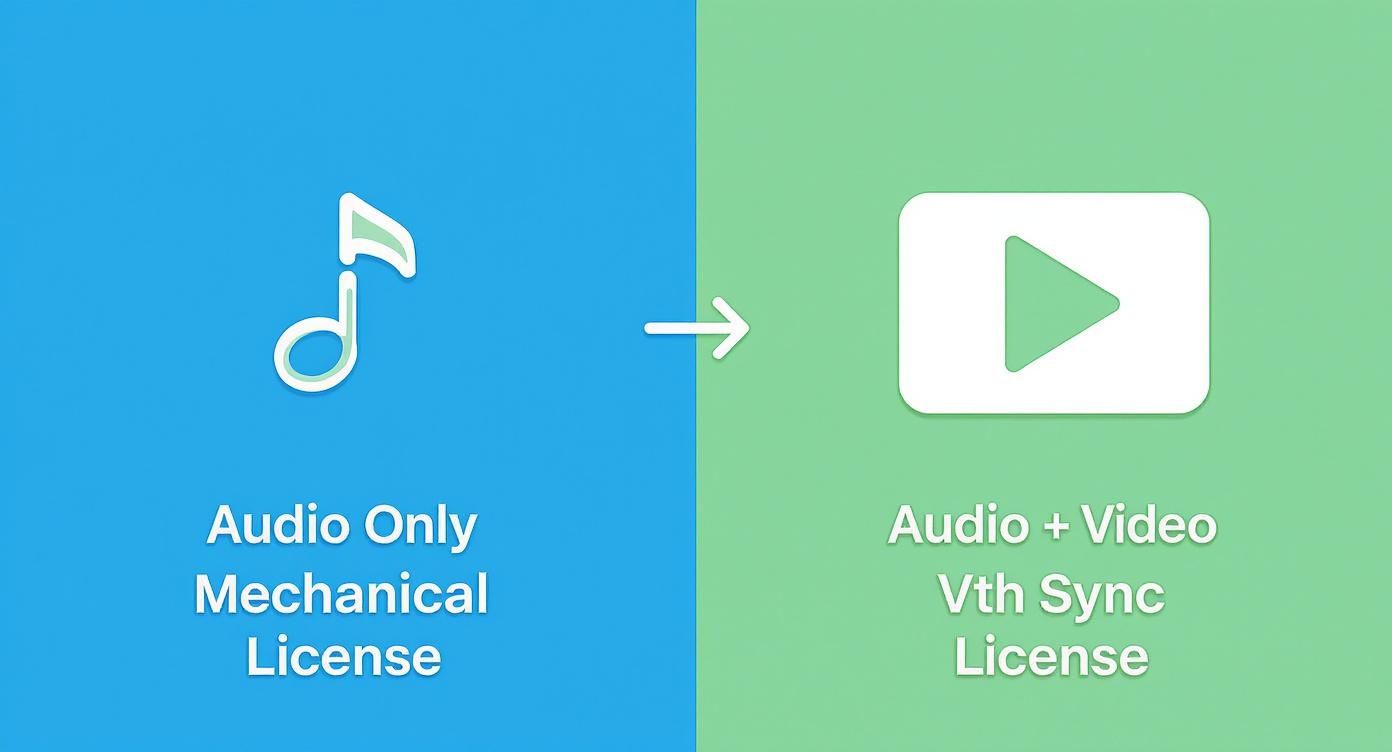
The two licenses you'll be dealing with are the mechanical license and the synchronization (or "sync") license. Think of them as two keys for two very different doors. One is strictly for audio-only releases, and the other is for anything that pairs your music with visuals. Understanding the distinction is everything, because the process, cost, and legal footwork for each couldn't be more different.
The Mechanical License: For Audio-Only Releases
A mechanical license grants you the right to reproduce and sell an audio recording of someone else's song. This is the license you'll need for any platform where the music is the main event, with no video attached.
You’ll need a mechanical license if your cover is headed for:
- Streaming services like Spotify, Apple Music, and Amazon Music.
- Digital download stores like the iTunes Store.
- Physical copies—yep, even CDs, vinyl records, or cassette tapes.
Let’s say you record a stripped-down piano version of a big pop hit and want to include it on your upcoming album. To get it on streaming services legally, you have to secure a mechanical license. The good news? In the United States, this is pretty straightforward thanks to a compulsory license provision in copyright law.
This basically means that as long as the original song has been released to the public, the publisher can’t actually say no. They have to grant you a license, as long as you pay the government-mandated royalty rate. This rate is set by the Copyright Royalty Board, which makes the cost predictable and easy to factor into your budget.
The Sync License: For Anything with Video
Now, what if you film yourself performing that same piano ballad? The second you pair your cover song with a moving image—whether for YouTube, Instagram Reels, or a TikTok video—you've officially stepped into the realm of synchronization licensing.
A sync license is permission to "synchronize" a piece of music with visual media. This is a totally separate right from a mechanical license, and here’s the crucial part: it is not compulsory.
This changes the game completely. Music publishers have the absolute right to approve or deny any sync request for any reason. Unlike the fixed, statutory rates for mechanicals, sync fees are 100% negotiable. The cost could be a few hundred bucks for a small indie film or climb into the tens of thousands for a big commercial.
When you reach out to the music publisher (or multiple publishers, if the song has several writers), they'll weigh a few key things:
- How you'll use it: Is this for your personal YouTube channel or a Super Bowl commercial?
- How famous the song is: A brand-new Taylor Swift hit will cost a lot more than a deep cut from a 70s rock band.
- How long it will be used: Is it a 15-second clip or the theme song for a whole series?
Nailing this distinction is the foundation for staying out of trouble. An audio-only release just needs a simple, non-negotiable mechanical license. But the moment a screen is involved, you need to be prepared to negotiate a sync license. Starting down the right path will save you a world of headaches, money, and legal risk later on.
How to Get a Mechanical License for Your Song
So, you've recorded an awesome cover and you're ready to share it with the world. The next step is getting it licensed, and for an audio-only release, that means securing a mechanical license.
I know, "licensing" sounds intimidating, but this process is way more straightforward than you might think. Unlike the complex, negotiation-heavy world of sync licenses (for video), the mechanical license is practically automatic in the United States. This is all thanks to a "compulsory license" provision in copyright law.
Essentially, as long as you follow the rules and pay the required royalties, you can legally release your version of the song. No one can stop you.
The whole point is to make sure the original songwriters and their publishers get paid for their work. You can technically try to contact the publisher directly, but trust me, that's the hard way. The much easier route—and the one most artists take—is to use a third-party service that handles all the heavy lifting for you.
Using Licensing Services
For pretty much any independent artist, going through a dedicated licensing service is a no-brainer. These platforms exist to cut through the red tape of music rights, letting you get back to what you do best: making music.
In the U.S., two names come up time and time again:
- Harry Fox Agency (HFA): A real institution in the music industry, HFA represents a massive catalog of publishers. They have a tool called Songfile that’s built specifically for folks like us who need to license a handful of songs without a major label's legal team.
- Easy Song: This service has become a massive favorite among indie artists, and for good reason. Their website is incredibly easy to navigate, and they manage all the research and paperwork. It makes the whole thing feel almost effortless.
Here’s a look at the Easy Song homepage, which shows just how simple and approachable they make it.
Services like this take what could be a frustrating hunt for copyright owners and turn it into a simple online transaction.
The popularity of these platforms makes sense when you see the numbers. In 2023, the U.S. Copyright Office issued over 1.2 million mechanical licenses for cover songs, which was a 15% jump from the year before. It's clear that licensing is a standard—and essential—part of the process for today's creators. You can see more data on this trend in the latest IFPI report on global music revenue growth.
Preparing Your Information
Before you even visit a licensing site, do yourself a favor and get all your information in one place. A little prep work here will make the actual process fly by.
Here's what you'll need to have ready:
- Original Song Title and Artist: Be precise. You don't want to accidentally license the wrong "Crazy" or "Hallelujah."
- Original Songwriter(s) and Publisher(s): This is the most important part. You can usually dig this up by searching the public databases of performance rights organizations like ASCAP, BMI, or SESAC.
- Your Recording Information: This includes your artist or band name, the exact length of your recording, and your planned release date.
- Distribution Plans: You'll have to estimate how many copies you expect to distribute. This applies to digital downloads, streams, and physical formats like CDs or vinyl records.
Understanding the Costs
Here’s the good news: in the United States, the cost of a mechanical license isn’t up for debate. It's set by law. This is called the statutory mechanical royalty rate.
As of 2024, that rate is 12.4 cents per track for any song that's five minutes long or shorter.
So, what does that look like in practice? If you plan to sell 1,000 digital downloads of your cover song, you'll owe $124 in mechanical royalties (1,000 copies x $0.124). The licensing service you use will typically add a small administrative fee on top of this for their work.
This fixed-rate system is fantastic because it takes all the guesswork out of budgeting for your release. You know exactly what it will cost upfront.
If you want to dive even deeper into the nuts and bolts, our complete guide on how to get a mechanical license to cover a song breaks down every detail with more tips and resources.
What About Using My Cover in a Video? Navigating Sync Licenses
The moment you decide to pair your cover song with any kind of visual—whether it's for a YouTube video, a TikTok clip, or an indie film—the licensing rules change completely. The simple, fixed-rate mechanical license we've been discussing no longer cuts it. Now, you've stepped into the much trickier world of synchronization licensing, or what everyone in the business calls a sync license.
A sync license is exactly what it sounds like: permission to "synchronize" a musical composition with moving pictures. This is a critical distinction because, unlike mechanical licenses for audio-only releases, publishers have zero obligation to grant you a sync license. They can approve or deny any request for any reason, which turns the whole process into a direct negotiation.
First Things First: Find and Contact the Publisher
Your first mission is to track down who actually owns the publishing rights to the song. This often isn't just one company. Many popular songs have multiple songwriters, and each might be represented by a different publisher. The best place to start your search is in the public databases of Performance Rights Organizations (PROs) like ASCAP, BMI, and SESAC.
Once you've identified the publisher (or publishers), you need to find their sync or licensing department. Your initial email should be professional, straight to the point, and packed with all the details they'll need to make a decision.
Be ready to lay out the following:
- Your Project: What exactly is this video? Is it a live performance shot for YouTube, a short film for a festival, or maybe a quick promotional clip for your band's social media?
- How the Song is Used: Describe the song's role. Is it playing in the background, is it the main focus of a performance scene, or does it just run over the end credits?
- The "Term" and "Territory": Be specific about how long you need the license (e.g., one year, or forever—known as "in perpetuity") and where people will see it (e.g., worldwide, North America only).
- Your Budget: Don't be shy. Be upfront about what you can realistically afford to pay for the fee.
Think of this first email as your pitch. Clarity and professionalism here can make the entire process smoother.
Let's Talk Money: Negotiating a Fair Sync Fee
There’s no price tag on a sync license. The fee is 100% negotiable and can swing wildly from a few hundred dollars to tens of thousands. What a publisher quotes you will depend on how famous the song is, the scale of your project (a student film versus a national ad campaign), and the size of your intended audience. If you want a deeper dive into how these fees are calculated, read our guide explaining how much a sync license costs.
The music publishing world is a massive industry. In 2023, the global music copyright market was valued at a staggering €42.0 billion ($45.5 billion). Music publishing accounted for €9.8 billion of that total. Interestingly, independent publishers—the kind you'll often be dealing with for cover songs—commanded a 26.3% market share, a figure that's growing thanks to digital collections. You can find more of these insights in the IMPF's global market report.
When you get a quote back, don't just accept it if it's way over your budget. You can absolutely negotiate. Politely explain your financial constraints and ask if they have any wiggle room. I've found that a well-reasoned, respectful request can often lead to a better deal, particularly for smaller indie projects.
Securing a sync license demands patience and a bit of persistence, but it’s a non-negotiable step to legally and safely release your video content to the world.
Common Licensing Mistakes and How to Avoid Them
Navigating music law can feel like walking through a minefield. It's easy to make a wrong turn, and even artists with the best intentions find themselves making costly mistakes when it comes to licensing cover songs. Knowing the common pitfalls is the best way to keep your release smooth, legal, and successful.
A huge point of confusion I see all the time is YouTube's Content ID system. A lot of creators think that if their video gets a Content ID claim and the revenue goes to the publisher, they're in the clear. That's a dangerous assumption.
A Content ID claim is not a substitute for a sync license. Think of it as an automated flag from the copyright holder, not a permission slip. Relying on it won't stop a publisher from demanding a takedown or pursuing legal action if they don't like how you've used their song.
The "I Changed It Enough" Myth
Another myth that just won't die is the idea that if you change a song's melody, lyrics, or arrangement by a certain percentage, you're off the hook. This is completely false. There's no "10% rule" or anything like it in copyright law.
If someone can listen to your track and still recognize the original song, you've created what's legally called a derivative work. That requires permission—a license—from the original copyright holder, just like a straightforward cover does. Trying to skirt the rules by changing the song can actually land you in even hotter water.
Every creator platform has its own set of rules on top of copyright law, so it's smart to get familiar with them. It’s worth your time to get a better handle on understanding potential content bans so you know how to react if your content gets flagged.
Jumping the Gun on Your Release
I get it. You've poured your heart into a cover and you're excited to share it. But releasing it before the license is finalized is a classic mistake that can put you in a really vulnerable position.
- Mechanical Licenses: Sure, they're compulsory, but the paperwork still takes time. If you release your song before that license is officially issued, you're technically infringing on the copyright.
- Sync Licenses: This is where things get even riskier. The publisher could reject your sync request after your video is already live. That means you'd have to pull it down and could still be on the hook for damages for the time it was up.
Always wait until you have the official license confirmation in your hands. Treat it as the final green light for your release, not just a bit of admin to clean up later.
Cover Song Licensing Pitfalls and Solutions
To make things even clearer, I've put together a quick-reference table. Think of it as a cheat sheet for spotting common mistakes and steering clear of them.
| Common Mistake | Potential Consequence | How to Avoid It |
|---|---|---|
| Relying on Content ID | Video takedowns, channel strikes, or legal action from the publisher. | Secure a proper sync license before uploading any video content to platforms like YouTube or TikTok. |
| The "10% Change" Myth | Copyright infringement claim for creating an unauthorized derivative work. | If the original song is recognizable, get a license. Drastic changes often require even more specific permissions. |
| Releasing Too Early | Forced takedowns, wasted marketing spend, and potential legal fees. | Wait for official confirmation and documentation for all required licenses before setting a release date. |
| Ignoring Public Domain | Paying for a license you don't actually need. | Verify that a song is truly in the public domain (both composition and recording) before using it freely. |
Dodging these common errors isn't just about following rules; it’s about protecting your art, showing respect for the original creators, and building a sustainable career on a solid legal foundation.
Got Questions? Let's Talk Cover Song Licensing
Even after you've mapped out your release, you're bound to have some lingering questions about the licensing process. It's a tricky area with a lot of nuances. Let's clear up some of the most common things that trip artists up.
So, Do I Really Need a License for a YouTube or TikTok Video?
Yep, you absolutely do. This is a huge point of confusion for a lot of artists. The second your cover song is paired with a moving image—whether it's a slick music video or a simple TikTok clip—you've entered synchronization (sync) license territory.
I see a lot of creators try to rely on YouTube's Content ID system, thinking it's a workaround. It's not. Content ID is a detection tool for copyright holders; it is not a license. Banking on it is a gamble that could get your video muted, demonetized, or even completely removed. If you want to do it right and protect your channel, getting a proper sync license from the publisher is the only way to go.
What's This Going to Cost Me?
The price tag for a license can swing wildly, and it all comes down to how you're releasing the song.
- Audio-Only (like Spotify or Apple Music): You're looking at a mechanical license. Here in the U.S., the government sets a statutory rate. Right now, that's 12.4 cents per sale (or per stream equivalent) for songs five minutes or less. It's predictable and straightforward.
- Video (YouTube, Social Media, etc.): This is where it gets tricky. Sync licenses are 100% negotiable. The fee is whatever you and the publisher agree on. I've seen them go for less than a hundred bucks for an indie artist with a small following, but they can easily climb into the thousands for projects with bigger commercial potential.
Can a Publisher Just Say "No" to My Request?
It depends entirely on the license you're after. The answer is a bit of a "yes and no."
When it comes to an audio-only release in the United States, the answer is a firm no. Copyright law includes a compulsory license provision, which means that once a song has been released to the public, the publisher cannot stop you from creating your own audio cover of it, as long as you secure the license and pay the royalties.
But for a sync license—the one you need for video—the publisher holds all the cards. They have the absolute right to approve or deny your request for any reason. They are under zero obligation to let you use their song with your video.
What Happens if I Just Release it Without a License?
Honestly, it's just not worth the risk. Releasing a cover without the proper license is copyright infringement, and the fallout can be anything from a minor headache to a financial disaster.
Best-case scenario? Your song gets pulled down from Spotify or your video gets removed from YouTube, and you lose any money it made. Worst-case scenario? The copyright holder decides to sue you for statutory damages, which can get incredibly expensive, fast. It's a gamble that can seriously derail your career.
Ready to take full control of your music career? With OohYeah, you can sell your tracks, merch, and subscriptions directly to your fans with zero commission. Build your community and keep what you earn. Start for free on OohYeah today!