Independent Artist Royalties Explained and Maximized
Learn how independent artist royalties work, from streaming splits to collection, and how to maximize every revenue stream as an independent artist.

September 18, 2026
Music Marketplace Advisor
Buying & SellingYou release a song, watch the stream count climb, and expect the royalty statement to make the success obvious. Instead, the payment looks smaller than expected, arrives later than expected, or fails to appear at all. That confusion isn't a sign that you're bad at business. A single stream can involve several rights, multiple collection organizations, platform deductions, listener geography, and different subscription models.
Independent artist royalties make more sense once you stop treating every stream as an identical coin. The useful question isn't only how many people played your song. You also need to ask which platform they used, where they live, what type of account they have, who owns the recording, who wrote the composition, and whether every right has been registered correctly.
Independent artists now occupy a major place in streaming economics. One industry report says they captured 57.3% of global streaming royalties, while live performance represented 82.1% of their earnings in the same dataset. Yet the report also lists average global streaming royalties of $4,100 in 2023, compared with $4,200 in 2022. You can review that underlying summary in the independent music industry statistics report.
This guide follows the money from the song file to your account. It separates the recording from the composition, shows where distributors, The MLC, and performance rights organizations fit, compares platform and market effects, and explains how contracts can protect your share. If you're also exploring creator payments in digital assets, how do NFT royalties function offers useful context on how those arrangements differ from music rights.
Introduction to Independent Artist Royalties Today
A song can be successful and still produce a disappointing royalty statement. That happens because the visible stream count is only the starting point. Services calculate payments through their own systems, then the money moves through rights owners, distributors, collection societies, publishers, and collaborators before it reaches the people entitled to receive it.
The first distinction is ownership. Your release contains a sound recording, often called the master, and an underlying composition, made up of the music and lyrics. A distributor typically handles the recording-side income from interactive services. The composition side follows a different path, often involving mechanical royalties through The MLC and performance royalties through a PRO.
A stream count measures usage. It doesn't, by itself, tell you who gets paid, which rights were activated, or how much money reaches each owner.
Digital income has become central to independent musicians. A 2025 government report found that streaming was the primary income source for 30% of independent artists, while all digital sources combined represented 44% of their income in the sample studied. The same report recorded streaming royalties rising from 12% of total royalties in 2016 to 30% by 2018, demonstrating how quickly digital royalties became important in major markets. The figures come from the Music Creators' Earnings Report.
That shift creates both opportunity and responsibility. You can release music globally without a traditional label, but you also have to maintain accurate metadata, agree on ownership, register works, read distribution terms, and inspect statements. A missed registration may leave composition income separate from the recording income you already collect.
The strongest royalty strategy therefore has two parts. First, claim every right your music generates. Second, understand your audience's market mix, because listeners in different countries and on different services can produce very different outcomes from similar activity.
How Music Royalties Actually Work for Independent Artists
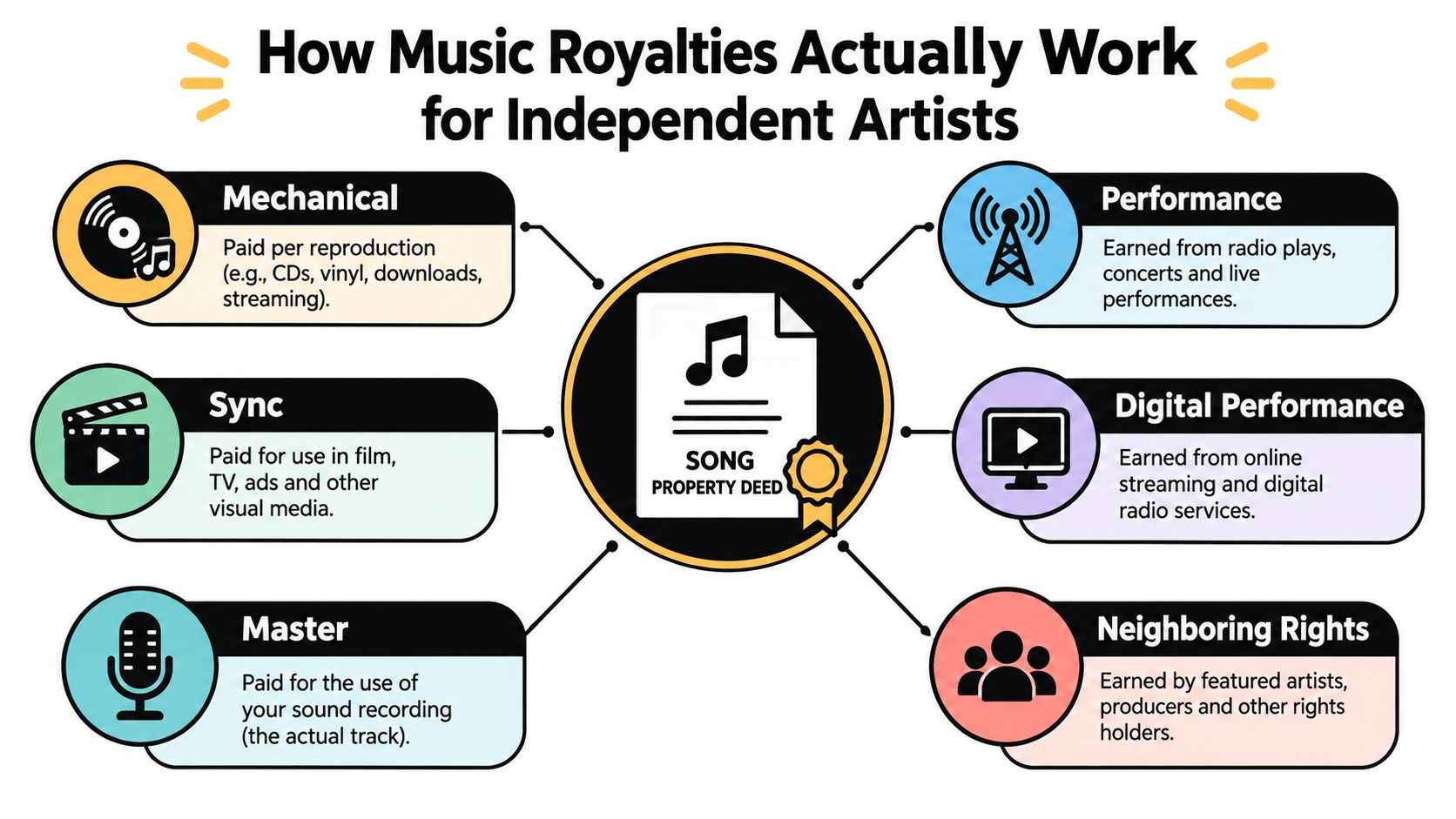
Think of a song as a property with two connected deeds. One deed belongs to the particular recording, including the vocal take, instrumental performance, and production captured in the master file. The other belongs to the composition, including the melody, lyrics, and musical structure.
When somebody streams the song, the service uses both. That means one use can create more than one payment, but each payment follows a separate rights path.
The recording side
Master royalties relate to the sound recording. If you own your master and distribute the track, the distributor receives reporting and payment from services, then pays you according to its agreement. A label, co-owner, or other rights holder may receive part of that money if you've granted them an interest in the recording.
Digital performance royalties apply to certain non-interactive digital uses, such as internet radio-style services. They aren't the same as the master income reported through an interactive streaming distributor. They involve a separate collection route and may cover featured performers, non-featured performers, and the sound recording owner.
Neighboring rights sit beside composition performance rights in some territories. They generally concern public use of the recording, particularly outside the United States, where local rules and collection systems differ.
The composition side
Mechanical royalties arise when the composition is reproduced, including through eligible digital uses. In the United States, independent songwriters commonly register their works with The Mechanical Licensing Collective, known as The MLC, to collect eligible digital mechanical royalties.
Performance royalties arise when the composition is performed publicly. A performance rights organization, or PRO, tracks qualifying uses and distributes the money to registered songwriters and publishers.
Sync royalties arise when music is paired with visual media, such as a film, program, advertisement, game, or social video. The composition and master usually require separate permissions, so ownership on both sides matters.
You can find additional practical answers about artist tools and music commerce in the OohYeah artist FAQ.
The key idea is simple: the recording and the composition are different assets. Registering one doesn't automatically register the other.
How Royalties Are Generated and Collected Step by Step
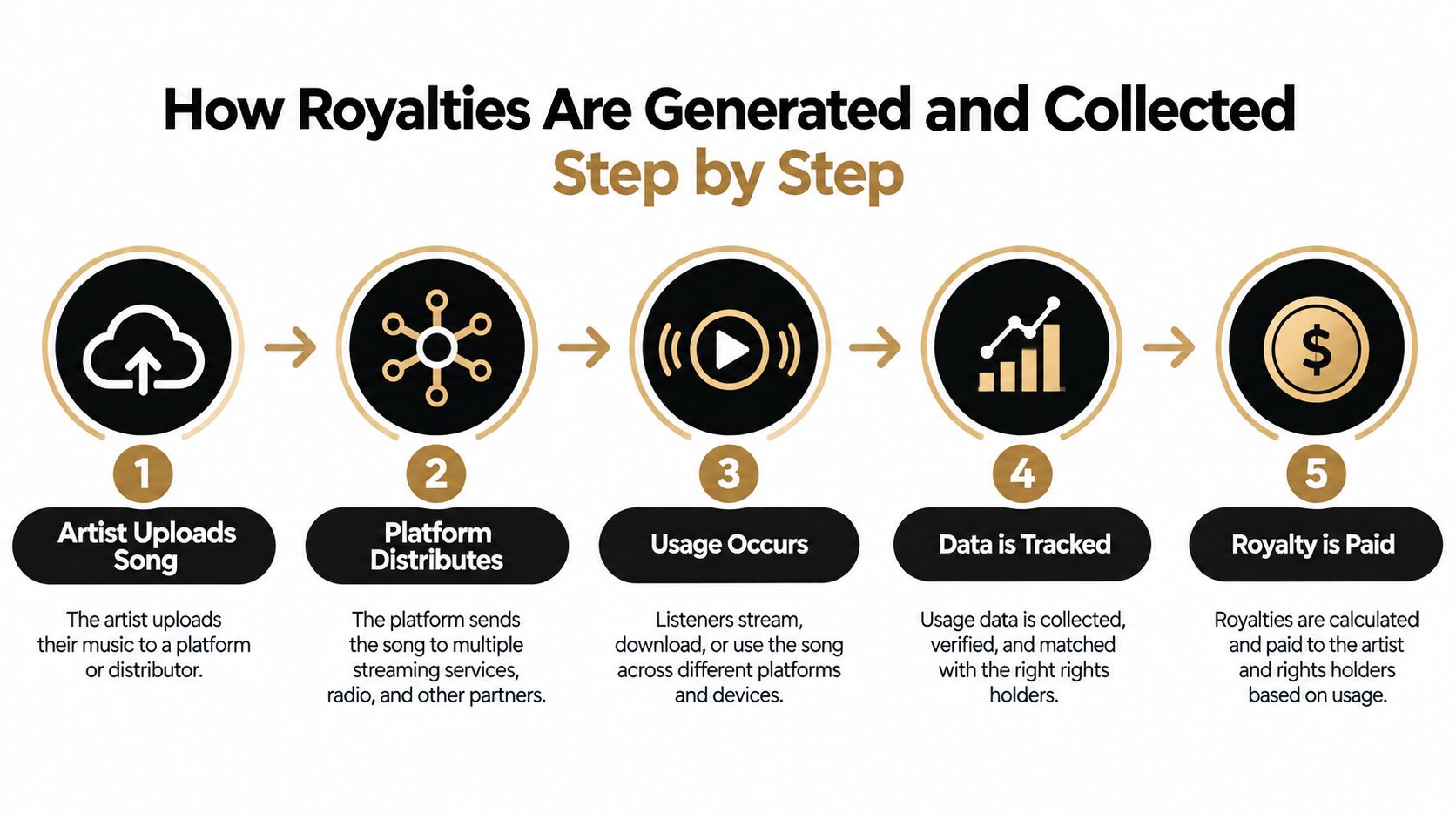
Royalty collection is a chain. A missing link can prevent payment even when the music is being used legally and generating reportable activity.
Step one, prepare the rights information
Before uploading, identify the owners of the master and composition. Record the song title, writers, publishers, producer arrangements, featured performers, and relevant identifiers in one place. If several people contributed, agree on the split before release rather than relying on memory.
The distributor needs accurate recording information. The MLC needs composition information. Your PRO needs songwriter and publisher details. These systems don't share every field automatically, so a correct upload alone isn't enough.
Step two, distribute the recording
Your distributor delivers the master to streaming and download services. When the recording is used, the distributor receives usage data and the recording-side payment, then credits your account after applying the terms of your distribution agreement.
That payment is often the figure artists see first. It isn't necessarily the complete royalty generated by the stream, because the composition has its own income path.
Step three, register the composition
If you wrote or co-wrote the song, register it with The MLC where applicable for mechanical royalties. Register the performance side with a PRO, and make sure your writer and publisher identities match across systems.
The practical issue is not merely registration. The title, writer names, ownership shares, and identifiers must also agree. A small metadata mismatch can make a correct claim difficult to match.
Step four, collect other uses
A stream isn't the only use that can pay. Live performances, radio-style digital services, public performances, visual media, and user-generated videos can involve different rights and collection routes. A publishing administrator may help with registration and collection, but read the agreement carefully so you know which territories and rights it covers.
The composition-side streaming payout is commonly described as roughly $0.001 to $0.002 per stream for mechanical royalties, plus about $0.0008 to $0.0012 per stream for performance royalties, according to a mechanical and performance royalty explanation. Those figures describe composition components, not a universal total for an artist.
Step five, reconcile the statements
Compare distributor statements with platform analytics, PRO statements, MLC records, and your own release log. Look for missing territories, duplicate releases, incorrect writer shares, and unexplained deductions.
The royalty collection video can help reinforce the flow visually, but your own spreadsheet or catalog system remains essential for tracking what you've registered and what you've received.
Why the Same Stream Count Pays Differently Across Platforms
Two artists can receive the same number of streams and earn different amounts because streams don't have a single fixed price. Platform, listener country, subscription tier, advertising mix, and rights deductions all influence the result.
A useful comparison from a 2026 analysis shows the following approximate recording royalty ranges:
| Platform or Market | Approx Per-Stream Range | What Affects Rate |
|---|---|---|
| Spotify | $0.003 to $0.005 | Service economics, listener market, account type, and rights splits |
| Apple Music | $0.007 to $0.01 | Subscription mix, territory, and recording ownership |
| Tidal | $0.012 to $0.015 | Platform model, territory, and applicable deductions |
| YouTube Music | $0.00069 to $0.008 | Advertising, subscription status, content context, and market |
| Emerging markets | $0.001 to $0.002 | Local purchasing power and subscription economics |
| United States | Closer to $0.004 in the cited breakdown | Listener country, service, and account type |
These ranges come from the 2026 streaming payout analysis. They aren't promises, rate cards, or guaranteed artist earnings. They describe why a generic “per-stream rate” can mislead you.
Geography changes the result
A listener in an emerging market may generate a different royalty outcome from a listener in the United States, even when both play the same track on the same broad category of service. Subscription pricing, advertising markets, currency, and local platform economics all shape the pool available for rights holders.
That makes audience geography a strategic metric. A dashboard showing total streams can hide the fact that one release has strong engagement in a lower-value market while another has fewer plays in markets with stronger subscription economics.
Platform mix matters too
Artists often promote a single stream target as though it were a universal business objective. A better approach is to track streams by service and territory, then compare those patterns with your royalty statements.
This doesn't mean you should chase one platform at any cost. Your audience may prefer a particular service, and forcing behavior can damage the fan relationship. It does mean you should understand what your current audience mix produces and build other income routes around it.
The visible number still isn't the final payment
The commonly quoted artist figure usually refers to the recording royalty after platform and rights deductions. Writers who control the composition must separately claim mechanical and performance income. This explanation of mechanical royalties makes that distinction clear.
Treat platform analytics as a map of audience behavior, not as a payment statement.
Understanding Splits Contracts and Ownership as an Independent Artist
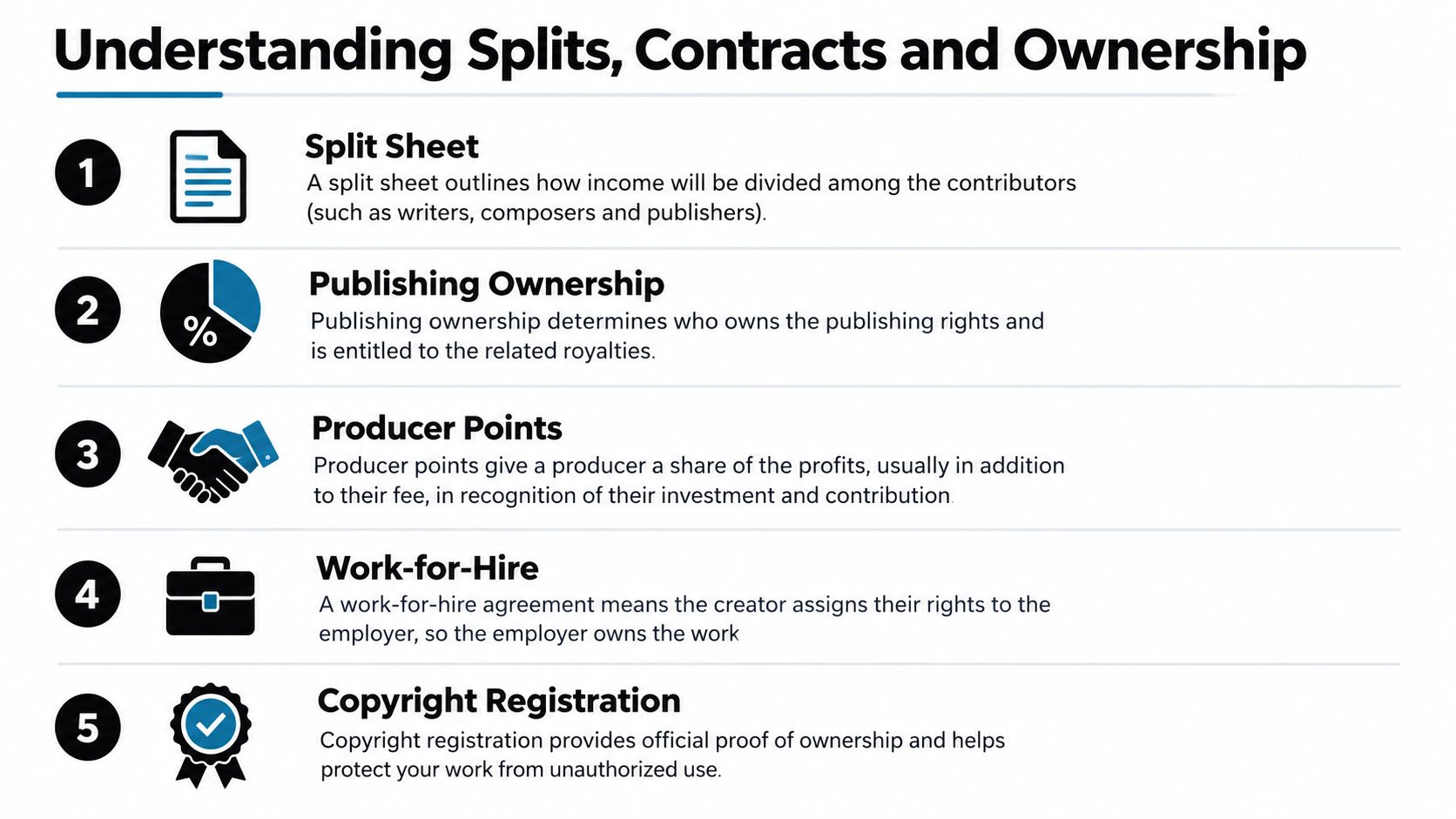
Royalty ownership is decided by agreements as much as by platform activity. If you share a track with another songwriter, producer, featured vocalist, or beat maker, the payment system needs a documented answer to one question: who owns which right, and in what share?
Start with a split sheet. It should identify every contributor, distinguish composition ownership from master ownership, state the agreed shares, and include signatures or another clear approval record. A split sheet doesn't replace a full contract, but it gives the registration and accounting process a reliable foundation.
Separate the deals
A producer may receive a master royalty interest, a composition share, a flat fee, or a combination. A featured artist may receive a master share and separate performance or songwriting treatment. A beat license may allow use under defined conditions without transferring ownership of the underlying composition.
Never assume that “I paid for the beat” answers every rights question. Check whether the agreement covers commercial release, content identification, sync, samples, future edits, and ownership of the composition.
Read the clauses that change your income
Look closely at:
- Ownership language: Confirm whether the agreement transfers, licenses, or merely permits use of a right.
- Royalty definitions: Identify whether a percentage applies to gross receipts, net receipts, or a specifically defined royalty base.
- Recoupment: Determine whether expenses must be recovered before another party receives a payment.
- Accounting terms: Check statement timing, audit rights, payment thresholds, and record access.
- Exclusivity: Make sure you understand whether another party controls licensing or distribution.
A fair split isn't automatically a simple split. Two co-writers may agree to equal composition ownership, while the master belongs to the artist who funded and released the recording. Another collaboration may justify a different arrangement. The important point is that everyone agrees before launch and registers the same information.
Don't negotiate from the stream count. Negotiate from the rights being granted.
If you need a direct artist-focused environment for organizing releases and audience activity, explore the OohYeah for artists page. Whatever platform you use, keep signed agreements and final metadata together in a catalog folder.
Practical Steps to Maximize Your Royalty Revenue
Maximizing independent artist royalties doesn't begin with chasing a larger stream count. It begins with preventing leakage, then identifying which markets and channels produce useful income for your catalog.
Use this workflow for each release:
Confirm ownership before upload. Save the split sheet, producer agreement, featured artist approval, and master ownership record. Make sure the release title and contributor names are consistent.
Choose distribution around your rights strategy. Compare how each distributor handles master payments, publishing administration, neighboring rights, content identification, withdrawals, and fees. A low headline fee may not be the right fit if you still need separate registration help.
Register every composition route. Join the relevant PRO, register works with The MLC where applicable, and consider publishing administration if international collection or catalog management exceeds your available time.
Read the market mix. Review platform, country, subscription, and playlist data. If your audience is concentrated in a lower-value market, don't treat that as failure. Use the information to plan merch, ticketing, memberships, sync pitching, and direct fan offers that aren't limited to platform payout economics.
Add income beyond interactive streaming. Independent artists still rely heavily on live work. One 2026 statistic set reports that 76% of DIY artists rely on live tours and merchandise for income, while fewer than 1.2% earn more than $10,000 annually from streaming. These figures are summarized in the independent artist statistics report.
Check thresholds and statements. The same report notes that Spotify introduced a minimum threshold of 1,000 streams in 12 months to generate royalties. That means small catalogs may produce no recording-side payment from qualifying activity before distribution commissions or other deductions are considered. Verify the current terms of each service and distributor rather than assuming every play creates a payable balance.
Build a direct channel carefully
A direct platform can complement distributors by letting you sell music, merchandise, or subscriptions under its own payment and agreement structure. OohYeah offers artist uploads for tracks, merchandise, and subscription services, alongside direct fan interaction and analytics. Treat it as one part of a broader system, not a replacement for registrations with the organizations that collect composition and performance rights.
Audit the catalog, not just the latest release
Set a recurring review for every track. Check whether the recording appears correctly at the distributor, the composition appears at The MLC, your PRO has the right writers and shares, and collaborators have received the statements promised in their agreements.
Small corrections are easier before a release spreads across services. Good royalty management is mostly disciplined recordkeeping applied repeatedly.
Building a Sustainable Royalty Strategy for the Long Term
Royalty management is an operating habit, not a one-time upload task. Every release should enter a system that records ownership, contributor agreements, identifiers, registrations, platform delivery, and received payments.
Keep separate records for master income, composition income, performance income, sync opportunities, direct sales, live revenue, and merchandise. That separation shows which parts of your career are growing and which depend too heavily on a single service or market.
Review your audience by platform and country, but don't reduce your strategy to the biggest stream number. A smaller audience in a stronger market may produce a different result from a larger audience elsewhere, while direct offers, live shows, merchandise, and licensing can make the same fan relationship more valuable.
Retain control where you can, and ask for professional advice before signing away publishing or master rights. Use transparent agreements with collaborators, audit statements, and correct metadata whenever a release changes.
For ongoing music business education and creator resources, visit the OohYeah magazine. Then choose one unreleased song and complete its split sheet, PRO registration, MLC registration, and distribution record before moving to the next release.
OohYeah gives artists a direct place to upload music, merchandise, and subscription offerings while managing pricing, distribution, fan interaction, and analytics. Visit OohYeah to add a direct monetization channel to your royalty strategy and keep your catalog business organized.