How to Host a Music Release Party: Indie Artist Guide
Plan a successful music release party as an indie artist. Learn timelines, budgeting, promotion, tech setup, and monetization strategies that actually work.
October 8, 2026
Music Marketplace Advisor
Buying & SellingYou've announced the single, booked a room, and started watching the guest list grow. Then the practical questions arrive: will anyone buy a ticket, what happens if the room is half full, and how do you turn one evening of attention into lasting income?
A music release party works when it's more than a launch-date gathering. Treat it as a compact fan funnel: give people a reason to show up in person, create something worth sharing, and offer a direct way to buy music, merchandise, subscriptions, or exclusive content afterward. The room can be small. The business model shouldn't be.
Why Release Parties Matter for Independent Artists
The original release party was less a public concert than a focused listening event. Artists, label representatives, journalists, industry contacts, family, and friends gathered around a new recording, creating a shared moment that helped people talk about the release and advocate for it. That relationship-building function still matters, but independent artists can now connect the room to direct sales and ongoing fan communication.
Nirvana offers a useful historical precedent. On September 13, 1991, the band held a party at Seattle's Re-Bar nightclub for the forthcoming release of Nevermind. The album officially arrived on September 24, sold 2 million copies before the end of that year, and ultimately sold more than 10 million copies in the United States alone, according to HistoryLink's account of the Re-Bar event and the album's commercial milestone. The party didn't cause those results by itself, but it shows how an intimate gathering can become part of a much larger release narrative.
Practical rule: Don't ask whether the party will “promote” the record. Ask which relationships, purchases, and conversations it will create.
Build the event around a shared moment
A standard concert asks fans to watch you perform songs they may already know. A release party gives them access to a moment they can't experience elsewhere. You might play the record from start to finish, explain the story behind key tracks, perform a stripped-back version, invite a collaborator onstage, or let attendees hear an unreleased version before the public launch.
That exclusivity gives the event a clear purpose. Without it, you're just competing with every other local show for attention. With it, fans have a reason to attend now rather than wait for a later tour date.
The strongest format combines three layers:
- Discovery, through the first full listen, a performance, or a guided conversation.
- Participation, through questions, community posts, fan messages, meet-and-greets, or a live discussion.
- Conversion, through direct music sales, merchandise, subscriptions, or digital access.
For an independent artist, the event can be a modest listening session, a livestream, a merchandise gathering, or a hybrid fan-community experience. You don't need a major concert budget to create concentrated attention. You need a compelling reason for the right people to gather at the same time.
Make advocacy part of the design
Invite people who can do more than fill seats. Loyal fans, local writers, playlist curators, photographers, producers, DJs, venue staff, and fellow artists can all extend the release beyond the room. Give them clear moments to capture, such as a visual reveal, a chorus everyone can sing, a limited physical item, or a short artist story that explains why the record exists.
Use the OohYeah Academy as part of your preparation for the wider release workflow, especially if you're connecting the party to direct fan engagement. The principle is simple: the event should produce both memories and usable follow-up assets.
Don't measure success only by attendance. Measure whether attendees bought something, joined your direct audience, shared the release, returned for another event, or became reliable advocates. A small room with strong participation can outperform a larger room full of passive guests.
The Economics Behind Release Party Investment
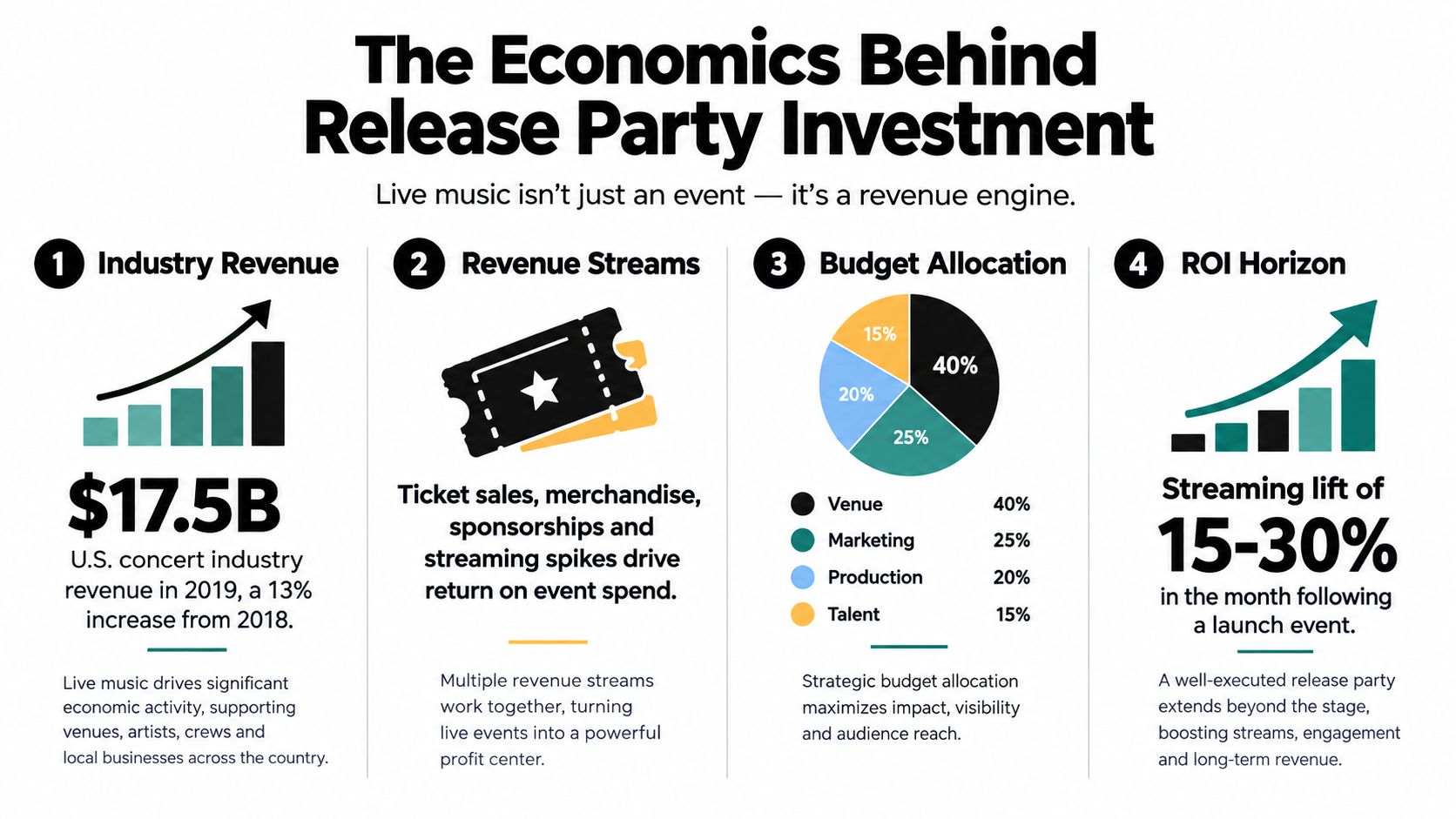
A release party becomes easier to budget when you stop treating every cost as marketing. It's a live sales environment with several possible revenue paths, and each path needs a deliberate role.
A U.S. economic-impact study covering concerts and live entertainment in 2019 recorded $132.6 billion in nationwide impact and supported approximately 913,000 jobs. The study also found that for every $100 spent on a concert ticket by an out-of-town attendee, another $334.92 flowed into accommodation, food and beverages, transportation, and retail, creating $434.92 in total local spending, as documented in the 2019 U.S. concert and live-entertainment economic-impact study.
A small release party won't replicate the scale of the concert economy. The lesson is that an event can activate spending beyond the ticket itself. Your audience may buy a shirt, pay for a premium experience, purchase the record, order food, subscribe for future access, or pay for a digital version after attending.
Start with break-even, not excitement
List every fixed and variable cost before you announce the event:
- Venue and staffing: Include hire fees, door staff, technical crew, cleaning, and any required insurance.
- Production: Account for sound, lighting, streaming, recording, staging, and backup equipment.
- Promotion: Include artwork, paid placements, photographer or videographer fees, and partner commissions.
- Artist costs: Travel, accommodation, hospitality, supporting performers, and rehearsals can erode the margin quickly.
- Sales infrastructure: Include payment processing, packaging, inventory, and delivery for physical products.
Then separate guaranteed income from hoped-for income. Presales and confirmed sponsorships belong in the first category. Walk-up tickets, merchandise purchases, and post-event subscriptions belong in the second. Build the event so it can survive without your most optimistic assumptions.
Venue economics make that discipline necessary. The National Independent Venue Association's 2025 report found that 64% of independent stages were unprofitable in 2024. It also reported that ticket sales represented 46% of venue revenue, while artist and booking fees accounted for 31% of expenses and staffing accounted for 26%, according to the NIVA State of Live 2025 report.
Those figures don't tell you what your event will cost, but they do challenge the assumption that a busy room automatically produces a healthy return.
Use scenarios instead of one forecast
Create a simple break-even sheet with three attendance scenarios: 25%, 50%, and 80% capacity. For each scenario, calculate ticket income, expected merchandise income, digital purchases, subscriptions, hospitality partnerships, and total costs. Keep the numbers grounded in your own audience history rather than generic industry expectations.
A hybrid model is often safer than a free party with no conversion plan. Keep the in-person experience intimate, then add commission-free digital downloads, limited merchandise, subscriptions, and exclusive content. The physical event creates urgency. The digital layer extends the selling window.
Your target isn't maximum capacity. It's a sustainable combination of cash collected before the event, revenue generated in the room, and fan value after the event. If the party can't reach break-even under a realistic attendance scenario, reduce production, renegotiate the venue, add a digital ticket, or postpone the launch format.
Planning Your Release Party Timeline and Checklist
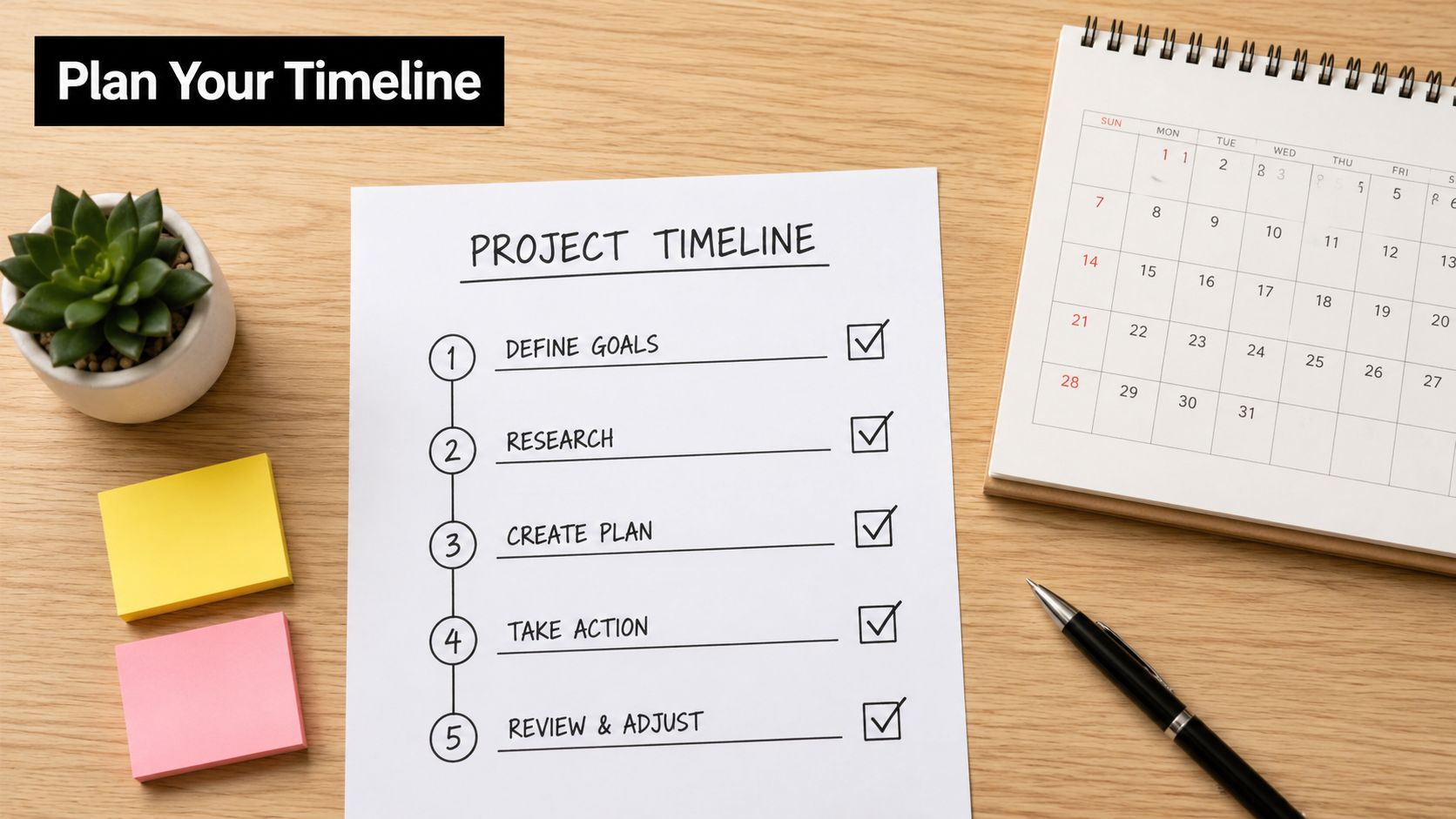
The event gets easier when every decision has an owner and a deadline. Work backward from the release date, then separate creative decisions from operational ones. The concept should be memorable, but the ticketing, access information, equipment, and staffing need boring precision.
Eight weeks out
Choose the format first. Decide whether guests will hear the album in full, see a live set, join a listening conversation, watch a hybrid broadcast, or move through several parts of the experience. Then lock the venue, release date, capacity, ticket structure, staffing plan, and production requirements.
Check the room in person. Listen from the back, stand near the bar, inspect power access, test mobile reception, and ask how the venue handles ticketing and merchandise. A room that sounds good at the front may produce an unfocused experience elsewhere.
Ask the venue for clear information about:
- Step-free entrances and routes
- Accessible toilets and seating
- Hearing support or assistive listening options
- Quiet areas and crowd-management procedures
- Lighting, sound limits, load-in access, and streaming permissions
Publish this information before tickets go on sale. Accessibility isn't a last-minute service decision. It affects who can confidently decide to attend.
Four weeks out
Release the announcement with one strong reason to attend. Avoid listing every feature in the first post. Lead with the rare experience, such as a full unreleased listen, a special performance, a limited physical edition, or a conversation with the people who made the record.
At this point, confirm:
- Ticketing and guest-list procedures.
- Artist and support schedules.
- Merchandise inventory and display location.
- Photographer, videographer, and streaming responsibilities.
- Accessibility requests and communication channels.
- Backup plans for missing equipment, delayed files, or performer cancellations.
Use direct messages and email for personal invitations. Public posts create awareness, but individual outreach creates attendance.
You'll find practical operational guidance and reusable planning resources in the OohYeah help center guides. Store your event brief, supplier contacts, running order, access notes, and post-event tasks in one shared document so the next release starts with a working template rather than a blank page.
One week and event day
One week out, test every digital asset and confirm the final guest list. Export offline copies of the album, visuals, presentation, ticket list, access requests, and emergency contacts. Send guests the arrival time, address, transport notes, accessibility details, and what they can expect.
On the day, assign one person to production and another to guest and sales support. You shouldn't troubleshoot a cable while greeting fans or selling your own merchandise.
The livestream needs its own plan, not just a camera placed at the back. Test the audio feed separately from the room mix, confirm the platform connection, monitor the broadcast from another device, and prepare a backup recording. A short technical rehearsal will expose problems while you still have time to fix them.
Document what happened immediately afterward. Record attendance, sales, questions, technical failures, useful suppliers, and the moments fans reacted to most. That record turns one release party into a repeatable operating system.
Promotion Strategies and Monetization Channels
Promotion and monetization should support each other, but they aren't the same job. Promotion gets the right people into the room. Monetization gives those people several natural ways to support the release once they're there.
Start with the channel you already control. Email and direct messages work well for personal invitations, early access, and ticket reminders. Social platforms are useful for visual teasers, rehearsal clips, guest announcements, and short explanations of the record. Local partners can contribute credibility and reach through record shops, independent venues, creative communities, radio programs, and complementary businesses.
Don't announce everything at once. Release the concept first, then reveal the guest experience, physical products, access options, and digital component in stages. Each update should answer one question: why attend, why buy now, or why share this with someone else?
Match the revenue stream to the audience
| Revenue Stream | Setup Complexity | Potential Impact | Best For |
|---|---|---|---|
| Tickets | Low to medium | Immediate event income | Audiences willing to commit to a date |
| Merchandise | Medium | Higher-value purchases and physical reminders | Fans who collect or want tangible support |
| Digital downloads | Low | Extends sales beyond venue capacity | Remote fans and attendees who want ownership |
| Subscriptions | Medium | Recurring support and ongoing access | Highly engaged listeners |
| VIP access | Medium | Premium income with limited capacity | Fans seeking direct artist interaction |
| Local partnerships | Medium to high | Shared promotion and in-kind support | Events with a strong community connection |
| Livestream access | Medium | Expands reach without enlarging the room | Remote fans and international audiences |
Use OohYeah's music and gear marketplace when you want to connect direct digital sales with merchandise or equipment-related offers. Keep the offer simple at the event. A QR code should lead to one clear page, not a maze of links.
Don't hide accessibility behind the fine print
Accessibility can expand your audience when you communicate it clearly. A 2025 Music Fans' Voice survey found that 13% of respondents would attend more gigs if venues were more accessible, while 60% said better value for money would increase attendance, according to its recommendations for improving live music access.
State the route, seating, toilets, hearing support, quiet space, lighting conditions, and contact method in the event listing. Offer access requests before tickets go on sale, then brief the whole team. Clear information helps fans decide without having to disclose personal details repeatedly.
If your audience is small, prioritize direct digital sales and personal outreach over expensive advertising. If the audience is highly engaged, add subscriptions or premium access. If the room attracts casual listeners, make the entry offer straightforward and place merchandise and digital purchase options where people naturally pause.
Running the Event and Show Structure and Execution
A release party needs a run-of-show, even when the atmosphere is informal. Without one, doors open late, the listening session drifts, the merch table becomes invisible, and the artist spends the night solving problems instead of connecting with fans.
Build the schedule around attention, not only clock time. Guests need space to arrive and talk, but the central moment must start when promised.
A compact listening party format
For a focused event, use this structure:
- Arrival and welcome: Give guests time to check in, find access points, visit merchandise, and settle.
- Opening context: Explain why the record matters and what listeners should notice. Keep it brief.
- Full listen or performance: Protect the central experience from interruptions. Silence notifications and reduce unnecessary movement.
- Artist conversation: Take questions, discuss selected tracks, and acknowledge collaborators.
- Conversion window: Make music, merchandise, subscriptions, and digital access easy to purchase.
- Closing moment: End with a clear thank-you, a final song, a group photo, or a limited reveal.
A longer celebration can add a support set, DJ segment, signing period, or livestream discussion, but every addition should serve the release. More programming doesn't automatically mean more value. It can dilute the reason people came.
Put one person in charge of each system
Assign a stage manager to call cues, a sound engineer to protect the listening experience, a sales lead to manage inventory and payment, and a host or moderator to guide the audience. If you're performing, don't make yourself the backup operator.
Prepare two versions of the schedule. The public version shows doors, performances, listening moments, and closing time. The internal version includes soundcheck, file checks, camera setup, staff briefings, access support, and contingency decisions.
Equipment fails. Streams drop. Attendance fluctuates. Your response should already exist:
- If playback fails: Keep a local backup on a separate device and switch to the conversation or live performance while the operator restores the system.
- If the room feels empty: Consolidate guests toward the strongest visual and acoustic area rather than leaving the audience scattered.
- If engagement drops: Change the format. Ask a specific question, bring up a collaborator, or move from passive listening to a short live demonstration.
- If the event runs late: Cut optional material, not the central release moment.
For larger parties, crowd flow and staff visibility matter as much as the setlist. If you're hiring professionals or working in New South Wales or Victoria, this practical guide to event security for NSW and VIC can help you think through staffing, entry, crowd behavior, and incident planning.
Record the best moments without turning the event into a content shoot. One strong clip of the audience reacting to the record is more useful than hours of footage nobody reviews.
Post-Event Follow-Up and Fan Retention
The night ends when the room clears. The release campaign doesn't. Your follow-up should make attendees feel recognized, give them something worth sharing, and create a next action that doesn't feel like a second ticket pitch.
Send a thank-you message while the event is still fresh. Include the official release link, a photo or short clip, access to promised digital material, and a direct invitation to reply. If someone asked a question during the event, answer it personally. That small effort separates a real fan relationship from a mailing-list transaction.
Segment people by behavior
Don't send the same message to everyone.
- Casual attendees should receive the released music, a concise thank-you, and an easy way to follow the next update.
- Active fans can receive behind-the-scenes material, early news, community discussion prompts, or invitations to future listening sessions.
- Premium supporters deserve the access or product they paid for, plus thoughtful recognition that doesn't turn every message into an upsell.
Track sales, attendance, digital purchases, subscription starts, replies, social mentions, new followers, and listening activity where the relevant platform provides those signals. The purpose isn't to create a vanity report. It's to identify which part of the event created a real relationship.
Turn the workflow into a release asset
Save the guest list with consent status, buyer history, access requests, content permissions, and follow-up outcomes. Keep the best questions, strongest audience reactions, and most effective invitation language. These records will improve the next launch.
Create an automated sequence with a personal tone:
- Thank attendees and deliver promised content.
- Share the official release and a story behind one track.
- Invite replies or discussion rather than asking for another purchase immediately.
- Present a relevant product, subscription, or future event.
- Ask what they want to experience next.
The most valuable outcome is not a single night of ticket income. It's a group of people who now understand the record, know how to support you directly, and expect to hear from you again. A small in-person room can start that relationship, while digital access keeps it alive after the lights go out.
OohYeah gives independent artists a place to combine direct music sales, merchandise, subscriptions, community posts, messaging, and fan access around a release. Build your next hybrid music release party around a small physical experience and a clear digital follow-up, then invite your audience to continue with OohYeah.