How to Get Paid on Spotify A Musician's Guide
Learn how to get paid on Spotify with our guide. We cover royalties, choosing a distributor, and strategies to maximize your music streaming income.
October 31, 2025
Music Marketplace Advisor
Buying & SellingGetting your music on Spotify is the first step, but getting paid is the real goal. To make that happen, you'll need to work with a digital distributor like DistroKid or TuneCore to get your tracks uploaded. From there, you'll link a payment method—like a bank account or PayPal—to your distributor's dashboard. Just as crucial is registering with a Performing Rights Organization (PRO) to make sure you're collecting all the royalties you've earned. Once you hit your distributor's minimum payout threshold, the money starts rolling in.
Decoding How Spotify Royalties Actually Work
Before we get into the nuts and bolts of setting up payments, it’s vital to understand how money actually travels from a listener's stream into your bank account. A lot of artists get tripped up thinking there's a fixed per-stream rate, but the truth is much more fluid. Spotify’s system isn't a simple, direct transaction; it’s a complex ecosystem where your earnings are tied to a shared revenue pool.
This visual gives a solid overview of how revenue flows from the platform right into an artist's pocket.
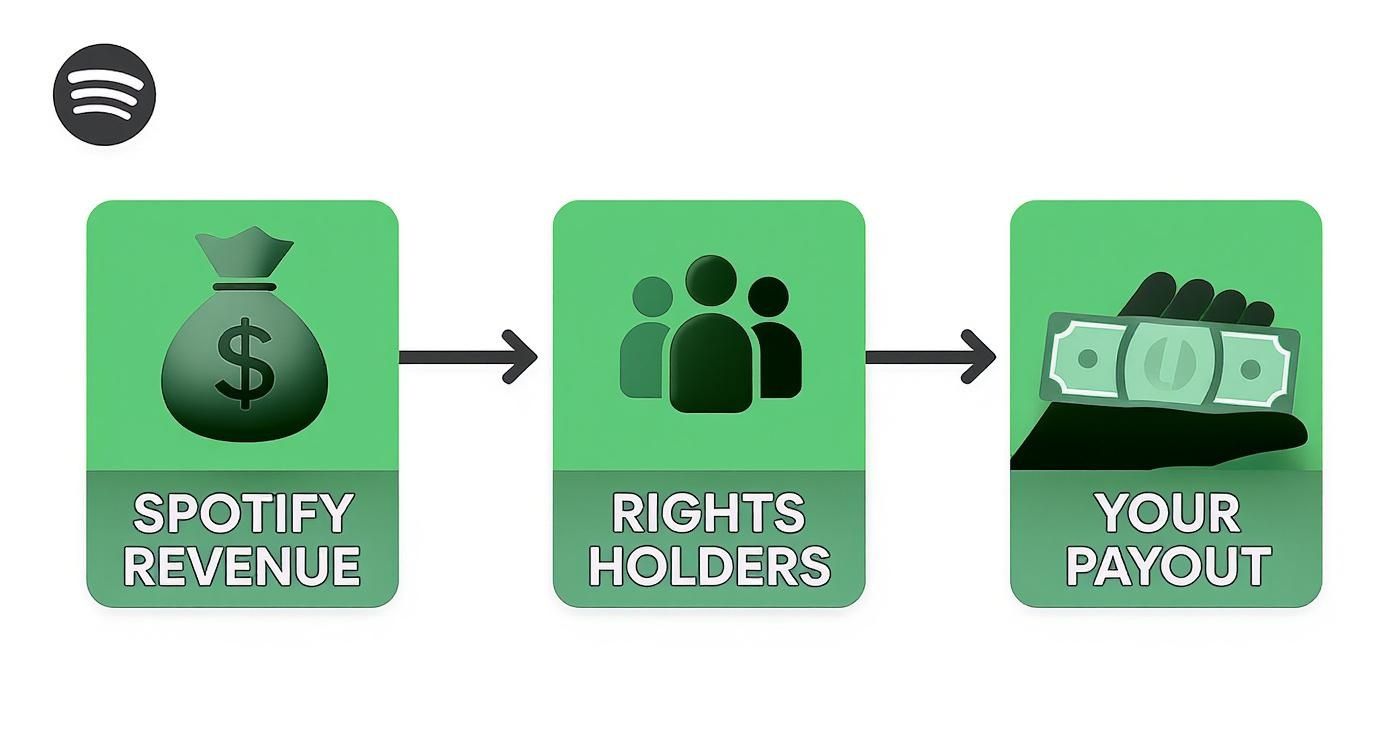
The main thing to grasp here is that your payout is a small slice of a much larger pie, which gets divided among every single rights holder on the platform.
The Pro-Rata Royalty Model
Spotify runs on what's called a pro-rata system. Instead of paying a flat fee every time someone hits play, the platform pools all the revenue from subscriptions and ads within a specific market (for example, the United States). From that giant pot of money, it calculates a "stream share" for each artist based on their percentage of the total streams in that market.
This means your per-stream earnings are never fixed. A stream from a Premium subscriber in the U.S. will generate more revenue than a stream from an ad-supported listener in a country with lower subscription fees. Spotify’s model is designed to share roughly 70% of its total revenue with rights holders—that includes labels, distributors, and publishers.
While you’ll often hear the average per-stream payout quoted between $0.003 and $0.005, this figure is just a blended average, not a guaranteed rate. Your actual earnings can swing quite a bit depending on several key factors.
To give you a clearer picture, here’s a breakdown of the main variables that determine your payout.
Key Factors Influencing Your Spotify Payout
| Influencing Factor | Impact on Your Payout | Example Scenario |
|---|---|---|
| Listener's Subscription Type | High | A stream from a $10.99/month Premium subscriber is worth more than a stream from a free, ad-supported user. |
| Listener's Geographic Location | Medium | A stream from a country with high subscription fees (like Switzerland) pays more than one from a market with lower rates. |
| Your Distribution Agreement | High | Your distributor takes a cut. A deal where you keep 100% of royalties (like with DistroKid) yields more than a deal with a percentage-based fee. |
| Relative Popularity | Medium | Your "stream share" is your percentage of total streams. If total streams on Spotify go up but yours stay the same, your per-stream rate can decrease. |
As you can see, it's not a one-size-fits-all number. Your per-stream rate is a direct result of who is listening and where they're listening from.
Performance vs. Mechanical Royalties
Every single time your song is played on Spotify, it generates two different kinds of royalties that you need to be set up to collect. It's a critical distinction that many independent artists miss.
- Performance Royalties: These are earned whenever your music is performed publicly, and yes, a stream on Spotify counts as a public performance. These are collected by Performing Rights Organizations (PROs) like ASCAP, BMI, and SESAC.
- Mechanical Royalties: These are paid to songwriters and publishers for the reproduction of a musical composition. Since a stream is considered both a performance and a reproduction, it generates both royalty types.
For independent artists, failing to register with a PRO is one of the most common ways to leave money on the table. Your distributor will typically handle the mechanical royalties, but those performance royalties? It's up to you to claim them.
Getting a handle on this dual royalty stream is fundamental to making sure you collect every cent you’re owed. It’s the kind of foundational knowledge that helps you set realistic expectations and figure out if you can truly make money from streaming services. Once you grasp these concepts, you can build a much smarter financial strategy for your music career.
Choosing the Right Digital Distributor
First things first: you can't just upload your music directly to Spotify. You need a partner in crime, a middleman known as a digital distributor. Their whole job is to take your finished tracks and get them onto streaming platforms, then turn around and collect the royalties you've earned.
Think of them as the crucial bridge connecting your music to millions of potential fans. Picking the right one is easily one of the most important financial decisions you'll make as an independent artist.
This isn't just about getting your songs online. It’s a business decision that needs to align with your career goals. Different distributors have wildly different ways of charging for their services, and what’s perfect for a producer dropping a new beat every week could be a terrible deal for a band that releases one album every couple of years.
Fee Structures: The Core Difference
When you boil it down, the main thing separating one distributor from another is how they charge you. Getting a handle on this is the key to maximizing what you get paid from Spotify.
- Annual Flat-Fee Model: You'll see this with services like DistroKid. They charge a single yearly subscription for unlimited uploads. You pay one price and can release as much music as your heart desires while keeping 100% of your royalties.
- Per-Release Fee Model: Companies like TuneCore often operate on a pay-as-you-go basis, charging a fee for every single or album you submit. This can be ideal if your release schedule is more sporadic.
- Commission-Based Model: Some distributors, such as CD Baby, might charge a one-time fee to get your music up, but they'll also take a small cut of your royalty earnings. With this setup, they have a vested interest in your success—they only make real money when you do.
To pick the right path, you have to be honest with yourself about your release plans for the next year or two.
I see this mistake all the time: an artist picks a distributor based on the lowest upfront cost, completely ignoring the long-term math. The musician who plans to drop a new single every month will save a small fortune on an unlimited plan, while the artist releasing a single album might just be throwing money away on a subscription they don't really need.
Matching a Distributor to Your Strategy
Let's look at how these models work in the real world for different artists. Your release frequency and your budget are the two main factors that should guide your choice.
Take a solo artist who’s constantly in the studio, putting out a new track every six weeks. For them, DistroKid’s flat-fee model is a no-brainer. They pay around $22.99 a year and can upload dozens of songs without a second thought, keeping every penny they earn. It’s a model that actually encourages creativity and frequent output.
Now, picture a four-piece rock band that just spent a solid year writing and recording a full-length album. Their plan is to release that one project and then hit the road for a year of touring, with no other releases on the horizon. For them, a per-release service like TuneCore or CD Baby makes a lot more sense. They pay a single fee for the album and don't have to think about a recurring subscription while they're living out of a van.
If you're still weighing your options, our detailed guide on the best strategies for independent music distribution can help you dig even deeper. The ultimate goal is to find a partner whose business model supports your creative flow, not one that gets in the way. Your distributor is a long-term piece of your career puzzle, so choose wisely.
Getting Your Money: Connecting Your Payout Accounts
Okay, your music is live and racking up streams on Spotify. That's the creative part done. Now for the business side of things: actually getting paid. It’s easy to get lost in the music and forget this part, but setting up your financial pipeline is non-negotiable. Think of your digital distributor as your financial middleman; you just need to tell them where to send your cash.
You'll do this right inside your distributor's dashboard, whether you're using DistroKid, TuneCore, or another service. Look for a section labeled something like "Payouts," "Banking," or "Wallet." This is command central for your earnings.
Setting Up Your Payout Method
Getting this set up is usually pretty painless. Once you find the right section in your account settings, you'll see a few options for how you can receive your money. Most distributors are set up to work with artists all over the world, so they offer a good bit of flexibility.
You'll typically see a few standard choices:
- Direct Bank Transfer (ACH): This is a popular one. It sends your earnings straight into your checking account. Simple and effective.
- PayPal: A fast, go-to option for many artists, especially if you're working across different countries.
- Wire Transfer: Better for larger payments and international transfers, but keep an eye on the fees—they can be a bit higher.
- Physical Check: It’s a bit old-school and definitely the slowest option, but some platforms still offer it if that’s what you prefer.
One thing to keep in mind is currency. Spotify typically pays out royalties in USD. If you're not in the US, this means dealing with currency conversion rates and fees. For musicians in South Africa, for instance, it might be worth looking into how to open a dollar account in South Africa to better manage those funds and avoid losing money to fluctuating exchange rates.
The Step Every Songwriter Forgets: Registering with a PRO
Here’s where a lot of artists trip up. Connecting your distributor to your bank account is only half the job. Remember how we talked about mechanical and performance royalties? Your distributor collects the mechanical royalties, but they do not collect your performance royalties. That money is sitting somewhere else, waiting for you to claim it.
This is hands down one of the biggest and most expensive mistakes I see independent artists make. If you haven’t registered with a Performing Rights Organization (PRO), you are literally leaving a huge chunk of your Spotify money on the table.
A PRO’s entire job is to track down and pay out the performance royalties owed to songwriters and publishers. If you’re in the United States, your main options are ASCAP, BMI, and SESAC. Every country has its own, like PRS for Music in the UK or SOCAN in Canada.
You need to register with a PRO as both a songwriter and a publisher to make sure you can collect 100% of the performance royalties you've earned. Yes, it’s a separate, one-time setup from your distribution deal, but it’s absolutely fundamental. Your distributor unlocks one revenue stream; your PRO unlocks the other. Don't skip it.
Actionable Strategies to Maximize Spotify Earnings
Just getting your music on Spotify is the first step. The real work begins when you start turning those streams into actual income. This isn't a "set it and forget it" game; growing your earnings means actively using the platform's tools and understanding what makes its powerful algorithms tick. It's the difference between just having your music on Spotify and building a real presence with Spotify.
Everything starts with your Spotify for Artists profile. If you haven't claimed it yet, stop what you're doing and get it done. This is non-negotiable. It’s your gateway to a whole host of promotional tools, but more importantly, it's how you can pitch your unreleased music directly to Spotify's editorial team for playlist consideration.
Pitching to Editorial Playlists
Pitching a new track is one of the single most impactful things you can do before a release. The golden rule? You have to submit your song at least seven days in advance through your Spotify for Artists dashboard. This gives Spotify’s curators enough time to actually listen and decide if your music is a good fit for their influential playlists.
When you're filling out the submission form, be thoughtful about the details you provide on genre, mood, and instrumentation. Specificity is your friend here. This info doesn't just go to human curators; it feeds the algorithm that can land your song on personalized playlists like Discover Weekly and Release Radar, even if an editor doesn't add it to a bigger list.
Landing on a major editorial playlist is like pouring gasoline on a fire. It can expose your music to a massive, engaged audience overnight, leading to a surge in streams that can genuinely change your monthly payout.
Driving Fan Engagement and Triggering the Algorithms
Beyond the editorial pitch, your own promotional efforts can directly influence how Spotify's algorithms see your music. The platform is designed to reward activity and engagement, so getting your fans involved is absolutely crucial. This is exactly where things like pre-save campaigns become so valuable.
A well-executed pre-save campaign sends a strong signal to Spotify that your upcoming release already has an audience waiting for it. When fans pre-save your track, it automatically lands in their library on release day, guaranteeing a burst of day-one streams and saves. That initial spike is often enough to trigger placement on algorithmic playlists, creating a snowball effect that can dramatically increase your total stream count.
Don't stop there. Here are a few other high-impact tactics to try:
- Canvas: Add a short, looping video to your tracks. It sounds simple, but songs with a Canvas see a real lift in shares and streams because they’re just more visually interesting.
- Marquee: This is Spotify’s own advertising tool. It lets you promote new releases directly to listeners who already like your music, making sure your biggest fans don't miss out on your latest drop.
It's also smart to think globally. Spotify recently paid out over $10 billion in artist royalties in just the first half of a year, with a huge chunk of that growth coming from European markets. In fact, these markets now make up nearly 35% of all global subscriptions. This shows just how important it is to think about your international audience when you're promoting your music.
By combining a direct pitching strategy with smart, fan-focused promotion, you give your music the best shot at getting noticed. For an even deeper dive, check out our guide on tips for increasing music streams and earnings.
How to Track and Understand Your Royalty Statements
Getting your music live on Spotify is one thing; figuring out what happens with the money is a whole different ballgame. Once those streams start rolling in, your distributor's dashboard becomes your financial command center. It's usually packed with analytics, but learning to make sense of it all is the real secret to turning that data into a sustainable income.
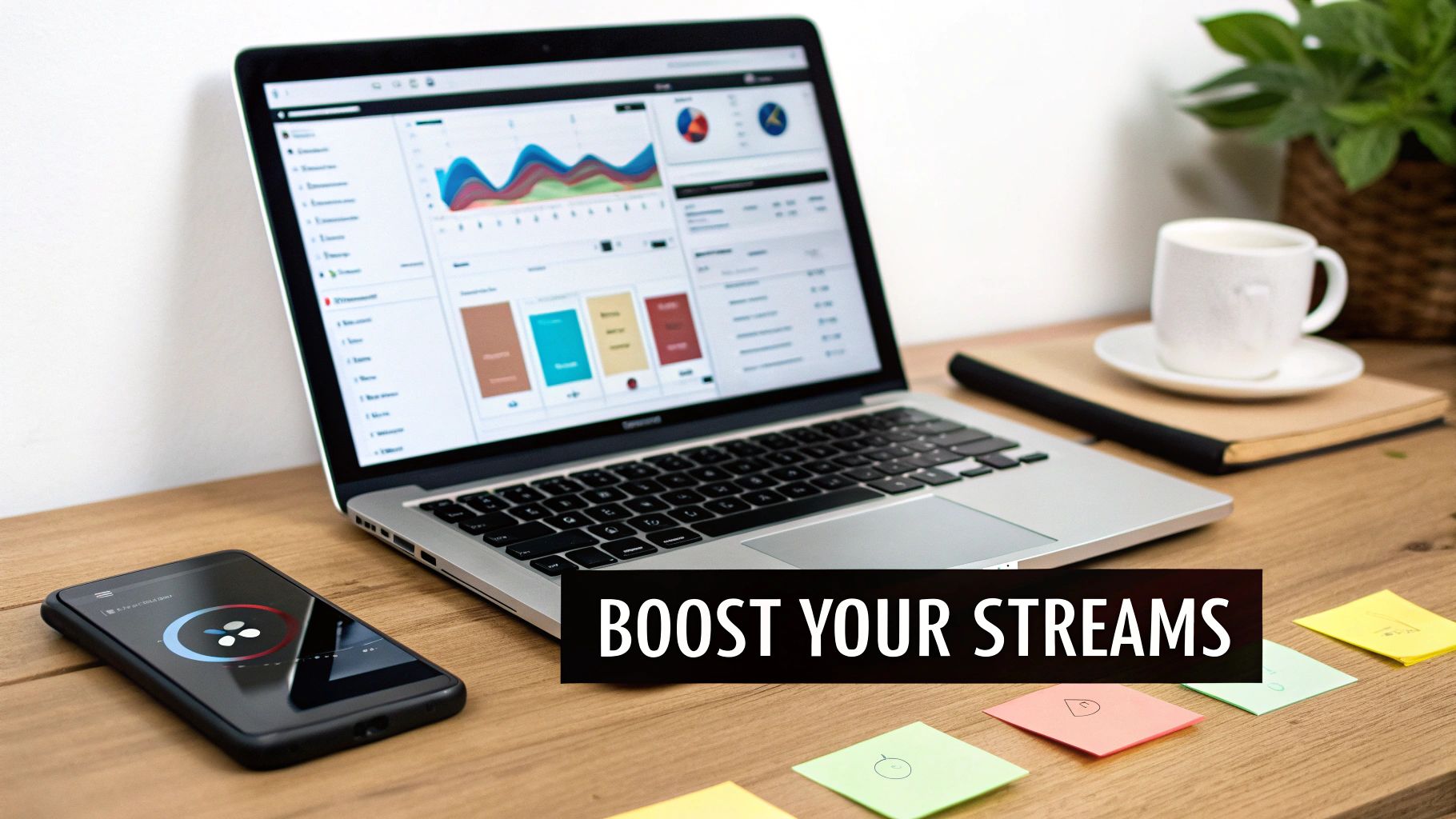
This dashboard isn't just for watching pennies trickle in. Think of it as a strategic tool. It reveals which songs are truly connecting with listeners, where in the world your fans are, and how they’re finding you in the first place. Honestly, unlocking how to get paid on Spotify is all about learning to read between the lines of these reports.
Identifying Your Top Earners
First things first, you'll want to pinpoint which tracks are your heavy hitters. Your analytics will clearly show your most-streamed songs, but it pays to look a little deeper. A song with slightly fewer streams from a country with high subscription rates, like the U.S. or Switzerland, might actually be earning you more than a viral hit in a market with lower ad revenue. It's not always about raw stream count.
The real gold is understanding the why behind your top songs, not just the what. Is a song blowing up because it landed on a popular fan playlist? Or is it getting consistent love from Spotify’s algorithmic radio? The answer tells you exactly where to focus your promotional energy next.
Let's say a specific track is getting a ton of traction from Discover Weekly. That's a huge signal from the algorithm that you should probably make more music with a similar vibe. That’s data you can act on. And for artists managing their own finances, getting a handle on the bookkeeping basics for small business is a non-negotiable for accurately tracking all your income and expenses.
Connecting Metrics to Real-World Strategy
Your data provides a direct roadmap for your career, if you know how to use it. By filtering your listener data by city, you can discover where your most dedicated fanbases are hiding, often in places you'd never expect.
Imagine you log in and see an unexpected surge of listeners in a city like Austin, Texas. That's a powerful piece of intel. You can immediately use that information to:
- Run targeted social media ads promoting your music specifically to users in that geographic area.
- Plan your next tour stop with a lot more confidence, knowing you already have an audience waiting for you.
- Reach out to local radio stations or music bloggers in that city for potential features or interviews.
These metrics transform your earnings from passive income into active business intelligence. The scale of those earnings can vary dramatically, of course. In a recent year, over 103,400 artists made at least $5,000 from Spotify, but only 20,500 managed to top $50,000. And remember, emerging artists have to hit 1,000 streams in a year just to qualify for royalties.
Mastering your analytics is how you move from just being on Spotify to actually building a career with it. It empowers you to make informed decisions that directly impact your bottom line, turning listener data into tangible financial growth.
Got Questions About Spotify Payouts? Let’s Clear Things Up
Navigating the money side of Spotify can feel a bit like a maze. As an artist, you're bound to have questions about how and when you actually get paid. It's totally normal, and getting these details straight is key to managing your career.
Let's break down some of the most common questions I hear from independent artists all the time.
One of the first things artists wonder is, "When do I get my money?" The truth is, it’s not an instant transfer from Spotify to your bank account. It all depends on your distributor.
Spotify sends the money to distributors on a monthly basis. From there, each distributor has its own timeline for processing those funds and getting them to you.
If you’re with a service like DistroKid or TuneCore, you can generally expect to see your royalties show up about one to three months after the streams actually happened. So, those streams you racked up in January? You'll likely see the payout for them sometime in March or April.
Why Do My Payments Swing So Much Month to Month?
It can be jarring to see your earnings bounce around, even when your stream count looks pretty stable. Don't panic—this is just how Spotify's "pro-rata" system works. You're not getting a fixed rate per stream; you're getting a slice of a massive, shared revenue pie.
Several moving parts cause these monthly shifts:
- Where Your Listeners Are: A stream from someone in the UK or the US, where subscription prices are higher, will always pay more than a stream from a region with lower-priced plans or less ad revenue.
- Their Subscription Plan: This is a big one. A stream from a Premium subscriber is worth significantly more than a stream from a free, ad-supported listener.
- The Time of Year: Ad spending often spikes in the last quarter of the year (think holiday season). This can give a little boost to the value of streams from free listeners during that period.
Your final payout is a blend of all these factors. Since your audience's listening habits and locations naturally change, so will your monthly earnings.
Payment Thresholds: The Hurdles to Your First Payout
Before you can actually withdraw your money, there are a couple of milestones you need to hit. First up is Spotify’s own rule. As of recent changes, a track needs to be streamed by at least 1,000 unique listeners in a 12-month period to even start generating royalties.
Once you’ve cleared that, you have to meet your distributor's minimum payout threshold. This is the smallest amount you can withdraw, and it varies from platform to platform. Most set this somewhere between $10 and $50. If you don't hit that minimum in a given month, your balance just rolls over until you do.
These rules are designed to help Spotify and distributors manage the sheer volume of music on the platform. Think of hitting that 1,000-listener mark as your first big checkpoint on the road to getting paid.
So, do you absolutely need a music publisher? It's not a requirement to get your distributor payouts, but a good publisher can be a game-changer. They chase down different kinds of royalties, like mechanicals, and pitch your music for sync licensing in TV shows, films, and ads. That's a whole other world of income that your distributor simply doesn't touch.
Ready to take full control of your music career? OohYeah provides a music-first ecosystem where you can sell your tracks, merch, and subscriptions directly to your fans with zero commission fees. Build a sustainable career on your own terms by visiting https://oohyeah.app today.