EP vs Single vs Album: Which Format Fits Your Release?
EP vs single vs album compared by track count, release goals and fan impact, with a guide to choosing the right format.
November 16, 2026
Music Marketplace Advisor
Buying & SellingStreaming generated US$20.4 billion globally in 2024, grew 9.5%, and represented 69.0% of total recorded-music revenue, according to the IFPI Global Music Report. That split should reset how you read an ep vs single vs album choice. Most recorded-music money now arrives as track-level listening, yet a stream, a download, and a physical copy are not the same commercial act.
I would treat the format as a fan-conversion and attention decision before I treat it as a length decision. A single can find a listener and still fail to hold them. An EP can deepen interest without the cost of a long campaign. An album can become a collectible and still miss the people who never hear track one. No format wins in every situation. The useful question is which fan behavior you need next, and whether your team can sustain the work that behavior requires.
Singles, EPs and Albums Side by Side
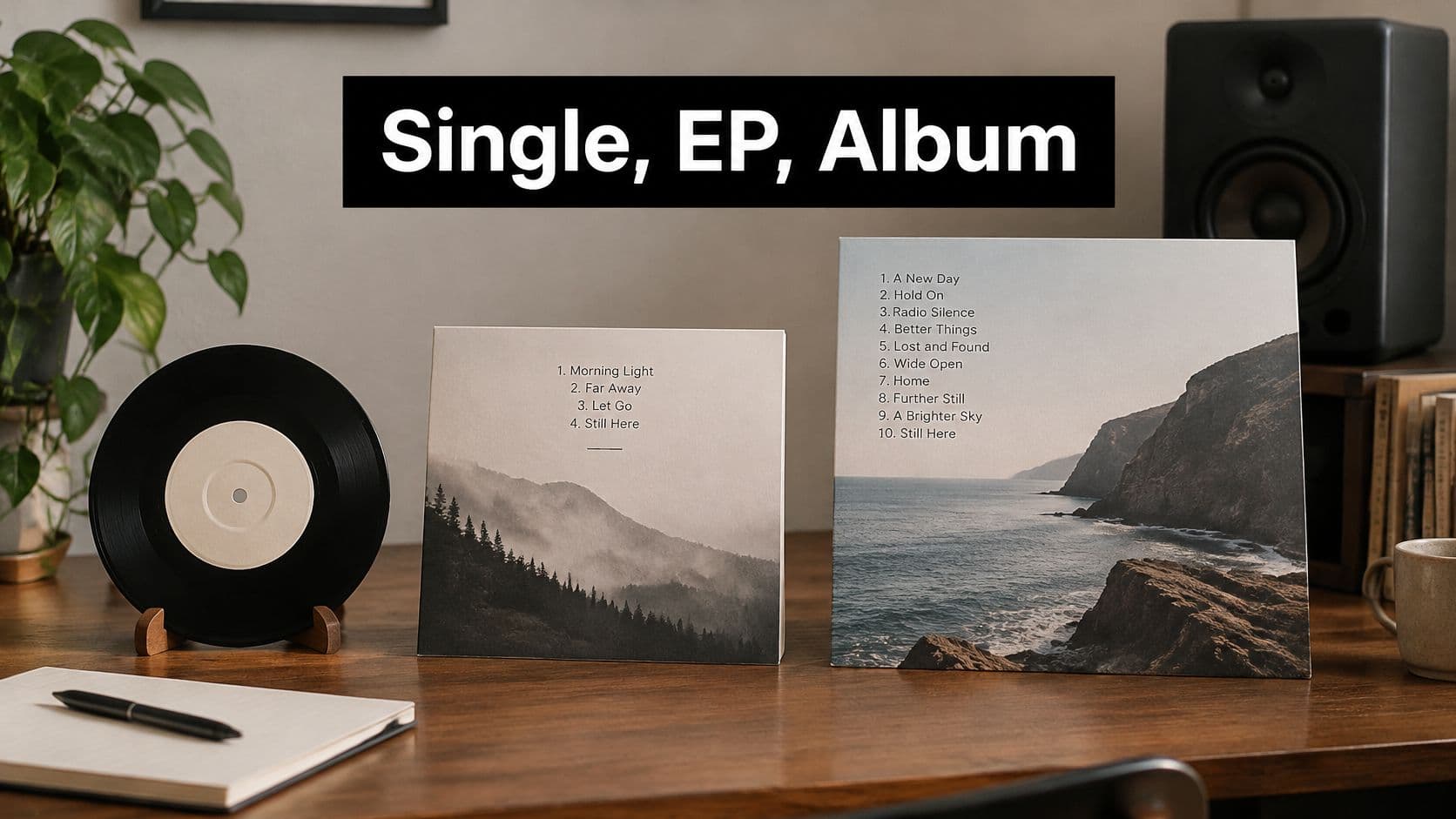
A single centers on one track and is scored through single-track downloads and streams. An EP (extended play) sits in the middle: more music than a single, less than a conventional album, and useful when you want to introduce a project without a full-length production and promo cycle. An album is a broader body of work, counted across physical sales, digital album downloads, and streaming. The IFPI methodology makes that split explicit. Its Global Single Chart counts digital consumption only. Its Global Album Chart includes physical, digital, and streaming formats.
| Format | Main job | How charts measure it | Typical effort |
|---|---|---|---|
| Single | Discovery and testing one track | Digital consumption only (IFPI Global Single Chart) | Low |
| EP | Deeper listening for a short, related project | Combined streams of the short project, under each chart's own rules | Medium |
| Album | Identity, storytelling and catalog depth | Physical, digital and streaming (IFPI Global Album Chart) | High |
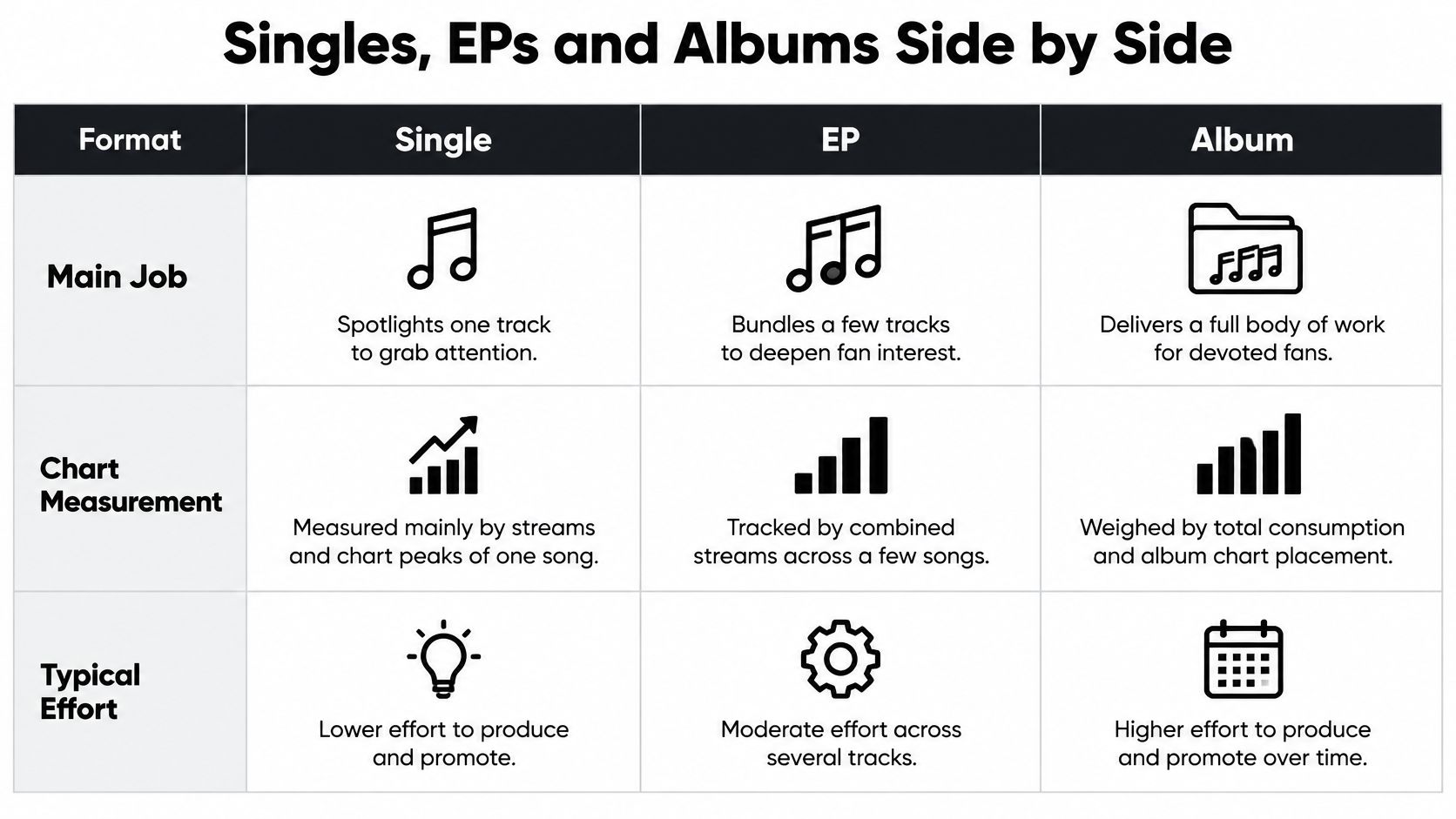
What each row is actually for
The single row is a test. You finish one master, point fans at one song, and learn whether the hook, the artwork, and the pitch land. Chart reporting follows that focus. Digital consumption of that track is what a global single chart can see. You are not building a catalog object yet. You are buying information about one song at a relatively low production and promotion cost.
The EP row is a short campaign with a point of view. Several related tracks give a new listener a second and third song without asking your team to sequence, press, and promote a long record. Chart treatment is not one global rule. Some charts roll the tracks into a short-project picture, and others reclassify the release once track count or runtime crosses their album line. You still plan one campaign, not six disconnected posts.
The album row is identity and catalog depth. Physical sales, digital album downloads, and streaming can all feed an album chart, so the same fan can count in more than one way. The cost is real. Sequencing, artwork, press, and a longer timeline all sit on this row. I would not pick it because you have "enough songs." I would pick it when the songs form a story fans can buy, talk about, and return to.
The same listener action is not valued identically across formats. A stream that lifts a single chart does not, by itself, build the physical and download picture an album chart can include.
Before you go further, name the one job this release must do: discovery, deeper listening, or a collectible product. Then circle the row that matches. If you want two jobs at once, you don't have a format yet. You have a sequence, and the first release should serve only the first job.
Track Count and Runtime Rules by Platform
Classification changes distribution, chart eligibility, and metadata. A general guide is a starting point, not a universal law. A single generally holds 1–3 tracks, with no track over 10 minutes. An EP commonly holds 4–6 tracks and stays under 30 minutes. An album typically has 7 or more tracks, or runs over 30 minutes. Wikipedia's overview of the extended play is a useful place to see how those thresholds diverge once a store or a chart writes its own rule.
| Rule set | Single | EP | Album |
|---|---|---|---|
| General guide | 1–3 tracks, no track over 10 minutes | 4–6 tracks, under 30 minutes | 7 or more tracks, or over 30 minutes |
| Apple Music | 1–3 tracks, each under 10 minutes | 4–6 tracks, 30 minutes or less | 7 or more tracks, or over 30 minutes |
| Official Charts Company | 1–3 tracks, 25 minutes or less | Four tracks or fewer, 25 minutes or less | More than four tracks, or over 25 minutes |
Apple Music treats an EP as 4–6 tracks and 30 minutes or less. The Official Charts Company classifies a release with more than four tracks or more than 25 minutes as an album. That second test is stricter. Four tracks can already fail it if you add a fifth song, and a short runtime can still fail it if you cross 25 minutes.
A five-track project that changes labels
Say you upload five songs that run 27 minutes in total. On Apple Music that package sits inside the EP band: five tracks, and under the 30-minute line. Under Official Charts Company rules, more than four tracks makes it an album, even though 27 minutes would have cleared a 30-minute EP ceiling elsewhere. The audio files did not change. The format label, the chart you can enter, and the way the release is reported all can.
That mismatch is why a "we'll call it an EP in the caption" plan fails. Stores and charts do not read your caption. They read track count, duration, and their own style rules. A distributor upload form may even use a third vocabulary, asking you to file two or more tracks as an album while a store later displays the same package as an EP. Plan the store rule and the chart rule as separate checks.
Count it before the upload
Add the track count, then add the runtime of the masters you will deliver, not the demos. Include hidden outros if they are separate audio files. Leave videos out of the song count. If one song runs past 10 minutes, don't assume the general single band still applies.
If you are also building a listening sequence for press or a private preview, check playlist runtime on HypedX so the running order you send matches the master you upload. A 27-minute sequence and a 31-minute sequence are not a rounding error. On several rule sets, that extra four minutes is the difference between an EP and an album.
I would verify every distributor and every chart territory before the release date is public. Use a single when you are testing one priority track. Use an EP when several related songs fit a production cycle you can finish. Use an album when sequencing, narrative, or catalog value justifies the extra metadata and the longer campaign. Write the track count and the total runtime on the same page as the goal you circled above, then check both numbers against every platform the release will reach.
How Release Frequency Competes for Fan Attention
Shorter formats now dominate the release mix. Singles and EPs represented 90.3% of releases in 2021, against 9.7% for albums, while albums represented 35% of releases in 2016, according to Music Admin's guide to release types. Artists moved toward more frequent entry points and away from one long project a year. That shift lowered the cost of being wrong about a full-length record. It also raised a different cost: attention.
| Metric | Value |
|---|---|
| Singles and EPs, share of releases, 2021 | 90.3% |
| Albums, share of releases, 2021 | 9.7% |
| Albums, share of releases, 2016 | 35% |
| New ISRCs per day to DSPs, 2024 | 99,000 |
| New ISRCs per day to DSPs, 2025 | 106,000 (up 7%) |
The volume behind that mix is the part most format advice skips. In 2025, about 106,000 new ISRCs were delivered to digital service providers each day, up from 99,000 daily in 2024, a 7% increase, in the Luminate year-end music industry report. You are not only choosing how many songs to ship. You are choosing how many competing entry points your fans, recommendation systems, and any outlet that might cover you have to sort through that week.
Why more singles is an incomplete plan
"More singles means more chances" is half true. Each single can create a post, a pitch, a story, and a reason to email the list. Each single also asks the same small audience to notice you again. If those notices don't add up to one project people can name, the campaign fragments. A coherent EP or album is worth the concentration only when you can hold attention for more than one track: enough engaged listeners, enough finished content, live dates that give the songs a room, or a direct relationship that doesn't depend on a playlist.
I compare formats by the conversion job, not by how many files are ready.
- Single: test or discovery. One song, one pitch, a clear read on whether anyone stays.
- EP: turn first interest into deeper listening. A short set that belongs together, promoted as one campaign.
- Album: identity, storytelling, or a high-value direct sale. Use it when fans already have a reason to want the whole object.
Commission-free downloads, subscriptions, merchandise, and direct messages can make a longer project commercially useful even when streaming favors individual tracks. That does not mean you should skip the single. It means the single's job is to find the people the longer project can later serve.
A cadence a small team can keep
Say an artist has a few hundred engaged fans and two live dates a month. One finished single every six weeks gives that room a new song without emptying the content pipeline. An album every year, with nothing between, asks those fans to remember a project they have not heard in months, then to absorb twelve songs on one Friday. The album can still be right later. It is a weak fit for that gap.
The same logic applies to the messages around the music. A release every six weeks needs a list you can write to on a rhythm you won't drop. Keeping a curation newsletter on schedule is a useful parallel: consistency compounds only if the calendar matches the hours you have.
Work out the gap your fan base, your content capacity, and your live schedule can sustain. Then choose the format that fits that gap. If the honest gap is six weeks and one song, ship the single. If you can hold one story for a month and you have four to six related masters, the EP is the concentration those fans can feel as an event.
Revenue Levers Each Format Unlocks
Streaming can dominate listening while physical demand still grows. In the United States, on-demand audio streaming reached 1.4 trillion streams in 2025, up 4.6%, while physical album sales rose 6.5%. Vinyl sales increased 8.6% to 47.9 million units, a nineteenth consecutive annual increase, in figures reported with the IFPI global charts overview. Singles remain the low-friction way fans discover you. An album can still work as a premium, collectible, relationship-building product. An EP is the test of whether fans will go deeper than one song before you fund a full campaign.
Match the product to the format, not the other way around.
- Entry-price download. A single is the low-cost door. An EP bundles several tracks into a moderate purchase. An album is the higher-value catalog item.
- Merchandise bundle. A single supports a one-track theme, a shirt or a sticker tied to one title. An EP can carry one concept. An album gives you the fullest story to put on a bundle.
- Subscriber exclusive. Singles suit a steady drip of extra audio or notes. An EP suits a campaign arc. An album suits fans who want ongoing deep listening, demos, and commentary.
- Collector or physical edition. A one-song physical run is rarely justified. A short EP can support a limited run. An album is the strongest object for collectors and superfans.
What one fan can actually buy
Take a 12-track album sold as a download with a merchandise bundle. That fan can buy the album, a shirt tied to the record, and a subscriber tier that includes a voice note about the sequencing. A single sold as a low-cost download reaches more people first, and it gives each of them less to purchase. The album may produce fewer first-day streams than a string of singles. It can still produce more direct sales per committed fan. If you have a defined concept but not the budget or the content pipeline for twelve songs, the EP is the middle ground: enough music to test commitment, not so much that the campaign collapses.
On our marketplace, sellers can offer music downloads, merchandise, digital products, subscriptions, exclusives, instruments, pro audio gear, and other music-related products. In My Purchases, fans see Purchased Music, Purchased Singles, and Purchased Albums as separate lists, so the format you choose is also how a buyer later finds what they own. Every artist chooses what to make available, so the shelf changes by profile. Streaming is still where fans find you. A purchase path sits beside it. You can point listeners who already care toward support for the artist once there is something specific to buy.
List the products each format could carry before you set a price. If the list for an album is only "the audio," you may not have a collectible yet. If the list for a single is a bundle, a vinyl, and a subscription arc, you are asking one track to do an album's commercial job.
Production Cost and Promotion Workload by Format
Production cost scales with the number of tracks you master and sequence, not with the word you print on the cover. A single needs one master. An EP needs several masters plus a running order. An album needs the full set of masters, a sequence that holds for the whole runtime, and a campaign long enough to introduce more than the opener.
Finish the single as one object. You need one master, one cover, one short campaign, and a release date you can say out loud. The reason to keep it this small is focus: every asset points at the same song. The common slip is skipping a second mix pass because the date is close. A rushed master is the version playlists and fans hear first, and you rarely get that first impression back.
Treat the EP as linked work, not a folder of singles. Mixing and mastering multiply, and someone has to decide the order, the gaps, and which song leads. The campaign has to explain why these tracks belong together. The common slip is mastering the songs weeks apart with different references, so track three is louder or duller than track one. Listen to the whole sequence in one sitting before you approve a master. If the energy drops in a way you didn't plan, fix the order or the master, not the caption.
Give the album a timeline that outlasts release week. Full sequencing, a coherent artwork set, and an interview or press cycle all take longer than the recording. The common slip is spending the entire promo budget on week one, then having nothing left when fans reach the later tracks. Hold at least one asset, a video, a live clip, or a direct note, for a song that isn't the lead.
Outside help belongs on the stage that would slip the date, not on every stage by default. Our Music Pros listings include Audio Production, Mastering Engineers, Mixing Engineers, Music Producers, Recording Studios, and Vocal Editing. Sellers can offer session work, overdubs, mixing, and mastering, and each listing shows its own currency and terms. Buyers can hire online session musicians, including guitarists, bass players, drummers, pianists, string players, horn sections, and vocalists, to record studio-quality tracks remotely. Sort by price or rating when you are comparing offers, and hire the one role that unblocks the master.
Promo video sits in the same workload, and it is easy to underprice. A startup promo video budget guide is a practical way to separate a simple lyric clip from a shoot that needs a location, a crew, and revisions. One strong clip for the lead single often beats four unfinished videos spread across an album you can't promote.
Estimate hours for writing the pitch, finishing artwork, delivering masters, and posting through the first month. Outsource only the stage that would move the release date. If the mix is the bottleneck, hire the mix. Don't hire a full campaign team to hide a song that isn't finished.
Which Format Fits Your Release Situation
The format should follow the conversion goal, not the amount of material sitting on a drive. Six finished songs can still be the wrong album. One finished song can be the right single even if you wish you had a record. Match the situation you are in.
| Situation | Best format | Why it fits |
|---|---|---|
| Testing a new sound with no established fans | Single | Low cost and fast feedback on one track |
| Building a fan base after first singles | EP | Deeper listening in one campaign without album cost |
| Concept-driven project with budget and content | Album | Identity, storytelling and a catalog object |
| Limited budget with a defined concept | EP | Middle ground between discovery and full album |
| Established fans wanting a collectible | Album | Premium paid product with merchandise potential |
| Small team needing a sustainable schedule | Single | Frequent entry points with a manageable workload |

Scenarios, not slogans
A producer testing a new genre, with no list and no live room that already knows the name, should ship one track. The feedback you need is whether strangers finish the song. An EP hides that answer inside five titles. You spend the budget before you know the sound travels.
A band whose first two singles built a small following has a different job. Those fans have already heard the test. They need a deeper listen that still fits one campaign: four to six related songs, one piece of artwork, one story for bookers and for the mailing list. That is the EP row. Jumping to an album here usually means paying for tracks the audience has not asked to sit with yet.
A songwriter with a concept, a budget, and a content plan can justify an album. The songs share a theme, the merch has a story longer than one chorus, and a subscriber exclusive can walk fans through the sequence. If that same concept is real but the budget stops at mixing, stay on the EP row. You keep the idea and drop the tracks you cannot finish well.
Established fans who ask for something they can hold are album fans, or at least physical-edition fans. Give them a complete object, a bundle, and a reason to talk about the sequence at a show. A small team that can reliably finish one song and one post cycle should stay on singles until the calendar proves otherwise. Frequency with a manageable workload beats a record that ships once and then goes quiet.
The format should follow the conversion goal, not the amount of material you have recorded.
A format is not a life sentence. A single can become the lead track of a later EP. An EP can grow into an album if the response, the budget, and the remaining songs support it. What doesn't work is relabeling a folder of unrelated demos because a release date is on the calendar. If you are ready to put the music where fans can follow the latest release, message you, and buy what you choose to offer, join as an artist and set the shelf to match the situation you picked.
Pick the row that matches this release. Write the format next to the goal. If the row and the goal disagree, change the release, not the goal.
Lock the Format and Build the 90-Day Sequence
Five checks turn the earlier decisions into a plan you can date. Skip one and the schedule becomes a wish.
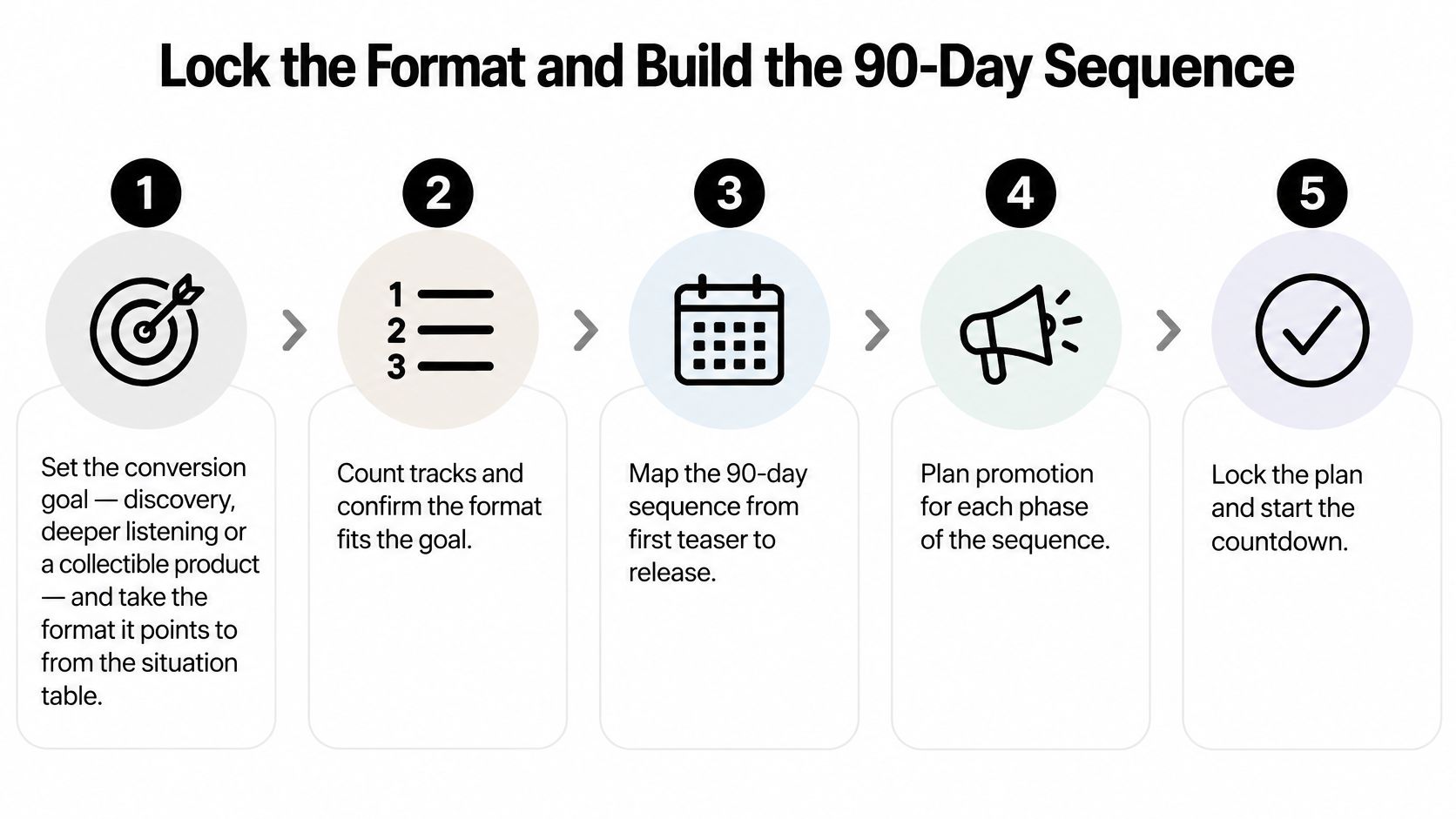
- Set the conversion goal, discovery, deeper listening, or a collectible product, and take the format the situation table points to. If the goal is discovery, don't start by pricing a vinyl run.
- Count tracks and runtime, then check them against each rule set. The same recording can carry different labels, so fix the sequence before you announce a format word.
- Confirm the release gap your engaged fans and your live dates can sustain. If you can't show up between releases, don't promise a cadence your team will miss.
- Price the production stages and outsource only the stage that would delay the release. Session players, a mix, or a master each solve a different delay. You can browse music services for the specific offer, then hire that stage only.
- List the products this release can carry: a download, a merchandise piece, a subscriber exclusive, or none yet. Price after the list exists.
Ninety days from lock to review
Days 1–14: finish masters, artwork, and metadata, and run the platform check. Days 15–30: release the lead single and start its campaign, even if an EP or album follows. Days 31–60: finish the remaining tracks for the EP or the next single, and set the purchase products. Days 61–90: release the next track or the EP, then review which songs drove streams and which drove direct purchases.
Keep the release on streaming first. We add a direct purchase path for fans, and that path doesn't replace streaming. The buying sequence is simple: fans stream to discover the artist, buy something the artist makes available, and help fund what comes next. Direct purchases can fund recordings, musicians, touring, and merchandise, which is why the product list in step 5 belongs on the same calendar as the masters.
At day 90 you should be able to say, in one sentence, whether this cycle was a single, an EP, or an album, and whether the next cycle stays there. If streams showed up and purchases didn't, the next gap may still be a single with a clearer offer. If a small group bought the bundle and asked what the songs mean together, you have evidence for a longer object, not just more files.
OohYeah is a music marketplace where you can stream, sell downloads, and offer merchandise, subscriptions, and exclusives without giving up control of your prices. Use it to match the format you just locked, whether that is a single for discovery, an EP for a short campaign, or an album fans can own, to a direct path beside streaming. Visit OohYeah and set up the release your fans can find, follow, and buy.