How to Be an Independent Artist: A Sustainable Career Plan
Discover how to be an independent artist with actionable strategies for distribution, monetization, and fan engagement that actually generate income.
October 12, 2026
Music Marketplace Advisor
Buying & SellingMost independent artists don't have a streaming problem. They have a business-model problem. Global recorded-music revenue reached approximately $36.2 billion in 2024, yet only 13.3% of surveyed artists reported earning a living solely from music in 2025. That gap explains why learning how to be an independent artist requires more than recording songs, posting clips, and waiting for an algorithm to notice you.
Independence doesn't mean doing every task alone. It means deciding where your time, rights, money, and audience attention should go, then building a portfolio of activities that can support one another. Streaming can introduce listeners to your work. Direct sales, memberships, shows, licensing, and fan relationships can turn that attention into a career.
Rethinking Income in the Streaming Economy
In 2024, the recorded-music market grew to approximately $36.2 billion, up 6.5% from the previous year. Streaming generated $22.2 billion, representing 61.3% of the total market, but its growth slowed to 6.2%, compared with 10.3% in 2023. These figures come from MIDiA's analysis of global recorded-music revenue.
That sounds like an obvious opportunity for independent musicians. It is, but not in the way many release checklists imply. A large streaming economy gives artists access to listeners around the world. It doesn't guarantee that an individual artist will capture enough attention, repeat listening, or income to cover recording and promotional costs.
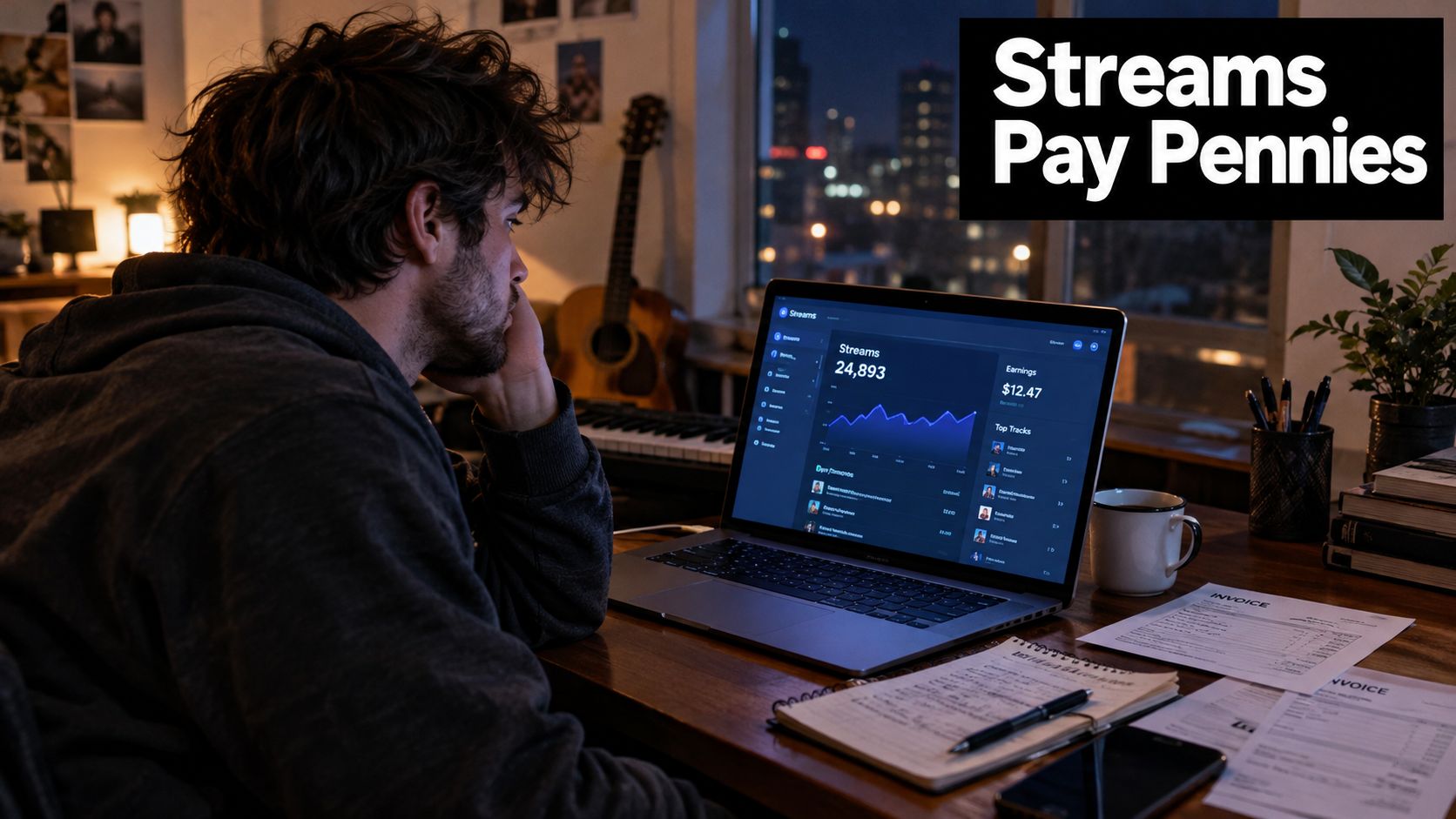
Treat streams as an entry point
Think of a streaming profile as the front door to your artist business, not the entire building. A listener might discover a song through a platform, save it, follow you, and eventually buy a ticket, order a shirt, join a membership, or commission work. If the listener never moves beyond the platform, you have limited control over the relationship.
Streaming also creates a competitive environment. Its share of the market didn't increase in 2024 for the first time, while growth slowed. That doesn't make streaming irrelevant. It means artists should use it deliberately for discovery, catalog listening, and credibility, while developing channels where they can communicate directly with supporters.
A sustainable release system therefore connects every song to a next action:
- Discovery: Make the track easy to find on streaming services and social platforms.
- Relationship: Invite interested listeners into an email list, community, or direct artist channel.
- Support: Offer a product, show, membership, download, or experience that gives fans a reason to pay.
- Retention: Continue serving supporters with releases, updates, live events, and useful exclusives.
The practical question isn't “How many streams did this song get?” It's “What did this release build that I can still use next month?” Resources such as the OohYeah music magazine can support the research side, but the core responsibility remains yours: connect attention to an owned relationship and a clear offer.
Building Multiple Revenue Lanes
Streaming income is fragile because the return from an individual play is small and the artist doesn't control the platform's payout rules. An academic analysis reports historical average payments of approximately $0.00473 per Spotify stream, $0.00735 on Apple Music, and $0.00402 on Amazon Music. Those figures are discussed in the Oregon State University academic analysis, which also notes that payment systems and rights-holder agreements affect the final outcome.
The solution isn't to abandon streaming. It's to give it a defined role inside a wider portfolio.
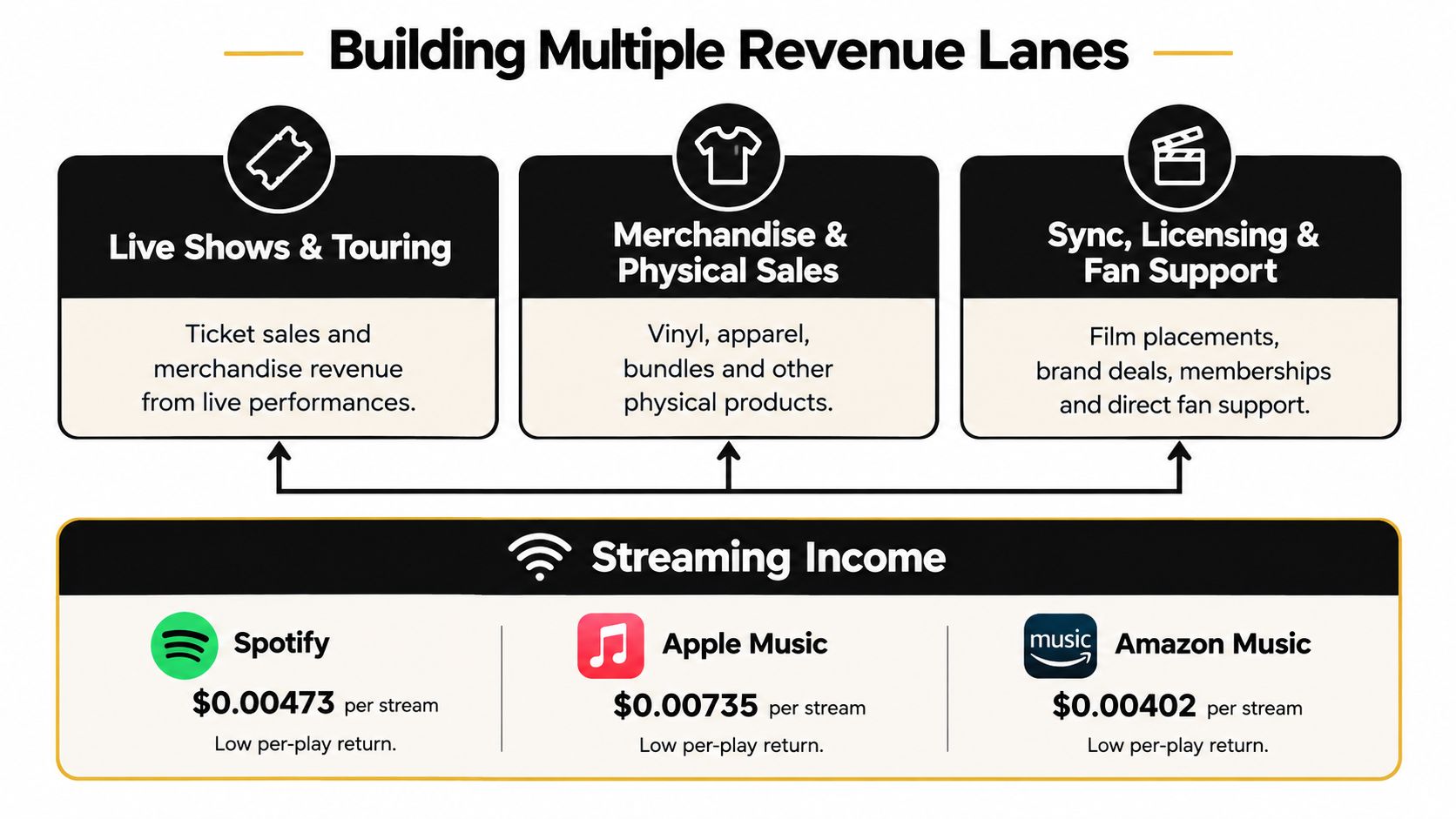
Compare the lanes, not just the totals
Recordings provide the catalog foundation. Songs can generate recurring listening, support playlist discovery, and supply material for performances or licensing. The weakness is that income depends on volume, rights administration, platform policies, and the distribution of attention across a crowded market.
Direct sales and memberships create a closer financial relationship. Downloads, physical releases, subscriptions, exclusive demos, lessons, and fan-supported offers let you sell an identifiable product or experience rather than relying only on individual plays. The work shifts toward customer service, fulfillment, communication, and creating benefits people value.
Live performances, merchandise, licensing, and commissioned work can produce larger transactions, but they carry more operational risk. A show includes rehearsal, travel, load-in, equipment, staffing, and promotion. Merchandise requires production, inventory decisions, shipping, and returns. Licensing requires clear ownership and organized metadata.
Practical rule: Every revenue lane needs an owner, a monthly target, and a cost record. If you can't explain what an activity earns after expenses, you don't yet know whether it belongs in your portfolio.
A band might use a new single for discovery, offer a limited digital bundle to existing supporters, and sell shirts at a show. Merch doesn't need to be elaborate to be useful. For artists comparing production methods, this guide to DTF printing for band merch offers practical context on creating apparel and related products.
The point is not to launch everything immediately. Start with lanes that match your audience, capacity, and skills. Use a direct platform such as the OohYeah marketplace alongside other tools if it helps you connect products, fan support, and music in one place. Keep the economics visible, then expand only when one lane demonstrates repeatable demand.
Creating a Portfolio Plan with Contribution Margins
Many artists make decisions from gross revenue. A show pays well, a product sells, or a song attracts streams, so the activity appears successful. That view hides the costs that determine whether the work actually supports your career.
Use contribution margin for each activity:
Contribution margin = net income minus production, travel, platform, advertising, and fulfillment costs.
Then calculate the return on your time. A performance that produces a positive payment can become unattractive after rehearsal, transport, load-in, soundcheck, performance, and follow-up. The same applies to merchandise when design, samples, packing, customer support, and unsold stock absorb the apparent profit.
Build the plan around decisions
A monthly portfolio plan should answer four questions:
- What must I create? Set a minimum viable creative schedule that protects songwriting, recording, rehearsal, or production time.
- What must the business earn? Assign targets to recordings, direct support, shows, products, licensing, or commissioned work.
- What must remain available? Keep a cash-flow reserve for unavoidable costs and avoid spending future income before demand is proven.
- What will I stop? Set a clear continue, change, or stop rule for each activity.
The financial reality makes this discipline necessary. In 2025, 77.8% of surveyed artists earned less than $15,000 from music, while 64.4% identified financial constraints as a major hurdle. Fanbase building and finding live opportunities were each identified by 55.6% of surveyed artists as major challenges, according to the 2025 music industry report from Xposure Music.
Use a simple monthly review
At the end of each month, record revenue, direct costs, hours, new supporters, repeat purchases, and outstanding obligations. Compare activities on both contribution margin and hourly return. A low-margin task may still deserve attention if it builds valuable relationships, but you should make that a conscious decision rather than an assumption.
Independence isn't measured by how many jobs you personally perform. It's measured by whether your effort creates assets you control, such as rights, catalog, customer information, reusable content, and reliable fan relationships.
The Evidence-Based Release Process
A release should answer a business question. “Will people like this?” is too vague to guide a budget. “Can this track convert interested listeners into direct supporters?” gives you an audience, an action, and a way to judge the result.
Research on 255 artists found no relationship between total social-media follower counts and total royalty earnings, although follower numbers were strongly associated with streaming royalties. The findings are available in this study of artists, social media, and royalty earnings. Use social platforms for reach, but don't confuse reach with an owned audience.
Start with one audience and one objective
Define the listener before choosing the content. You might be targeting local gig-goers, producers who value technical breakdowns, fans of a specific scene, or supporters who prefer limited physical products. A clear audience improves your creative decisions and prevents you from promoting the same release to everyone.
Choose one measurable objective. It could be community sign-ups, direct purchases, ticket presales, or qualified listeners who save and return to the track. Don't select follower growth only because it's easy to see.
Test before you scale
Use one track, one primary visual asset, and a limited promotional budget. Test different hooks, captions, thumbnails, or audience segments, but change one important variable at a time. Your first test should teach you something useful even if the campaign doesn't produce a large result.
Track the journey in cohorts rather than looking only at total plays:
- Engaged-listener cost: What did it cost to attract someone who listened meaningfully?
- Save or completion rate: Did the audience stay with the track?
- Profile-to-community conversion: Did interested listeners join a permission-based channel?
- First-purchase conversion: Did supporters pay for something relevant?
- Repeat-purchase rate: Did the first transaction lead to another?
- Retention: Did the relationship remain active after the release period?
A release earns the right to scale when its next action works, not when its top-line reach looks impressive.
Release consistently enough to create comparable evidence, but don't flood your catalog to compensate for weak positioning. If the test produces attention without supporter conversion, improve the offer or audience fit before committing to a larger campaign, EP, or tour.
Leveraging Unified Platforms for Growth
Independence does not require managing a separate distributor, storefront, membership service, messaging app, ticketing system, spreadsheet, and analytics dashboard. Each tool may solve one task, but disconnected records hide the path from listener to buyer, repeat supporter, or potential concertgoer.
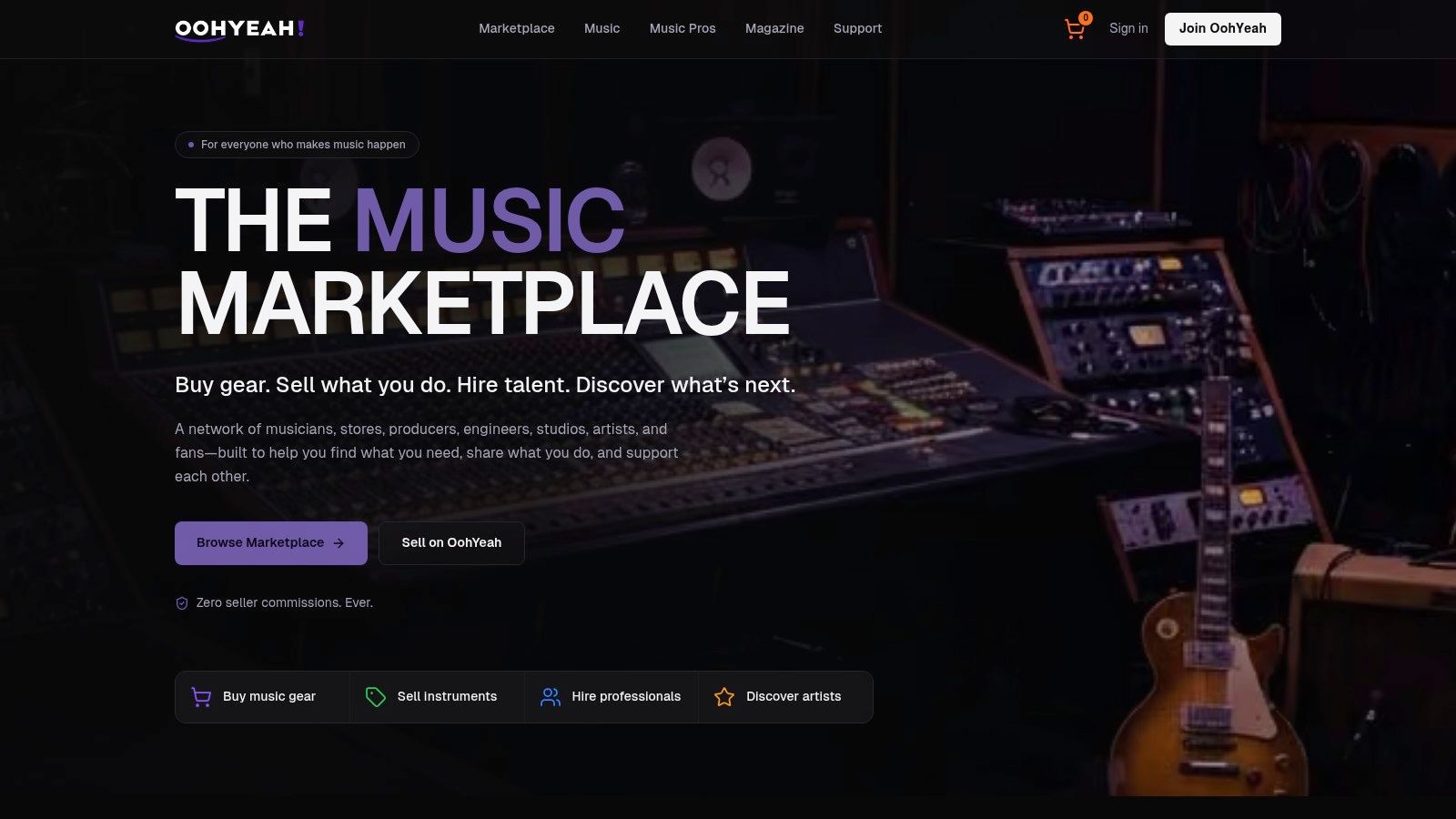
A unified platform can bring artist profiles, music uploads, digital downloads, merchandise, subscriptions, direct messaging, community posts, and audience information into one operating system. OohYeah illustrates this model. Artists can use an artist profile on OohYeah for Artists to sell music, products, exclusive content, and subscription offerings directly to fans, while fans can listen and communicate within the same ecosystem.
Connect measurement to action
Consolidated data matters when it changes a decision. Track which release drives profile visits, which audience segment joins your community, which product sells after a song campaign, and where direct supporters live. Use those findings to shape a touring route, product drop, or content choice.
A unified platform should support your operating model, not dictate it. Artists comparing audience behavior and distribution options may find this guide to picking between SoundCloud and Spotify useful when deciding where discovery activity belongs. External services may still serve specific purposes, while a unified platform gives direct-to-fan work a clearer center.
Set up the workflow around a measurable action:
- Upload the release and complete the artist profile.
- Attach a download, membership, product, or community invitation.
- Monitor movement from attention to supporter activity.
- Use those results to adjust promotion, products, and live planning.
- Continue an offer that produces meaningful supporter activity, and pause one that repeatedly consumes time without a useful response.
The goal is a portfolio of connected income and audience channels, not another dashboard to maintain. Strong music and consistent promotion still matter, but supporter behavior should guide resource allocation more than vanity metrics.
Navigating the AI-Era Rights Landscape
Generative AI has changed the practical questions artists need to answer. The issue isn't only whether AI will affect the music business. It's whether you can prove what you made, what you licensed, what you permitted a tool to use, and what your collaborators agreed to.
One projection estimates that AI could represent around 20% of music-streaming revenue and 60% of music-library revenue by 2028, while placing nearly a quarter of creators' income at risk. That projection is discussed in coverage of AI-generated music and its consequences for artists. Treat it as a planning signal, not a guaranteed outcome.
Make provenance part of your workflow
Before using an AI tool, document the rights attached to the vocal, backing track, lyrics, samples, recordings, and source material. Read the tool's license terms, preserve the relevant version, and disclose AI assistance to collaborators when it affects the creative or commercial result.
Maintain a catalog register that includes:
- Dated project files, stems, drafts, and session exports.
- Split sheets and written collaborator agreements.
- Sample, beat, vocal, and software licenses.
- Notes describing where AI assistance was used.
- Separate labels for human-made and AI-assisted releases.
- Ownership information for every recording and composition.
This documentation supports registration, licensing, dispute resolution, and honest communication with fans. Transparent provenance can become a competitive advantage because supporters increasingly care about how work was created, not only how it sounds.
Don't build your audience entirely inside opaque recommendation systems. Move engaged listeners toward permission-based relationships, such as email, community membership, direct messaging, or fan-supported offers. Those channels give you a way to explain your process, protect trust, and continue communicating when platform rules change.
Sustaining Your Independent Career Long-Term
The artists who last aren't necessarily the ones with the biggest single release. They're the ones who turn creative work into a repeatable operating system. Streaming supplies discovery, direct offers create monetization, live work builds experience and community, and careful rights administration protects the assets that make future opportunities possible.
Review the business every 90 days. Look at release-to-follower conversion, community opt-ins, direct-purchase rate, customer acquisition cost, refund rate, revenue per active supporter, contribution margin, and repeat support. Set stop-loss rules for paid promotion, and don't fund a tour with debt until demand has been tested through presales and realistic cost estimates.
Long-term test: Keep an activity when it creates controlled assets, positive economics, or meaningful supporter relationships. Change it when the evidence is mixed. Stop it when it consumes scarce resources without a credible path to value.
The live side of the business still deserves structured attention. Venue research, booking materials, timing, and professional communication can determine whether opportunities progress, so a practical resource such as the Paul Robins Promotions booking guide can help artists approach that work with greater preparation.
Learning how to be an independent artist isn't about mastering every platform or chasing every trend. It's about building a diversified portfolio, measuring what remains after costs, protecting your rights, and moving listeners toward relationships you can maintain.
OohYeah gives independent artists one place to present music, sell downloads and merchandise, offer exclusive content or subscriptions, and communicate directly with fans. Visit OohYeah to build a more connected release and revenue system around your catalog.