How Much Does Spotify Pay Per 1000 Streams? Find Out Now
Curious how much does Spotify pay per 1000 streams? Discover payout details, factors influencing earnings, and tips to maximize your income today.
August 18, 2025
Music Marketplace Advisor
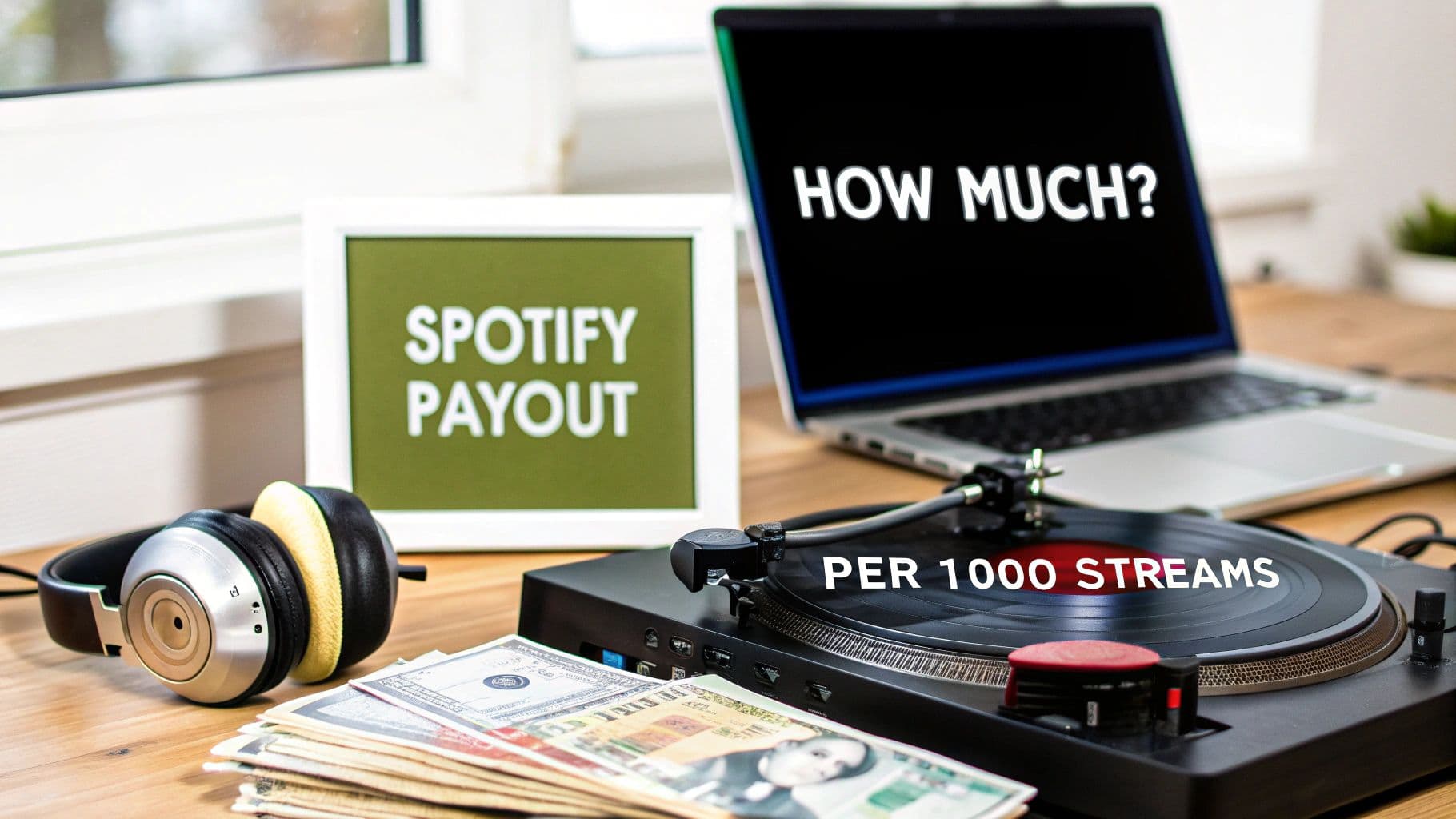
Buying & SellingLet's get one of the most common questions out of the way first: How much does Spotify actually pay? The short answer is that artists typically earn between $3 and $5 for every 1,000 streams.
But that's just an average, not a guarantee. The reality is far more nuanced, with your final payout being a moving target that can shift from one month to the next.
Your Quick Guide to Spotify Payouts Per 1,000 Streams
To really wrap your head around Spotify income, you have to ditch the idea that every stream is worth the same amount. It’s not like getting paid a fixed rate per hour. A better way to think about it is that you're earning a slice of a massive, shared pie.
This "pie" is the total revenue Spotify generates from things like Premium subscriptions and ads. The size of your slice depends on your music's share of the total streams on the platform.
This model is why the per-stream rate fluctuates between approximately $0.003 and $0.005. So, for every 1,000 streams, you're looking at a payout somewhere in the $3 to $5 range. What pushes it to the high or low end? It's all about the mix: where your listeners are, whether they're on a Premium or free plan, and the specifics of your deal with your label or distributor. You can get a more detailed look at how Spotify pays artists and the different factors involved.
Estimating Your Potential Earnings
Okay, so the rate is variable. But you still need to forecast your income, right? We can use that average range to get a decent ballpark estimate of what you might earn at different milestones. This is crucial for setting realistic goals and understanding what it takes to make a living from your music.
It's important to remember these are just estimates. Your actual earnings will be a unique blend based on your audience, their listening habits, and your distribution agreement.
The table below gives a practical look at what those numbers can mean for your bank account. It’s a helpful reference point for what you can expect as your stream count grows.
Estimated Spotify Payouts By Stream Count
This table shows the estimated earnings an artist can expect at various streaming milestones based on the average payout rate.
| Total Streams | Estimated Payout (Low End ~ $0.003/stream) | Estimated Payout (High End ~ $0.005/stream) |
|---|---|---|
| 1,000 Streams | $3.00 | $5.00 |
| 10,000 Streams | $30.00 | $50.00 |
| 100,000 Streams | $300.00 | $500.00 |
| 1,000,000 Streams | $3,000.00 | $5,000.00 |
| 10,000,000 Streams | $30,000.00 | $50,000.00 |
As you can see, the difference between the low and high end becomes pretty significant once you hit major numbers. This really underscores why understanding the factors that influence your per-stream rate is so vital for maximizing your revenue.
Unpacking Spotify's Pro Rata Payout Model
So, why isn't there just a simple, flat rate for every stream? The answer lies in Spotify's pro rata payout system. I've always found it helpful to think of it as the "big pool" method—it’s a surprisingly good analogy.
Picture this: all the money Spotify brings in each month from Premium subscriptions and ad revenue gets dumped into one giant swimming pool of cash. Before a single artist gets paid, Spotify takes its cut right off the top. What's left over is the royalty pool, and that’s the money that gets divided among all the rights holders—artists, songwriters, labels, you name it.
How Your Share Is Calculated
Here’s the part that trips up a lot of artists: you don’t get paid a fixed amount per stream. Instead, your payment is based on your streamshare, which is simply your slice of the total streaming pie on the platform.
Let’s break it down. If your songs racked up 0.1% of all streams on Spotify in a given month, you're entitled to 0.1% of the money in that month's royalty pool. Simple as that. This is the core reason why figuring out how much Spotify pays per 1000 streams is so difficult; the value of a single stream is a moving target, changing every single month depending on how much money is in the pool and how many total songs were streamed.
This pro-rata system means your earnings are directly tied to the platform's overall performance and total listenership, not just your own stream count. A busier month on Spotify with more total streams could mean each individual stream is worth slightly less.
This infographic does a great job of visualizing the moving parts at play—your streams, the variable rate, and your final payout.
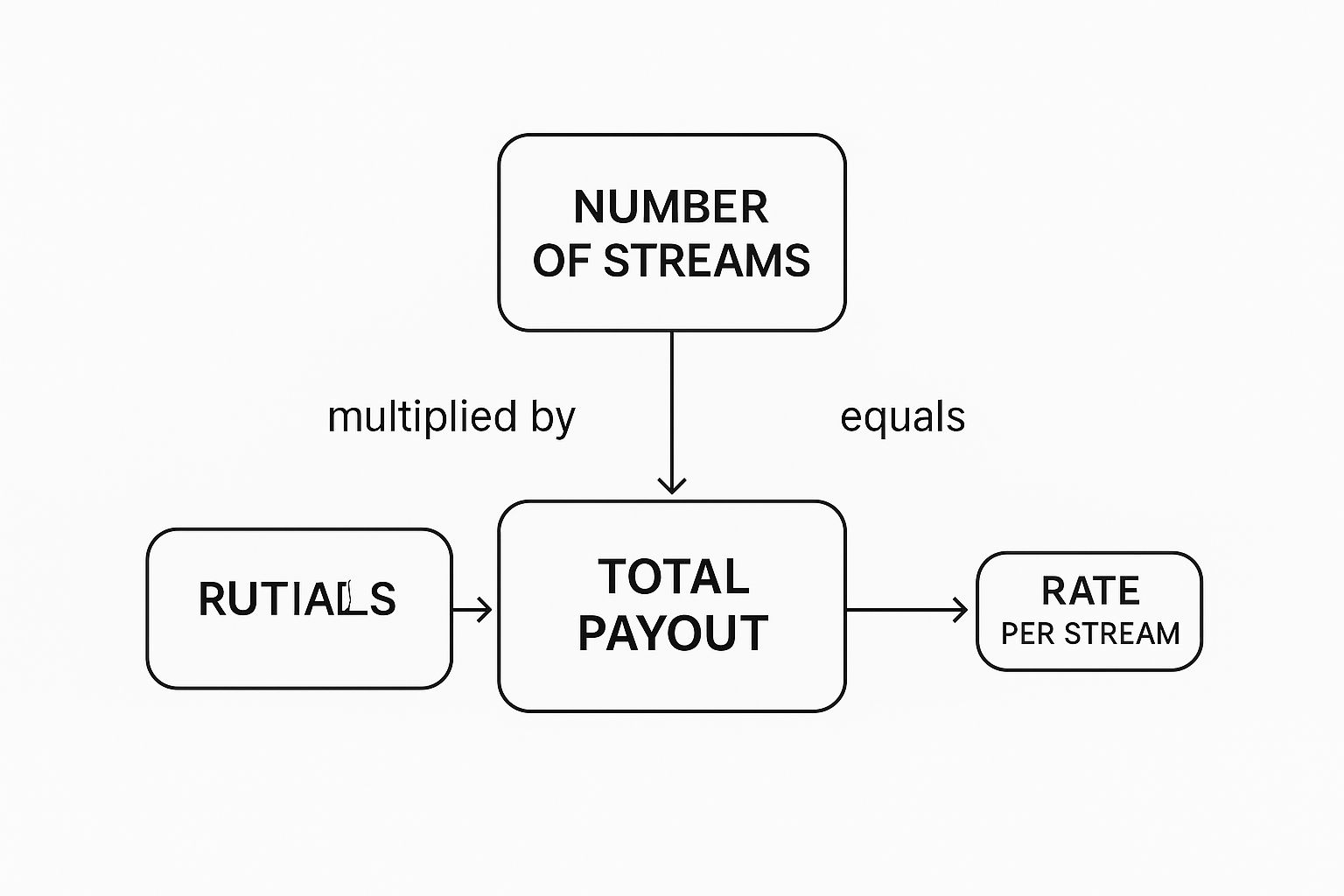
As you can see, the final number is a direct result of your total streams multiplied by a rate that's never quite the same from one month to the next.
The Big Pool Breakdown
To add another layer, the "big pool" isn't really one single, global pot of money. It’s actually a collection of many different pools, separated by country and by subscription tier (Premium vs. Free). This is why a stream from a Premium user in the U.S. is worth more than a stream from an ad-supported user in another country.
From a practical standpoint, the process looks something like this:
- Step 1: Revenue Collection: Spotify tallies up all the subscription and ad money from a specific market for the month.
- Step 2: Royalty Pool Creation: They take their cut, and the rest becomes the royalty pool for that market.
- Step 3: Streamshare Calculation: The system calculates your total streams as a percentage of all streams in that specific pool.
- Step 4: Payout Distribution: You receive your percentage share, which then makes its way to you through your distributor.
Getting a handle on this system is crucial, but it’s really just the beginning. A strong Spotify presence is just one part of a much bigger financial picture. For any artist serious about building a sustainable career, it's smart to look at platforms where you can sell your music directly to your audience and take more control over your income.
The Key Factors That Influence Your Earnings Rate

So, we've covered the pro-rata model—the how behind Spotify's payouts. But the real question for any artist is how much. The answer isn't a simple, fixed number. Not all streams are created equal, and understanding what makes one play more valuable than another is the key to truly grasping your royalty statements.
Think of it this way: your per-stream rate is always in motion, influenced by a few core variables. These factors act like multipliers, either boosting or shrinking the value of every single listen your music gets.
Once you get a handle on these dynamics, you can shift your focus from just chasing stream counts to cultivating a higher-quality, more valuable audience.
Your Listener’s Subscription Plan
First and foremost, the biggest driver of your payout rate is the type of account your listener has. Spotify's ecosystem is split into two main worlds: the free, ad-supported tier and the paid Premium subscription. Each contributes very differently to the royalty pot.
Simply put, a stream from a Spotify Premium subscriber is worth significantly more than a stream from a free user. Why? Because Premium users are paying a monthly fee that goes directly into that revenue pool, making their listens inherently more valuable.
On the flip side, streams from free accounts are paid for by advertisers. Ad revenue is far less predictable and generally lower than subscription fees, which translates into a smaller payout for you when those users hit play.
The Geographic Location of Your Listeners
Where in the world your fans are listening from has a huge impact. The value of a stream is directly linked to what Spotify charges for subscriptions and ads in a specific country, and these rates are all over the map.
A stream from someone in the United States or Switzerland, where subscription prices and the cost of living are higher, will drop more money into the royalty pool. In contrast, a stream from a developing market with lower-priced plans will contribute less, resulting in a smaller slice of the pie for you.
This is exactly why an artist with one million streams from the U.S. can easily out-earn another artist with the same number of streams spread across lower-paying territories. Location is everything.
Spotify’s average pay-per-stream rate has been a moving target for years, generally fluctuating between $0.003 and $0.005. To put that in perspective, you need somewhere between 200 and 330 streams to earn just $1. It’s a stark reminder that in the streaming world, volume is the name of the game.
Your Distribution and Label Agreements
Finally, let's talk about the money trail. The royalties from Spotify don’t just magically appear in your bank account. They first flow through an intermediary—your music distributor or record label—and the deal you have with them dictates how much you actually pocket.
Your distributor is the service that gets your music onto Spotify and collects the money on your behalf, usually for a small commission or a flat annual fee. A record label deal is a different beast entirely, where the label often takes a much larger cut in exchange for its investment in marketing, recording, and support. This is a critical piece of the puzzle for learning how independent artists make money from music.
The better your deal, the more you keep. A low-commission distribution agreement directly increases your effective per-stream rate, making every single play more profitable.
Impact of Key Variables on Spotify Payouts
To see how these factors play out in the real world, let's break them down side-by-side. The following table illustrates how different scenarios can either boost your earnings or pull them down.
| Factor | Higher Payout Scenario | Lower Payout Scenario |
|---|---|---|
| Listener Subscription | Your audience consists mainly of Premium subscribers who pay a monthly fee. | Your listeners are primarily on the free, ad-supported tier. |
| Listener Location | Your streams come from high-payout countries like the US, UK, or Switzerland. | A large portion of your streams originate from lower-payout territories. |
| Distribution Deal | You have a low-commission or flat-fee deal, keeping 90-100% of your royalties. | Your label or distributor takes a significant percentage of your earnings. |
Understanding this interplay is crucial. You could have a massive hit in a lower-payout country but still earn less than an artist with a smaller, more concentrated fanbase of Premium subscribers in the United States. It's all about the quality and context of your streams, not just the raw numbers.
Understanding Spotify's 1,000-Stream Gate
For any artist just starting out, getting that first royalty check from Spotify feels like a major milestone. But before the money starts rolling in, there’s a crucial first step every single track has to clear. Think of it as a gatekeeper for monetization.
Spotify requires a track to get at least 1,000 streams within a 12-month period before it can start earning royalties. This policy was put in place to tackle artificial streaming and make sure the money flows to artists who have a real audience, no matter how small.
How It Affects Your New Music
So, what does this mean in practice? It’s pretty straightforward: the first 999 streams on your brand-new song earn $0. Nothing. It’s only when you hit stream number 1,001 that the cash register starts to ring. Those first thousand streams are all about getting you to the starting line.
This reality highlights just how important your release day strategy is. All that work you put into social media posts, playlist pitching, and telling your friends isn't just for exposure—it's what gets you past this initial barrier and into the monetization game.
Essentially, the threshold acts as a filter. It prevents the system from getting clogged with tiny payments for millions of tracks that nobody is listening to, focusing the revenue on music with genuine listener engagement.
It might seem like a tough hurdle, but it also gives you a clear, measurable goal for every song you release. Your job isn't just to upload the music; it's to rally your core fans to get each track over that initial hump.
The "Why" Behind the Rule
Spotify's logic here boils down to two things: efficiency and fraud prevention. Imagine the administrative nightmare of processing payments for millions of songs that only have five or ten plays. It just isn't practical. By setting a minimum, Spotify keeps the payout system manageable.
More importantly, it helps shut down bad actors. Without a threshold, people could upload thousands of low-quality tracks and use bots to generate a few streams on each, slowly siphoning money from the royalty pool. Requiring a baseline of real listener activity helps protect the integrity of the whole system for legitimate artists.
Once your song is eligible, the numbers start to look much more encouraging. A track that crosses the one-million-stream mark, for instance, could earn anywhere from $3,000 to $5,000. You can find more details about Spotify’s monetization policies on printify.com to get a fuller picture.
Actionable Strategies to Maximize Your Spotify Revenue
Knowing the math behind your Spotify payout is one thing, but putting that knowledge to work is what really counts. If you want to increase what you make per 1,000 streams, you need a plan that’s more sophisticated than just crossing your fingers for more listeners. It's all about strategically guiding your audience and signaling to Spotify's algorithm that your music deserves a bigger spotlight.
The real aim is to get a flywheel going—where every action you take builds momentum for the next. This means focusing on tactics that don’t just drive a few initial streams but also foster the kind of long-term engagement that genuinely grows your income.
Master Your Spotify for Artists Profile
Think of your Spotify for Artists dashboard as mission control. It’s your most direct line of communication with the platform and your biggest lever for influencing how people discover your music. Ignoring this tool is like turning your back on potential earnings.
Your first order of business for any new release is pitching it to Spotify’s editorial team. You have to do this at least seven days before your release date, right from your dashboard. A thoughtful pitch can be the ticket that lands your track on a massive playlist like New Music Friday, putting your music in front of thousands of new ears overnight.
A great pitch goes beyond the music itself—it tells a story. Make sure to highlight the genre, the song's mood, and any marketing you have planned. Giving editors this context helps them see exactly where your track belongs.
Beyond pitching, keep your artist profile fresh. Regularly updating your bio, photos, and tour dates makes your page look professional and shows both fans and the platform that you’re an active, serious artist.
Drive Engagement Before and After Release
Building hype before a song drops is a game-changer for clearing that initial 1,000-stream hurdle. Running a pre-save campaign is one of the single most effective ways to guarantee a flood of streams the minute your track goes live.
When a fan pre-saves your song, it’s automatically added to their library on release day. That initial spike in activity is a huge signal to the Spotify algorithm that your music has momentum, which dramatically increases its chances of being recommended to other listeners.
But the work doesn't stop once the song is out. Keep encouraging your listeners to:
- Follow Your Profile: Followers are your built-in audience. They get notified about your new releases, ensuring you have listeners ready for future music.
- Add Songs to Their Playlists: When a user adds your track to their personal collection, it’s a powerful sign of engagement that the algorithm absolutely loves.
- Share on Social Media: Make it simple for fans to spread the word. Give them direct links and create shareable clips or images to post on their own feeds.
Broaden Your Reach and Revenue Streams
Growing your Spotify income isn’t just about what happens on the platform. Use your other channels—your social media, your email list—to funnel your most dedicated fans directly to your Spotify profile. These are the high-intent listeners who are far more likely to listen to your entire catalog, not just a single song.
Collaborating with other artists is another proven way to cross-pollinate fanbases and introduce your sound to a fresh, engaged audience. If you want to go even deeper, our guide on https://oohyeah.app/posts/tips-for-increasing-music-streams-and-earnings offers more detailed strategies.
And while Spotify may be your main focus, don’t forget to think bigger. Learning how to monetize content authentically across different platforms can build a much more stable financial foundation, making you less dependent on the ups and downs of stream rates alone.
Seeing Spotify as More Than a Paycheck
It's easy to get caught up in the numbers game, constantly checking how much Spotify pays per 1,000 streams. But honestly, that’s a trap. While royalties matter, if you only see the platform as a direct deposit, you’re missing its true power as a career-launching rocket.
Think of your Spotify presence as your digital business card—a living, breathing portfolio that swings open doors to opportunities that are far more valuable than the streaming checks themselves. The visibility you get from streams, a great playlist placement, or the algorithm's magic touch is what really fuels your entire music business.
Your Spotify profile isn't just a place to host songs; it's the engine driving everything else.
Building a Sustainable Music Career
Every single stream, every save, and every new follower adds up to real-world value that goes way beyond a fraction of a cent. This is how you build a community—a dedicated audience that wants to buy your stuff and come along for the ride.
Your growth on Spotify directly feeds your other, often more profitable, income sources:
- Live Shows: A spike in listeners in a particular city isn't just a vanity metric. It's hard data you can show a booking agent to prove you can sell tickets.
- Merchandise Sales: The fans who discover your music on a late-night playlist are the same people who will buy your t-shirts, vinyl records, and other merch.
- Sync Licensing: Music supervisors for TV shows, movies, and commercials are constantly digging through Spotify playlists and artist profiles to find the next perfect track.
Your Spotify presence is not just a revenue source; it is your primary marketing tool. It builds the social proof and audience data needed to unlock bigger opportunities that dwarf streaming royalties.
Beyond streams, there are so many ways for artists to build an income. Start thinking about how you can monetize your digital content effectively to create a stronger, more diverse financial foundation for your career. When you adopt this mindset, Spotify transforms from a simple payout system into the central hub of your long-term growth.
Diving Deeper: Your Spotify Payout Questions Answered
Alright, let's wrap this up by hitting some of the most frequent questions I get from artists about their Spotify earnings. Think of this as a quick-fire round to clear up any lingering confusion and make sure you've got a solid handle on how the money works.
We've covered the big picture, but the details are where your strategy really comes to life.
What Actually Counts as a "Paid" Stream?
This is a huge one. Not every time someone presses play on your track translates to cash. For a stream to actually count towards your royalties, someone has to listen for at least 30 seconds.
If they skip out at the 29-second mark, you get nothing for that listen. It's a simple, black-and-white rule across the entire platform.
This 30-second threshold is Spotify’s way of filtering out accidental plays or skips from genuine listens. It’s also why you see artists getting creative with song intros—that first half-minute is absolutely critical for hooking a listener and securing the payout.
The takeaway here is simple but powerful: your intro has to do some heavy lifting. If you can't capture their attention for 30 seconds, you've lost both a fan and the revenue for that play.
How Often Does the Money Actually Arrive?
While Spotify crunches the numbers and sends out royalty payments every month like clockwork, that doesn't mean you'll see a deposit on the 1st of every month.
Here’s how the chain of custody works: Spotify pays the rights holders first. For most independent artists, that’s your digital distributor (like TuneCore, DistroKid, etc.) or, if you're signed, your record label.
It’s your distributor who then processes that money and sends it to you based on their own payment schedule. Most of them pay out monthly, but only if you’ve cleared whatever minimum payout amount they've set—say, $10 or $50. You'll need to check the fine print in your distribution agreement to know their exact terms and timing.
Ready to take control of your music career and keep 100% of your earnings? With OohYeah, you can sell your music, merch, and more directly to fans, commission-free. Start building your future today.