How does Spotify make money: how does spotify make money explained
Learn how does spotify make money through premium plans, ads, and royalties, and what it means for artists and listeners.
February 7, 2026
Music Marketplace Advisor
Buying & SellingSpotify's entire business model boils down to two core income streams: Premium subscriptions from users who want an ad-free, on-demand experience, and advertising revenue from everyone else listening on the free tier. This dual-engine approach is the secret sauce that allows the platform to pull in a massive global audience and then monetize it in two very different ways.
Understanding Spotify's Dual Revenue Engine

Think of Spotify's business like a hybrid car. It has two different engines working in tandem to keep it moving forward.
The main engine, the one providing most of the power, is its Premium subscription service. This generates a steady, reliable flow of recurring monthly income. The second engine is its ad-supported tier, which brings in money by serving ads to millions of people who listen for free.
This two-pronged strategy is the bedrock of Spotify's market dominance, creating a powerful loop where each side of the business feeds the other.
The Freemium Funnel Strategy
The free tier is much more than just a way to make a little money from ads; it's a brilliant customer acquisition machine. It's the gateway. By letting anyone access its massive library of music and podcasts for free, Spotify completely removes the barrier to entry. This simple move has attracted hundreds of millions of users who might never have signed up for a paid service.
Once people are in the ecosystem, they get to experience the product, but with limitations—think shuffle-only playback on mobile, a limited number of skips, and, of course, ads. The entire experience is designed to gently nudge them toward upgrading. After a while, many listeners get hooked on the convenience and decide the seamless, ad-free experience is worth paying for.
By offering a surprisingly robust free version, Spotify built one of the most effective customer acquisition funnels in the business. The free tier constantly seeds the market for future premium subscribers.
Two Sides of the Same Coin
Let's take a quick look at how these two revenue streams compare side-by-side.
Spotify's Core Revenue Streams at a Glance
| Revenue Stream | How It Works | Target Audience | Revenue Contribution |
|---|---|---|---|
| Premium Subscriptions | Users pay a monthly fee for ad-free listening, offline downloads, and on-demand playback. | Dedicated music fans, families, students, and users who want an uninterrupted experience. | The overwhelming majority of total revenue (typically ~90%). |
| Ad-Supported Revenue | Brands pay Spotify to place audio, video, and display ads between songs for free users. | Casual listeners, users in markets with lower disposable income, and those testing the platform. | A smaller but significant portion of revenue (typically ~10%). |
As you can see, while subscriptions are the financial powerhouse, the ad-supported tier plays a vital strategic role.
The ad revenue generated by the free user base helps offset the enormous royalty payments Spotify has to make for every single stream, making the free service financially possible. In turn, the stable, predictable income from premium subscriptions is what fuels the company's growth, R&D, and expensive content deals (like those for major podcasts).
This dual strategy allows Spotify to:
- Maximize its reach: By catering to both paying and non-paying users, it can achieve market penetration that subscription-only services can't match.
- Build a conversion pipeline: The free tier acts as a constant, self-replenishing source of potential new subscribers.
- Diversify its income: Having two distinct revenue streams makes the business more financially resilient.
Getting a handle on this dual-engine model is the first step to really understanding the complex financial machinery behind the world's biggest audio streaming platform. It also helps artists understand why music streaming platforms are crucial for exposure, as both tiers contribute to their visibility in different ways.
The Subscription Engine Fueling Spotify's Growth
While the ad-supported tier casts a wide net, the real financial heart of Spotify beats to the steady rhythm of its Premium subscriptions. This isn't just a revenue stream; it's the company's primary power source, delivering the predictable, recurring income needed to run a global audio empire. It’s how Spotify transforms casual listeners into a loyal, paying customer base—the entire point of their freemium strategy.
This model is the bedrock of their financial stability. For a deep dive into why this approach is so potent for digital platforms, it’s worth exploring the core advantages of a subscription business model. In short, it’s a system built on delivering undeniable value in exchange for a consistent monthly fee.
For anyone using the platform, the jump from Free to Premium feels less like an upgrade and more like unlocking the real Spotify. The appeal is powerful and direct because it’s designed to solve every major annoyance of the ad-supported experience.
The Value Proposition of Premium
So, how does Spotify convince millions of people to open their wallets every month? It’s not about flashy gimmicks. They simply offer a compelling set of features that fundamentally change the way you listen to music.
- Ad-Free Listening: This is the number one reason people upgrade. You get pure, uninterrupted music and podcasts without jarring ads breaking the flow.
- On-Demand Playback: No more shuffle-only mode on your phone. Premium users can pick any song, album, or playlist and hear it instantly. It’s the difference between a radio and your personal record collection.
- Offline Downloads: A game-changer for commuters, travelers, and anyone trying to save on mobile data. You can download your favorite content and listen anywhere, no internet required.
- Unlimited Skips: Premium puts you back in the driver's seat. You can skip as many songs as you want, giving you total control over what you hear next.
This clear value exchange is the engine that drives conversions. Spotify lets you feel the friction of the free tier just long enough for the benefits of Premium to seem less like a luxury and more like a necessity.
The entire freemium ecosystem is a masterclass in behavioral psychology. By making the free tier useful but intentionally limited, Spotify creates a powerful incentive for its most engaged users to subscribe for a superior, unrestricted experience.
And the numbers prove it works. Premium subscriptions are far and away Spotify’s primary revenue generator, showing incredible growth year after year. As of Q3, the platform hit 281 million premium subscribers—a 12% jump from the previous year. This massive subscriber base brought in a total revenue of €4.3 billion in that quarter alone, also a 12% increase. You can see the full breakdown in Spotify's Q3 2025 earnings report.
A Tier for Every Listener
Spotify understands that a "one-size-fits-all" approach just doesn't fly with a global audience. That's why they've rolled out a smart, diversified range of subscription plans designed to appeal to different people and their unique situations.
- Individual: The classic, straightforward plan for a single user, unlocking all Premium features.
- Duo: A smart, discounted option for two people living at the same address, which even comes with a shared "Duo Mix" playlist.
- Family: The best value for households, allowing up to six family members to have their own separate Premium accounts. It also includes a "Family Mix" and parental controls.
- Student: A heavily discounted plan for eligible university students, giving them the full Premium experience at a fraction of the cost.
This tiered strategy is brilliant. The Family and Duo plans lower the cost-per-person, making the decision to subscribe much easier for couples and households. The Student plan gets a younger generation hooked on the service early, banking on them converting to a full-price plan after they graduate.
Each tier acts as a carefully designed on-ramp to Spotify's paid ecosystem, expanding their potential subscriber base as much as possible. For independent artists, there’s a lesson here. While Spotify operates on a massive scale, artists can apply the same logic. Building a dedicated fanbase on platforms like OohYeah, where direct subscriptions and sales are the focus, gives you far more financial control and a much higher revenue share per fan than the fractions of a penny you'd earn from the massive streaming pool.
Turning Free Streams into Big Money
Premium subscriptions might be Spotify's financial engine, but the ad-supported free tier is much more than a side gig. It's a massive revenue generator in its own right and a crucial part of the whole business. This is how Spotify cashes in on hundreds of millions of users who don't pay a dime, turning their listening habits into a serious income stream.
Think of the free tier like a giant, bustling town square. Every single listener is a potential customer for an advertiser. Spotify sells ad space to brands, just like a radio station sells commercial time, but with a massive tech advantage. These aren't just random ads blasted out to everyone.
The real magic here is the data. Spotify knows what genres its free users love, what time of day they listen, their general age, and where they are. This gives advertisers laser-like precision. A company selling running shoes can target people cranking up workout playlists, ensuring their message hits exactly the right ears.
How Spotify Sells Your Ears
Spotify has built a whole toolkit for advertisers, giving them different ways to reach listeners without completely disrupting the vibe. Each ad format is designed to feel as natural as possible while still making an impact.
- Audio Ads: These are the bread and butter—classic 15 or 30-second commercials that play between songs. They're basically modern radio ads, catching you when you're already locked into listening.
- Video Ads: If you're actively looking at the app, Spotify can serve you video. This includes things like "Sponsored Sessions," where watching a brand's video gets you 30 minutes of ad-free listening, or full-screen takeover ads on the desktop app.
- Sponsored Playlists: This is a much softer sell. A brand can put its name on one of Spotify's huge playlists, like "Today's Top Hits." Their logo gets front-and-center placement, connecting their brand with the music people already love.
- Display Ads: Simple, effective banner ads that pop up within the app. It's another visual way for brands to get noticed.
When you have the kind of massive audience Spotify does, these ad spots add up quickly. Just look at milestones like Metallica's 'Enter Sandman' achieving over 1 billion plays on Spotify. A huge chunk of those streams came from free listeners, and every single one was a chance to serve an ad.
The World's Biggest Sales Funnel
Beyond the direct ad money, the free tier plays another critical role: it’s the primary pipeline for converting users into paying subscribers. By giving people a good-but-not-great experience—complete with ads, shuffle-only playback on mobile, and limited skips—Spotify gives its most dedicated listeners a powerful reason to upgrade.
The ad-supported tier isn't just about ad revenue; it's a long-term play. Every free user is a potential Premium customer, and the ads they listen to effectively cover the cost of their music until they're ready to make the switch.
And the growth here has been staggering. Advertising is Spotify's second-biggest source of income and it's been rocketing up, almost tripling since the company's early days. The company recently pulled in €1.85 billion from ad-supported revenue, a healthy jump from €1.68 billion the year before. Other spotify revenue statistics and insights show this is no fluke; it's a steady upward climb. It proves that advertisers are more than willing to pay for access to Spotify's massive, engaged, and well-understood audience.
For artists, all this ad money is an important, if indirect, part of their paycheck. The revenue from ads gets thrown into the same big pot as the subscription fees. A slice of that combined total is then paid out to rights holders as royalties. So, in a way, every ad a free user hears is putting a tiny fraction of a cent back into the pockets of the artists who made the music.
The Complex Path from Streams to Artist Payouts
So, we've covered how Spotify makes its money from subscriptions and ads. But the million-dollar question for any artist is: how does that revenue actually get into my pocket?
The journey is far more complicated than most people think. It's definitely not a simple case of Spotify sending a check for a few cents every time your song gets played. The reality is a winding financial maze that dramatically dilutes the money before it ever reaches a creator. Understanding this path is crucial for grasping the economic reality for musicians on the world's biggest streaming platform.
The "Big Pie" Payout System
First, let's get one thing straight: Spotify doesn't have a fixed, per-stream rate. Forget that idea.
Instead, think of it like this: all of Spotify’s net revenue from a specific country in a given month gets pooled into one giant pie. This pie is a mix of money from both Premium subscriptions and ad revenue. Now, every single stream that happened on the platform that month is like a raffle ticket. If your songs accounted for 1% of all the streams (the tickets), you’re entitled to 1% of that revenue pie.
This is the pro-rata system, and it's a game-changer. It means the value of a single stream is never static; it's constantly in flux. The final amount depends on a few moving parts:
- How much total revenue Spotify brought in that month.
- The total number of streams across the entire platform.
- Where your listeners are (different countries have different revenue pies).
- Whether your streams came from paying subscribers or ad-supported listeners.
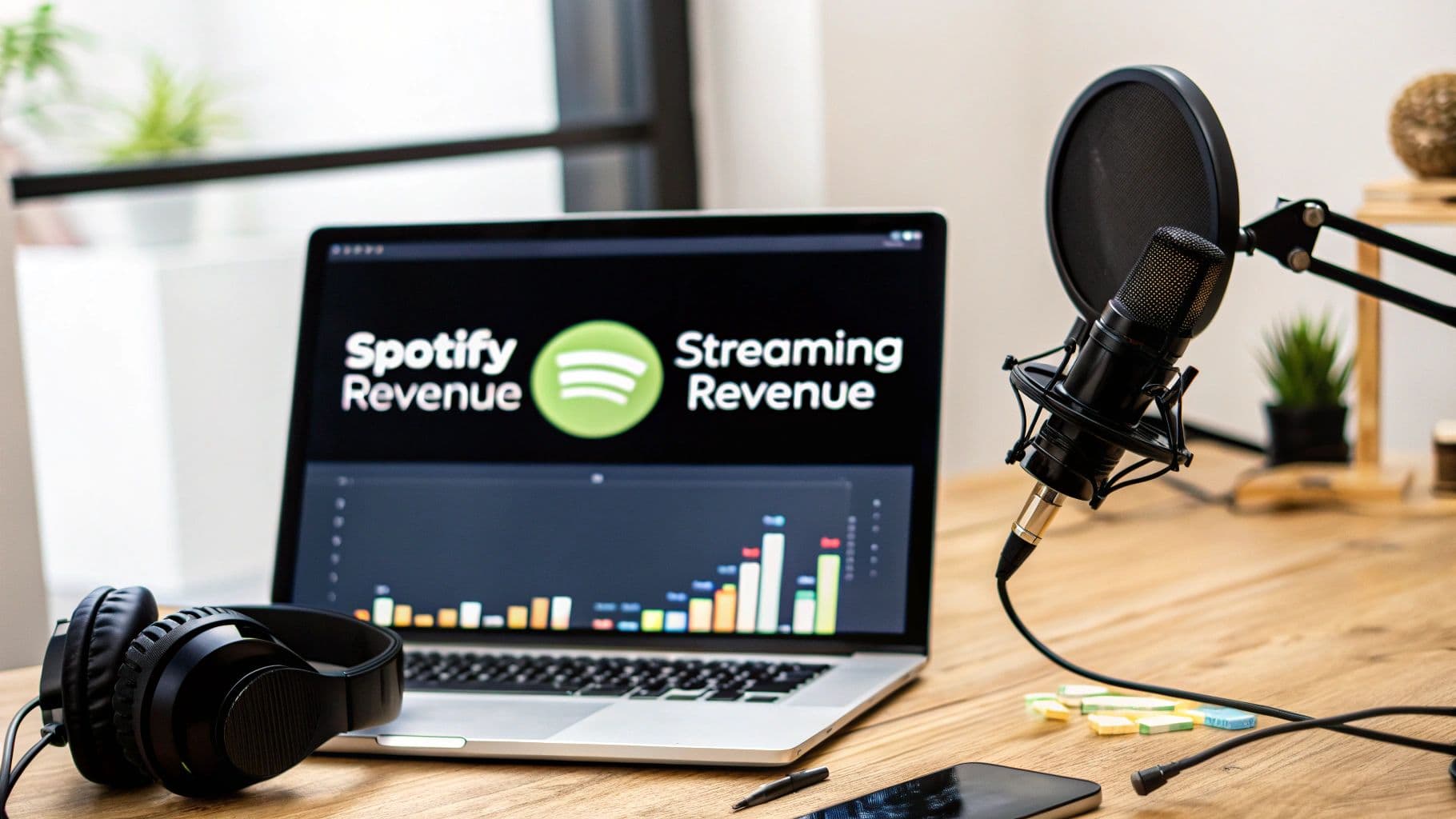
The ad revenue that gets baked into this pie is generated from the platform's massive free user base.
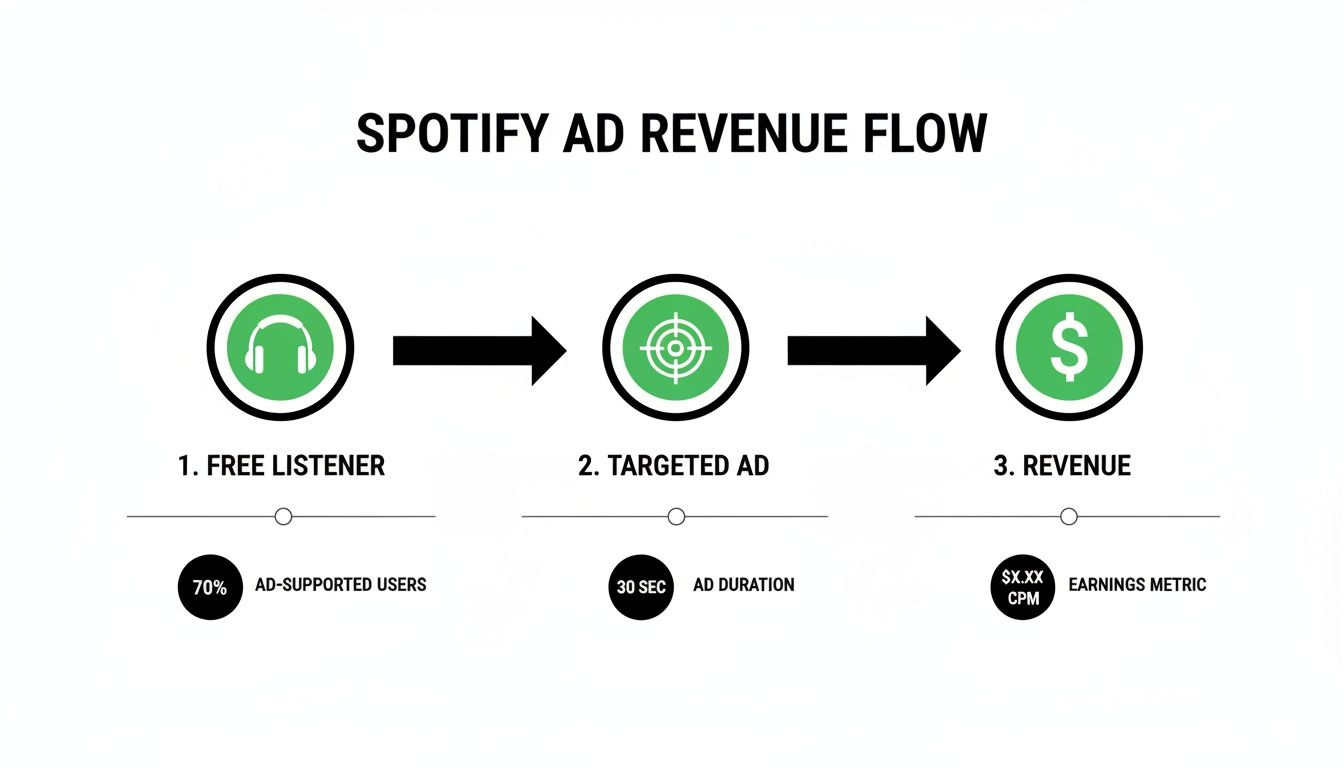
As you can see, free listeners are shown targeted ads, which generates the cash that gets added to the overall royalty pool.
The Middlemen Taking Their Slice
Even after Spotify calculates a rights holder's slice of the pie, the money doesn't just show up in an artist's bank account. It first has to pass through a chain of intermediaries, and each one takes a cut.
It’s important to remember that Spotify pays rights holders, not individual artists. These are the entities that own the master recording and the publishing rights to a song.
- Record Labels and Distributors: The biggest chunk of the payout goes to the owner of the sound recording. If you’re signed, that’s your record label. If you’re an independent artist, it’s your digital distributor (like TuneCore or DistroKid).
- Publishers and PROs: A smaller portion is set aside for songwriting royalties. This money flows to publishers and Performing Rights Organizations (PROs) like ASCAP or BMI, who then pay the songwriters and composers.
By the time the money trickles down through all these layers, what an artist actually sees is just a fraction of what Spotify initially paid out.
The journey of a dollar from a Spotify listener to an artist is long and fragmented. The pro-rata system first determines a gross payout, which is then divided among multiple rights holders, each with their own contractual cuts, before the artist receives their final share.
This complex structure is central to Spotify's enormous financial influence. The company now accounts for roughly 30% of the entire recorded music industry's revenue. They recently announced a record payout of over $11 billion to the music industry in a single year—a figure that is more than 10 times what the largest retailers paid out at the peak of the CD era. You can read more about Spotify's massive impact on industry revenue.
Comparing Payout Models
The hard truth for emerging artists is that trying to build a sustainable income from Spotify streams alone is a serious uphill battle. It's why so many are starting to look at alternative, more direct ways to connect with their fans and get paid. For a deeper dive, check out our guide on whether artists can truly make money from streaming services.
The difference becomes crystal clear when you put Spotify's model side-by-side with a direct-to-fan platform. Let's trace where $10 from a fan actually goes in each scenario.
Artist Revenue Path Spotify vs Direct-to-Fan
| Stage | Spotify (Pro-Rata Model) | Direct-to-Fan (Commission-Free Model) |
|---|---|---|
| Fan Payment | A fan's $10 subscription fee gets tossed into a massive global revenue pool. | A fan pays $10 directly to an artist for a digital album or a subscription. |
| Platform Cut | Spotify takes its cut (around 30%), leaving $7 for the rights holder pool. | Platforms like OohYeah take 0% commission on music sales and subscriptions. |
| Intermediary Cuts | The $7 is then split between the label/distributor and the publisher. | Standard payment processing fees apply (e.g., about ~$0.60). |
| Artist Payout | After everyone takes their cut, the artist might see a small fraction (~$0.50-$1.50) of the original $7. | The artist receives nearly the full amount (around ~$9.40). |
This comparison really highlights the fundamental difference. One model is built on massive volume and fractional payments filtered through a complex system. The other is built on direct, transparent transactions between the artist and the fan who wants to support them.
Moving Beyond Music: Where Spotify's Future Money Lies
If you want to grasp Spotify's long-term game, you have to look past the music. The company is making a massive, calculated push to become an all-encompassing audio empire. Why? To break free from the notoriously thin margins and costly royalties of music streaming. This isn't just about adding new features; it's a strategic overhaul designed to capture more of your listening time and, in turn, a much bigger slice of the advertising pie.
The most obvious sign of this shift is their huge bet on podcasting. Spotify has poured hundreds of millions into buying up podcast studios and locking down exclusive deals with big names. In doing so, they've turned what was once a simple music app into a one-stop-shop for all things audio, creating a powerful new revenue stream that works very differently from their music business.
Think about it: with music, a complex web of royalties gets paid out from a shared pool for every single stream. Podcasting, on the other hand, is much more direct. Spotify can sell ads on its own exclusive shows or let other creators use its advertising marketplace, giving them far more control over the revenue and, crucially, the profit margins.
The Makings of an Audio Ad Powerhouse
Spotify's endgame here is to build a powerful advertising network that stretches across its entire audio library. They're rolling out a few key initiatives to draw in big ad dollars and create new ways to cash in.
- Podcast Advertising: As its podcast listenership explodes, Spotify can offer brands hyper-targeted ad slots, using its data to connect advertisers with just the right audience.
- Live Audio: Their move into live audio rooms opens up an opportunity for real-time advertising, much like old-school radio but with all the advantages of digital targeting.
- Video Podcasts: By bringing video into the mix, Spotify is stepping into the ring with platforms like YouTube to fight for a piece of the massive video advertising market.
All of these moves are about building a defensive wall around their audio business. By owning both the content and the ad tech, they're creating a self-sustaining ecosystem that’s far less dependent on the whims of major record labels.
This shift is Spotify's answer to the razor-thin profits of music streaming. By aiming to be the default platform for all audio, they're tapping into new, much more profitable revenue streams that offer real financial stability and a firmer grip on their own destiny.
What's on the Horizon?
Beyond podcasts, Spotify is dipping its toes into other waters to make more money from its enormous user base. These new ventures are all about keeping users locked into the app while creating new opportunities to spend money.
One big play is merchandise integration. Artists can now link their merch stores directly to their Spotify profiles, thanks to partnerships with platforms like Shopify. This means fans can shop for t-shirts, vinyl, and posters without ever leaving the app. Spotify might get a small cut, but the real win is making the platform indispensable for artists and stickier for fans.
Another promising avenue is ticketing and live events. Spotify is already helping artists promote tour dates and linking to ticket sellers. This move plants them firmly in the live music world and could easily evolve into revenue-sharing deals on ticket sales down the road.
For any independent artist watching this, the message is loud and clear: your career can't just be about streams anymore. It's about building a complete brand with multiple income sources. This is precisely the philosophy behind platforms like OohYeah, which are designed from the ground up to help artists sell music, merch, and subscriptions all in one place. Spotify's own evolution just proves the point—a diversified strategy isn't just a good idea; it's the key to survival.
Building a Sustainable Career Beyond Streaming
After breaking down how Spotify’s money machine works, one thing becomes crystal clear: for most artists, streaming is a volume game, and trying to live off it alone is a tough road. Those fractions of a penny per stream just don't add up for a long time.
The smartest artists I know don't see Spotify as their bank account. They see it as their single most powerful marketing tool—a global stage to get their music discovered. It's the top of their funnel, not the finish line.
The real job is to turn those casual listeners into genuine fans who want to support you directly. This is how you take back control, building a career that isn't at the mercy of an algorithm or fluctuating payout rates.
The Shift to Owning Your Fan Relationships
This is where true sustainability kicks in—when you build a direct line to your audience. Think of your Spotify listeners as the first handshake. From there, it’s up to you to invite them deeper into your world, moving them from passive streaming to active support on channels where you call the shots.
A diversified approach creates multiple income streams, which is just a smarter, more secure way to run your music business. Successful artists use their Spotify presence as a launchpad to drive traffic to the places they actually own.
The goal for a modern artist isn’t just to make money on Spotify, but to make money because of Spotify. Use its massive reach to find your people, then bring them into your own ecosystem where their support actually moves the needle.
A great place to start is your Spotify for Artists profile. Use every feature it gives you. Link out to your merchandise store, your fan club, or a platform like OohYeah where you can sell music and subscriptions without giving up a huge cut.
Actionable Steps for Artists
Building this bridge from Spotify to your own turf is all about creating clear, easy paths for your fans to follow. Here are a few practical ways to get started:
- Promote Your Owned Platforms: Don't be shy about it. Use your song outros, podcast interviews, and social media posts to tell people that the best way to support your work is by buying directly from you.
- Use Your Bio Wisely: That bio on your Spotify profile is prime real estate. Use it to point people directly to your main sales channel, whether that’s a merch store or a subscription page.
- Create Exclusive Content: Give your biggest supporters something they can't get on Spotify. Offer B-sides, early demos, or limited-edition merch on a platform you control. It gives them a real reason to follow you off-platform.
When you start thinking this way, you stop chasing streams and start building a real business. If you want to dive deeper, you can find more tips for increasing music streams and earnings and learn how to make them serve your long-term vision.
Questions Artists Are Always Asking About Spotify
Once you start digging into how Spotify actually works, a lot of questions pop up. This is especially true for artists trying to make sense of their royalty statements. Let's tackle a few of the most common ones.
Why Does My Per-Stream Payout Rate on Spotify Change Every Month?
This is a big one, and the answer lies in Spotify's "pro-rata" system. It's not a fixed rate per stream. Instead, think of it like a giant, shared pool of money.
Every month, Spotify collects all the revenue from a specific country and user type (like Premium vs. ad-supported) into one big pot. They then divide that total pot by the total number of streams from all artists in that same category. The result is a "per-stream value" that shifts constantly. Your payout is just your slice of the pie—your total streams multiplied by whatever that value happened to be for the month.
So, your rate is always in flux because it depends on:
- Where your listeners are (different countries have different revenue pools).
- If your streams came from Premium subscribers or free users.
- How many total streams happened across the entire platform that month.
This is worlds away from a direct sale, where you know exactly what you'll make each time someone buys your track.
Does Spotify Pay Artists Directly?
Simply put, no. Spotify never sends money straight to an artist's bank account. Instead, the payments go to the rights holders.
So who are the rights holders? It’s usually your record label (if you're signed) or your digital distributor (like DistroKid or TuneCore). Spotify also sends separate songwriting royalties to publishers. These companies get the money first, take their cut based on your agreement, and then pass the rest on to you.
This multi-layered system is exactly why there’s often a huge difference between what Spotify pays out for a song and what an artist actually ends up with.
How Can I Use Spotify to Grow My Income on Other Platforms?
This is where you need to get strategic. The smartest way to use Spotify is as a powerful discovery engine—a top-of-funnel tool for getting your music in front of new ears. The real goal, though, is to turn those listeners into genuine fans who will support you elsewhere.
First things first: optimize your Spotify for Artists profile. Your bio is prime real estate. Put direct links to your own merch store, your fan club, or wherever you sell music directly. You can also use the "Artist Pick" feature to pin a link to your latest vinyl pre-order or Patreon page.
Then, use your social media and email list to be direct with your audience. Tell them that the best way to support you is by buying your music or merch directly from your site. Your Spotify data gives you a huge advantage here—you can see which cities your fans live in and target your messaging to drive them off the streaming platform and into your own ecosystem, where you control the relationship and the revenue.
Ready to take control and build a direct connection with your fans? OohYeah provides the tools you need to sell music, merchandise, and subscriptions directly to your audience—all with 0% commission on your sales. Stop leaving money on the table and start building a sustainable career today at https://oohyeah.app.