How Do You Get Paid on Spotify Your Ultimate Guide
Discover how do you get paid on Spotify with our ultimate guide. Learn how to navigate distributors, royalties, and payouts for independent artists.
October 19, 2025
Music Marketplace Advisor
Buying & SellingSo, you've got your music on Spotify. Now, how do you actually get paid for it? It's one of the most common questions artists ask, and the answer isn't as simple as Spotify sending you a check.
The money doesn't flow directly from Spotify to you. Instead, Spotify pays the royalties to your music distributor—the service you used to get your songs on the platform in the first place. That distributor then pays you after taking their agreed-upon commission or fee. It all works on a pro-rata system, which means your earnings aren't based on a fixed rate per stream but on your share of the total streams across the entire platform each month.
Decoding How Spotify Royalties Actually Work
Before a single dollar lands in your bank account, you need to get a handle on the financial engine running behind the curtain. The idea of a fixed "per-stream rate" is one of the biggest myths in the music industry. The reality is that your income is tied to a massive, shared pool of money.
Here's how it breaks down. Spotify collects all the revenue it generates in a month from two primary sources:
- Premium subscriptions: All those monthly fees paid by millions of users for ad-free listening.
- Advertising revenue: The money made from ads played to listeners on the free plan.
From this giant pot of cash, Spotify pays out roughly 70% to rights holders. This group includes record labels, publishers, and—the one that matters most to you—your music distributor. Your final payout is determined by your slice of that pie, calculated based on how your stream count measures up against the total number of streams on the platform that month.
Mechanical vs. Performance Royalties
It’s also crucial to understand that every single stream generates two distinct types of royalties for the song's composition.
- Mechanical Royalties: Think of these as royalties for reproducing your song. They're paid to songwriters and publishers for the right to make a copy of the music, which is exactly what a stream is—a temporary digital copy. Your distributor usually collects and pays these out to you.
- Performance Royalties: These are generated whenever your music is performed publicly, and yes, streaming counts as a public performance. These are collected on your behalf by a Performance Rights Organization (PRO) like ASCAP or BMI.
Your distributor handles the royalties for the master recording, but you absolutely need to be signed up with a PRO to collect all the songwriting revenue you're owed. Forgetting this step is like leaving money on the table.
Why Your Payout Varies So Much
If you've noticed your earnings fluctuate wildly from month to month, you're not alone. Several key variables influence how much your slice of the pie is worth. For example, a stream from a Premium subscriber in the United States generates far more revenue than a stream from a free user in a country with lower advertising rates.
This variability is why pinning down a single per-stream rate is impossible.
To help clarify this, let's look at the main things that affect your earnings.
Key Factors That Influence Your Spotify Payout
| Factor | Impact on Your Earnings |
|---|---|
| Listener's Subscription Type | A stream from a Premium user pays significantly more than one from a free, ad-supported user. |
| Listener's Geographic Location | Countries with higher subscription fees and ad rates (like the U.S. or UK) generate more revenue per stream. |
| Your Distributor's Agreement | The specific deal your distributor has negotiated with Spotify can affect the final payout rate. |
| Total Monthly Stream Pool | Your "streamshare" is smaller in months with higher overall streaming activity, potentially lowering your per-stream rate. |
All these moving parts explain why the often-quoted figure of $0.003 to $0.005 per stream is just a ballpark average. It's not a guarantee.
On top of that, Spotify has introduced new eligibility thresholds. To qualify for royalties, a track now has to be streamed for at least 30 seconds and reach a minimum of 1,000 streams within a 12-month period.
These complexities highlight why understanding the system is the first step toward building a sustainable income. For a deeper look into the potential earnings, check out our guide on whether artists can make money from streaming services. It'll help you set practical financial goals for your music career.
Choosing the Right Music Distributor for You
First things first: you can't just upload your music directly to Spotify. You need a partner to get your tracks on the platform, and that partner is your music distributor. Picking the right one is arguably one of the most important decisions you'll make early in your career, and it's central to figuring out how do you get paid on Spotify.
Think of a distributor as the digital bridge between your finished master recording and the ears of listeners on Spotify, Apple Music, and dozens of other platforms. They handle the technical side of delivery, but more importantly, they are responsible for collecting the royalties your streams generate and getting that money back to you.
Comparing Commission and Fee Structures
This is where things can get tricky because distributors don't all play by the same rules. Some, like the popular service DistroKid, work on a subscription model. You pay a flat annual fee and, in exchange, you keep 100% of your royalties. If you're prolific and plan on dropping a new single every month, this can be a fantastic deal, since your costs don't increase with each release.
Then you have services like CD Baby or TuneCore, which often lean toward a pay-per-release model. You'll pay a one-time fee to get a single or album distributed, and it stays up pretty much forever. Some of these services might also take a small commission from your earnings. For an artist who saves up to release a big album every two years, this approach can often be more cost-effective than paying a yearly subscription.
The best choice isn't about finding the cheapest option. It's about matching the fee structure to your personal release schedule. A constant creator has very different needs than a project-based artist, and your distributor should support your workflow, not complicate it.
Payout Thresholds and Timing
Getting your music live is just half the battle; actually getting paid is the other. Every distributor has a payout threshold—a minimum balance you have to hit before you can cash out. These can be as low as $1 or as high as $50 or more. If you're just starting out, a high threshold can feel like a roadblock, leaving your hard-earned money locked away for months.
The speed of payment matters, too. Some distributors can process withdrawals in just a few business days, while others might have a longer waiting period. This is a huge deal for managing your cash flow, especially if you're counting on that royalty income to fund your next marketing push or studio session. Always read the fine print on their payout terms before you sign up.
This infographic lays out the core factors you should be weighing.
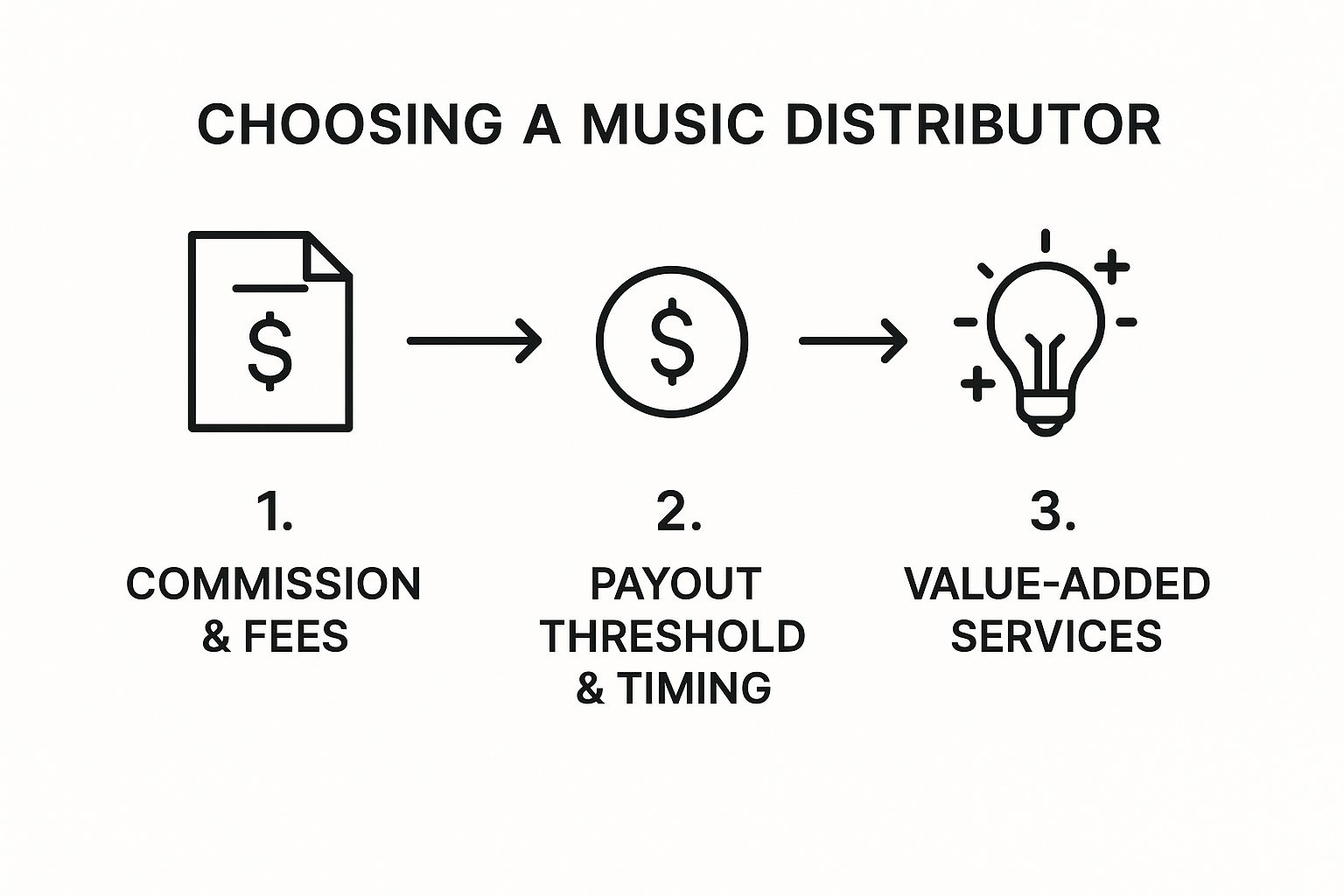
As you can see, it really boils down to three things: the fees, the payout logistics, and any extra services they bring to the table.
Value-Added Services to Consider
Sometimes, the little extras are what make one distributor stand out from another. Beyond just getting your music online, many services offer tools that can genuinely help you grow.
- Playlist Pitching: Some distributors have built-in tools that make it easy to submit your new tracks for consideration on official Spotify editorial playlists. This can be a game-changer for discovery.
- Detailed Analytics: Don't settle for basic stream counts. The best distributors provide deep-dive dashboards showing you who is listening and where they are in the world.
- Marketing Tools: Look for features like pre-save campaign links, social media content generators, or other promotional assets that can help you build hype for a new release.
Ultimately, choosing your distributor is a foundational business move. For a much deeper comparison of the top services, check out our complete guide on how to choose the right music distribution service.
Setting Up Your Accounts to Receive Payments
Alright, you’ve picked a distributor. Now for the most important part: building the bridge between your Spotify streams and your bank account. This isn't just a bit of admin work; getting this right from the start is the difference between getting paid on time and chasing down missing money for weeks. A single typo can throw a wrench in the whole system.
First thing's first, you need to officially tell Spotify who you are. The absolute non-negotiable step here is claiming your Spotify for Artists profile. Think of this as your digital passport. It's how you prove to both Spotify and your distributor that you are the rightful owner of your music. This profile is the key that unlocks all your juicy analytics, but more importantly, it verifies your identity.
Once you’re in, you’ll have access to your own mission control for tracking how your music is performing. It looks a little something like this:
This dashboard is amazing for seeing who’s listening and where, but the actual money part is handled back on your distributor's website.
Connecting Your Payment Details
With your Spotify for Artists profile secured, it's time to head back to your distributor’s dashboard. This is where you’ll answer the question, how do you get paid on Spotify? Look for a section called "Bank," "Payouts," or "Wallet"—every platform names it something slightly different, but the goal is the same: to link your financial information.
You'll usually see a few different ways to get your money:
- Direct Bank Transfer (ACH): This is the most popular route. The money goes straight into your checking account. Simple and effective.
- PayPal: A great choice, especially if you’re working with collaborators you need to pay or if you're managing funds across different countries.
- Wire Transfer: Typically reserved for larger payout amounts. It’s reliable but can come with higher fees, so check that first.
- Payoneer: Another solid option for international artists who need to receive payments in their local currency without getting hit by bad exchange rates.
Which one is right for you? It really depends on where you live, what kind of bank account you have, and how fast you need the cash. My advice? Double and triple-check every single digit you enter for your account and routing numbers. A simple typo is the #1 reason payments fail.
Here's a pro-tip: Setting up your payment method isn't a "set it and forget it" task. I make a habit of reviewing my details at least once a year, and immediately if I ever switch banks. Keeping this info current is the best way to avoid a surprise gap in your income.
Navigating Tax Forms and Payout Thresholds
Before your distributor will send you a dime, you have to deal with taxes. It’s a mandatory step for them to stay compliant, so there’s no getting around it. If you’re an artist in the U.S., you'll fill out a W-9 form. For everyone else outside the States, it'll likely be a W-8BEN form. Getting this right ensures the correct amount of tax is withheld (if any) and saves you a major headache later.
Finally, keep an eye on the payout threshold. Most distributors won’t let you withdraw your earnings until you’ve hit a certain minimum, like $10 or even $50. Knowing this number helps you plan your finances and sets realistic expectations for when you’ll actually see the money. Taking the time to set all this up correctly from day one is the single best thing you can do to ensure a smooth, reliable flow of cash from your music.
So, you’ve got your music on Spotify. That's a huge first step. But the real goal is turning those streams into a steady paycheck, and that means getting comfortable with the numbers. To really understand how you get paid on Spotify, you need to know where to find your data and, more importantly, what it all means.
Your performance data is split between two main hubs: your Spotify for Artists dashboard and your distributor's analytics portal.
Think of Spotify for Artists as your command center for audience insights. It’s where you see the human side of the data—who's listening, where they live, and how they found you. Are you getting added to a lot of playlists in Mexico City? Is your latest single taking off with college-aged listeners in the UK? This is where you’ll find out.
Your distributor’s dashboard, on the other hand, is all about the money. This is where the stream counts from Spotify get crunched into cold, hard cash. You'll see the raw earnings, any fees or commissions, and how close you are to hitting your next payout. It’s less about fan demographics and more about the dollars and cents.
Decoding Your Distributor's Financial Statements
The first time you log in and see a royalty report, it can feel like you’re staring at a complex financial document. Don't get overwhelmed. You just need to zero in on a few key pieces of information that directly affect your bank account.
Most reports will break things down with columns like these:
- Territory: The country where the stream happened.
- Net Revenue: The money earned after Spotify takes its cut, but before your distributor takes theirs.
- Units/Streams: The total number of plays for that track in that region.
- Your Share: The final amount that actually lands in your account after all fees and splits.
This level of detail is critical because, as you'll quickly learn, not all streams are created equal. For a play to even count as a "stream," someone has to listen for at least 30 seconds.
Beyond that, where those streams come from matters—a lot. Spotify's payout rates are different in every country, influenced by things like local subscription prices and ad revenue. As a result, 1,000 streams from listeners in the United States will almost always earn you more than 1,000 streams from a market where subscription fees are lower.
With a global average hovering around $0.00238 per stream, it becomes a game of volume. To earn about $2,380, an artist would need to pull in over a million monthly streams. If you want to dive deeper into how these numbers work, Spotify’s Loud & Clear site is a great resource.
Pro Tip: Set a monthly reminder to compare your Spotify for Artists data with your distributor’s financial report. If you notice a big listener spike from Brazil in your Spotify dashboard, you should see that reflected in your royalty statement. If the numbers don't seem to match up, it might be worth a closer look.
Connecting Data to Your Music Strategy
Learning to read these reports isn’t just about making sure you got paid correctly. It’s about making smarter decisions for your career. When you understand the data, you can start to see which of your marketing efforts are actually paying off.
Let's say you ran a targeted social media ad campaign in Germany for a week. If you check your next royalty report and see a noticeable bump in revenue from that specific territory, you have clear proof that your strategy worked.
This is how you move from just releasing music to building a business. You can spot trends, identify your most profitable markets, and focus your time and money where they’ll have the biggest impact. Suddenly, that spreadsheet isn't so intimidating—it's a roadmap for growth.
Withdrawing Your Money and Solving Payout Issues
https://www.youtube.com/embed/9iAtz1dkzig
Alright, this is the moment you've been working for—turning those streaming numbers into actual money in your bank account. Once your distributor's dashboard shows you've cleared their minimum payout threshold, you're clear to make a withdrawal. It’s usually a simple process, but knowing what to expect can save you a ton of headaches.
After you hit that "withdraw" button, don't expect the money to appear instantly. There's always a processing period. This can be anywhere from a few business days to a week or more, and it really depends on your distributor and the method you chose. A direct bank transfer (ACH), for example, typically takes 3-5 business days, but an international wire transfer will almost certainly take longer.
A good habit to get into is planning your withdrawals around these timelines. If you've got a studio session or a marketing campaign you need to fund, don't wait until the day before to pull your money out.
Troubleshooting Common Payout Problems
Even when you do everything right, things can go sideways. A failed transaction is probably the most common hiccup, and nine times out of ten, it’s because of a simple typo. One wrong digit in a bank account number or a misspelled name on your PayPal account is all it takes to bring the whole thing to a halt.
If a payment fails, your first move should be to double- and triple-check the payment details you gave your distributor. Fix any mistakes and try the withdrawal again. If you're certain everything is correct but the money still isn't showing up, it’s time to get in touch with your distributor's support team.
Pro Tip: When you contact support, have all your info ready to go. They'll need specifics like the withdrawal amount, the date you requested it, and any transaction IDs they gave you. The more information you can provide upfront, the faster they can sort it out.
As your earnings start to add up, it's worth looking into all your options. For artists interested in newer financial tools, you can explore various payout methods that include things like cryptocurrency. Just make sure whatever you choose fits with how you manage your finances.
Managing Your Income for a Sustainable Career
Getting that first payout feels incredible, but learning to manage that income is what separates a hobby from a career. It's so easy to see that money hit your account and think of it as pure profit, but you have to resist that urge. As an independent artist, you are a small business owner.
Here are a few practical things I've learned to do with every payout:
- Taxes Come First: Depending on where you live, you're on the hook for taxes on your music income. A safe bet is to immediately move 20-30% of every single payout into a separate savings account just for your tax bill. Don't touch it.
- Reinvest in Yourself: Your music is your business, and businesses need investment to grow. Earmark a portion of your earnings for things that will push your career forward—maybe that's better recording gear, a professionally designed album cover, or a targeted ad campaign for your next release.
- Track Everything: You don't need fancy software. A simple spreadsheet tracking your income and expenses is a game-changer. Knowing where your money comes from and where it goes is the bedrock of any financially stable career in music.
By adopting a business mindset from day one, you can turn those hard-earned streams into a reliable income source that fuels your art for years to come.
Maximizing Your Income Beyond Just Streams
Let's be real: relying only on streaming royalties is a slow burn. The good news is your Spotify profile can be much more than just a place to host your tracks—it's a powerful tool for generating real income if you know how to use it. By tapping into Spotify's built-in features, you can give your listeners more ways to support you directly and build a more stable financial foundation for your music career.
Think of your profile as the central command for your entire brand. Fans are already there to listen, which makes it the perfect spot to show them everything else you have to offer. This isn't just about diversifying your income; it's about creating a deeper connection with the people who love your music.
Turn Your Profile Into a Storefront
One of the smartest moves you can make is to link your merchandise directly to your Spotify profile. If you have a Shopify store, you can integrate it so fans can browse and buy your t-shirts, vinyl, and other gear right inside the Spotify app. It creates a seamless shopping experience that can easily turn a casual listen into a sale.
You should also get creative with the Artist Pick feature. A lot of artists just pin a new single, which is fine, but you can also use that prime real estate to highlight your latest merch drop. It puts your products front and center, making sure no one who visits your profile misses them.
Your most dedicated fans are the ones most likely to buy your merch. Making it dead simple for them to shop while they listen is probably the fastest way to boost your earnings outside of streams.
Mobilize Your Fans for Shows and Support
Selling physical products is just one piece of the puzzle. Spotify also gives you tools to drive direct financial contributions and get people to your live shows.
- Promote Your Gigs: The 'Concerts' tab is a game-changer. It syncs with platforms like Ticketmaster and Eventbrite to automatically list your upcoming shows. This is how you convert listeners into ticket holders, showing them exactly when you’ll be in their town.
- Activate Fan Support: This feature lets you add a direct tipping link—think of it as a virtual tip jar. It's an incredibly straightforward way for your biggest fans to send you money, helping you fund that next album or van repair.
These features all work together to create a powerful ecosystem around your music. A fan finds you on a playlist, checks out your profile, sees you're playing locally, and buys a ticket. Another listener might drop a tip after having your new album on repeat. These small actions add up quickly and can often be more impactful than streaming royalties alone. For more ideas, check out these tips for increasing music streams and earnings.
Common Questions About Spotify Payments
Let's be honest, the money side of music streaming can feel a little murky. Even after you've done everything right, questions always pop up about when you'll see your money and why the numbers look the way they do. Let's tackle some of the most common questions I hear from artists.
"When Do I Actually Get Paid?"
This is probably the number one question. You see the streams climbing, but when does that turn into actual cash in your bank account?
The timeline isn't instant. Spotify sends the royalties to your distributor on a monthly basis, but there's a delay. You can expect your distributor to receive the funds roughly 60-90 days after the month the streams happened. From there, your distributor processes it and pays you based on their own schedule.
So, as a rule of thumb, the money you see from your January streams will likely land in your account sometime in March or April.
"Why Is My Payout Lower Than I Expected?"
It's a common moment of confusion: you calculate your streams, do some rough math, and then the final number on your royalty statement is... different. This almost always comes down to a few key factors.
First, not every stream is a paid stream. For a listen to count and generate a royalty, someone has to play your track for at least 30 seconds. Anything shorter than that doesn't register.
Beyond that, the math isn't as simple as "streams x rate = payout." Here's why:
- Rates Aren't Fixed: The per-stream payout changes constantly. It depends on where the listener is in the world and whether they're a Premium subscriber or using the free, ad-supported version.
- Your Distributor's Cut: Remember, your distributor takes a commission or a fee for their services. They get paid before you do.
- Splits with Rights Holders: If you're signed to a label or have a publishing deal, they're getting their piece of the pie before the money ever gets to your distributor.
Think of it this way: The number on your Spotify for Artists dashboard is just the raw stream count. The number on your distributor's statement is the final, monetized result after all the real-world variables and deductions have been factored in.
"Am I Collecting All the Money I'm Owed?"
This is a huge one, and it's where a lot of artists accidentally leave money on the table.
Your distributor, like TuneCore or DistroKid, is responsible for one specific job: collecting royalties for the master recording—the actual audio file of your song.
But that's only half the story. Every song also has an underlying composition (the lyrics and melody), which generates its own separate royalties. To collect that money, you need to be registered with a Performance Rights Organization (PRO). In the US, the main ones are ASCAP, BMI, and SESAC.
If you're not signed up with a PRO, you are not collecting all your earnings. It’s that simple. To truly answer the question of how do you get paid on Spotify completely, you need both a distributor for your recordings and a PRO for your songwriting.
At OohYeah, we believe in putting artists in control of their finances. Our platform is built to help you sell directly to your fans and build a sustainable career on your own terms. Start building your future today.