How Do You Copyright Your Music A Practical Guide
Learn how do you copyright your music with this practical guide. Get actionable advice on the registration process to protect your creative work.
November 10, 2025
Music Marketplace Advisor
Buying & SellingYou've poured your heart and soul into creating original music. But did you know that your song is technically copyrighted the moment you create it? While that's true, formal registration with the U.S. Copyright Office is what gives your copyright teeth. It’s the difference-maker that lets you legally defend your ownership, sue for infringement, and actually collect damages.
This one step transforms your art into a legally protected asset.
Why Copyrighting Your Music Is a Crucial Business Move
It’s easy to see copyright registration as just another piece of administrative busywork. That’s a mistake. Think of it as a foundational business decision that cements your control and opens the door to real revenue.
Without that official registration, trying to enforce your rights is an uphill battle, leaving you exposed if someone uses your work without permission. Formal registration is also the key that unlocks licensing deals for film, TV, commercials, and video games. It creates a public record of your ownership, which makes it simple for music supervisors and brands to find and clear your music for use.
Understanding Your Assets
Here’s something many artists don't realize at first: every recorded track you create actually has two separate copyrights. Nailing this distinction is essential if you want to be fully protected.
The Composition: This is the song's DNA—the melody, chords, and lyrics. Think of it as the song in its most basic form, like the sheet music or a simple voice memo. It’s the intellectual property of the song itself.
The Sound Recording: This is the specific, tangible version of that song you recorded. It's often called the "master." You can have many sound recordings of one composition—the album version, an acoustic take, a live recording, a remix, etc.
By protecting both, you control the song's fundamental structure and every specific performance you produce. This dual protection is absolutely vital. The global music copyright market hit $45.5 billion in 2023, nearly doubling in a decade from streaming, performance royalties, and sync licenses.
A core part of treating your music like a business is clearly defining who owns what. For a deeper dive into this, it's worth reading up on understanding intellectual property ownership clauses-ownership-clauses).
By registering, you’re not just protecting a song; you’re securing a valuable piece of intellectual property that can generate income for your entire life plus 70 years.
Taking this step is what separates the hobbyists from the professionals. For more strategies on keeping your work safe, check out our guide on how to protect your music rights online.
Getting Your Ducks in a Row: How to Prep for a Smooth Registration
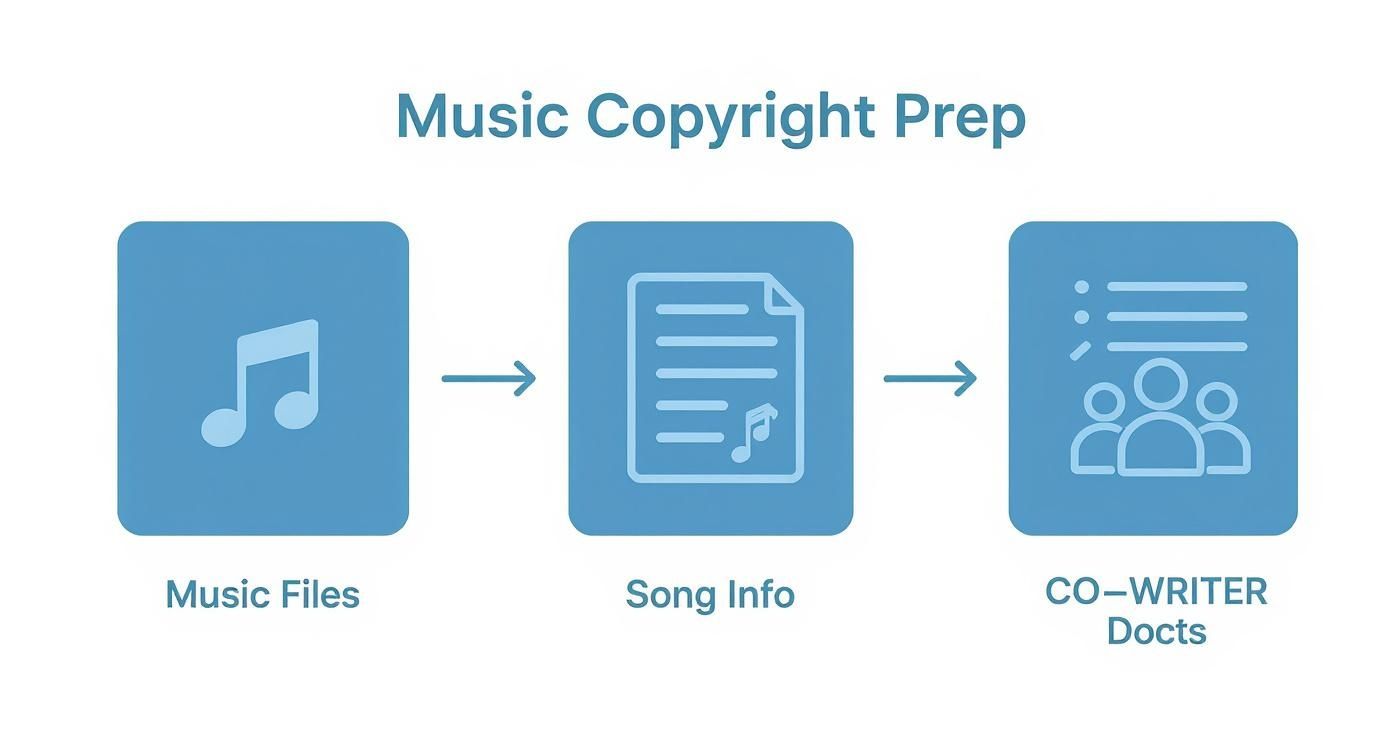
Before you even think about filling out the copyright application, you've got to get organized. Think of it as your pre-flight checklist. Taking the time to gather everything you need upfront makes the actual registration process a whole lot smoother and helps you avoid costly mistakes. You can't protect your music without having the right documentation ready to go.
First up, you'll need what the U.S. Copyright Office calls "deposit copies." These are just the final, polished digital files of your work. The office is flexible and accepts standard formats like MP3, WAV, and FLAC for audio, and PDFs for things like lyrics or sheet music. Make sure these are the definitive versions you want to protect, labeled clearly.
The Nitty-Gritty Details You Can't Forget
Beyond the music files themselves, you need to collect some key pieces of information about the song and everyone who helped create it. Having this stuff on hand will save you a ton of headaches later, especially if you're collaborating with other writers.
Here’s what you absolutely must have ready:
- The full legal names of every single songwriter or contributor. No nicknames here.
- The exact date your song was finished.
- The date and country of first publication, if it's already been released.
Let’s say you’re in a band with a couple of co-writers. Before you even start the application, the first thing you should do is create a split sheet. This is a straightforward agreement that clearly spells out who owns what percentage of the song. For instance, the person who wrote the lyrics might get 50%, while the two people who composed the music each get 25%.
A split sheet isn't something you file with the Copyright Office, but it's an essential internal document. It acts as your proof of ownership and ensures everyone is credited correctly on the official application, preventing disputes down the road.
Putting It All Together: A Quick Example
Imagine a band called "Crimson Tide" just put the finishing touches on their new track, "Ocean's Echo," on June 1, 2024. The song was a team effort: Jane wrote the lyrics, Mark handled the melody, and Sarah created the instrumental arrangement. They all agreed on a 40-30-30 ownership split.
Before heading to the copyright website, they get their materials in order:
- A final, high-quality WAV file of "Ocean's Echo."
- The full legal names and current addresses for Jane, Mark, and Sarah.
- Their signed split sheet, which clearly documents the 40-30-30 ownership agreement.
Because they did this prep work, they can now sit down and knock out the copyright application in a single session. They’ve avoided the common pitfalls that can delay or even invalidate a registration.
A Musician's Guide to the Copyright Office Portal
Okay, let's talk about the U.S. Copyright Office's eCO portal. The first time you land on the page, it can feel a little intimidating—it has that classic, no-frills government website look. But don't let that throw you. This is where you turn your music into a legally protected asset.
Think of it less as filling out a form and more as making a few key strategic decisions to protect your work for decades to come.
This simple login screen is your entry point to creating an official, public record of your ownership. It’s the single most powerful step you can take to enforce your rights if someone uses your music without permission.
Choosing the Right Application for Your Music
The first—and most important—choice you'll make inside the portal is picking the right application type. This isn't a small detail; it affects your filing fees, what you can include, and the overall scope of your protection.
For musicians, it usually boils down to three main options:
- Standard Application: This is the workhorse application. You'll use this if you've got co-writers, if a producer has a stake, or if the copyright owner is a separate entity, like your band's LLC or a publishing company.
- Single Application: The streamlined, budget-friendly option for solo creators. The rules are strict: you must be the sole author and the sole owner of the song you're registering. No co-writers, no other claimants.
- Group Registration of Unpublished Works (GRUW): A fantastic money-saver for prolific songwriters. This lets you bundle up to ten unpublished songs into one application, paying a single fee. It’s perfect for registering a batch of demos or an album’s worth of songs before they’re released.
Deciding which application to use can feel tricky, so I've put together a quick comparison to help you find the best fit for your situation.
U.S. Copyright Application Types Compared
| Application Type | Best For | Typical Fee | Key Limitation |
|---|---|---|---|
| Single Application | A solo artist who is the only writer and owner. | $45 | Can only be used by the single author/owner of one work. |
| Standard Application | Co-written songs, works owned by a band's LLC or publisher. | $65 | Higher fee, slightly more complex application process. |
| GRUW | Registering a batch of up to 10 unpublished songs at once. | $85 | All works must be unpublished and have the same author(s)/owner(s). |
As you can see, matching your specific project to the right application saves you both time and money. A solo singer-songwriter registering one new song should stick with the Single Application, while a band with multiple writers will need the Standard Application.
Clearing Up Common Stumbling Blocks
One of the most frequent points of confusion I see is the distinction between the "author" and the "claimant." It’s a simple but critical detail.
The author is the person (or people) who physically created the music and lyrics. The claimant is the legal owner of the copyright.
For a solo artist, the author and claimant are usually the same person. But for a band, the authors are the individual members who wrote the song, while the claimant might be the band's official business entity. Nailing this on the application is vital for your registration to be valid.
Ultimately, registering your music is a foundational business move. It typically costs between $45 and $85 for an electronic filing and can take several months to process, but the protection it grants is invaluable, lasting for your entire life plus 70 years. Understanding the global copyright music market only reinforces how crucial this official protection is.
Getting these details right from the start means your copyright is accurate, legally sound, and ready to be defended. You're not just checking a box; you're building a solid legal foundation for your music career.
Navigating Copyright Protection on a Global Stage
https://www.youtube.com/embed/Q-Q3RWeAncc
Your music has the potential to connect with people all over the planet, which means your copyright protection needs to think globally, too. Thankfully, you don't have to get bogged down registering your songs in every single country. An international treaty called the Berne Convention does most of the heavy lifting for you.
The moment you create your song in a "tangible form"—like saving a recording or writing down the lyrics—it's automatically given basic copyright protection in all 181 countries that have signed the convention. That's a huge deal. It means your work is recognized from Brazil to Japan the second it exists.
But here's a crucial distinction that trips up a lot of creators: automatic protection isn't the same thing as legal power. If someone overseas infringes on your copyright, that automatic status alone won't give you the teeth to fight back in court.
Turning Protection into Power
To actually enforce your rights abroad, you first need an official registration in your home country. For those of us in the United States, that means a formal filing with the U.S. Copyright Office. This registration is your foundational proof of ownership, the document that gives you standing in other Berne Convention nations.
I like to think of it as a passport for your music. You get it issued here at home, but it's what allows your creative work to be officially recognized and defended internationally.
Your home-country registration is the key that unlocks your ability to take legal action and defend your creative work on a global scale. Without it, your international "protection" is essentially unenforceable.
This step is non-negotiable if you want to effectively copyright your music for a worldwide audience. On top of that, don't forget the role of Collective Management Organizations (CMOs). Groups like ASCAP or BMI in the U.S. (and their international partners) are essential for collecting performance royalties on your behalf, ensuring you get paid whenever your music gets played in different territories.
Putting Your Registered Copyright to Work
Getting that copyright certificate in your hands feels great, but it’s really just the starting line. Now it’s time to put that official registration to work, turning it from a piece of paper into a powerful tool that protects your music and helps you get paid.
Think of your registration as the key that unlocks the doors to royalty collection. To get paid, you need to affiliate with organizations that track music usage and distribute earnings back to artists like you. And the first thing they'll ask for? Proof of ownership. Your registration is exactly that.
Activating Your Revenue Streams
To start collecting the money your music generates, you'll need to connect with a few key players in the industry. Each one handles a different kind of royalty, so it’s crucial to know who does what.
- Performing Rights Organizations (PROs): Groups like ASCAP and BMI are your go-to for performance royalties. They collect money whenever your composition is played publicly—think radio, bars, live venues, or on TV.
- SoundExchange: This non-profit focuses on digital performance royalties for your master sound recording. They collect from non-interactive services like SiriusXM satellite radio and Pandora.
- The Mechanical Licensing Collective (The MLC): The MLC is in charge of collecting mechanical royalties from streaming services in the U.S. for your composition.
Having your music officially registered makes joining these organizations a smooth and straightforward process. It's the credential you need to ensure you can collect every single cent you've earned from public performances and digital plays.
Beyond these foundational royalties, your registration is your ticket to maximizing income from all sorts of modern avenues, like getting paid premium royalties on Apple Music. The streaming world is massive, with global revenues now topping $20 billion a year and making up more than half of all recorded music income. It's also essential when it comes to understanding how to get rights to a song for potential licensing deals and collaborations.
Got Questions About Copyrighting Your Music?
I get it. The world of music copyright can feel like a maze, and artists always seem to bump into the same tricky questions. Let's clear up some of the most common points of confusion so you can protect your work with confidence.
Do I Really Need to Register Before I Release My Music?
Technically, your song is copyrighted the moment you create it and fix it in a tangible form—like saving an audio file or writing down the sheet music. But here's the crucial part: registering it with the U.S. Copyright Office is what gives your copyright real teeth.
If you register before releasing the song or within three months of its release, you unlock some powerful legal advantages. This "timely registration" makes you eligible to claim statutory damages, which can be up to $150,000 per infringement, plus your attorney's fees if you ever have to take someone to court. Without that timely registration, you're stuck trying to prove "actual damages," a much tougher and often less rewarding path.
Think of it this way: Timely registration is like activating the full security system for your song. Without it, you might have a camera on the wall, but it isn't actually plugged in and recording.
Is Copyright the Same as Registering with a PRO?
This is a big one, and a mix-up I see all the time. They are completely different things, and you absolutely need both.
- Copyright Registration: This is your official, legal claim of ownership over the song itself—both the underlying composition (lyrics and melody) and the master sound recording. You do this through a government body like the U.S. Copyright Office.
- PRO Registration: This is when you join a Performing Rights Organization, like ASCAP or BMI. This affiliation allows them to track public performances of your music (on the radio, in a bar, on TV) and collect the performance royalties you're owed.
In short, copyright proves you own it. The PRO makes sure you get paid when it gets played.
Can I Copyright a Song Title or a Cool Chord Progression?
The short answer is no. U.S. copyright law is designed to protect a complete, original work of authorship. It doesn’t cover the individual building blocks of music.
Things like song titles, short phrases, and common chord progressions (like a standard 12-bar blues) are considered too common or generic to be protected on their own. They're part of the public toolkit that all creators can use.
Understanding these details also means knowing how long your protection lasts before your work eventually enters the public domain. For a full breakdown of that timeline, check out our guide on how long before a song is public domain.
Ready to take control of your music career? OohYeah provides the tools you need to sell, stream, and market your work directly to fans, ensuring you keep more of your revenue. Join our artist-first ecosystem today and start building a sustainable future for your music at https://oohyeah.app.