How Do I Get My Music Copyrighted: how do i get my music copyrighted in 5 steps
Wondering how do i get my music copyrighted. This guide breaks down the registration steps, protects your rights, and helps secure your income.
January 1, 2026
Music Marketplace Advisor
Buying & SellingIt's one of the most common myths in the music industry: the moment you write a song down or record a demo, you're fully protected. While it's true that your work is copyrighted the instant it’s created, relying on that automatic copyright alone is like owning a house without having the deed. It’s yours, but you have no real power to defend it.
For any serious artist, the game-changer is formal registration with the U.S. Copyright Office. This is what turns your creative ownership into an enforceable legal right.
Your Guide to Music Copyright What Artists Need to Know
I've seen too many artists learn this lesson the hard way. They think that "poor man's copyright" (mailing a copy to yourself) or just having the creation date is enough. It isn't. Without an official registration certificate, you can't even file a lawsuit for copyright infringement in federal court. That means if someone steals your track, you have virtually no path to claim damages or get them to stop.
Think of it this way: automatic copyright establishes that the song is yours. But registered copyright gives you the legal firepower to actually do something about it if things go south.
Automatic Copyright vs Registered Copyright at a Glance
To make it crystal clear, let's break down the real-world differences between just creating your music and formally registering it.
| Feature | Automatic Copyright (Upon Creation) | Registered Copyright (U.S. Copyright Office) |
|---|---|---|
| Legal Basis | Exists the moment your work is in a fixed, tangible form (e.g., a recording, sheet music). | Granted after submitting an application and a copy of your work to the U.S. Copyright Office. |
| Public Record | No public record of ownership. It’s on you to prove when you created it. | Creates an official, public record of your ownership, which is presumed legally valid in court. |
| Ability to Sue | You cannot file a federal lawsuit for infringement. | A prerequisite. You must be registered before you can sue an infringer. |
| Statutory Damages | Not eligible. You must prove actual financial losses, which is incredibly difficult and costly. | Eligible for statutory damages ($750 to $30,000 per infringed work) if registered before infringement occurs. |
| Attorney's Fees | Not eligible. You must pay all your own legal fees, even if you win (which is unlikely without a lawsuit). | Eligible to have the court order the losing party to pay your attorney’s fees. This is a massive advantage. |
This table really highlights the "why." Registration isn't just a piece of paper; it's your ticket to the courthouse and your best financial leverage against infringement.
Why Formal Registration Matters More Than Ever
The music business is booming, and your rights have never been more valuable. The global value of music copyright rocketed to $45.5 billion in 2023—that's an 11% jump in just one year. That number has nearly doubled since 2014, mostly thanks to streaming. You can dig into the numbers in the economist's annual report.
This isn't just some abstract industry figure. It means your music is a tangible, valuable asset. Leaving it unregistered is like leaving your gear unlocked in a public place.
By registering your work, you secure the ability to:
- Sue for Infringement: This is the big one. It's your right to take legal action.
- Claim Statutory Damages: This is huge. It lets you claim a set amount of money without the headache of proving exactly how much you lost.
- Recover Attorney's Fees: Winning a lawsuit is one thing; not having to pay for it is another.
The single biggest mistake an independent artist can make is assuming automatic copyright is sufficient. Formal registration transforms your creative work from a piece of art into a legally protected, enforceable asset.
The Foundation of Your Music Career
At the end of the day, learning how to get your music copyrighted isn't just about navigating bureaucracy. It's a foundational business move for building a real, sustainable career. It creates a public record of ownership, scares off potential thieves, and gives you the legal standing you need to protect what you’ve built.
For more strategies, take a look at our guide on how to protect your music rights online. In the sections ahead, we’ll walk you through the entire registration process, step-by-step.
Untangling the Two Types of Music Copyrights
Before you even think about filling out an application, we need to get one thing straight. This is probably the most critical—and most misunderstood—part of the whole copyright process. Every single piece of music you create has two distinct copyrights attached to it. Nailing this difference is the key to filing correctly and making sure your work is actually protected.
Think of it like this: you have the blueprint for a house, and then you have the physical house that was built from that blueprint. In music, you have the underlying song, and then you have the actual recording of it.
The Musical Composition: Your Song's DNA
First up is the musical composition. This is the intellectual soul of your track. It's the unique combination of melody, harmony, rhythm, and lyrics—the stuff you could write down on sheet music or a lyric sheet. It’s the song itself, separate from any particular performance of it.
Ownership of the composition belongs to the songwriter(s) and, if they have one, their music publisher. This is the copyright that comes into play when another artist wants to record a cover of your song. They’re using your composition, even if they create a brand new recording.
The U.S. Copyright Office has a specific form for this: Form PA (for a "Work of the Performing Arts"). You’d file a Form PA if you’re only trying to protect the song you wrote—just the lyrics and melody—and not a specific studio recording.
The Sound Recording: The Master File
Next, you have the sound recording, which most of us in the industry just call the "master." This copyright protects the specific, captured performance of a composition. It's the actual audio file—the .WAV or .MP3 you upload to OohYeah—that people listen to. This right covers everything from the singer's vocal inflections to the producer's final mix.
This copyright belongs to the recording artist and the record label (if one paid for the recording). If you record an amazing cover of a Bob Dylan song, his publisher still owns the composition, but you own the copyright to your unique sound recording.
To register this, you’ll use Form SR (for "Sound Recording"). This is the form for protecting your finished, mixed, and mastered track that's ready for release.
Here's the easiest way I've found to explain it to artists: The composition is the song that gets covered. The sound recording is the track that gets played. One is the idea; the other is the expression of that idea.
The Smart Way to File When You Own It All
Now, here’s the good news for most independent artists. Chances are, you wear both hats. You’re the songwriter and the recording artist. You wrote the tune in your bedroom and then recorded it yourself. You own both the composition and the master.
So, does that mean you have to file two separate applications and pay two fees? Thankfully, no.
The U.S. Copyright Office has a shortcut for us. When you own both the song and the recording, you can file a single Form SR to register both copyrights at the same time. On the application, you simply indicate that the claim includes the underlying musical composition. This one move protects your master recording and the song itself.
For DIY musicians, this is the most efficient and budget-friendly way to get it done. It's the real answer to "how do I copyright my music?" in one clean, simple step.
Diving Into the Online Copyright Registration Process
Alright, now that you know the critical difference between a composition and a sound recording, let’s get our hands dirty. It’s time to walk through the actual process of registering your music with the U.S. Copyright Office's online portal, the Electronic Copyright Office, or eCO.
I know, government websites can look a little intimidating. But trust me, once you get the hang of it, the eCO system is far more straightforward than it appears. My goal here is to cut through the legal jargon and give you a clear, confident path forward.
Your First Steps in the eCO System
Everything starts at the official U.S. Copyright Office website. I can't stress this enough—this is the only legitimate place to register your copyrights in the United States. Avoid any third-party sites that claim to do it for you unless you've thoroughly vetted them.
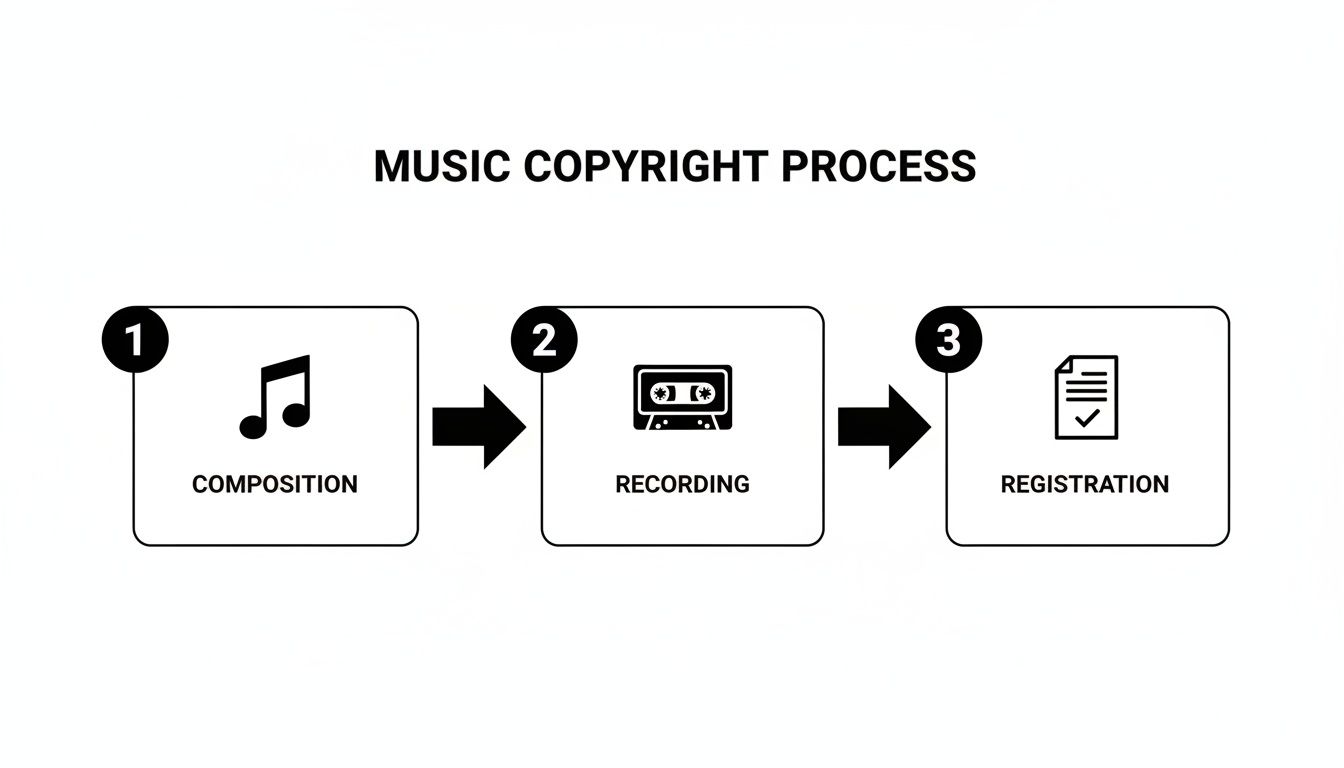
First things first, you'll need to create a user account. It’s a quick, one-time setup where you’ll provide an email and set a password. Once you're in, you’ll be in the eCO system dashboard, which will become the home base for all your copyright applications.
Getting the Application Details Right
Once you start a new registration, the portal will guide you through a series of pages. Most of it is self-explanatory, but a few sections are absolutely critical to get right. Let's break them down.
Type of Work: This is where our earlier discussion pays off. You'll choose "Work of the Performing Arts" for a composition (the song itself) or "Sound Recording" for the master audio file. If you own both and are registering them together, select "Sound Recording" and make sure to check the box indicating it includes the underlying musical work.
Titles: Simple enough—enter your song or album title. If you're registering a full album, you can list all the individual track titles here.
Author(s): Who created the work? For a composition, the "author" is the songwriter(s). For a sound recording, it's usually the performer(s) and producer(s). List everyone who contributed.
Claimant(s): Who owns the copyright? For most indie artists, you are both the author and the claimant. The claimant is only different if you’ve transferred your rights to another entity, like a publisher or a label.
Take your time here. Accuracy is everything. A typo or an omitted name can turn into a real headache (and a costly one) to fix down the line.
Uploading Your "Deposit"
After you've filled out all the details, the system will ask for a "deposit copy." Don't let the legal term throw you; this is just the file that proves what you created. It's the official version of the work the Copyright Office keeps on record.
Think of your deposit copy as the official evidence of your creation. This is what the U.S. Copyright Office holds onto, so double-check that you're uploading the correct, final version of your work.
What you upload depends on what you're registering:
- For a Sound Recording (SR), you'll upload an audio file like a .WAV or .MP3.
- For a Musical Composition (PA), a simple lyric sheet, sheet music, or even a basic phone recording of the melody and lyrics (what we used to call a "dembone" tape) will do the trick.
The last step is paying the registration fee. Once your payment goes through and your files are uploaded, your application is officially in the queue.
A Game-Changing Tip for Prolific Songwriters
Here’s a piece of advice that has saved artists I've worked with a ton of money. If you're sitting on a batch of songs that you haven't released yet, you can register them together as a "collection of unpublished works."
This is a huge deal. It lets you register up to 10 unpublished songs with a single application and for a single fee.
To do this, you just give the collection one overarching title (something like "2024 Song Demos") and upload a single ZIP file containing all 10 audio files or lyric sheets. It’s one of the most powerful, cost-effective tools available to a productive musician. Just remember the key rule: this only works for music that has not been commercially released to the public.
Understanding Costs, Timelines, and Global Protection
So, you've figured out what you're filing and how you're going to do it. Now for the million-dollar questions: How much will this set me back? How long is the wait? And does a US registration actually protect my music in other countries?
Let's get into the practical side of things. Registering your music is an investment, but it's probably a lot more affordable than you think, especially when you stick to the online eCO system. Filing electronically isn't just faster; it's a huge money-saver compared to the old-school paper forms.
Breaking Down the Costs of Copyright Registration
The fees set by the U.S. Copyright Office are surprisingly straightforward. The whole point is to make protection accessible for independent creators, not to put up a financial roadblock.
If you want real legal muscle, especially in the US—which accounts for a massive 48% of the global streaming market—filing directly at copyright.gov is the only way to go. In 2023, the office handled over 700,000 registrations, so they know what they're doing.
Right now, the online fee is just $45 to register a single work by a single author. If you have a batch of unreleased songs, you can bundle up to 10 of them together for that same $45 fee. It's a fantastic deal. You can get more context on the global music copyright landscape from industry reports.
This "unpublished collection" option is an absolute game-changer for prolific writers. It effectively brings your per-song registration cost down to less than five bucks. Honestly, it’s one of the most powerful and underutilized tools for artists who need to protect their catalog without breaking the bank.
Here's a quick look at what to expect for costs and turnaround times when filing online.
Copyright Registration Cost and Timeline Overview
The U.S. Copyright Office's online portal is by far the most efficient route. This table summarizes the general fees and processing times you can anticipate.
| Registration Type | Typical Fee (Online) | Estimated Processing Time |
|---|---|---|
| Single Work (One Author) | $45 | 3 - 6 months |
| Standard Application (Other) | $65 | 3 - 6 months |
| Group of Unpublished Works | $85 | 3 - 6 months |
Keep in mind these are just estimates. Timelines can shift depending on the office's workload, but these numbers give you a solid ballpark figure to work with.
Setting Realistic Timeline Expectations
I get it—the waiting period can be a little nerve-wracking. After you hit "submit" and send your money, the process isn't instant. It’s important to know how the timeline works so you don’t stress. The U.S. Copyright Office deals with a staggering number of applications, and a real human examiner reviews every single one.
Here's the most important thing to remember about the timeline: Your copyright protection is effective from the date the Copyright Office receives your complete application, not the date they finally issue the certificate.
This is a critical detail that trips a lot of people up. Even though it might take a few months to get that official certificate in your email, your legal protection kicks in the moment your application, payment, and music files are successfully submitted. That "effective date of registration" is what holds up in court.
Here’s a bird's-eye view of what happens after you file:
- Application Submitted: The day you fill out the form, pay the fee, and upload your music. Your protection starts now.
- Processing Queue: Your application gets in line to be assigned to a government examiner.
- Examiner Review: An examiner checks your application for any errors or missing info. This is where most of the waiting happens.
- Certificate Issued: Once it’s approved, your official registration certificate is generated and sent to you.
The Copyright Office also has a great tutorial video that walks you through the Standard Application process.
How US Copyright Protects Your Music Globally
Here’s the best part: when you register your copyright in the United States, that protection extends far beyond our borders. You don’t need to run around filing for copyright in every single country where your music might get played. This amazing global reach is possible thanks to international treaties.
The big one is the Berne Convention, an international agreement signed by over 180 countries. Under this treaty, all member countries agree to recognize the copyrights of citizens from every other member country.
What does that mean for you? A song created and registered in the U.S. gets the same protection in the UK, Japan, Australia, and Brazil as it does back home. This principle is called "national treatment," and it ensures your U.S. copyright registration acts as a powerful international shield, protecting your work across most of the world without any extra fees or paperwork.
Putting Your Copyright to Work After Registration
Holding that official copyright registration certificate is a huge milestone. But let's be clear: the registration itself doesn't magically deposit money into your bank account or build a forcefield around your music.
Think of your registration as the official deed to your creative property. Now you need to install the locks, set up the mailbox, and actually start collecting the rent. This is where you transform that legal document into a real, working asset. It all comes down to a few critical next steps: nailing your metadata, joining the right organizations, and knowing how to enforce your rights.
Embed Your Ownership with Accurate Metadata
Before you even think about uploading that new track to a platform like OohYeah or sending it off to your distributor, you have a crucial housekeeping task. You need to bake your ownership information—your metadata—directly into the audio files.
This is the digital equivalent of the liner notes on a classic vinyl record, and it's shockingly important. Inaccurate or missing metadata is one of the biggest reasons artists miss out on royalties. If collection societies and streaming services don't know who to pay, the money simply gets lost in the system.
Clean, complete metadata dramatically increases the odds of you getting paid correctly and on time. At a bare minimum, every .WAV or .MP3 file should include:
- Song Title: The full, official name of your track.
- Artist Name(s): List all primary and featured artists.
- Album Title: The name of the EP or album, if it's part of a larger project.
- Composer/Songwriter(s): The full legal names of every single writer.
- Year of Creation: The year the copyright was originally established.
- ISRC Code: This is the International Standard Recording Code—a unique fingerprint for your specific master recording.
You can edit this info using most audio software (like Apple Music or Audacity) or a dedicated metadata editor. This simple step creates a digital paper trail that follows your song wherever it goes.
Join a PRO to Collect Your Performance Royalties
If you only do one thing after registering your copyright, make it this. To collect royalties from the public performance of your musical composition, you absolutely must join a Performing Rights Organization (PRO). These are the groups that track, collect, and pay out money to songwriters and publishers.
Every time your song is played on the radio, streamed online, performed live, or used on TV, it generates a performance royalty. Without being a member of a PRO, that money literally has nowhere to go.
In the United States, the main PROs for compositions are:
- ASCAP (American Society of Composers, Authors and Publishers)
- BMI (Broadcast Music, Inc.)
- SESAC (Society of European Stage Authors and Composers)
- GMR (Global Music Rights)
You’ll typically join as both a songwriter and a publisher (even if your "publishing company" is just a name you made up for yourself). Once you're in, you have to register your entire catalog with them. This is how you tell your PRO which songs you own so they can claim royalties for you.
Don't mix up your Copyright Office registration with your PRO registration. The U.S. Copyright Office is what establishes your legal ownership. Your PRO is the collection agency that gets you paid when that song is performed. You need both to be fully protected and paid.
Defending Your Work with DMCA Takedown Notices
Now we get to enforcement. Your registered copyright is your shield, and the Digital Millennium Copyright Act (DMCA) is your sword. The DMCA is a powerful law that gives you the right to demand that online platforms take down content that infringes on your copyright.
Let's say you find your song being used in a YouTuber's video without your permission. Instead of starting a flame war in the comments, you can issue a formal DMCA takedown notice.
While you can hire a lawyer, you can often handle these clear-cut cases yourself. A valid DMCA notice is a legal document, and it needs to contain specific information to work.
Your notice has to include:
- Your Contact Information: Legal name, address, phone number, and email.
- Identification of the Infringed Work: A clear description of your song and a link to where it exists legitimately.
- Location of the Infringing Material: The exact URL where the unauthorized use is happening.
- A Good Faith Statement: A sentence stating you have a "good faith belief that the use is not authorized by the copyright owner, its agent, or the law."
- A Statement of Accuracy: A line declaring that your notice is accurate, "under penalty of perjury."
- Your Electronic Signature: Simply typing your full legal name will do.
You send this notice to the platform's designated DMCA agent (YouTube, SoundCloud, and others all have a specific process for this). By law, they have to act quickly to remove the infringing content. This is a direct, powerful way to control your music, and it's a right that is backed up by your federal copyright registration. For a deeper dive into making money from your music, check out our guide on understanding music licensing.
Got Questions About Music Copyright? Let's Clear Things Up.
Diving into music copyright can feel like trying to read a foreign legal document. Even once you get the hang of registering your work, there are always a few tricky questions and persistent myths that seem to stick around. Let’s cut through the noise and tackle some of the most common ones I hear from artists.
Is "Poor Man's Copyright" a Real Thing?
I see this one all the time, and it's one of the most dangerous pieces of misinformation out there. The idea goes that if you mail a CD or a thumb drive of your song to yourself in a sealed envelope, the postmark serves as proof of your creation date.
Let me be crystal clear: This has absolutely zero legal standing in a U.S. court of law. It’s a myth. A postmark doesn't create the official, public record of ownership that a formal registration does. If someone infringes on your work, that sealed envelope won't give you the power to sue them in federal court or claim statutory damages. Don't waste the postage; put that money toward an actual registration with the Copyright Office.
What If I Wrote a Song with My Bandmates?
Collaboration is what music is all about, but it can get messy from a legal standpoint if you're not careful. When you create a song with other people, the law considers it a “joint work.” This means that, by default, every single contributor is a co-owner of the entire copyright.
The single most important thing you can do is get a "split sheet" signed by everyone before the song ever sees the light of day. This simple document outlines who owns what percentage of the song. It can save you from massive legal headaches and royalty disputes later on.
When you go to register the copyright, you have to list every single co-author. Forgetting someone isn't just a simple mistake—it could invalidate the entire registration. When it comes to co-writing, good paperwork makes for good partnerships.
Can I Copyright My Song Title or a Chord Progression?
This is a great question because it gets right to the heart of what copyright actually protects. The short answer is no. You can't copyright things like song titles, short phrases, or band names. They’re considered too generic to grant one person exclusive ownership.
The same goes for the fundamental building blocks of music, like a standard I-V-vi-IV chord progression. Copyright is designed to protect the unique expression of an idea—not the idea itself. It’s your specific melody, your lyrics, and your arrangement all put together that becomes a protectable work, not the individual chords or a catchy title in isolation.
Someone Stole My Registered Song. Now What?
This is the exact moment you'll be glad you formally registered your music. If you find out someone is using your work without your permission, your registration gives you real legal teeth.
Your first step is usually to send a formal cease and desist letter. If the infringement is happening online on a platform like YouTube or Spotify, you can file a DMCA takedown notice. More often than not, this is enough to solve the problem.
But if they ignore you, your registration gives you the power to take them to federal court. This is where you can demand statutory damages and potentially have your attorney's fees covered—powerful leverage that is only available to those who have a registered copyright. It's the ultimate insurance policy for your creative output.
The protection you get from registration lasts a long time, but not forever. If you want to understand when a work's copyright eventually expires, check out our guide on how long before a song is in the public domain.
Ready to take control of your music career? OohYeah provides the tools you need to sell your music, merch, and subscriptions directly to your fans, commission-free. Sign up and start building your future at https://oohyeah.app.