How Do I Copyright My Song A Practical Guide
Wondering how do I copyright my song? This guide provides clear, actionable steps to protect your music, secure your rights, and get paid for your work.
October 28, 2025
Music Marketplace Advisor
Buying & SellingWhen you're ready to copyright your song, the first step is to register it with the U.S. Copyright Office. This is what officially establishes your legal ownership. Think of it this way: the registration is what gives your copyright its teeth, allowing you to sue for infringement and collect statutory damages if someone uses your work without permission. It turns your creative expression into a legally protected asset.
Why Copyrighting Your Song Is More Than Just Paperwork
Let’s get one thing straight: copyrighting your music is probably the most critical business decision you'll make. This isn't just about filling out a form; it's the bedrock of actually getting paid for your art. Registration gives you the power to shut down unauthorized use, whether it’s in some influencer’s reel or a local company's commercial.
More than that, it's your ticket to making money. A registered copyright is non-negotiable for collecting streaming royalties, performance fees from PROs, and sync licensing payments for film and TV. This has become absolutely vital in today’s music landscape. Global recorded music revenues have skyrocketed to US$29.6 billion, with streaming making up over 67% of that pie. Your registration is what ensures you get your piece of it.
The Two Copyrights In Every Song
Every recorded track you create actually holds two distinct copyrights. Getting your head around this is fundamental to protecting your work properly.
- The Musical Composition: This is the song itself—the melody, the chords, the lyrics. It's the core idea that exists even on a crumpled napkin before you ever hit "record."
- The Sound Recording: This is the specific version you recorded, often called the "master." If you lay down an acoustic demo and later a full-band studio version, you’ve created two separate sound recordings of the same single composition.
Registering both the composition and the sound recording is the only way to get total control. It lets you decide how your music is used and licensed, and failing to secure both copyrights means leaving money on the table and weakening your legal position.
While copyrighting is a crucial legal step, it fits into the larger picture of broader intellectual property protection strategies that can safeguard all your creative work. It's also smart to be proactive about protecting your music from day one, which is something we cover in our guide here: https://oohyeah.app/posts/how-to-protect-your-music-rights-online.
Getting Your Ducks in a Row Before You File
There's nothing more frustrating than getting halfway through a government form only to realize you're missing a crucial piece of information. To make sure your copyright registration goes off without a hitch, it’s best to treat this preparation phase like a pre-flight checklist.
Getting everything organized before you log into the U.S. Copyright Office website is the secret to a smooth filing. It helps you avoid the common mistakes that can delay your registration or, in a worst-case scenario, even get it rejected.
First things first, you'll need what the Copyright Office calls a "deposit copy." This is just the official term for a digital version of your song that's in a fixed, tangible format. In plain English, an idea for a melody you hummed in the shower doesn't count. You need an actual file someone can listen to or read.
The Files You'll Need to Upload
Let's break down exactly what you'll be submitting. Your song actually has two distinct copyrights, and you'll need a file for each part you're registering.
For the sound recording (the master), you'll need a clean digital audio file. The Copyright Office is pretty flexible on formats, but these are the most common and reliable choices:
- .WAV: This is your best bet. It’s a high-quality, uncompressed format that’s perfect for archival.
- .MP3: A compressed file that's smaller and works just fine for the application.
For the musical composition (the underlying song itself—lyrics and melody), you need something visual. A simple lyric sheet saved as a .PDF will usually do the trick. If you want to be extra thorough, especially for a complex melody, including a lead sheet with musical notation is even better.
The single most common holdup I see is incomplete author information. Before you even start the application, confirm the full legal names of every single co-writer and the exact date of creation for the song. A nickname or a forgotten contributor can cause major headaches later.
Taking a few minutes to gather these specific files and details beforehand is a game-changer. It transforms a potentially confusing bureaucratic task into a straightforward process, saving you time and ensuring your copyright registration is solid from day one.
A Musician's Guide to the Copyright Office Website
Let's be honest—government websites aren't usually known for being user-friendly. But when it comes to protecting your music, the U.S. Copyright Office's portal is the official place to get it done. I'll walk you through the Electronic Copyright Office (eCO) system and cut through the confusion.
Your first move is to create an account on the eCO portal. Think of this as your command center for all your copyright filings, now and in the future.
This infographic breaks down exactly what you should have ready before you even start filling out forms.
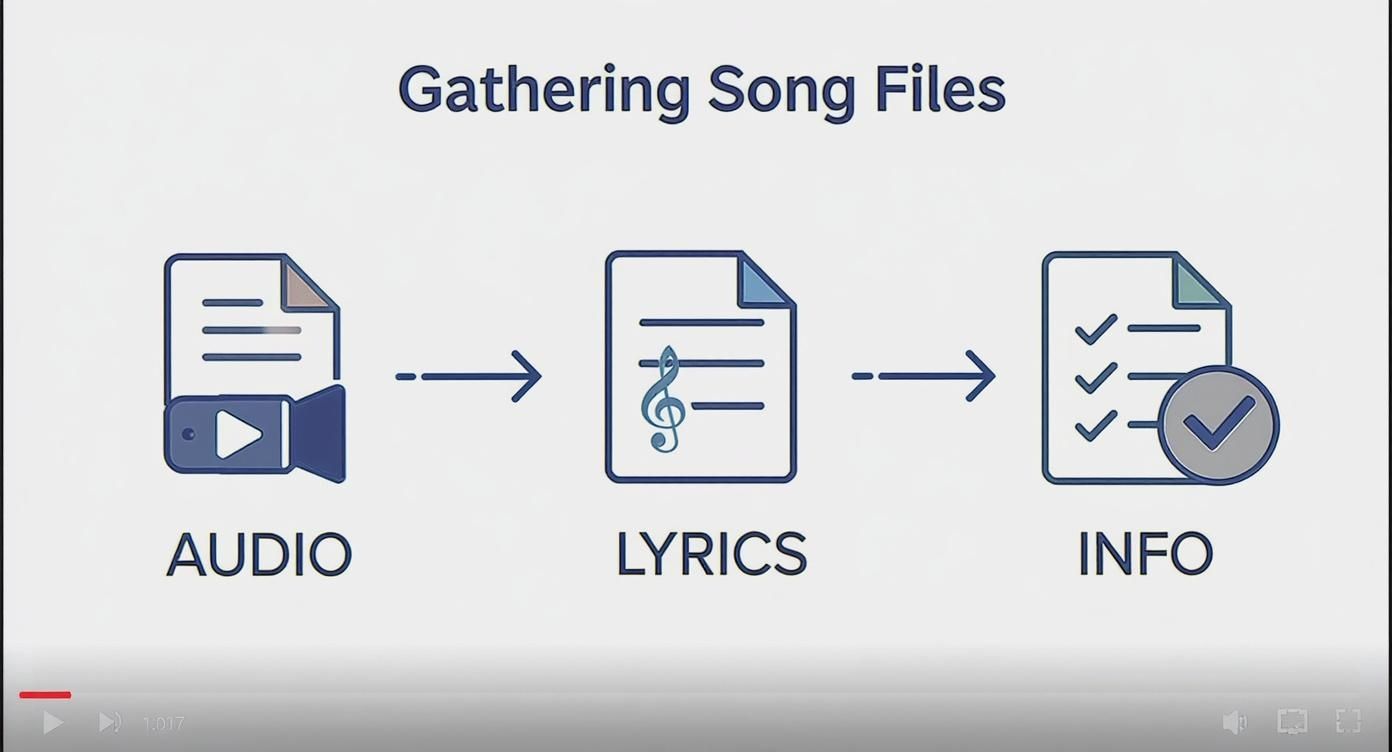
Trust me on this: gathering your audio files, lyric sheets, and song details beforehand makes the whole process faster and far less stressful. No one wants to hunt for a missing MP3 file with an application halfway done.
Kicking Off Your Registration
Once you're logged into your new account, you’ll land on a dashboard with a few different choices. For nearly every indie artist or songwriter, the path starts with the "Register a Work" option. This is your gateway to copyrighting a new song or a full album.
From there, the system will ask you to pick an application type. This is probably the most common point of confusion for musicians, so let's clear it up.
Choosing the Right Copyright Application
The type of application you choose directly impacts your cost and what you can register together. This quick table breaks down the most common options for musicians.
| Application Type | Best For | Key Limitation | Approximate Fee |
|---|---|---|---|
| Standard Application | A single song, an EP, or an album released as a single unit. | Can only be used for one "work" at a time (e.g., one album). | $45 - $65 |
| Group of Unpublished Works (GRUW) | Songwriters with a batch of up to 10 unreleased songs. | All songs must be unpublished and have the same author(s). | $85 |
| Group of Published Works (Short Online Literary Works) | Registering up to 50 short online works, like blog posts or articles. Sometimes used for lyrics. | Limited to text-based works; not ideal for the music itself. | $65 |
For most songwriters sitting on a folder of new demos, the GRUW option is a game-changer. It lets you register up to ten tracks for one fee, offering a huge cost saving over filing them all individually.
A quick heads-up on a key legal term: "publication." The Copyright Office considers a song "published" when it's distributed to the public through sale, rental, or even streaming. So, the moment your song hits Spotify or Apple Music, it's officially published.
Making Sense of the Legal Lingo
The application form is filled with legal terms that can feel intimidating, but they're simpler than they sound.
When you see the word "claimant," that’s just the legal term for the copyright owner. If you wrote the song yourself, the claimant is you. Simple as that.
You'll also run into the phrase "work made for hire." For almost all independent artists, this section does not apply. This is meant for situations where a person creates something as part of their job for an employer, or in very specific cases where a freelancer signs a written "work for hire" agreement. If you're writing your own music on your own time, you can confidently move right past this part.
The Cost of Copyright vs. The Cost of Not
It’s easy to look at the U.S. Copyright Office filing fee and wince. A standard application will run you between $45 and $65, and for a working artist, that can feel like just another expense on a very long list.
But let's completely reframe that thought. This isn't just a fee; it's your ticket to getting paid. Without an official registration, you’re basically powerless when it comes to collecting the money your music actually earns.
Turning on the Money Faucet
Your registered copyright is the legal backbone for every single revenue stream your music can generate. Seriously, think about it—all the ways you get paid trace directly back to this one document.
Mechanical Royalties: Every single stream on Spotify, every download from Apple Music, every physical CD sold—each one generates a mechanical royalty. Registration is your undeniable proof of ownership required to collect that cash.
Performance Royalties: When your song gets airtime on the radio, plays over the speakers at a coffee shop, or is performed live, it's earning performance royalties. Your PRO, whether it’s ASCAP or BMI, needs that copyright on file to send you the checks.
Synchronization (Sync) Fees: This is where the big money can be. If a brand wants your track for an ad, or a film director needs it for a scene, they pay a sync fee. You can bet they won’t even consider licensing a song without a registered copyright. It's a non-starter.
You have to see the filing fee as a one-time investment that unlocks a lifetime of potential earnings. It's the most crucial business decision you'll make for that song.
And the potential upside is staggering. Global revenue from music copyrights has exploded, climbing to an estimated $50 billion—nearly doubling in just a decade. That pie includes $28.5 billion from recorded music alone, plus billions more in royalties for songwriters.
This isn't some abstract number; it's a direct reflection of the value that formal copyright protection unlocks. For more on this, check out the analysis of the growth of music copyright revenues at ANote Music. That small filing fee is your entry pass into this massive market.
What to Do After Your Copyright Is Registered

Getting that official registration certificate in the mail feels great, but don't just file it away and forget about it. Think of your copyright not as a finish line, but as the starting block for actively managing your music's career.
A simple but powerful first step is to use a copyright notice. While it's not strictly required in the U.S. anymore, it's a smart, professional habit to get into. Adding a clear "© 2024 Your Name" to your work sends an immediate signal of ownership. It can stop someone from claiming they "didn't know" it was protected in the first place.
Dealing With Unauthorized Use
So, what do you do when you find someone using your song without your permission? It’s tempting to panic or get angry, but a measured approach is usually best, especially for smaller infringements like a YouTube video with a few hundred views.
Before you call a lawyer, start with a cease and desist letter. This is a formal, written notice telling the other party they’re using your work without permission and that they need to stop. It’s a serious warning that shows you mean business, often resolving the issue without things getting more complicated or expensive.
Properly managing your copyright is about more than just playing defense; it’s about setting your music up for success on a global stage. With your song officially registered, you’re ready to tap into a booming international market. For instance, the Middle East and North Africa saw music revenues jump by 22.8%. This kind of growth highlights the huge opportunities waiting for artists whose work is properly protected.
With a registered copyright in hand, you'll feel much more confident as you learn how to release your music independently and stand up for your rights. And remember, that protection lasts a long time. To get the full picture, check out our guide on just how long before a song is public domain.
Unpacking Common Questions About Copyrighting Your Music
When it comes to copyrighting your music, a lot of questions—and myths—tend to surface. It’s an area that can feel confusing, so let’s cut through the noise and tackle the questions I hear most often from artists.
First, let's bust one of the most persistent myths: the "poor man's copyright." This is the old idea that you can just mail a copy of your song to yourself to prove you created it. Let me be clear: this method offers zero legal protection and is completely worthless in a court of law. Official registration with the U.S. Copyright Office is the only path to securing real legal benefits, like the ability to sue for statutory damages if someone infringes on your work.
Copyright vs. PROs: What’s the Real Difference?
Many artists get tangled up trying to figure out where copyright ends and Performance Rights Organizations (PROs) begin. It’s a simple but critical distinction.
- Copyright is your proof of ownership. Think of it as the legal title to your song—it confirms you are the creator and owner.
- A PRO like ASCAP or BMI acts as a collection agency. They track public performances of your music (on the radio, in a restaurant, on TV) and collect the performance royalties you're owed.
You need to officially copyright your song first to establish ownership. Only then can you register that song with a PRO to actually get paid for its public performances. They are two separate but essential pieces of the puzzle.
How Long Does Copyright Protection Last?
The good news is that copyright protection is built to last. For any work you create today, your copyright protection extends for your entire lifetime plus an additional 70 years.
This lengthy term ensures your music remains a valuable asset, providing a potential income stream for you and your family for generations to come.
A huge point of confusion I see all the time involves using samples. While you can register a copyright for your new song, that copyright only covers the parts you created. If you used a sample from someone else's recording, you have to get legal permission first. Without clearing that sample, your own copyright registration could be invalid, and you could be walking into a legal minefield.
Clearing samples is a whole different ballgame, which is why it's so important to understand how to get the rights to a song before you even think about dropping it into your track.
OohYeah is the all-in-one platform for musicians to sell, stream, and market their work directly to fans. Take control of your career and keep more of your earnings. Build your future at https://oohyeah.app.