How Do Artists Make Money on Spotify? Find Out Here
Wondering how do artists make money on Spotify? Learn about royalties, streaming payouts, and strategies to boost your income on the platform.
September 7, 2025
Music Marketplace Advisor
Buying & SellingLet's be clear: making money on Spotify isn't as simple as getting paid a few cents every time someone hits play. The platform's payment model is a bit more complex, but understanding it is the first step toward maximizing your earnings. It all revolves around a concept called the 'pro-rata' system.
Think of all the money Spotify generates each month—from both Premium subscriptions and ad revenue—as one giant pot of cash. Your earnings are determined by what percentage of the total streams on the platform are yours. Essentially, you're not getting a fixed rate per stream; you're earning a slice of the total revenue pie.
Your Guide to Spotify’s Payout System
So, how does that money actually find its way from a listener's headphones into your bank account? It’s a journey with a few important stops, but the path becomes clear once you see the map.
First, before any artist gets paid, Spotify takes its cut off the top of that revenue pool. What's left for rights holders (that's you, your label, your publisher, etc.) is the majority of the pot, typically around 70% of the total revenue. This is the money that gets distributed based on who got the most plays.
From Streams to Payouts
Your share of that 70% is directly tied to your "streamshare." This is simply the proportion of your streams compared to the total number of streams across all of Spotify for that month.
Because the total revenue pool and the total number of streams change every single month, the value of one stream is never fixed. It’s a constantly moving target.
You’ve probably heard people throw around an average payout rate of $0.003 to $0.005 per stream. While that's a decent ballpark figure, it's crucial to remember it's just an average. The actual value of a stream can swing based on factors like the listener's subscription plan (Premium streams are worth more than ad-supported ones), their country, and the specific deals your distributor has with Spotify.
To make that real, an artist with one million streams might see a payout somewhere between $3,000 and $5,000. But again, that's an estimate, not a guarantee. For a deeper dive into the numbers, Ditto Music offers some great insights on how these rates break down.
One last critical piece of the puzzle: the money doesn't come straight to you. It has to pass through the hands of the rights holders you work with first.
- Distributors: Services like DistroKid or TuneCore are your gateway to Spotify. They upload your music and are the first to collect the master recording royalties on your behalf.
- Publishers & PROs: These organizations (like ASCAP or BMI) collect the separate publishing royalties owed to the songwriters and composers.
- Record Labels: If you're signed to a label, they'll receive the money first. Your payment then comes from them, based on the terms of your record deal.
Beyond just royalties, Spotify provides other avenues for artists to generate income. This table breaks down the main ways you can build a revenue strategy on the platform.
Artist Revenue Streams on Spotify at a Glance
| Revenue Stream | Description | Who It's For |
|---|---|---|
| Streaming Royalties | The primary income source, paid out from a collective revenue pool based on your share of total streams. | All artists with music on the platform. |
| Merch Sales | Integration with platforms like Shopify allows you to sell merchandise directly from your artist profile. | Artists with physical products to sell. |
| Concert Tickets | List upcoming tour dates and link to ticket vendors through integrations with partners like Ticketmaster. | Touring artists and bands. |
| Tipping / Fan Support | Add a "Fan Support" link to your profile, directing fans to platforms like PayPal or Cash App to donate. | Independent artists looking for direct fan funding. |
Each of these streams plays a part in creating a sustainable career. While streaming royalties are the foundation, building out your profile with merch, tour dates, and fan support links turns your Spotify page into a true commercial hub.
Decoding the Pro-Rata Royalty Model
If you want to understand how artists actually get paid on Spotify, you have to get your head around its core payment system: the pro-rata royalty model, also known as "streamshare." The first thing to do is throw out the idea that Spotify pays a fixed rate for every stream. It doesn't. Your earnings are always a moving target, directly tied to how your music performs against every other song on the platform.
Think of it like this: all the money Spotify pulls in from subscriptions and ads each month gets pooled together into one giant pot. This is the total revenue available to pay everyone. The slice you get isn't based on a set price per stream; it's determined by what percentage of the total streams your music generated.
This is the very reason why the question, "How much does Spotify pay per stream?" is so notoriously tricky to answer. The value of any single stream is constantly shifting.
The Ever-Changing Value of a Stream
Several key factors are always tweaking the size of that revenue pot and, in turn, the value of your slice. These are the ingredients that make every month's payout a little different.
- Your Listener's Subscription: A stream from a Premium subscriber is worth more because they contribute more cash to the pot than someone on the free, ad-supported tier.
- Your Listener's Location: Where your fans are listening matters—a lot. Payouts can vary dramatically from one country to another. For example, a stream from the United States might net around $0.0039, but one from Portugal could be closer to $0.0018. Your audience's geography has a direct line to your bank account.
- Your Distributor's Deal: The specific agreement your distributor or record label has with Spotify also influences the final calculation before the money ever gets to you.
This infographic breaks down how all these pieces fit together to figure out what you ultimately earn.
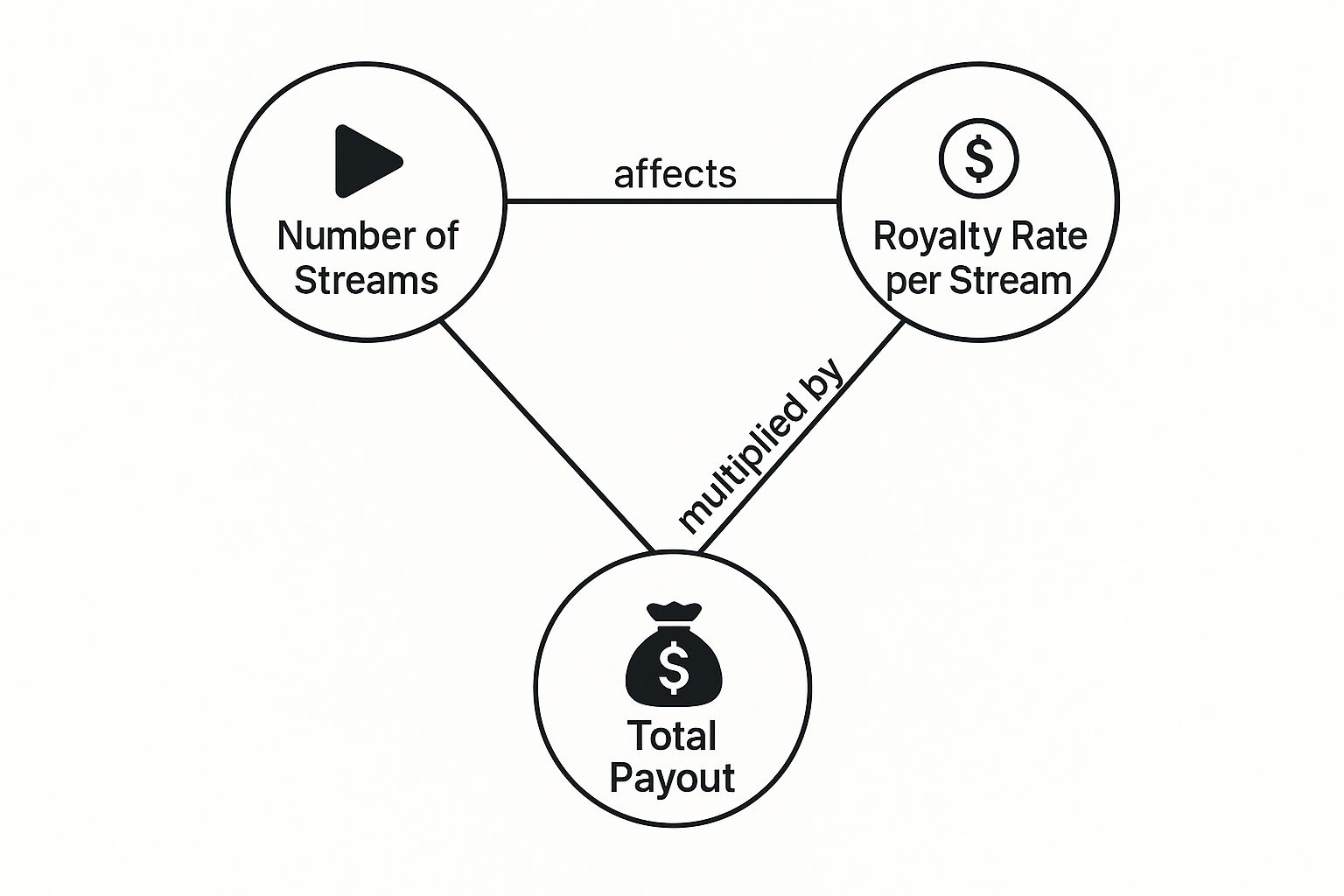
As you can see, your total stream count is just one variable in a much bigger, more dynamic equation.
Your Share of the Pie
Because of how this all works, obsessing over a mythical per-stream rate is a waste of time. The metric that truly moves the needle is your streamshare—your slice of the total streaming pie for that month. The higher your streamshare, the bigger your payout, no matter how big or small the overall revenue pot is.
The real takeaway is this: Your earnings aren't a direct transaction where Spotify pays you for a stream. Instead, you're getting a calculated cut of a collective revenue pool, and the size of your cut depends on how your music stacks up against everyone else's.
This is why a million streams in January might pay out differently than a million streams in July. The total revenue, the total number of streams platform-wide, and where those streams came from are always in flux. Getting a solid grip on this pro-rata system is the first and most important step in building a real strategy to earn more from your music on Spotify.
Understanding the Different Types of Royalties
When your song gets played on Spotify, it’s not as simple as one stream, one payment. Each play kicks off a complex chain reaction, sending different types of royalty payments to various people who own a piece of the music. To really get a grip on how you make money, you first have to understand what these royalties are and who gets them.
Think of your song as having two distinct halves. There's the master recording (the actual audio file you hear) and the composition (the song itself—the melody, chords, and lyrics). Each half generates its own kind of royalty.
Spotify actually provides a pretty helpful diagram that shows how the money travels from their platform to everyone involved.
As you can see, the path for recording royalties is separate from the one for publishing royalties. They’re two different streams of money flowing to different places.
Recording Royalties: The Sound Itself
For most artists, this is the royalty they’re most familiar with. Recording royalties are paid to whoever owns the master sound recording.
If you're an independent artist, you likely use a service like TuneCore or DistroKid to get your music on Spotify. In that case, your distributor collects these royalties and passes them on to you. If you’re signed to a record label, the label collects them first and then pays you based on the terms of your deal.
Publishing Royalties: The Song's DNA
This is where it gets a bit more complicated, but it's essential to understand. Publishing royalties are paid to the owners of the composition—that's the songwriters and their publishers. This single royalty is actually split into two smaller, critical pieces:
- Mechanical Royalties: These are generated every time a song is reproduced. In the digital age, every stream counts as a reproduction, which is why these are so important. They are typically collected by publishing administrators or mechanical rights organizations.
- Performance Royalties: These are paid out whenever a song is performed publicly. Believe it or not, a stream on Spotify is legally considered a public performance. These are collected by Performing Rights Organizations (PROs) like ASCAP, BMI, and SESAC.
Heads up: If you write your own music, it is absolutely crucial to be set up with a PRO and a publishing administrator. If you skip this, you’re basically leaving money on the table. Those royalties will be generated, but no one will be there to collect them for you.
This whole system is powered by a massive global listenership. By mid-2025, Spotify had ballooned to 696 million monthly active users, with total revenue hitting €4.2 billion. You can learn more about Spotify’s expanding user base and financial growth directly from their reports.
So, you’ve got your tracks mixed, mastered, and ready for the world. But how do you actually get your music on Spotify?
First things first, you can’t just upload your songs directly. Spotify, like other major streaming platforms, requires you to go through an approved partner. This ensures that all the music they receive is properly formatted, licensed, and ready for global distribution.
You have two main avenues to get your music from your studio to the ears of millions: partnering with a digital distributor or signing with a record label.
Choosing Your Path to the Platform
Each route comes with its own set of pros and cons, and the right choice really boils down to your career goals, your desire for creative control, and where you're at in your journey as an artist.
The Digital Distributor Route
For most independent artists, a digital music distributor is the go-to option. Think of companies like DistroKid, TuneCore, or CD Baby as your personal delivery service to the digital world. You pay them a small annual fee or a commission, and in return, they handle all the technical heavy lifting of getting your music onto Spotify, Apple Music, and dozens of other stores.
The biggest advantage here? You keep 100% ownership of your master recordings and maintain total creative freedom. It's your music, your vision, your rules.
The Record Label Route
The other path is the more traditional one: signing with a record label. This is a whole different ballgame. A label brings a lot to the table—money for recording and marketing, an established network of industry contacts, and a team of people dedicated to pushing your music.
But that support isn't free. When you sign a label deal, you're almost always giving up a significant percentage of your master recording ownership and a much larger slice of your royalty pie. You trade a degree of control for access to their resources and infrastructure.
Making this choice is a pivotal business decision. It's a classic trade-off: the complete autonomy of the independent path versus the powerful machine a record label can offer.
Digital Distributor vs. Record Label Comparison
To help you figure out which path makes the most sense for you, let’s put them side-by-side. Seeing the key differences laid out can make it much clearer which option aligns with your goals as an artist. This is a foundational step before you start thinking about how to get your music heard by a bigger audience.
| Feature | Digital Distributor | Record Label |
|---|---|---|
| Ownership | You retain 100% ownership of your master recordings. | You often sign over a percentage (or all) of your master ownership. |
| Royalty Share | You keep 80-100% of your royalties, depending on the distributor's model. | The label takes a significant cut; artists may receive 15-50% of royalties. |
| Upfront Cost | You pay an annual fee or a small percentage per release. | No upfront cost, but you repay expenses through future royalties (recoupment). |
| Creative Control | You have complete control over your music, artwork, and release schedule. | The label has significant input and final say on creative decisions. |
| Marketing & Support | You are responsible for all marketing, promotion, and playlist pitching. | The label provides a dedicated team for marketing, PR, and radio promotion. |
| Best For | Independent artists who want full control and ownership of their career. | Artists seeking significant financial backing and mainstream promotion. |
Ultimately, there’s no single "best" answer. The independent route gives you freedom and higher royalty rates, but you have to do all the work yourself. A label can open doors you could never open alone, but it comes at a significant cost to your ownership and long-term earnings.
Strategies to Increase Your Spotify Earnings
Knowing how the royalty system works is one thing, but actually growing your stream count is how you start to see real money from Spotify. To get there, you need a solid game plan that covers your activity both on and off the platform. It all starts with treating your Spotify profile less like a simple music player and more like your personal storefront.
Think of your Spotify for Artists account as your command center. A complete and polished profile—with a great bio, professional photos, and current social links—tells fans and Spotify's own editors that you mean business. This is your shot to share your story and build a bond that goes deeper than just one song.
Optimize Your Profile and Releases
If you want to cut through the noise, you have to master the tools Spotify gives you. These features aren't just for show; they're built to boost engagement, which ultimately leads to more streams.
- Use Canvas: Add a short, looping video to your tracks. Spotify’s own data shows that tracks with a Canvas are far more likely to be shared, saved, and added to user playlists.
- Run Pre-Save Campaigns: Before you drop a new track, get your fans to pre-save it. This small action guarantees your song lands in their libraries on release day, creating a huge surge in initial streams that Spotify's algorithms will notice.
- Pitch to Editorial Playlists: Get your music in front of Spotify's playlist editors by using the pitching tool in your artist dashboard. Make sure you submit it at least a week before your release date. A spot on a big official playlist can be a total game-changer, putting your music in front of thousands of new listeners practically overnight.
Another fantastic tool in your arsenal is a Marquee campaign. This is essentially a sponsored pop-up that recommends your new music to people who are already listening to artists like you. It's a highly targeted way to turn casual listeners into genuine fans.
Drive Traffic from Outside Spotify
While optimizing your profile is crucial, your work doesn't end there. A massive part of growing on Spotify is learning how to pull your audience from other places onto the platform.
Engage with your followers on social media, build an email list, and consistently share direct links to your Spotify profile, new releases, and personal playlists. Encourage them to follow you and add your tracks to their own collections. This constant push from the outside is what builds a dedicated, long-term listener base.
The hard truth is that Spotify earnings are all over the map. While over 103,400 artists earned at least $5,000, countless others are still trying to hit the 1,000-stream threshold just to see their first royalty payment. You can discover more insights on Printify's blog about this earnings gap.
This data really drives home how important it is to actively and consistently build your audience. It's what separates the artists making pocket change from those building a career. For more hands-on advice, dive into our guide on tips for increasing music streams and earnings. By blending a great profile with smart, consistent promotion, you can make a real difference in your presence and your bank account.
Monetizing Your Presence Beyond Streams
Streaming royalties are just the beginning. If you're only focused on per-stream payouts, you're leaving a ton of money on the table. The real secret is to stop thinking of your Spotify profile as just a place to host music and start treating it like your central business hub. Spotify gives you some powerful tools to turn casual listeners into genuine fans who want to support your career directly.
This is all about diversifying your income streams, and you can do it right from your artist page. Take Spotify’s integration with Shopify, for example. It lets you link your merch store directly to your profile, transforming it into a virtual merch booth. A fan can be listening to your latest single and, in that exact moment of connection, buy a t-shirt or a vinyl record without ever leaving the app.
Activating Direct Fan Support
Merch is a great start, but it doesn't stop there. You can also use your profile to sell tickets to live shows and even receive direct contributions from your audience.
By linking services like Ticketmaster or Songkick, your upcoming tour dates show up right on your profile. It’s a seamless way for a listener to go from discovering your music to buying a ticket to see you live.
Another fantastic feature is Fan Support. This is as simple as it sounds. It lets you add a payment link from services like PayPal or Cash App, giving your most dedicated fans a direct way to tip you for your work. This creates a financial connection that completely bypasses the complex world of royalty splits.
By weaving these features together, you build a complete ecosystem around your music. A fan might discover your song on a playlist, jump over to your profile, see you're playing in their city, buy a ticket, and then grab a hoodie to wear to the show—all without leaving Spotify.
As you think bigger than just streams, many artists are exploring new ways to get paid. For those looking to get ahead of the curve, learning how to accept crypto payments for your business can open up entirely new channels for fan support.
Ultimately, building a sustainable career is about creating multiple revenue streams. As you grow, choosing the right partners becomes critical, and our guide on how to choose the right music distribution service can help you navigate that decision.
Common Questions About Spotify Earnings
Let's be honest, figuring out how streaming royalties work can feel like trying to solve a puzzle. To help connect the dots, let's tackle some of the most common questions artists have about making money on Spotify.
How Long Does It Take to Get Paid?
You've racked up streams in January, so the money should hit your account on February 1st, right? Not quite. There's a built-in delay in how the money flows.
Spotify typically pays out royalties with a two to three-month lag. So, the money you earned in January will likely show up in your distributor's account sometime in March or April. This gap gives Spotify the time it needs to tally up all the streams, collect the revenue from advertisers and subscribers, and then send the correct payments out to all the rights holders.
Think of it like a chain reaction. First, Spotify pays your distributor. Then, your distributor has to process that payment and send it to you. Each step adds a little more time to the journey from a fan's listen to your bank account.
Do All Streams Pay the Same?
This is a huge misconception. Not all streams are created equal, and the difference comes down to who is doing the listening.
A stream from a Premium subscriber is worth much more than a stream from someone on the free, ad-supported tier. Why? Because premium users contribute more money to that big royalty pot we talked about earlier. The exact value of each type of stream changes every month, depending on the total subscription and ad revenue Spotify brought in.
What Is the Minimum to Get Paid?
As of early 2024, Spotify put a new rule in place. To even be eligible for royalties, a track needs to have been streamed at least 1,000 times in the last 12 months.
This policy is aimed at cracking down on fake streams and making sure that the money goes to active, legitimate artists. If a song doesn't hit that 1,000-stream mark, the tiny bit of money it earned just stays in the royalty pool to be shared among all the other artists who did qualify.
At OohYeah, we believe artists deserve full control and transparency over their careers. Our platform is built to help you sell music, merch, and subscriptions directly to your fans, commission-free, so you keep more of what you earn. Start building your independent music business with OohYeah today.