how do artists get paid on spotify: a quick guide
how do artists get paid on spotify: discover royalties, per-stream rates, and practical tips to boost your revenue.
October 25, 2025
Music Marketplace Advisor
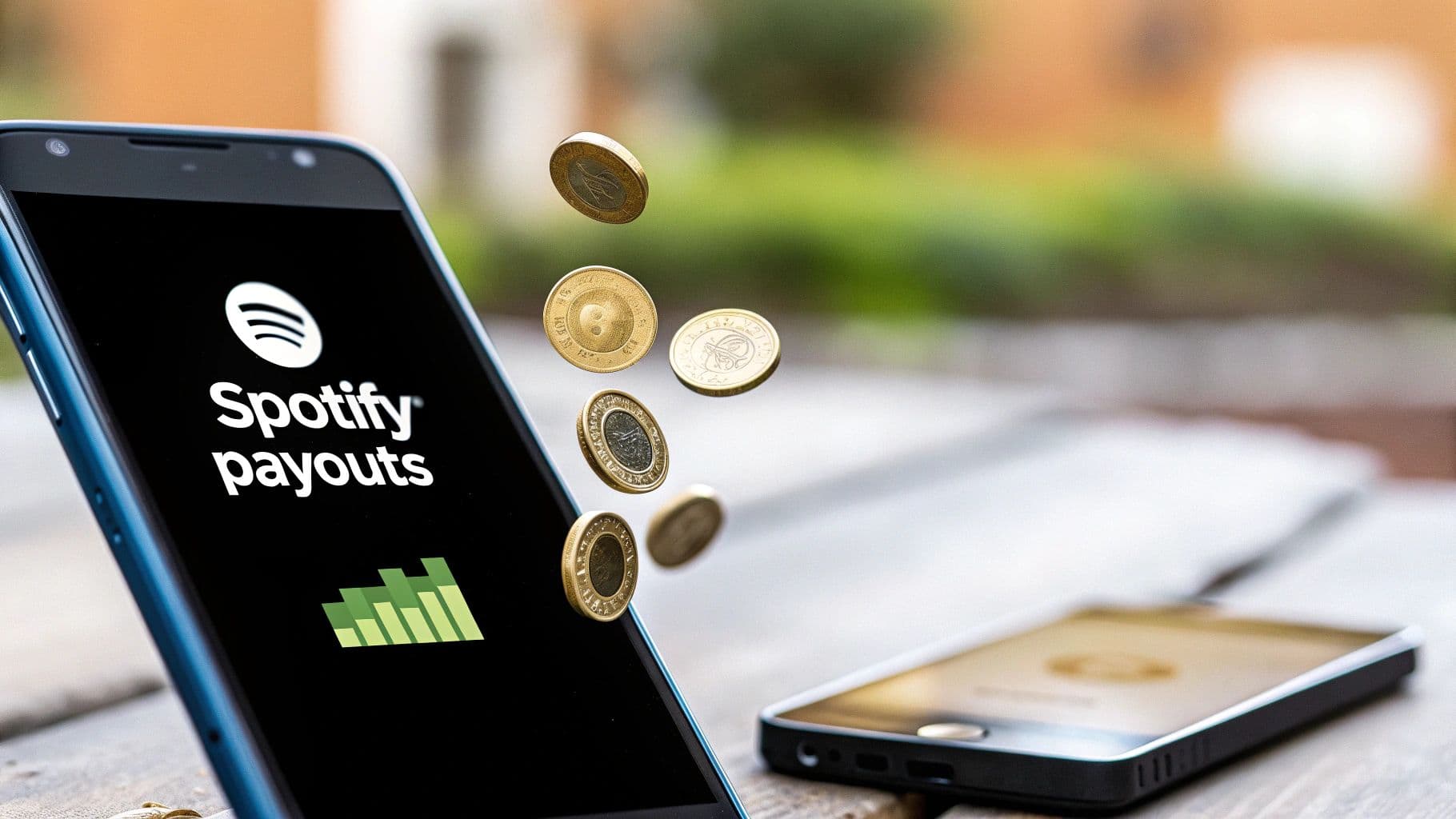
Buying & SellingSo, how do artists actually get paid by Spotify? It’s the million-dollar question, and the answer is a lot more complicated than a simple "cents-per-stream" number. Forget everything you've heard about a fixed rate.
Instead, think of it like this: Spotify gathers all the money it makes in a month into one massive pot. Your payout is determined by what slice of that pot your music has earned.
Your Guide to Spotify Artist Payouts
Getting a handle on Spotify's payment system is absolutely essential if you want to build a real career in music today. The platform doesn't pay a flat fee every time someone hits play. Instead, it uses a model that the industry calls “pro-rata,” which is just a fancy way of saying "in proportion."
Let's break it down with an analogy. Imagine all the revenue Spotify generates each month from Premium subscriptions and ad placements gets collected into one giant swimming pool. This is the net revenue pool.
At the end of the month, Spotify tallies up every single stream from every artist on the platform—from global superstars to brand-new indie bands. Your music's performance is then measured against that grand total.
The Pro-Rata System Explained
If your songs made up 0.001% of all the streams that month, your rights holders would get 0.001% of the money from that swimming pool. It’s all about market share.
This is exactly why you see so many different "per-stream" rates floating around online. They're all just averages, and they're always changing because the total revenue and total stream count are different every single month.
Key Takeaway: You're not earning a fixed fee per stream. You're earning a percentage of Spotify's total revenue, determined by how many streams your music gets compared to everyone else on the platform.
Factors That Shape Your Earnings
Several moving parts determine how big that revenue pool is and, ultimately, how much your slice is worth. Understanding these variables is the key to decoding your royalty statements.
To simplify, let's look at the main factors that affect your final payout.
Key Factors That Influence Your Spotify Payout
| Factor | Description |
|---|---|
| Listener Location | A stream from a high-income country like the U.S. or Norway pays more than one from a market with lower ad rates and subscription fees. |
| Subscription Type | Spotify Premium streams generate significantly more revenue than streams from free, ad-supported listeners. |
| Rights Holder Deals | The specific agreements your label, publisher, or distributor has with Spotify can directly impact the final payout rate. |
Grasping these core ideas helps you see past the myth of a single per-stream rate and understand how the system really works. With this knowledge, you can start analyzing your data more effectively and make smarter moves to grow both your audience and your income.
Tracing a Dollar Through the Spotify Royalty System
To really get a handle on how artists get paid on Spotify, you have to follow the money. And it's a winding road. It’s not as simple as a fan's subscription fee landing directly in your bank account. Instead, every dollar is part of a complex system that spreads the revenue across the entire platform.
Think of it like this: picture all the money Spotify makes in a month—from millions of Premium subscriptions and countless ads—flowing into one massive pot. This is the net revenue pool, and it's where your payment journey begins.
Before a single artist gets paid, that pot gets split. The first, and most important, slice is the famous 70/30 division. Roughly 70% of the total revenue pool is set aside for the people who own the rights to the music. Spotify keeps the other 30% to run their business, develop new tech, and, of course, turn a profit.
This visual gives you a good idea of how that money moves from the big pool to the artists.
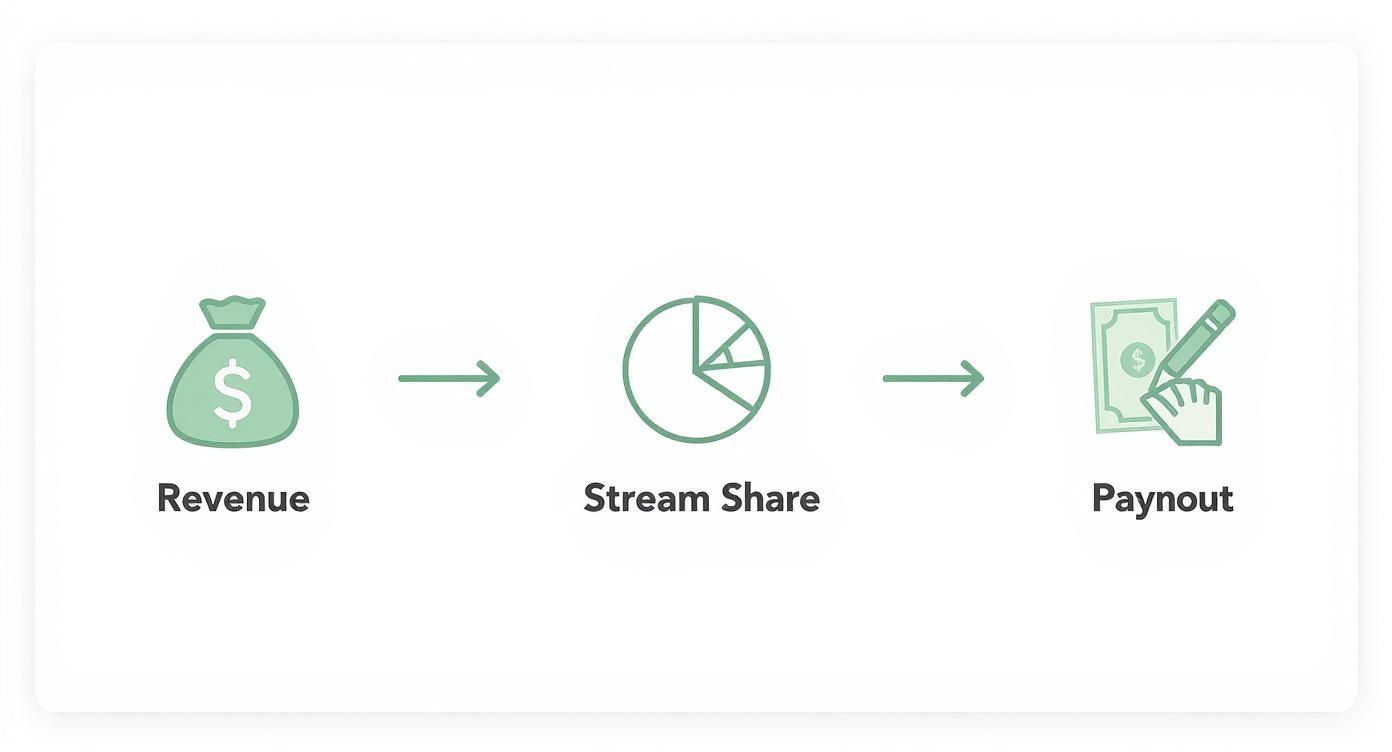
The main thing to remember is that your payment isn't a direct transaction for your streams. It’s a small piece of a much larger pie.
Calculating Your Slice of the Pie
Once Spotify carves out that 70% for rights holders, they have to figure out your stream share. This is the heart of their pro-rata model. Basically, they count up every single stream across the entire platform for the month, then calculate what percentage of that massive number belongs to you.
Let’s break it down with a simple example:
- Let's say the total pot for rights holders in a given month is $70 million.
- Now, imagine there were 20 billion total streams on Spotify that same month.
- If your songs racked up 2 million streams, your stream share is 0.01% (2 million divided by 20 billion).
In this scenario, your music earned 0.01% of that $70 million pool, which comes out to $7,000. That gross amount is then sent to your distributor or label, who will take their cut before you see a penny.
This entire system is built on that 70/30 split. For 2025, this works out to an average of $0.003 to $0.005 per stream, though that number can wobble based on different factors. At that rate, 10,000 streams will generate between $30 and $50 in gross revenue—before anyone else takes their piece.
Mechanical vs. Performance Royalties: Splitting the Payout
The money that comes from your stream share isn't just one check. It's actually split into a few different types of royalties. See, every song has two distinct copyrights: one for the master recording (the finished audio file) and one for the composition (the underlying lyrics and melody).
- Master Royalties: This goes to the owner of the master recording. If you're an independent artist, that's you. If you're signed, it's usually your record label. This is typically the biggest chunk of the payout.
- Publishing Royalties: This goes to the owner of the composition—the songwriters and their publishers. This slice is then split again into two more categories.
Key Insight: It’s critical to understand that a single stream generates multiple royalty streams. If you wrote and performed the song yourself, you're owed money from both the master and the publishing side.
This is where it gets a little more granular. Those publishing royalties are divided into:
- Mechanical Royalties: This royalty is for the right to reproduce and distribute the song. On Spotify, every stream is considered a "reproduction." In the U.S., these are collected and paid out by organizations like The Mechanical Licensing Collective (The MLC).
- Performance Royalties: This royalty is triggered anytime a song is performed publicly—and yes, a stream on Spotify counts as a public performance. These are collected by Performing Rights Organizations (PROs) like ASCAP, BMI, and SESAC.
Your distributor will usually handle collecting and paying out your master royalties. But to get your hands on all the publishing money you're owed, you (or your publisher) need to be registered with a PRO and, in the U.S., The MLC. If you skip this step, a serious chunk of your earnings could be left sitting on the table, unclaimed. The question of whether artists can make money from streaming services often boils down to making sure every one of these collection channels is properly set up.
Why Your Per-Stream Rate Is Always Changing
One of the most common misconceptions about Spotify royalties is the idea of a fixed per-stream rate. You’ve probably heard figures like “$0.003 per stream” thrown around, but treating that as a set fee is a surefire way to get confused when your statements arrive.
The truth is, your payout rate isn't static. It's a dynamic number that shifts every single month.
Trying to pin down a single per-stream number is like trying to nail jello to a wall—it just doesn’t work. The rate is a moving target, influenced by dozens of variables that are always in flux. Once you understand what makes it move, you can stop focusing on a misleadingly simple calculation and start truly grasping how your revenue is generated.
This knowledge is what separates amateur artists from professionals. It empowers you to analyze your own streaming data with a critical eye and make strategic decisions that actually grow your income.
Not All Listeners Are Created Equal
The single biggest factor that sways your payout is who is listening and where they're listening from. It's a simple concept: not all streams contribute the same amount of money to the overall revenue pool that gets distributed. The value of any given stream is tied directly to the real-world money it helps generate.
A stream from someone with a Spotify Premium account in a high-income country like the United States or Switzerland is worth far more than a stream from a free, ad-supported user in a market with lower ad rates.
Why? Because the Premium subscriber is putting more cash into the pot each month. As a result, their streams carry more financial weight when it's time to slice up the pie.
Your per-stream rate is really just an average of thousands of individual stream values. If you suddenly get a flood of new listeners from a lower-payout region, your overall average rate can actually go down, even while your total stream count goes up.
Spotify's own growth illustrates this perfectly. In the first half of 2025, the platform hit a major milestone, paying out over $10 billion to the music industry. While the average payout often lands between $0.003 and $0.005 per stream, that number is just a blend of countless high-value and low-value streams from every corner of the globe. You can get a clearer view by exploring Spotify’s subscriber growth and artist payouts in more detail.
The Key Variables That Make Rates Fluctuate
Beyond listener location and subscription type, a few other crucial elements make your payout rate a constantly moving target. Think of it as a small economy where any change can ripple through and affect the final numbers.
Here are the main variables in play:
- Total Monthly Revenue: Spotify's total income from subscriptions and ads isn't the same every month. A great month for Spotify means a bigger revenue pool for artists.
- Total Global Streams: Your "stream share" is your slice of the total pie. It’s calculated by dividing your streams by the total number of streams across the entire platform. If your streams hold steady but everyone else's go up, your share (and your payout) will shrink.
- Distributor Agreements: The deal your specific distributor or label has with Spotify can impact the percentage of revenue they receive, which in turn affects your final cut.
Let's see how this works with a quick, real-world example.
Imagine last month, your music was mostly streamed by Premium listeners in Germany. This month, you go viral on social media. Your streams triple—fantastic!—but most of your new fans are on the free tier in countries with much lower ad revenue.
So, what happens to your money?
- Your total stream count shoots through the roof.
- But, the average value per stream plummets because of where the new streams came from.
- Your total royalty payment will likely still go up thanks to the sheer volume, but your calculated per-stream rate will be significantly lower than it was last month.
This is the dynamic you have to understand. It’s the reason why a massive spike in streams doesn't always lead to an equally massive check. It’s not just about getting more streams; it’s about understanding the quality and source of those streams.
Understanding Your Payout Path via Distributors or Labels
Here's one of the first things you need to wrap your head around: Spotify never pays artists directly. It’s a common misconception, but a crucial one to clear up. Your money always travels through an intermediary—someone who collects the royalties on your behalf before they land in your bank account.
This journey your royalties take follows one of two main roads, and the one you're on depends entirely on your career status. You’re either an independent artist using a digital distributor, or you're signed to a record label. Each path has a completely different financial structure that determines how much you actually earn.
The Independent Route Through Digital Distributors
For most artists starting out today, the path to Spotify runs straight through a digital music distributor. Think of services like TuneCore, DistroKid, or CD Baby as the essential on-ramp to the global streaming highway. You can't get your music on the major platforms without one.
It’s a straightforward exchange: you pay them a fee, which might be an annual subscription or a one-time cost per release. In return, they handle the technical side of uploading your music to Spotify, Apple Music, and hundreds of other digital storefronts. But their most important job is collecting the master recording royalties your streams generate.
Once Spotify sends your distributor the big pot of money earned from all their artists' streams, the distributor slices off your piece, takes any fees or commission they charge, and sends the rest to you. The biggest win here? You're in the driver's seat and get to keep a much larger share of the money.
Key Takeaway: As an independent artist, you typically keep 100% of your master recording royalties after the distributor takes its administrative fees. This gives you a much bigger piece of the pie than a traditional label deal.
Picking the right distributor is a huge deal, since their fee models and services can be worlds apart. In fact, learning how to choose the right music distribution service is one of the most critical business decisions you'll make.
The Signed Artist Path via a Record Label
Things look completely different when you sign a record deal. The label becomes the primary owner and controller of your master recordings. They take over everything—distribution, marketing, PR, and all the administrative headaches. In exchange for this massive investment, they also collect 100% of the streaming revenue directly from Spotify.
Instead of keeping the lion's share, you get a much smaller percentage defined by your contract. For a new artist, a typical royalty rate might be somewhere between 15% and 25% of the net revenue. The label pockets the remaining 75% to 85% to cover their significant costs and, of course, to make a profit.
And then there's the advance. Any money the label gives you upfront has to be paid back from your tiny sliver of royalties before you see another cent. This is called recoupment. So, if you got a $20,000 advance, your royalty share has to add up to $20,000 before you start getting paid out.
This is why you hear stories of artists with millions of streams who haven't received a royalty check. All their earnings are just going back to the label to pay off that initial investment.
To make this crystal clear, let's break down how the money flows in each scenario.
Comparing Independent Distribution vs Record Label Payouts
The table below offers a simplified look at how royalties flow from Spotify to your pocket, comparing the two primary paths an artist can take. It highlights the major trade-offs in control, cost, and earning potential.
| Payout Aspect | Independent Artist (via Distributor) | Signed Artist (via Record Label) |
|---|---|---|
| Royalty Split | Typically keeps 90-100% of master royalties (after distributor fees). | Receives 15-25% of master royalties, with the label keeping the rest. |
| Upfront Costs | Pays distribution fees (annual or per-release). | Usually receives an advance, but all costs are paid by the label. |
| Recoupment | No advance to recoup; earnings are paid out directly. | Must recoup the entire advance before receiving royalty payments. |
| Control | Retains full ownership and control over master recordings. | The label typically owns or controls the master recordings. |
Ultimately, choosing between independence and a label deal is a classic trade-off. Going indie means more financial control and a much higher royalty percentage, but you carry all the risk and do all the work. Signing with a label gives you access to funding, a powerful team, and industry connections, but it comes at the steep price of ownership and a much smaller piece of the revenue you generate.
Actionable Strategies to Maximize Your Spotify Earnings
Knowing how Spotify pays out is one thing. Making that system actually work for you is a whole different ballgame. Let's move past the theory and get into real, practical strategies you can use to boost your streaming income. This isn't just about chasing more plays; it’s about getting the right kind of plays and building a listener base that Spotify’s algorithm can't ignore.
You have more control over your performance—and your paycheck—than you might think. The trick is to stop seeing your artist profile as a static page and start treating it like the dynamic hub for your music and your brand that it is. When you actively manage your presence, you start turning passive listeners into dedicated fans who drive real revenue.
Master Your Spotify for Artists Dashboard
Think of your Spotify for Artists account as mission control for your music career. It's packed with data that goes way beyond simple stream counts. Learning to read the tea leaves in these analytics is the key to growing your earnings. This dashboard gives you a direct look into who your listeners are, where they are, and how they’re finding you.
For instance, dive into your audience analytics and see which countries are bumping your tracks the most. Remember how streams from listeners in high-subscription areas pay more? You can use this data to laser-focus your marketing. If you see a fanbase bubbling up in Germany or the UK, you can target those regions with social media ads or virtual tour promotions.
This data-first approach means you can pour your limited time and marketing budget where it will actually make a difference, helping you find and connect with the very listeners who add the most to your royalty checks.
Get Your Music on Algorithmic Playlists
Algorithmic playlists are absolute game-changers for discovery on Spotify. Getting your track on a playlist like Discover Weekly or Release Radar can put your music in front of hundreds of thousands of new listeners who are already primed to love your sound. These aren't curated by a person; they’re built by algorithms that match music to a user's specific taste.
So, how do you get the algorithm to notice you?
- Pitch Your Music Early: Use the playlist submission tool in Spotify for Artists at least 7-10 days before your release. This gets your track on the radar for both human editors and the bots that power Release Radar.
- Drive Initial Engagement: The first 24-48 hours are everything. Rally your existing followers to stream, save, and add your new song to their own playlists. A strong initial surge tells the algorithm that people are connecting with your track.
- Build Your Follower Count: Release Radar is unique to every user, showing them new music from artists they follow. It's simple math: the more followers you have, the more Release Radar playlists your new song lands on, creating an instant wave of streams.
Key Strategy: A well-executed pre-save campaign can be a massive advantage. It guarantees your song is automatically added to fans' libraries and playlists on day one, giving you that critical early engagement algorithms love to see.
Optimize Your Artist Profile for Engagement
A sharp, engaging artist profile does more than just look good. It encourages listeners to stick around, dig into your back catalog, hit the follow button, and save your music—all actions that boost your streams and signal your value to Spotify's algorithm.
Start by sprucing up these key elements:
- Artist Pick: This is the first thing people see. Use it to showcase your new single, a full album, or a playlist you’re featured on.
- Canvas: Add a short, looping video to your tracks. Spotify's own data shows a good Canvas can increase shares by up to 145% and playlist adds by 20%.
- Bio and Photos: Keep your bio fresh with the latest news and use current, high-quality images. It's all part of telling your story and forging a real connection with listeners.
While knowing the payout system is crucial, actively growing your audience is where the real money is. Learning about creating viral content can massively expand your music's reach and funnel new listeners to Spotify. For more platform-specific tactics, our guide offers additional tips for increasing music streams and earnings. Every little optimization adds up to build a more sustainable career in music.
Spotify's Evolving Payout Landscape
To really get a handle on how Spotify pays artists, you have to look past a single royalty statement. The whole system is a living, breathing thing, constantly shifting with global trends, the platform's own growth, and policy tweaks that can directly hit your bottom line. It's definitely a competitive world out there, but when you zoom out, you see a system that’s actually creating more chances for more artists than ever before.
The biggest story here is the incredible growth of the global royalty pool. As Spotify pulls in more subscribers and expands into new countries, the total amount of money available for everyone—artists, labels, publishers—gets bigger. This growth has paved a more sustainable path for a much wider range of artists, which is a night-and-day difference from the old industry model where only a tiny handful of superstars made any real money.
Growing Opportunities for Artists
The numbers don't lie. The financial outlook for artists at almost every level is looking up. Over the last ten years, building a career from streaming has gone from a long shot to a legitimate reality, not just for the top 1%, but for thousands of working musicians.
Just look at the earnings data from 2014 to 2024. The 100,000th-ranked artist, for instance, saw their annual royalties rocket from under $600 in 2014 to nearly $6,000 a decade later—that's a tenfold increase. At the same time, the 10,000th-ranked artist's earnings shot up from $34,000 to $131,000 per year. You can dig deeper into these numbers by checking out the breakdown of Spotify’s economic impact.
Navigating Recent Policy Changes
Of course, the system never stands still. Spotify recently rolled out new policies designed to make sure royalties are going to active, legitimate artists. It's crucial for every musician to understand these changes because they directly impact your ability to get paid.
Here are the key updates:
- Track Monetization Threshold: As of 2024, a track needs at least 1,000 streams in the past 12 months before it can even start earning royalties.
- Minimum Unique Listeners: To clamp down on bot farms and fake streams, tracks also have to be played by a certain number of individual listeners to qualify for a payout.
These new rules are all about fighting fraud and making sure the money is split fairly among artists who are putting in the work. It might feel like another hoop to jump through, but it's really about protecting the value of your legitimate streams.
Building a lasting career on Spotify is all about seeing both the opportunities and the ever-changing rules of the game. The platform has undeniably kicked the doors wide open for musicians, but getting ahead requires a smart, strategic mindset. By understanding the bigger financial picture and keeping up with policy shifts, you can learn to work the system and build a more stable future in today's music economy.
Answering Your Spotify Payout Questions
Even when you think you have a handle on the royalty system, specific questions always seem to pop up. Let's tackle some of the most common ones I hear from artists to clear up any lingering confusion about how money actually gets from Spotify into your pocket.
How Often Do Artists Get Paid from Spotify?
Spotify sends out royalty payments every month, but there’s a built-in delay. They release the funds to rights holders—which is your distributor or label—about 30 to 45 days after a month ends.
But that’s not the end of the journey. Your distributor then has to process that payment and deposit it into your account based on their own schedule. So, in practice, the money you earned from streams in January might not actually show up until March or even April.
Do I Get Paid If I Stream My Own Music?
The short answer is no. Trying to juice your numbers by playing your own songs on repeat is a fast track to getting in trouble.
Spotify has sophisticated systems in place to detect what they call "artificial streaming." This isn't just about bots; it includes individuals trying to game the system. If their alarms go off, they can withhold royalties, issue a strike against your account, or even pull your music down completely. Simply put, only real streams from real listeners will ever earn you a dime.
Why Did My Payout Per Stream Change This Month?
This is a big one, and it's completely normal. Your per-stream rate is never a fixed number; it's designed to fluctuate every single month. That's just how Spotify’s pro-rata system works.
Think of it as a moving target. Several factors are constantly changing, all of which affect the final rate you see:
- How much total ad and subscription revenue Spotify generated that month.
- The total number of streams across the entire platform.
- Where in the world your listeners are located.
- The blend of streams from Premium subscribers versus free, ad-supported listeners.
If any of these pieces of the puzzle shift—and they always do—the size of the royalty pool and your slice of it will change, too. The result is a brand new per-stream payout calculated every month.
Empower your music career by taking full control. With OohYeah, you can sell your tracks, merch, and subscriptions directly to fans with zero commission fees, ensuring you keep more of what you earn. Join OohYeah today and build a more sustainable future for your music.