Fan Monetization Platform Guide: Models, Features, Income
Learn how a fan monetization platform works, compare revenue models, and see how OohYeah returns more earnings to creators.
November 8, 2026
Music Marketplace Advisor
Buying & SellingYour latest release gets plays, followers leave encouraging comments, and someone asks when the merchandise is coming. Then you check your income and wonder why the attention hasn't translated into money for the next recording. The missing piece may not be more exposure. It may be a clear offer, an easy purchase path, and a reason for supporters to come back.
A fan monetization platform connects those pieces. But choosing one requires more than comparing feature lists. You need to understand what fans will pay for, what you can reliably deliver, and how much remains after the costs of serving them.
What a Fan Monetization Platform Does and Where It Fits Beside Streaming
A fan monetization platform is a service where artists sell music, merchandise, memberships, and direct access to fans. Think of it as a storefront and a backstage pass in the same place. The artist chooses the offer, sets the price, and explains what the buyer receives.
Say someone hears your single, visits your profile, and buys a download. Later, they return for a physical release. Those purchases can help fund recordings, musicians, touring, and merchandise without requiring every listener to become a subscriber.
The workflow brings listening, commerce, and audience information together.
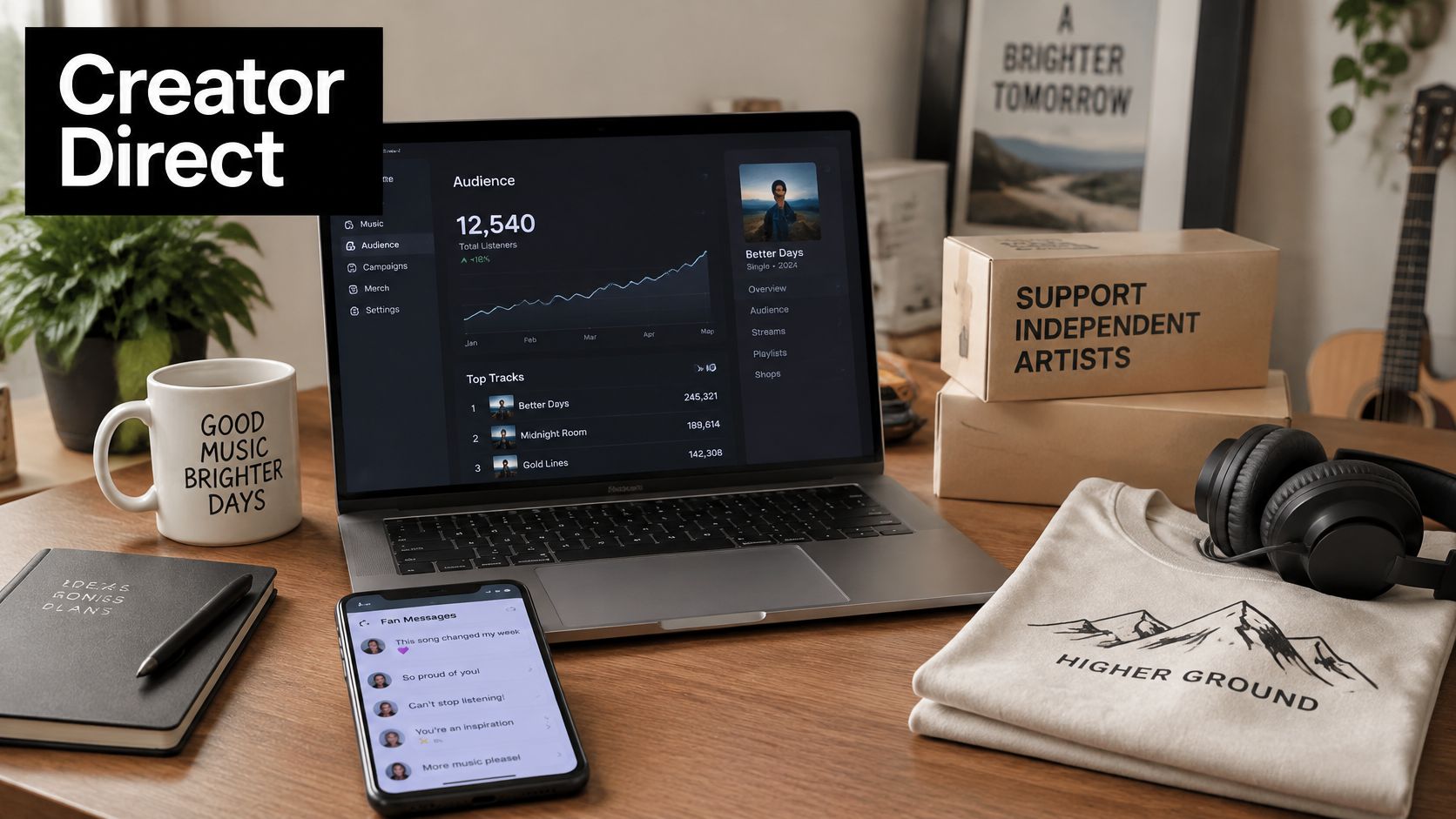
Discovery, conversion, and retention are different jobs
- Discovery helps someone find your music.
- Conversion gives that listener a reason to pay.
- Retention gives a buyer a reason to return or remain subscribed.
Streaming remains central: IFPI's global recorded-music report puts worldwide recorded-music trade revenue at US$29.6 billion in 2024, with streaming generating US$20.4 billion, or 69.0% of the total.
This didn't happen overnight. UNESCO's music policy perspectives reports 255 million paid-streaming users in 2018, compared with 523.9 million subscribers in 2021.
The practical conclusion isn't to abandon streaming. Our artist marketplace adds a direct purchase path rather than replacing it: stream to discover the artist, buy something the artist makes available, and help fund what comes next.
Start with a relationship audit: Identify which audiences you can contact directly and which you can reach only when another platform distributes your post.
Revenue Models Compared at a Glance
| Revenue model | Who pays | Revenue pattern | Creator control |
|---|---|---|---|
| Recurring membership | Committed fans | Monthly or annual, predictable while members renew | High: sets price and perks |
| Direct purchase of downloads | Buyers of specific releases | One-time per sale | High: sets price and availability |
| Merchandise | Fans buying goods | One-time per order | High: sets price and stock |
| Exclusive releases and early access | Superfans and members | One-time or bundled with membership | High: decides what is exclusive |
| Community tiers and direct messages | Paying members | Recurring with membership | Medium: limited by platform tools |
| Tips and one-off support | Casual supporters | Irregular; average comes from actual contribution history | High: no fixed price |
| Ticketed events and livestreams | Attendees | Per event; annual frequency follows the artist's schedule | Shared: artist controls offer, venue and tools constrain delivery |
Match the model to the promise
Recurring memberships are the strongest candidate for a predictable base because supporters authorize continuing payments. Predictable doesn't mean guaranteed: the promise must remain useful enough for members to renew.
Downloads work when a fan wants a particular recording rather than an ongoing obligation. Make the file format, included material, and delivery process clear before checkout.
Merchandise introduces a different calculation. The selling price must cover the item, packaging, fulfillment, and the work involved in resolving damaged or missing orders. A successful sale isn't necessarily a profitable sale.
Exclusive releases and early access sell timing or scarcity rather than a different physical product. Specify whether the material will eventually become public so buyers know what exclusivity means.
Community tiers sell participation. Direct messages can make that participation meaningful, but an open-ended promise of personal availability can become difficult to honor as membership grows.
Tips offer a low-commitment way to contribute, but they're a weak basis for recurring expenses. Ticketed events can support a specific moment, provided the artist budgets for production and clearly explains access, scheduling, and cancellation terms.
For an alternative view of project-level financial tracking, you can see Flash's live project metrics from Fundl. Keep the distinction clear: project funding measures progress toward a defined objective, while membership reporting must also account for continuing service and renewals.
Build a recurring base without forcing everyone into it
Paid access deserves serious consideration. IFPI's Global Music Report 2025 reports that paid-subscription streaming revenue grew 9.5% during 2024, while ad-supported streaming grew 1.2%.
That comparison supports testing paid utility, not assuming your listeners will subscribe. A catalog subscription and a membership for an individual artist solve different problems. Your offer needs its own evidence of demand.
Use free access to demonstrate what makes the artist worth following. Keep the paid promise specific: rehearsal recordings, release previews, production breakdowns, or a moderated member discussion are easier to evaluate than vague promises of closer access.
Then measure the recurring layer with a cohort, a group of fans who started during the same period or through the same campaign:
- Trial-to-paid conversion shows whether the initial experience persuades people to purchase.
- Monthly churn measures the share of existing subscribers who leave during a month.
- Involuntary churn isolates losses caused by failed payments rather than deliberate cancellations.
- Average revenue per paying fan shows what supporters spend, not just the advertised entry price.
- Lifetime value estimates the contribution from a paying relationship over its duration.
Don't calculate lifetime value from a membership's opening rush alone. Early supporters may behave differently from people acquired through later campaigns, and gross receipts don't account for servicing costs.
Record cancellations separately from failed renewals. The response differs: a disappointed member may need a better offer, while a payment failure calls for a recovery process.
Build the base with memberships you can sustain, then add merchandise and exclusives for fans who want more. Don't make every supporter buy the same way.
Core Features That Turn Listeners into Supporters
A useful feature hierarchy starts with the transaction, continues with delivery and engagement, and ends with evidence of what worked. An attractive feed isn't enough if fans can't understand the offer or receive what they purchased.
The relationship between those tools matters more than the length of the feature list.
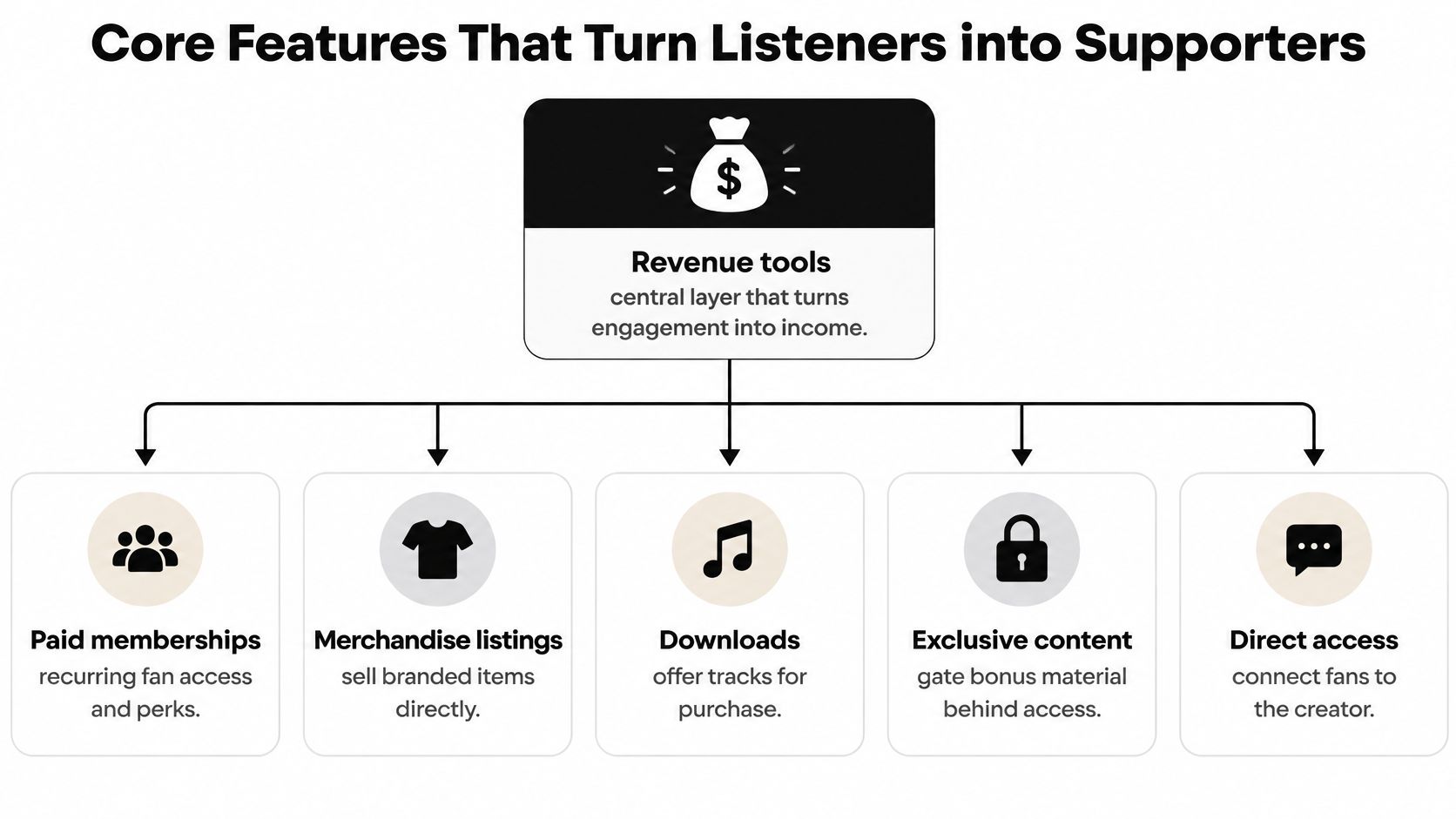
Start with payment and reliable delivery
The monetization base should support clear membership terms, usable merchandise listings, downloadable files, and appropriately restricted exclusive content. Buyers should know what they're buying before payment and where to find it afterward.
For gated material, server-side authorization matters. The service should check whether the account has an active entitlement before delivering protected content, rather than merely hiding a button in the browser.
Separate the purchase record from the access permission. A billing record explains what happened financially; an entitlement explains what the fan can access now. Renewals, cancellations, refunds, and grace periods need consistent handling across both.
Test the entire experience as a fan. Buy an item, locate the receipt, open the download, and try accessing member content from another device. A feature that exists on a checklist may still be confusing in practice.
Use interaction to support the offer
Messages, voice notes, and community posts give artists ways to explain their work and acknowledge supporters. They shouldn't become unrelated chores that consume the time needed to make music.
The relationship opportunity is real: Deloitte's 2025 Digital Media Trends survey found that roughly 50% of surveyed Gen Z and millennial consumers reported a stronger personal connection with social-media creators than with television personalities or actors.
That finding concerns surveyed consumers, not your future conversion rate. Use it as a reason to test meaningful interaction, not as proof that personal access will sell.
Set boundaries in the offer itself. A scheduled group conversation is different from unrestricted private replies. State the format, availability, and subject matter so supporters aren't buying expectations you can't meet.
Connect fan activity to purchases
A useful analytics layer brings consented activity into a coherent account history. Relevant events include follows, content views, downloads, messages, merchandise clicks, subscription upgrades, and event attendance.
Our signed-in accounts store the landing page, referrer, campaign source, optional signup interest, and times of first playback, artist follow, playlist creation, and recent activity. These records can help distinguish a recent arrival from someone who has repeatedly returned.
For decision-making, assess signals together:
- Recency distinguishes current interest from an old interaction.
- Frequency shows whether someone returns rather than visits once.
- Monetary value separates browsing from demonstrated purchasing behavior.
- Interaction depth distinguishes a passing view from deliberate participation.
Say a fan repeatedly checks a physical release and engages with its production updates. A relevant availability message may suit them better than a generic membership promotion. Someone who has only just followed may need a helpful introduction instead.
Compare conversion and retention by acquisition source, campaign, artist, content type, and geography. Avoid treating attribution as certainty: a recorded click can identify a measurable step without proving it was the only influence.
The practical test is simple: can the platform connect a fan's actions to a purchase well enough to improve your next decision?
How Artists, Producers, Managers and Fans Use It
The same platform can support very different workflows. Every artist chooses what to make available, so offerings vary by profile rather than following a single prescribed business model.
A release team needs to decide who owns each task before sending fans toward checkout.
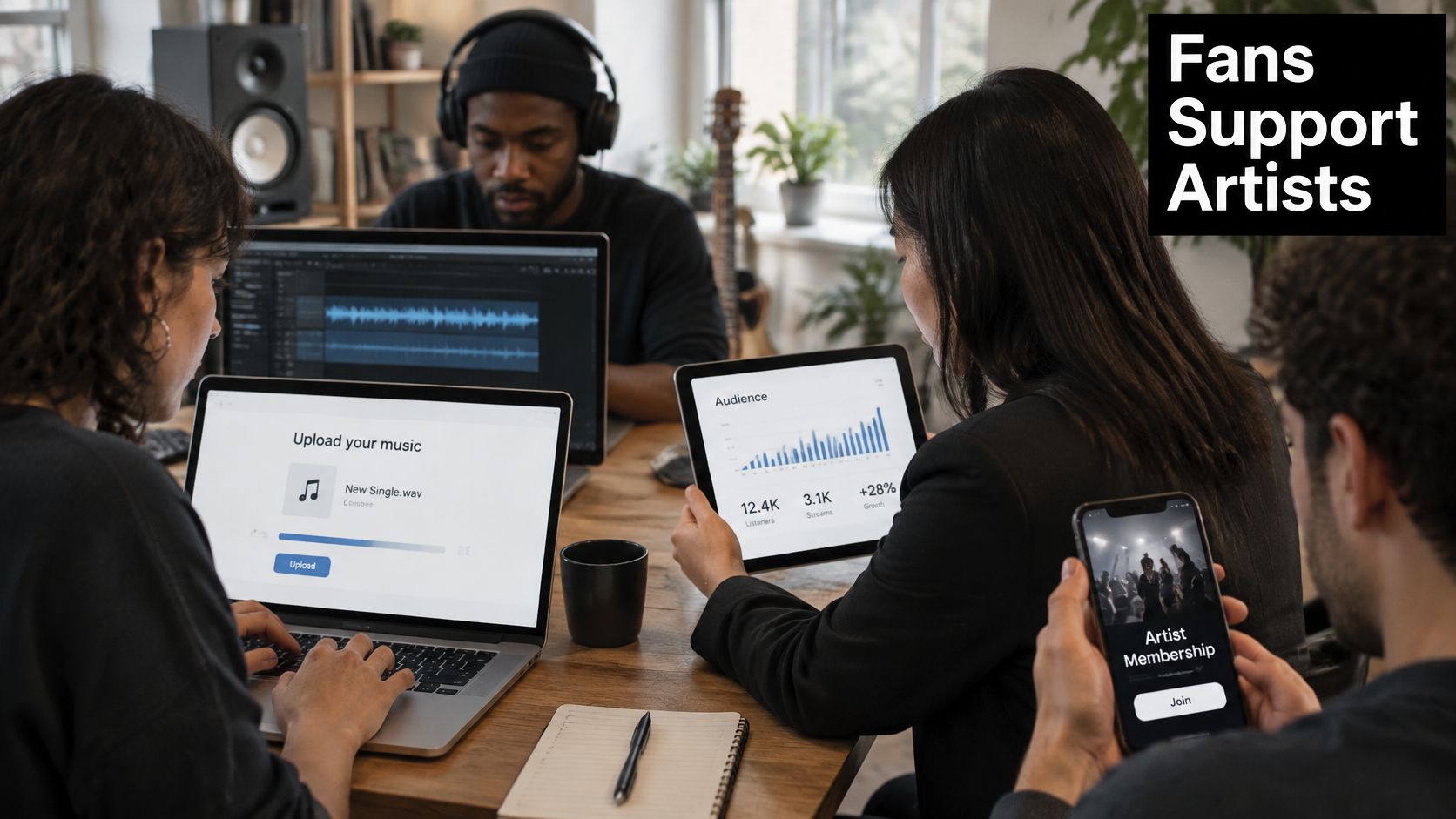
An artist turns a release into a clear offer
Say an independent artist releases a single publicly, makes the track available as a direct download, and reserves a studio commentary for members. A community update explains how the recording developed and points interested listeners toward the appropriate purchase.
The artist then checks whether readers of that update became buyers. The trade-off is access: putting material behind payment may limit how widely that particular material circulates.
Artists preparing that workflow can review our artist joining process. Decide what belongs in the public release and what makes a paid addition worthwhile before publishing.
Producers and DJs sell what they have permission to offer
A producer might list original tracks, production resources, or other products they choose to make available. A DJ needs to distinguish original or properly cleared material from mixes containing recordings they don't have permission to sell.
The commercial question is which releases attract buyers, not merely which receive plays. The trade-off is rights clearance and preparation: something suitable for a promotional set isn't automatically suitable for paid distribution.
Managers and promoters coordinate the path
A manager can assign distinct campaign tags to a release announcement, an email, and a collaborator's promotion. That makes it easier to compare which activity brought paying fans rather than treating all traffic as equal.
The trade-off is discipline. Inconsistent tagging makes campaign comparisons unreliable, even when the checkout records are accurate.
A promoter or industry professional may use artist discovery and event-promotion resources to identify relevant acts and publicize an event. Interest in an artist still isn't a ticket commitment, so booking decisions need their own assessment of audience fit and logistics.
The video below provides an additional viewing resource alongside those practical workflows.
Fans choose the relationship they want
A fan might follow an artist, send a voice note, buy merchandise, and consider membership when the perks justify the recurring fee. Another may prefer occasional purchases and never subscribe. Neither path is less valuable.
For a collector buying vinyl, delivery is part of the experience. Sellers planning fulfillment can review Packaging Panda's corrugated packaging options for records before choosing packaging suited to the format.
Keep the choice honest: Explain what membership includes without making occasional buyers feel like second-class supporters.
The fan's trade-off is commitment versus flexibility. The creator's job is to make both choices understandable, then deliver what each buyer was promised.
Why Fan Count Alone Does Not Pay the Bills
A 2026 survey of 5,039 independent artists across 112 countries found that 74% earned under US$1,000 from music in 2025, according to the Ditto Music survey announcement. That's a warning against treating visibility as a financial outcome.
Test the offer with explicit assumptions
The following figures are hypothetical arithmetic, not conversion benchmarks or platform prices. They show illustrative monthly membership income for an assumed audience of engaged fans.
| Scenario | Engaged fans | Paying share | Monthly price (US$) | Gross monthly (US$) |
|---|---|---|---|---|
| Low engagement | 1,000 | 1% | 5 | 50 |
| Medium engagement | 1,000 | 2% | 5 | 100 |
| High engagement | 1,000 | 4% | 8 | 320 |
In the medium scenario, the assumed audience multiplied by the paying share produces the subscriber count; multiplying that by the assumed price produces gross receipts. Gross isn't take-home income.
Our artists keep 100% of eligible sales, minus payment processing. Your forecast must still account for applicable seller subscription costs, fulfillment, and taxes.
- Payment costs reduce the amount retained from successful transactions.
- Cancellations and failed payments reduce the active paying base.
- Irregular releases can make purchases cluster around launch periods.
- Purchasing power affects whether the same offer is affordable across audiences.
Keep a separate net-income calculation using the actual fee schedule and your own renewal history. Don't invent a churn assumption and present it as an established result.
Casual listeners and repeat purchasers need different invitations. Our guide to supporting artists gives fans a practical starting point; artists should test which invitation produces a completed purchase before spending more to expand reach.
Choose a Fan Monetization Platform That Fits Your Catalog
Choose a fan monetization platform by checking whether it can support your catalog, obligations, and working routine. A service can offer attractive commerce tools and still be unsuitable for the rights you hold or the promises you intend to make.
Use the checklist as a starting point, then inspect the actual terms and purchase experience.
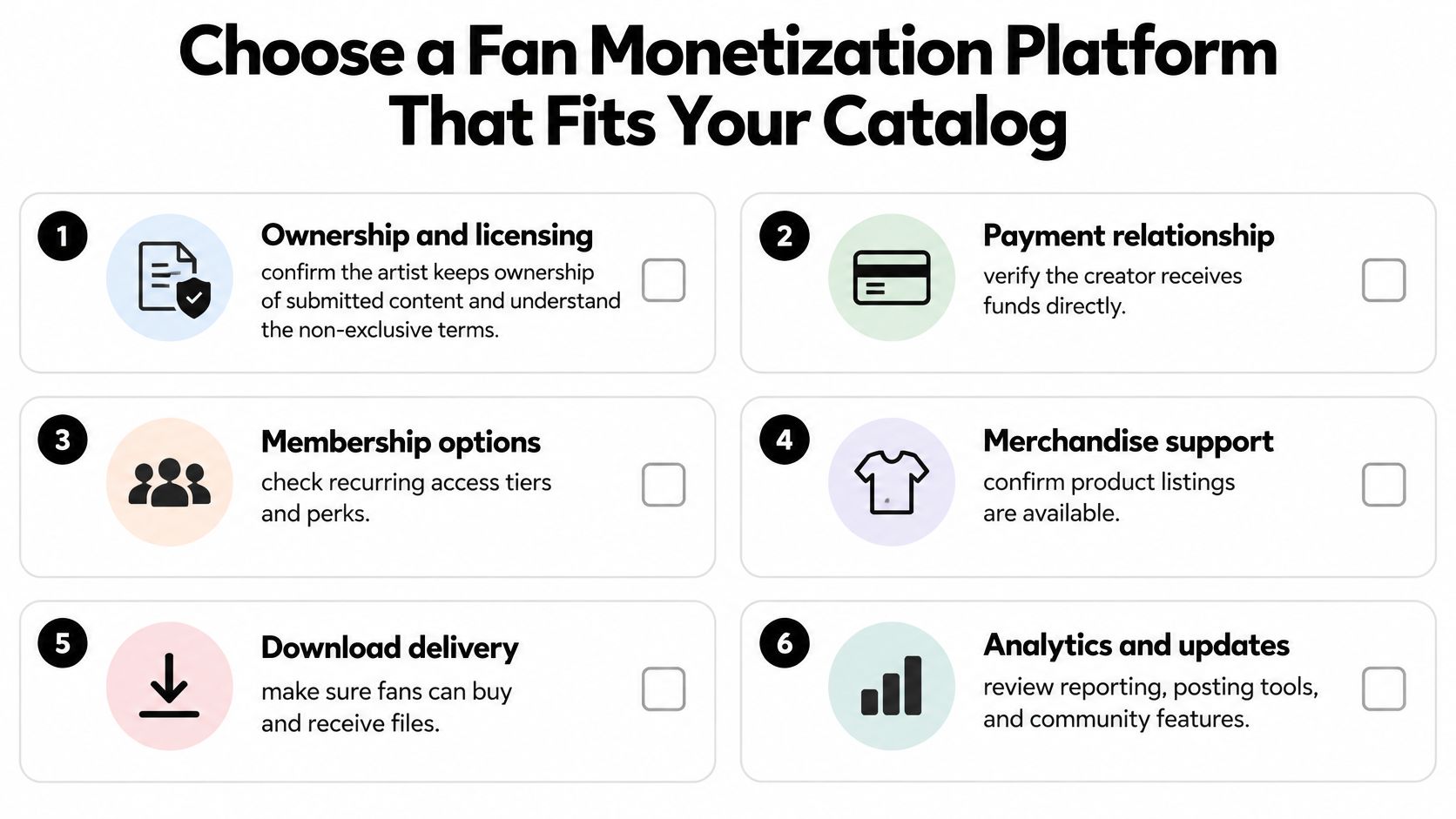
Verify the terms before publishing
Ownership and licensing. You keep ownership of content submitted to OohYeah. You grant us a non-exclusive, worldwide, royalty-free license to host, display, distribute, and promote it as needed to operate and market the service. Ownership and licensing aren't opposites: you can retain ownership while granting operational permissions. Check that collaborators and any third-party material are covered by the rights you hold.
The artist agreement. An Artist Agreement is required before publishing artist content or artist monetization on OohYeah. Read it before uploading material intended for sale. Pay particular attention to the obligations attached to your role, rather than assuming a general account registration settles every publishing question.
Refunds and disputes. Understand the applicable refund rules before describing a purchase as reversible or final. We can facilitate communication, review platform records, and enforce marketplace rules, but we don't guarantee a refund. Keep product descriptions and delivery records clear enough to establish what was promised and supplied.
Check the operating economics
Fees and payouts. Compare the full cost of operating, not just the commission headline. We take no commission from marketplace sales and charge sellers a subscription instead; PayPal handles payments and subscriptions. Review the applicable payment terms, processing charges, and withdrawal arrangements before deciding how much of each sale you can commit elsewhere.
Data access and working tools. Identify the decisions you need to make, then check whether the available records support them. You may need to distinguish new buyers from repeat customers, assess a campaign, or reconcile a release's orders. Also confirm whether the information can be exported if portability matters to your workflow.
Support responsibility. Know where to take a publishing problem versus a transaction problem. Customers can contact OohYeah or PayPal directly for help with the platform or a transaction. Keep receipts, account details, and relevant communications available so the appropriate team can investigate.
Budget for content production as well as the selling platform. If promotional video is part of your plan, you can browse video creation plans from LunaBloom AI and compare that expense with the revenue the campaign would need to justify it. A production tool is a cost to evaluate, not evidence that an offer will convert.
This week, read the Artist Agreement, put your real costs into a spreadsheet, and list the offers your audience is most likely to buy. Choose one that you can describe clearly and fulfill reliably, then test it before building a larger paid program.
OohYeah brings music discovery, direct purchases, merchandise, and optional fan subscriptions into a music-first platform. Visit OohYeah to explore the artist tools and test a focused offer that gives your listeners a clear way to support what you make next.