Event Promotion Social Media: A Practical Playbook
Master event promotion social media with a practical playbook covering planning, content calendars, ads, community engagement, and measurement that actually

September 23, 2026
Music Marketplace Advisor
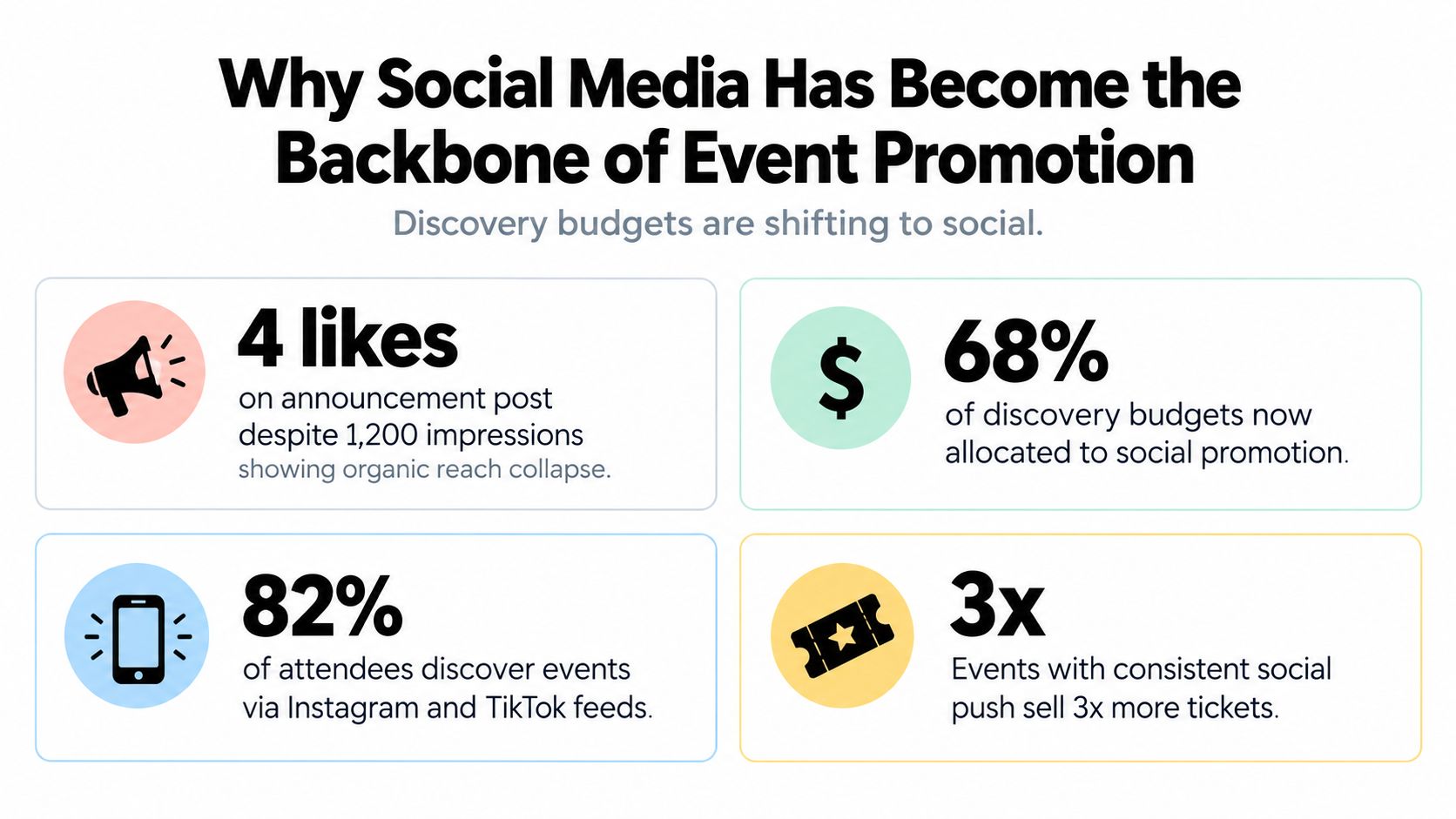
Buying & SellingYou've put together the artwork, confirmed the lineup, and scheduled the announcement. Then launch day arrives: four likes, a few comments from friends, and a reach figure that looks respectable until you compare it with the number of tickets sold. The post didn't necessarily fail. It may have been asked to do a job it wasn't designed to do.
Effective event promotion social media isn't a stream of announcements. It's a connected system that builds anticipation, converts intent, captures live energy, and gives the next show a warmer audience than the last one. Flyers, email, venue listings, and artist websites still matter, but social platforms help you find and qualify the people most likely to care before those channels ever get a chance to convert them.
Why Social Media Has Become the Backbone of Event Promotion
The structural case is straightforward. As of February 2025, 5.24 billion people worldwide used social media, nearly 64% of the global population, according to Sprinklr's event promotion research. The same source reports that the share of adults globally visiting social platforms to learn about brands reached 50% in 2025, up from 47.7% in late 2022.
That changes the promoter's starting point. Your audience isn't only made up of people who already follow the band, venue, or promoter. It includes people whose location, viewing habits, interests, and interactions indicate that a particular show might belong in their plans.
Discovery happens before the ticket link
Social platforms offer three practical advantages for independent music campaigns:
- Audience signals: Platforms can use behavior and context to place content in front of people with relevant interests and locations. A venue spreadsheet can tell you where past buyers live, but it can't match the depth of current behavioral signals available inside advertising platforms.
- Shared distribution: A fan who shares a lineup announcement, saves a venue reveal, or sends a post to a friend extends the campaign without requiring another media purchase. DMs are especially valuable because they carry personal recommendation rather than broadcast exposure.
- Reusable assets: A rehearsal clip can support the initial announcement, a ticket reminder, a day-of story, and a post-event recap. Unlike a single radio placement, the asset can keep working after its first publication.
The Eventbrite social media guide reports that nearly 25% of ticketing-page views come directly from social platforms. It also describes Eventbrite's analysis of 25 million event-related tweets, finding that 40% of the conversation happened before an event and 42% during it. Social therefore supports more than awareness. It can move people from discovery to anticipation, live participation, and post-show conversation.
Promoter's rule: Reach is useful only when it leads somewhere. Give every important post a job, then measure the action attached to that job.
For a wider look at practical paid and organic promotion workflows, AdManage.ai performance marketing is a useful reference. Promoters can also find broader music marketing ideas in the OohYeah magazine. The rest of the campaign should follow the event's lifecycle, not the platform's posting calendar.
Mapping the Event Lifecycle to Each Social Platform
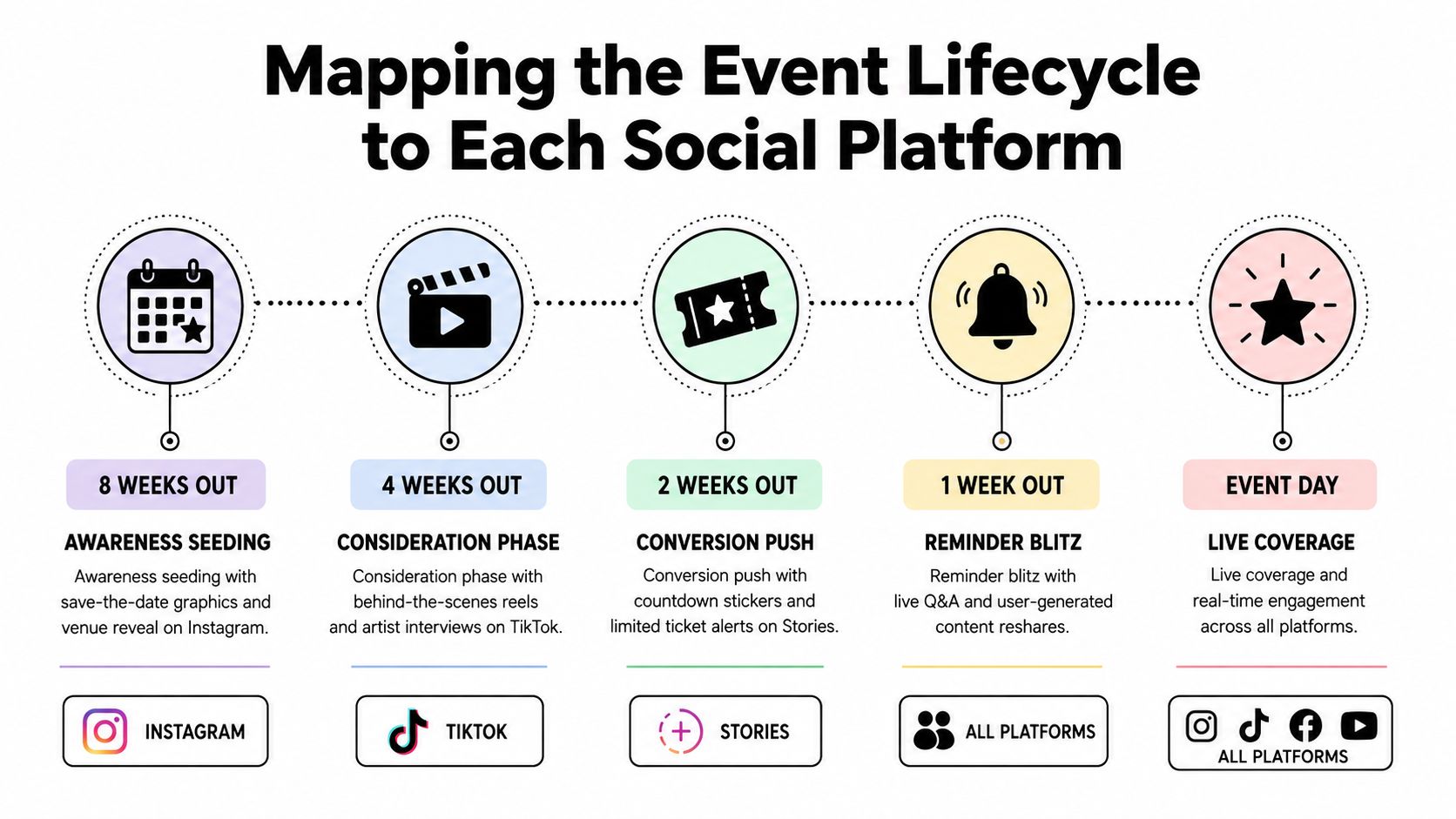
A show needs different messages at different distances from the doors opening. An eight-week announcement shouldn't sound like a final ticket warning, and a live post shouldn't read like a press release.
Eight weeks to four weeks out
At eight weeks, seed awareness. Publish a save-the-date graphic, reveal the venue, and post a short clip that communicates the artist's sound or the room's atmosphere. Instagram is useful for visual identity, while Facebook can carry the event page and local community distribution. TikTok can test discovery-led clips that introduce the act without assuming viewers already know it.
At four weeks, make the lineup and ticket path unmistakable. Publish an opener carousel, a short artist introduction, and a direct ticket-on-sale message. The creative should answer three questions quickly: who is playing, where is it happening, and what should the viewer do next?
Two weeks to event day
At two weeks, move from recognition to consideration. Record artist interviews, rehearsal footage, equipment details, or a short explanation of what makes this show different from a standard club night. Stories can carry countdown stickers and ticket reminders without forcing the main feed to repeat the same graphic.
At one week, remove friction. Post the running order, doors time, transport information, accessibility details, and any age or entry requirements. Ask superfans to share the announcement directly, and reply to questions publicly when the answer may help other buyers.
On event day, divide responsibilities. One person should capture vertical video, another should monitor comments and mentions, and someone should protect the ticketing and information flow from noise.
Match the job to the channel
Instagram carries visual storytelling, TikTok can introduce music to discovery-focused audiences, Facebook remains practical for RSVP behavior and local communities, and X is strongest when the event generates fast-moving conversation. YouTube Shorts gives performance clips and tour announcements a longer search life than a disappearing story.
The audience split matters. Eventbrite's event-discovery coverage reports that about 61% of Millennials used social media to find things to do in 2025, while nearly 30% of Gen Z used TikTok specifically for event discovery. The same source says around 24% of attendees discovered events by following people with similar interests.
Use the supplied video as a production prompt for your own timeline, content roles, and live coverage plan:
Choosing Where Your Event Belongs to Live Online
The right platform depends less on fashion than on genre, audience age, ticket price, and geography. A local punk night, a touring electronic act, and an online listening party may share a fan base, but they won't use the same channel in the same way.
Choose one primary platform as the campaign's home base. Add two supporting channels only when you can adapt the content rather than copy and paste it everywhere.
| Platform | Best Lifecycle Stage | Audience Age | Content Strength |
|---|---|---|---|
| Pre-event discovery, reminders, live stories, recap | Broad, especially younger visual audiences | Reels, Stories, carousels, artist visuals | |
| TikTok | Awareness and discovery | Particularly useful for younger audiences | Short performance clips, personality, trends |
| Local awareness, RSVPs, community reminders | Stronger with established adult audiences | Event pages, groups, practical updates | |
| X | During-event amplification | Depends on scene and local culture | Real-time commentary, updates, journalist sharing |
| YouTube Shorts | Discovery and post-event recapture | Broad search-led audience | Performance excerpts, venue and tour content |
| Bandcamp, Bandsintown, Resident Advisor | High-intent conversion support | Genre and community dependent | Releases, listings, genre-specific event discovery |
Instagram is usually the strongest visual hub for an independent act with good footage. TikTok earns priority when the artist's music, humor, or live personality can be understood in a short native clip. Facebook deserves attention for local shows where groups, event pages, and established community networks influence attendance.
X works best when there's something happening now, such as a festival lineup, surprise guest, set-time change, or fast-moving conversation. YouTube Shorts is less useful for a one-off reminder but valuable for searchable clips that continue introducing the band after the campaign ends.
Niche platforms often bring fewer casual viewers but stronger intent. A fan browsing Bandcamp, Bandsintown, or Resident Advisor is already closer to a music decision than someone who encounters a generic sponsored impression.
Don't ask which platform is biggest. Ask which platform already contains the people who'd miss the show if nobody reminded them.
Building a Weekly Content Calendar That Actually Fills Seats
A usable calendar gives every post a role. It also prevents the familiar mistake of publishing seven versions of the same ticket graphic and calling that a campaign.
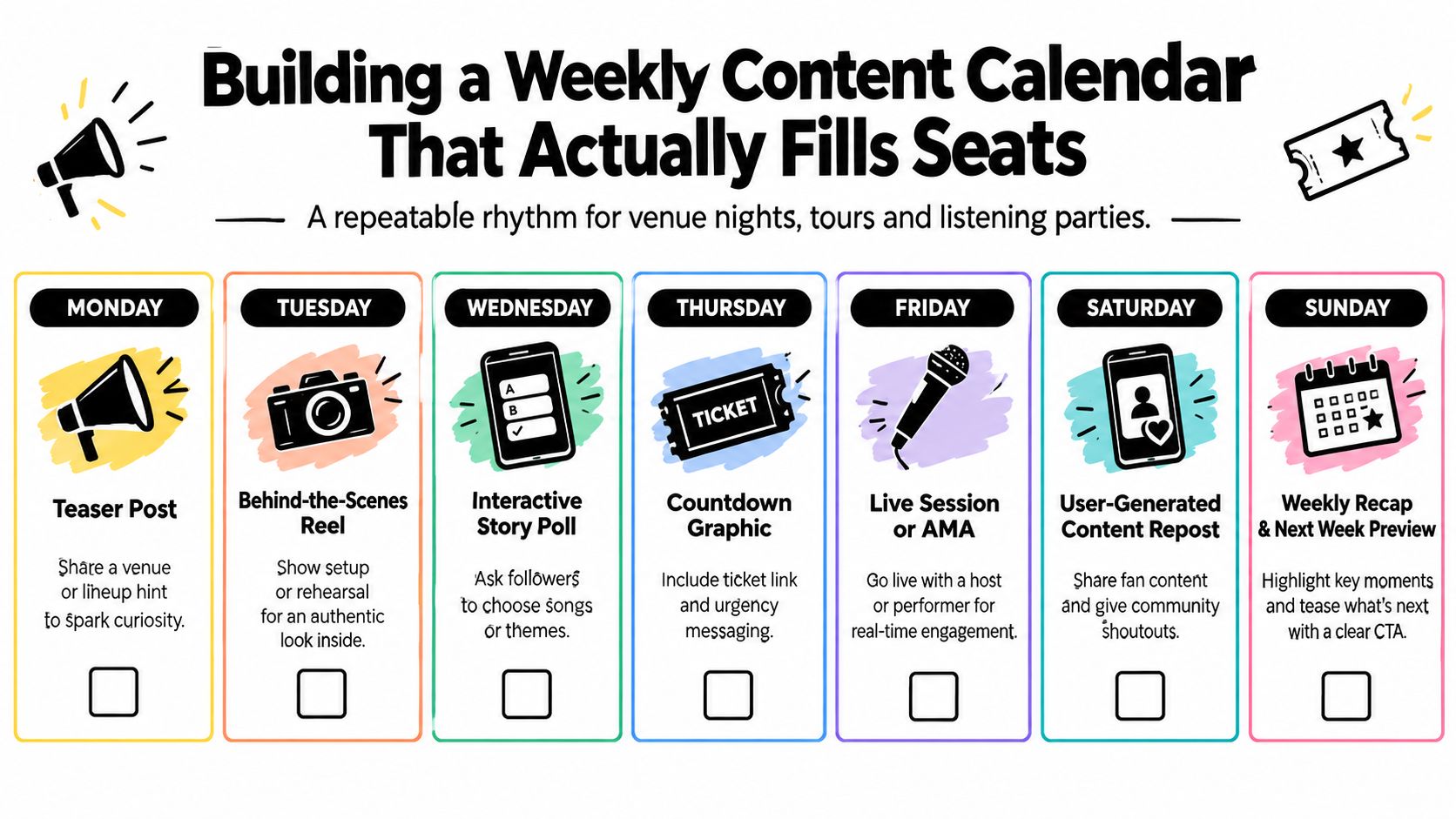
Start with a repeatable weekly rhythm, then tighten the frequency as the date approaches.
A practical weekly rhythm
Monday should create curiosity. Use a teaser reel with a venue detail, a lyric fragment, a lighting test, or a cropped lineup clue. Don't reveal everything if the audience has no reason to return.
Tuesday can show the work behind the show. A load-in story, rehearsal clip, pedalboard, synth patch, or dressing-room preparation makes the event feel real rather than manufactured.
Wednesday is useful for participation. Run a story poll about a song, opener, set theme, or merch color. The answer isn't just engagement. It gives you language and preferences to use in later posts.
Thursday carries the clearest conversion message. Pair the countdown with the ticket link, venue details, and a reason to act now. Avoid fabricated scarcity. If tickets are limited, say why. If there's a deadline or price change, state it accurately.
Friday is a strong moment for a live session, short AMA, or artist check-in. A performer answering questions can overcome uncertainty more effectively than another polished trailer.
Saturday should make room for the community. Repost fan content, rehearsal responses, playlist mentions, or posts from adjacent artists. Sunday can recap the week and preview the next concrete milestone.
Adjust the rhythm to the event
For a single venue night, publish the strongest practical information repeatedly in different formats during the final week. For a tour, localize each asset with the city, venue, support act, and ticket path. For an online release party, replace transport and doors information with the stream destination, start time, timezone, and participation prompt.
Generic “best time to post” charts rarely solve the core problem. Your best timing is the point when your own audience is available and able to act. Review when followers watch, reply, click, and buy, then schedule around those behaviors.
During door hours, switch from polished planning content to useful live information. Post queue updates, last-entry details, soundcheck moments, and short clips that show the room filling. Keep captions short enough to read while someone is walking to the venue.
Running Paid Ads and Boosts Without Burning the Budget
Paid social works best when the campaign objective matches the audience's distance from the decision. Cold viewers don't need the same message as people who watched the trailer, visited the ticket page, or attended a previous show.
Use awareness creative for an unfamiliar act. Artist footage usually beats generic venue b-roll because it gives the viewer a reason to remember the performer. Use traffic campaigns when the ticket page is the immediate destination, then reserve conversion-focused retargeting for people who have already shown intent.
Independent benchmark data reports that paid social event ads typically produced 40,776 impressions, 288 clicks, and a 0.71% CTR, while paid search and display reached 121,510 impressions, 1,834 clicks, and a 1.51% CTR in the same benchmark set, as documented by Direct Development's event marketing benchmarks. Those figures point to a useful division of labor. Social introduces and reminds. Search often captures people already looking.
Budget decisions should follow evidence
The requested budget tiers below are planning scenarios, not guaranteed forecasts. No reach or cost-per-lead estimate should be treated as promised performance without historical account data, audience size, creative quality, ticket price, and conversion tracking.
| Tier | Total Budget | Campaign Duration | Primary Objective | Expected Reach | Target CPL |
|---|---|---|---|---|---|
| Test sprint | $150 | One week | Awareness and warm-audience traffic | Establish from account baseline | Set after initial results |
| Sustained push | $500 | One month | Awareness, traffic, retargeting | Establish from account baseline | Set against ticket economics |
| Tour campaign | $2,000 | Multi-channel tour campaign | City-level awareness and conversion | Establish by market | Set by market and ticket value |
A small sprint should test two or three creative angles, not six platforms. A month-long push can separate prospecting from retargeting. A tour campaign needs distinct audiences and landing pages by city, because a fan near one venue has no reason to see another city's ticket message.
Build audiences from past ticket buyers where the platform and consent framework allow it. Test venue-radius targeting, artist interests, similar acts, and video viewers separately so you can see which signal produces ticket actions. For a deeper operational framework, use this paid social management guide.
Watch cost per ticket sold, not merely impressions. A cheap click from a poor landing page is still expensive if it never becomes a registration or purchase.
Turning Fans Into a Community That Sells Tickets for You
Broadcast posting is necessary, but it rarely creates the strongest recommendation. Music spreads through relationships, especially when a fan can identify with the artist, the scene, or the people already attending.
Start with the first 48 hours after announcement. Reply to comments, answer DMs, thank people who share the post, and notice which questions keep appearing. Those conversations reveal objections that your scheduled content may have missed, such as unclear set times, confusing ticket tiers, or uncertainty about the venue.
A ticket giveaway can create useful distribution when the entry action reflects the behavior you want. Asking people to tag a friend who would genuinely attend is more relevant than collecting passive likes. Set clear terms, avoid misleading scarcity, and make the prize and deadline easy to understand.
Build adjacency instead of begging for reach
Invite local micro-creators, compatible bands, playlist curators, record-shop staff, and venue regulars into the campaign. Give each collaborator a reason to participate and an asset they can adapt in their own voice. A support act may care about introducing its audience to the headliner. A local selector may care about the scene. A creator may care about access, content, or genuine discovery.
Fan-generated content often outperforms a polished trailer because it answers the question a potential buyer has: what does this feel like from inside the room? Repost a shaky but energetic crowd clip, a fan's setlist reaction, or a short message from someone who discovered the artist at the last show. Authenticity doesn't mean abandoning quality. It means showing evidence instead of only making promises.
For artists who need a direct place to organize releases, fan communication, and promotional activity, OohYeah for artists is one option to evaluate alongside existing social and ticketing tools. Keep the relationship portable by maintaining permission-based email or community channels, not only rented platform audiences.
Community practice: Give fans something specific to share. “Come to our show” is a broadcast. “This is the song we'll play first, and here's why” gives someone a story to pass along.
A Discord server or group chat can work well for ticket holders when it has a clear purpose. Use it for set updates, listening sessions, transport coordination, merch previews, or post-show discussion. Don't create another empty channel and expect the audience to supply its meaning.
Tracking Registrations, Sales, and ROI From Post to Punch-In
A promoter should be able to answer four questions after every campaign: what did each channel cost, how many registrations did it produce, how many tickets were sold, and what revenue followed? Impressions, reach, likes, and follower counts can describe attention, but they don't prove that the attention filled the room.
Create a separate UTM-tagged link for each meaningful source and lifecycle phase. Your Instagram announcement, TikTok rehearsal clip, Facebook event page, retargeting ad, and day-of reminder should not all point to an indistinguishable URL. Connect those links with the ticketing platform, advertising pixels where permitted, and a single reporting workspace such as Looker Studio or Notion.
The Samaaro white paper on event promotion channels reports that 91% of event planners use social media as a primary channel, while email drives 86.3% of event and webinar registrations and nearly a quarter of event-page traffic comes from social. The operational lesson is clear. Social and email should be measured together rather than treated as competing worlds.
Use one row per channel and phase
| Platform | Lifecycle Phase | Spend | Registrations | Tickets Sold | Revenue | CPA |
|---|---|---|---|---|---|---|
| Pre-event awareness | ||||||
| TikTok | Discovery | |||||
| Retargeting | ||||||
| Final reminder | ||||||
| X | Day-of push |
Use CPA consistently, but define whether it means cost per registration or cost per ticket sold. For higher-priced events, revenue per channel matters more than the cheapest lead. A channel can produce fewer conversions and still be valuable if those buyers purchase premium tickets, merchandise, or future offers.
Reconcile the numbers before judging the campaign
- Export ticket data: Compare the ticketing platform's order report with each campaign's attributed conversions.
- Check tracking gaps: Review UTMs, pixel events, redirects, and mobile checkout behavior before blaming creative.
- Separate assisted actions: Record people who clicked social but converted through email or direct traffic as assisted conversions when your reporting system can support it.
- Tag lifecycle spend: Keep awareness, retargeting, and day-of promotion in distinct rows so you can compare their roles.
- Save the audience: Within 72 hours of the event, organize attendees into a permission-based remarketing or lookalike workflow for the next show, subject to platform rules and consent.
Post-event recapture is where many independent campaigns waste their strongest asset. The attendees have just experienced the music, the room, and the community. Send the recap while the memory is still vivid, invite them into the next relevant conversation, and connect their engagement to the next ticket path.
For answers to common platform and campaign questions, consult the OohYeah FAQ. A clean dashboard won't make weak creative sell tickets, but it will tell you whether the problem was the message, the audience, the offer, or the checkout.
OohYeah gives independent artists and promoters a music-focused place to manage content, fan interaction, releases, merchandise, and promotional activity alongside their event campaigns. If you want to connect social discovery with a more direct artist-to-fan relationship, visit OohYeah and explore how it can fit into your next show's promotion workflow.