Mastering distribution in music: A Proven Guide for Independent Artists
Discover distribution in music and learn proven strategies for releasing, monetizing, and growing your independent music career.
January 21, 2026
Music Marketplace Advisor
Buying & SellingSo, you've poured your heart and soul into creating a track. It's mixed, it's mastered, and it sounds incredible. Now what? How do you get it from your studio to the headphones of listeners around the world? That's where music distribution comes in.
Think of it as the vital link—the supply chain—connecting your finished song to platforms like Spotify, Apple Music, and TikTok. It’s the behind-the-scenes engine that makes your music discoverable and playable for everyone, everywhere.
What Is Music Distribution and Why It Matters Now
At its heart, music distribution is the bridge between your art and your audience. For decades, that bridge was guarded by major record labels. They were the gatekeepers, and they decided who got to cross. But today, that entire system has been turned on its head. Independent artists can now bypass the old guard and connect directly with a global audience.
Getting a handle on this process is more than just a technical checklist; it's the bedrock of your music business. A solid distribution strategy isn’t just about uploading a file. It’s about being smart with your reach, making sure you collect every cent you’re owed, and building a real career on your own terms.
The New Era of the Independent Artist
The power shift from major labels to independent creators is undeniable. It's one of the biggest stories in the music industry right now. In terms of sheer volume, indie and DIY artists are absolutely dominating the daily flood of new music.
Don't just take my word for it. Recent data reveals that independent and DIY artists are responsible for a mind-boggling 96.2% of daily uploads to streaming platforms. The major labels? They only account for the remaining 3.8%. That's a seismic shift from just a few years ago. You can explore more about this industry shift and see just how much independents are steering the future of music.
What this means is that getting your music out there isn't the big challenge anymore. The real test is learning how to navigate all your options to your advantage. An artist-first approach to distribution really boils down to three core ideas:
- Ownership: You keep 100% control over your master recordings and your creative vision. No one tells you what to do.
- Reach: Your music gets delivered to every platform and service where your future fans are hanging out.
- Monetization: You establish all the right connections to collect royalties from every single stream, download, and use of your music.
By mastering the principles of distribution, you move from simply being a musician to becoming an entrepreneur in control of your artistic legacy and financial future.
Choosing Your Music Distribution Channels
So, you’ve made the music. Now, how do you get it into the ears of listeners? Think of this next step as picking the right roads to get your art out into the world. You might focus on one main highway or take a few scenic routes—it all depends on where you want to go.
Today, the entire music world revolves around Digital Service Providers (DSPs). These are your modern-day record stores: platforms like Spotify, Apple Music, and TIDAL, where nearly everyone goes to stream and discover music. Getting your tracks on these services is non-negotiable for reaching a global audience.
The Role of Digital Aggregators
But how do you get your music from your laptop onto those massive platforms? That's where digital aggregators come in.
Think of companies like DistroKid, TuneCore, and CD Baby as your personal couriers. They take your finished songs, package them up with all the right data, and deliver them to hundreds of digital stores and streaming services simultaneously.
They handle all the technical busywork, making sure your audio files and artwork meet the strict requirements of each platform. Without them, you’d be stuck trying to negotiate separate deals with every single DSP, which is practically impossible for an independent artist.
If you’re trying to figure out which service is best for you, our guide on how to choose the right music distribution service breaks down the top players in the game.
Beyond Digital Streaming
While streaming is king, it's not the only way to get your music out there. A smart distribution strategy looks beyond the obvious and taps into other channels that can bring in real revenue and connect you with fans in different ways.
A truly complete approach to distribution in music often includes a mix of these channels:
Physical Distribution: Never underestimate the power of something you can hold. Selling vinyl, CDs, or even cassettes through specialized services or at your shows creates a powerful connection with your most dedicated fans and can be a fantastic source of income.
Sync Licensing: This is the big one. Getting your music placed in a movie, a TV show, a video game, or a commercial is what we call sync licensing. A single placement can mean a huge upfront paycheck, ongoing royalties, and exposure to a massive new audience that might never have found you otherwise.
Direct-to-Fan (D2F): This is your home turf. Using platforms like Bandcamp or your own personal website puts you in the driver's seat. You can sell anything—digital downloads, limited-edition vinyl, t-shirts, exclusive bonus tracks—and keep a way bigger slice of the profit. This is where you build a real community.
Building a multi-channel distribution strategy is like diversifying an investment portfolio. You spread your presence across different platforms to minimize risk and maximize potential returns from streaming, sales, and licensing opportunities.
For artists wanting to expand their world beyond the music itself, physical merch is a no-brainer. You might want to look into the Print On Demand business model, which lets you create and sell custom gear without having to buy a single shirt upfront.
To help you visualize how these pieces fit together, here's a quick comparison of the main distribution channels.
Comparison of Music Distribution Channels
This table gives you a side-by-side look at the primary ways to get your music to listeners, helping you decide where to focus your energy.
| Channel Type | Primary Function | Artist Control | Revenue Model | Best For |
|---|---|---|---|---|
| Digital Aggregators | Mass delivery to hundreds of DSPs like Spotify & Apple Music. | Low-to-Medium | Per-stream/sale royalties, often with an upfront fee or commission. | Reaching a broad, global audience and getting on major playlists. |
| Physical Distribution | Manufacturing and selling tangible formats like vinyl, CDs, and cassettes. | High | Direct sales revenue, with higher profit margins per unit. | Superfans, collectors, and creating a premium product experience. |
| Sync Licensing | Placing music in visual media (films, TV, ads, games). | Low (Agent-led) | Large upfront sync fees and backend performance royalties (PROs). | Generating significant income and gaining massive exposure. |
| Direct-to-Fan (D2F) | Selling music and merch directly from your own website or Bandcamp. | Complete | Direct sales, where you keep 85-100% of the revenue. | Building a loyal community and maximizing profit per fan. |
Ultimately, each channel plays a different role. Digital aggregators give you scale, physical sales cater to your true fans, sync licensing offers jackpot potential, and D2F platforms give you control and community.
By understanding how they all work, you can build a distribution plan that truly supports both your art and your career.
How to Actually Get Paid from Your Music
Great distribution in music isn't just about getting your songs out there; it's about building a pipeline to collect every single dollar you've earned. To make that happen, you have to understand a fundamental truth: every song you write and record is actually two separate assets.
Each of these assets has its own copyright, and more importantly, its own unique streams of income.
First, you have the master recording. This is the actual audio file—the final, mixed, and mastered version of your song that you upload. Think of it simply as the "sound." The artist who performed on the track is typically the owner of the master.
Second, there’s the composition. This is the song's DNA: the melody, the lyrics, the chords, the structure. It’s the "songwriting" itself, and it’s owned by the songwriter(s) and their publisher. It's common for a single master recording to have multiple songwriters who all share a piece of the composition.
Mapping the Money Flow
Each of these copyrights generates different kinds of royalties. Getting this right is absolutely crucial, because it determines where your money comes from and who is supposed to pay you. If you only chase one type, you're literally leaving money on the table.
Here's how those two copyrights make you money:
Master Royalties: This is the cash earned directly from the master recording. When your song gets streamed on Spotify or purchased from iTunes, the platform pays your distributor, and your distributor pays you. For most artists, this is the most straightforward income from distribution.
Composition Royalties: This is the money generated by the use of the song itself. It gets a little more complicated here and splits into two main types:
- Mechanical Royalties: These are paid out every time your song is "reproduced," which in today's world includes every stream, download, or physical sale (like a CD or vinyl).
- Performance Royalties: These are generated anytime your song is performed publicly. That means radio play, TV shows, live concerts, and yes, even digital streams.
Here's a helpful way to think about it: imagine a movie. The actor (the performing artist) gets paid for their specific performance in that film (the master recording). Separately, the screenwriter (the songwriter) gets paid every time the script (the composition) is used. Both are essential, and both get paid for their work.
Tracing a Single Stream Back to You
So, let's follow the money from a single play on Spotify. When a listener streams your track, Spotify pays a fraction of its revenue out. That tiny payment is immediately split to honor both the master and composition copyrights.
The Master Share: A big chunk of that money flows straight to your digital distributor (like TuneCore or DistroKid). They’ll take their fee or commission and pass the rest on to you.
The Composition Share: The remainder of the money is routed to collection societies. Performance Rights Organizations (PROs) like ASCAP and BMI collect the performance royalties. Meanwhile, in the U.S., a group called The Mechanical Licensing Collective (The MLC) is responsible for collecting mechanical royalties from streams. These organizations then pay the songwriters and publishers.
To collect all the money you're owed, you have to be affiliated with a PRO and ensure your songs are properly registered with them. This is a non-negotiable step that countless independent artists accidentally skip. If you're looking for a wider perspective on turning creative work into income, this blueprint for creating and selling digital products offers some great insights.
This whole system can feel complex, but it underscores why knowing your rights is so critical. For a deeper dive into making a living from your music, our guide on how independent artists make money from music lays out even more strategies.
Comparing the Three Models of Music Distribution
Figuring out how to get your music out into the world is one of the biggest decisions you'll make as an artist. There's no magic bullet—the "right" path really depends on where you are in your career and what you're trying to achieve. Your choice will ripple through everything, from your creative freedom to how much money you actually take home.
Let's walk through the three main ways artists get their music heard: using a digital aggregator, signing a classic label deal, or going all-in on a direct-to-fan strategy. Each one strikes a very different balance between resources, control, and potential earnings.
The Digital Aggregator Route
This is the go-to option for most independent artists today. Think of digital aggregators like DistroKid or TuneCore as the essential middlemen connecting your tracks to hundreds of streaming platforms, from Spotify to Apple Music and beyond.
For a pretty modest fee, they handle all the technical heavy lifting to get your music delivered correctly and then collect the royalties for you.
- Pros: It’s cheap, quick, and accessible to anyone. You keep 100% of your rights, call all the creative shots, and still land on every major streaming service and online store.
- Cons: You’re flying solo. An aggregator gets your music on the platforms, but that’s where their job ends. All the marketing, playlist pitching, and audience building is entirely up to you.
This model is a fantastic fit for the DIY artist who wants a worldwide presence without giving up ownership and is ready to hustle to promote their own work.
The Major Label Deal
Signing with a major label is the path many artists have traditionally dreamed of. When you sign, you're not just getting a distributor; you're getting a full-blown business partner. They front a significant investment (an "advance") and bring a whole machine to the table—marketing muscle, radio pluggers, and a dedicated team pushing your music.
Of course, that kind of support doesn't come for free. In return, you sign over a huge amount of creative control, ownership of your master recordings (often permanently), and a massive slice of your future income.
Think of a label deal like selling a huge chunk of stock in your career. You get a massive injection of cash and expertise, but you lose the final say on major decisions and give up the lion's share of the profits.
This route makes the most sense for artists who have already built a serious buzz on their own and are willing to trade some of their independence for a shot at the big leagues, backed by an industry powerhouse.
The Direct-to-Fan (D2F) Approach
The direct-to-fan model, or D2F, is all about cutting out the middlemen. Using platforms like Bandcamp or building within an artist-first ecosystem, you sell your music and merchandise straight to your listeners. This approach gives you the highest profit margins possible, letting you keep anywhere from 85-100% of the revenue.
You also get total control over everything—your release schedule, your pricing, and most importantly, your direct connection with your fans. The catch? It's the most entrepreneurial path. You're responsible for building your own digital storefront, driving every bit of traffic to it, and handling all the customer support.
The D2F model is incredibly powerful for nurturing and monetizing a core, dedicated fanbase, but it isn't built for getting your music in front of millions of brand-new listeners.
Your Essential Pre-Release Checklist
A successful release doesn't just happen when you click 'upload.' It starts weeks, sometimes months, before. Think of this checklist as your pre-flight inspection; running through these steps methodically is what separates a smooth launch from a chaotic one. Honestly, skipping this prep work is one of the most common—and costly—mistakes I see artists make.
First things first: your master audio. This isn't the time for an MP3. Your final, mixed, and mastered track needs to be a high-quality, lossless file. Most distributors will ask for a WAV or FLAC file because it preserves the full audio fidelity, ensuring your music sounds its best on every platform.
Next up is your artwork. It has to be professional and meet some very specific technical requirements. Every digital service, from Spotify to Apple Music, has strict rules. That usually means a perfect square JPEG, at least 3000 x 3000 pixels, in the RGB color space. Critically, it can't have any website URLs, social media handles, or pricing on it.
Gather Your Critical Metadata
Metadata is the DNA of your release. It’s all the background data that tells the world—and more importantly, the royalty collection societies—who made this music, what it's called, and who gets paid for it. Mess this up, and you're looking at a huge headache trying to track down your money later.
Here’s what you absolutely must have in order:
- Song and Album Titles: Get the capitalization and spelling perfect. Don't add extra fluff like "Single Version" or "Radio Edit" unless it's an official part of the title.
- Artist Names: Clearly list every primary artist and be sure to specify any featured artists or remixers.
- Songwriting Credits: This is huge. You need to credit every single person who contributed to writing the song and know their ownership splits.
- ISRC and UPC Codes: Think of an ISRC as a unique fingerprint for each individual track and a UPC as the barcode for the entire product (the single or EP). Your distributor can typically assign these for you if you don't have them.
Getting your metadata organized and accurate isn't just about being professional. It's the engine that drives the entire system of distribution in music. Every single stream and sale across the globe is tracked and paid out because of this data.
Set a Realistic Release Timeline
I can't stress this enough: don't rush. Give yourself a proper runway before your release date—at a bare minimum, aim for four to six weeks.
This buffer is non-negotiable for a few key reasons. It gives your distributor plenty of time to get everything processed and delivered to all the digital storefronts without any last-minute drama.
Even more importantly, this lead time is what makes your track eligible for editorial playlist consideration on platforms like Spotify. It also gives you the space you need to line up your marketing and promotion, making sure your entire launch is a coordinated, high-impact event.
This timeline shows just how much the models have changed over the years, moving from long label-driven cycles to much faster artist-led releases.
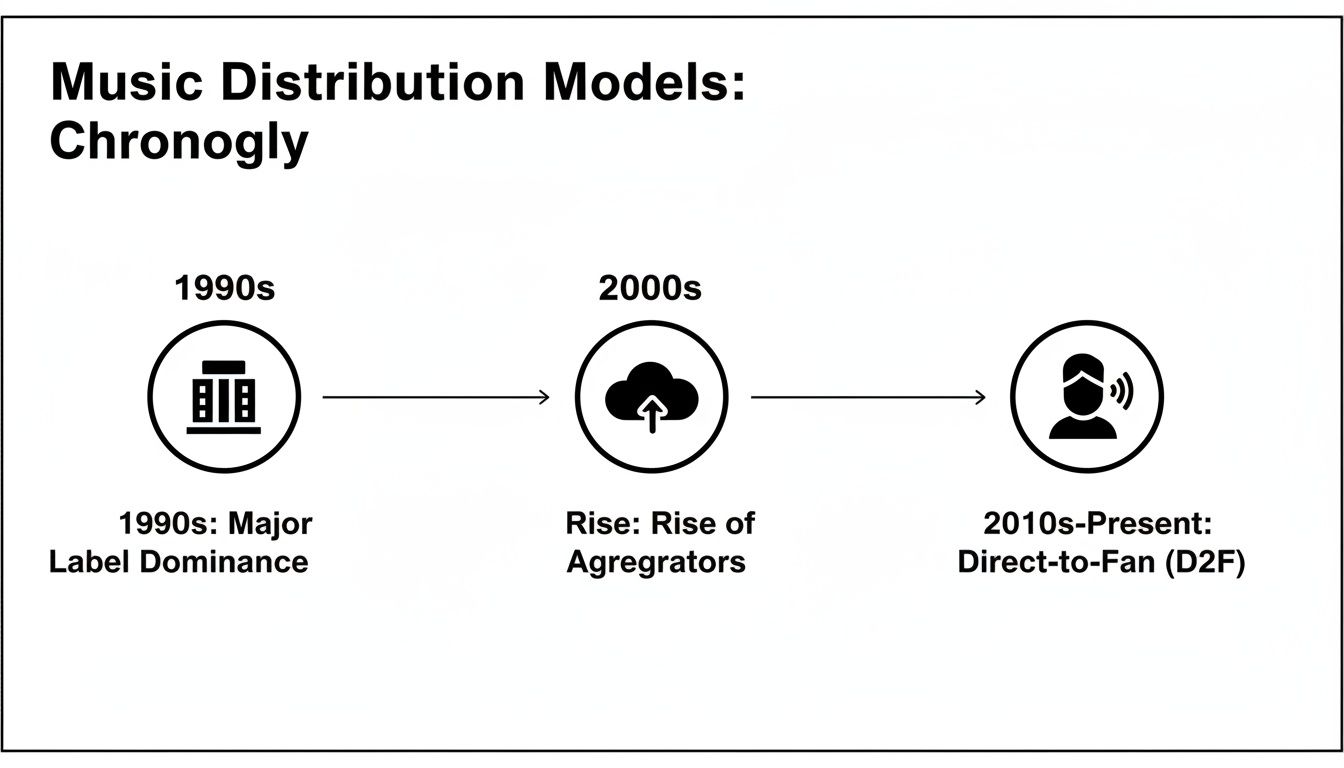
As you can see, direct-to-fan and aggregator models have dramatically sped things up, putting more control directly into artists' hands.
The opportunity here is massive. The global music streaming market is projected to grow by USD 53.49 billion by 2029. To grab your piece of that pie, a well-planned launch is everything. You can learn more about the growth of music streaming from Technavio. For an even deeper dive into putting all this into action, check out our guide on the best practices for releasing new music online.
Common Questions About Music Distribution
Even with the best plan in hand, getting into the nitty-gritty of music distribution can feel like you're trying to read a foreign language. It's totally normal. Most independent artists hit the same roadblocks and have the same questions when they're gearing up for a release.
Let's clear the air and tackle some of the most common questions that pop up, so you can sidestep easy mistakes and keep your momentum going.
How Long Does It Take for My Music to Go Live?
This is the big one, isn't it? The question every artist needs an answer to. You should always, always plan for a lead time of at least two to four weeks.
Some distributors might advertise a faster turnaround, and while that sounds great, rushing is a huge mistake. Giving yourself that buffer allows platforms like Spotify and Apple Music plenty of time to review your release, ingest the metadata correctly, and flag any potential issues before your big day.
But here’s the real reason that lead time matters: it’s your ticket to getting on playlists. Spotify requires you to pitch your track through their artist portal at least a week before it drops to even be considered for huge playlists like New Music Friday. Skipping this window is probably one of the biggest missed opportunities for a new artist.
What Are ISRC and UPC Codes?
Think of ISRC and UPC codes as the digital DNA for your music. They’re not just important—they're non-negotiable. You can't release anything without them, because they’re how every single stream and sale gets tracked back to you.
It's simpler than it sounds:
ISRC (International Standard Recording Code): This is a unique code for a single recording. If you have your main track, an acoustic version, and a remix, each one gets its own ISRC. This is how the system knows which specific master recording is being played and who to pay royalties to.
UPC (Universal Product Code): This is the barcode for the entire product. A single gets one UPC. An album with twelve songs gets one UPC. It identifies the whole package you're selling.
Without these, you won't see a dime. The good news? You don't have to go hunting for them. Pretty much every digital distributor will automatically generate and assign these for you when you're setting up the release.
Can I Switch My Music Distributor Later On?
Yes, you can, and many artists do as their careers grow and their needs change. But you have to be careful about it. If you're not, you risk losing your stream counts and all those hard-won playlist placements.
The basic process is to issue a "takedown" with your old distributor and then re-upload everything with your new partner. The key to making this seamless is to use the exact same information: the original ISRC codes, the same audio files, the same artwork, and the original release date. This tells the streaming services that it's the same product, just coming from a new source.
You'll want to coordinate the timing perfectly to minimize any downtime where your music isn't available. And before you start anything, read the fine print in the terms of service for both distributors to make sure there are no hidden snags.
Ready to take full control of your music and connect directly with fans? With OohYeah, you can distribute your work, sell merchandise, and build a loyal community all in one place, keeping more of your revenue. Start your journey with OohYeah today.