Distribution Deals Music: A Guide for Artists
distribution deals music: Learn how to choose partners, compare terms, and maximize earnings with an artist-friendly guide.
October 22, 2025
Music Marketplace Advisor
Buying & SellingSo you’ve poured your heart and soul into creating your music. Now what? Getting those finished tracks from your hard drive into the ears of listeners worldwide is the next crucial step, and that’s where a music distribution deal comes in.
Think of it as the essential bridge connecting your art to a global audience. Without a solid distribution plan, your music is stuck in the studio, unheard by the masses. Nailing down the right partnership is the key to generating royalties and building a career that lasts.
What Are Music Distribution Deals?
Let's use an analogy. Imagine you've created an incredible new product. To sell it, you need to get it onto the shelves of major stores like Target or Walmart. A music distribution deal does the exact same thing, but for your songs. It’s a partnership that puts your music into all the major digital "stores"—Spotify, Apple Music, Tidal, Amazon Music—making it available to practically anyone with an internet connection.
But this isn't just a simple upload. Your distribution partner handles all the complex behind-the-scenes work, like technical delivery, formatting all the metadata correctly, and collecting the royalties that each unique platform owes you. For any artist serious about their career, this infrastructure is non-negotiable.
The Engine of Your Music Career
A good distribution deal is the engine that powers both your reach and your revenue. It turns your creative work into a real, tangible asset that can earn you an income from every stream and download. The right agreement doesn't just get your music online; it can also give you the tools and support to seriously accelerate your growth.
A distributor's key functions really boil down to a few critical things:
- Global Reach: Getting your music onto hundreds of digital service providers (DSPs) across the globe.
- Royalty Collection: Making sure you actually get paid for every single stream and download.
- Data and Analytics: Giving you the insights to understand who is listening to your music and where they are.
The industry built around these partnerships is absolutely booming. The global music distribution services market is on track to grow from about $1.43 billion in 2025 to an estimated $2.06 billion by 2033. This explosion shows just how vital these deals have become for artists at every level. You can read more about the music distribution market growth on datainsightsmarket.com.
A poorly chosen deal can create huge roadblocks, trapping you in bad terms or offering little to no support. On the flip side, a strategic partnership becomes a true cornerstone of your career, giving you the resources you need to thrive in a crowded market.
Breaking Down the Types of Distribution Deals
Not all distribution deals are created equal. When you're an artist trying to get your music out there, the options can feel overwhelming, but they really boil down to three main types. Each one is built for a different kind of artist at a different point in their journey.
Think of it like choosing how to travel. You could drive yourself, hire a specialist driver for certain legs of the trip, or go with a full-service tour company. The right choice depends on your budget, how much you want to be in the driver's seat, and the kind of support you need to reach your destination.
The DIY Digital Aggregator
This is the ground floor, the most common starting point for just about every independent artist. We're talking about companies like DistroKid, TuneCore, and CD Baby. Their job is simple: take your music and get it onto Spotify, Apple Music, and hundreds of other digital storefronts.
In exchange for a small annual fee or a cut of your revenue, you get access to the global market. The best part? You keep 100% ownership of your master recordings and have complete creative control. It’s a straightforward, no-frills service that puts you in charge.
The key word here, though, is "DIY." These platforms don't typically offer marketing, playlist pitching, or much in the way of hands-on support. You’re the artist, the publicist, and the project manager. If you're ready to take on that role, digging into the best strategies for independent music distribution is a must.
Label Services Deals
Once you start building some momentum, you might find yourself needing more muscle than a basic aggregator can offer. That's where label services deals come into play. These are offered by specialized companies or established distributors who provide a menu of services you can pick from.
Think of it as hiring a professional crew for your road trip. You still own and drive the car (your masters), but now you have experts helping with navigation, promotion, and logistics.
A la carte services often include:
- Targeted Playlist Pitching: Getting your tracks in front of the right curators.
- Digital Marketing Campaigns: Running strategic ad campaigns and social media promotions.
- Sync Licensing Representation: Pitching your music to be used in TV shows, movies, and ads.
- Physical Distribution: Pressing vinyl and getting your CDs into brick-and-mortar stores.
Getting one of these deals is more selective. Companies will want to see that you have a growing fanbase and a solid plan. The costs are also higher, usually structured as a percentage-based commission or a significant upfront fee.
Traditional Distribution Deals
At the very top of the food chain are traditional distribution deals. These are the big leagues, typically involving major labels or powerhouse indie distributors like The Orchard or Believe. This isn't just a service; it's a full-blown partnership.
Here, the distributor invests heavily in your success. They’re putting up advances, funding massive global marketing campaigns, pushing for radio play, and using their deep industry connections to open doors you couldn't on your own.
This level of support comes at a price. Artists almost always give up a much larger slice of their royalties and often grant the distributor exclusive rights to their music for a specific number of years or albums. These deals are reserved for established artists with proven commercial appeal.
To make these distinctions clearer, it helps to see everything side-by-side. This table breaks down what you can generally expect from each type of deal.
Comparing Common Music Distribution Deal Structures
This comparison table lays out the key differences between the deals, helping you quickly see the trade-offs in terms of cost, control, services, and your potential earnings.
| Deal Type | Typical Cost/Fee | Royalty Split (Artist's Share) | Artist Control | Included Services |
|---|---|---|---|---|
| DIY Aggregator | Annual fee ($20-$50) or small commission | 90-100% | Full Control | Digital uploads, basic royalty collection |
| Label Services | Higher fees or commission (15-30%) | 70-85% | High Control | Marketing, playlist pitching, sync |
| Traditional Deal | Commission-based (20-50%+) | 50-80% | Shared Control | Full-service marketing, advances, radio |
Ultimately, the right deal is the one that fits where you are right now and where you want to go next. Each path has its own set of pros and cons, so understanding them is the first step toward making a smart, career-defining choice.
Understanding How You Get Paid
Following the money in the music industry can feel like you’re trying to navigate a maze. But once you break it down, the path from a listener’s stream to your bank account is actually pretty logical. It all starts the moment someone presses play on your track.
When a fan streams your song on a platform like Spotify or Apple Music, a tiny sliver of money is generated—we're talking fractions of a penny. That micro-payment is first collected by the streaming service, or DSP (Digital Service Provider). They take their slice of the pie before sending the rest over to your distributor. From there, your distributor gathers all those tiny payments from every stream on every platform. This is where your specific distribution deal really comes into play, as it dictates what happens next.
Simply put, your distributor’s job is to collect these earnings, run the numbers, and pay you what you’re owed, minus any fees or commissions spelled out in your agreement.
Breaking Down the Revenue Flow
The total amount of money collected from all the DSPs is called your gross revenue. Before that cash lands in your pocket, a couple of key deductions are made.
Here’s a typical breakdown of the process:
- Platform Fee: The DSP, like Apple Music, takes its share right off the top. This is usually around 30%.
- Distributor's Cut: Your distributor then takes their agreed-upon percentage from what's left. This can be anything from 0% to 30% or more, depending on the deal you signed.
- Artist's Net Revenue: The money that remains after these cuts is your net earning. This is what gets paid out to you, usually once you hit a minimum payment threshold.
Let’s walk through a quick example. Imagine your song gets a million streams on a platform paying about $0.004 per stream. That generates a gross revenue of $4,000. After the platform takes its 30% cut ($1,200), you're left with $2,800. If your distributor's commission is 15%, they’ll take $420, leaving you with a final payout of $2,380.
This is a simplified look, of course, but it clearly shows the journey your money takes. It’s also worth remembering this only covers one type of royalty. You can learn more by understanding music licensing and how it can boost your revenue.
The diagram below gives you a bird's-eye view of the different tiers of music deals, from going it alone to signing with a major label.
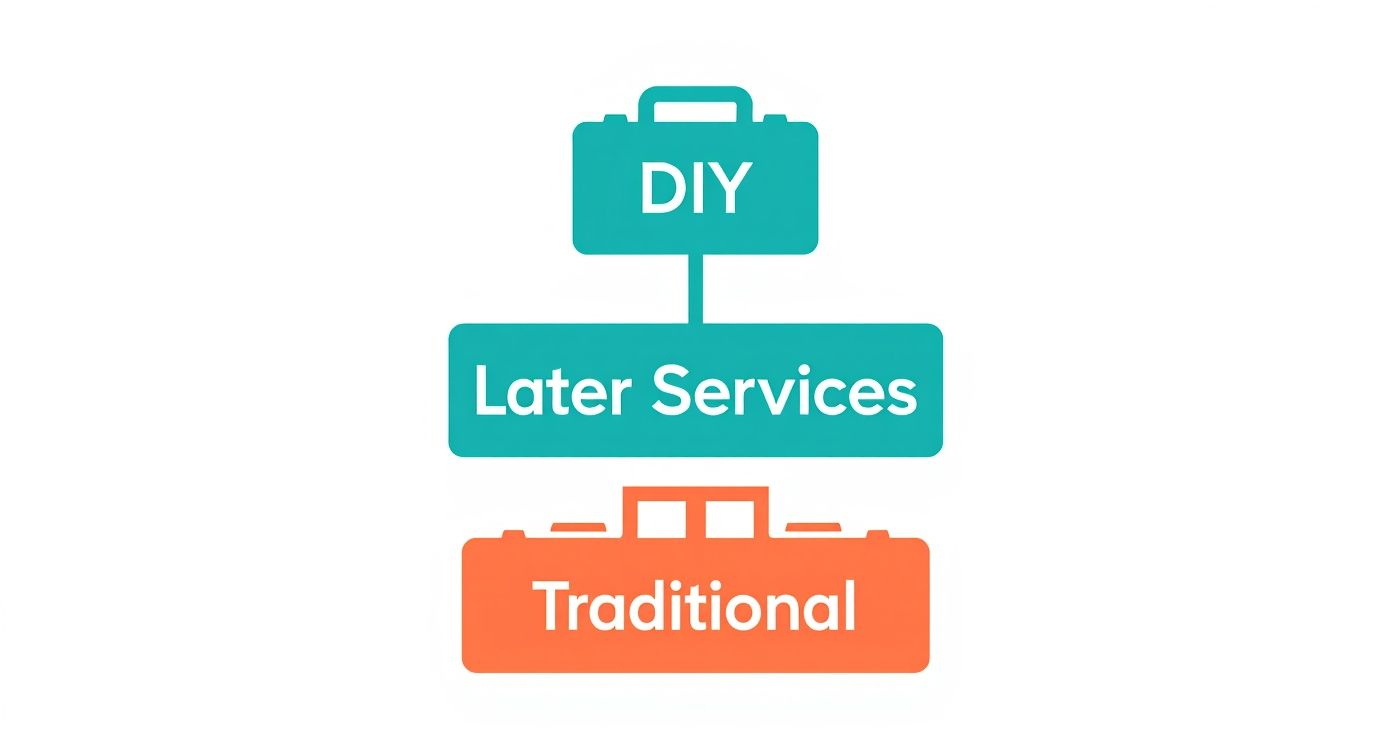
As you can see, the more you move from a DIY approach toward a traditional deal, the more services you get, but you often trade a larger piece of your earnings and creative control to get them.
This whole financial engine is fueled by the incredible scale of modern streaming. In the first half of 2025 alone, global recorded music revenues reached $18.3 billion, and a staggering 84% of that came directly from streaming. With over 600 million people subscribed to streaming services worldwide, getting a firm grip on how these payments work isn't just helpful—it's essential for building a career. For more details on this, you can check out the growth of global music revenues on midiaresearch.com.
Key Contract Terms You Must Negotiate

Signing on the dotted line is a big deal. It’s not just a formality—it’s a binding legal agreement that can define your career path for years. If you just skim the boilerplate language and accept the standard terms, you could be seriously limiting your creative freedom and your income.
Think of it this way: your contract is the rulebook for your career. To protect your art and your future, you have to get in there and negotiate the clauses that really matter. Every sentence counts, but a few carry much more weight than others. This is your playbook for the most important parts of any distribution deals music artists will encounter.
The Term and Territory
First up, the Term. This is simply the length of the agreement. How long does the distributor have the exclusive right to handle your music? Many deals will have an initial term, say one year, that automatically renews if you don't give them notice. You want to push for a shorter initial term and a very clear, artist-friendly way to walk away if the partnership isn't working.
Then there's the Territory, which lays out the geographical areas where the deal applies. For digital distribution, "worldwide" is the standard, but you absolutely need to see that in writing. If a deal isn't worldwide, you're free to find another partner for the regions they don't cover. Always get clarity on these two points before you go any further.
Your Negotiation Goal: Fight for a shorter initial term (1-3 years) with straightforward termination clauses. Make sure the territory is explicitly defined—ideally "worldwide" for digital releases—so there are no nasty surprises later.
Scope and Exclusivity
Next, you need to pin down the Scope of the deal. What music are we actually talking about here? Does it only cover a specific album or EP, or does it apply to everything you create while you're under contract? This is a massive distinction. A deal that ropes in all your future work can lock you into a partnership that might not fit your vision in a few years.
Exclusivity is another big one. It dictates whether you can work with other distributors. Most agreements are exclusive, meaning you can't use another service for any music covered by the deal. That’s pretty standard, but you have to understand exactly what it means for you. It’s also wise to get a solid grasp of what would happen if things go wrong, which is where understanding breach of contract can be incredibly helpful when you're reviewing these agreements.
When you're discussing scope and exclusivity, here are the questions you need to ask:
- Which Recordings: Are we talking about my back catalog, just this new release, or all future music for the next few years?
- Creative Control: Do I keep 100% control over my artistic vision and, most importantly, my master recordings?
- Exit Clause: What are the exact, specific conditions that would allow me to terminate this contract?
By getting into the weeds and actively negotiating these points, you transform from a passive client into a true business partner. It’s this kind of proactive approach that ensures your distribution deal actually serves your career, not the other way around.
Evaluating a Distributor's True Value
In an age where anyone can get a song online, the real test of a distribution deal isn’t just about getting your music onto Spotify. That’s the bare minimum. The game-changer is what happens after your track goes live.
Think of it this way: a basic digital aggregator is just a delivery truck. A true distribution partner, on the other hand, is in the passenger seat with you, helping navigate the road ahead. To find a real partner, you have to look past the upfront fee and size up their entire operation.
The distributors who actually move the needle for artists are the ones offering services that create real momentum. These aren't just flashy promises on a pricing page; they're concrete actions that open doors. It's the difference between buying a billboard and hiring a publicist—one just puts you on display, the other actively fights for your success.
Beyond the Upload Button
So, what really separates a simple delivery service from a strategic partner? It almost always boils down to their industry relationships and whether they’re willing to put that network to work for their artists.
Here are a few services that provide genuine, tangible value:
- Active Playlist Pitching: This is so much more than checking a box on Spotify's editorial submission form. A great distributor has real, human relationships with playlist curators at Spotify, Apple Music, and beyond. They are on the phone and sending emails, actively pitching your music for a shot at that career-changing placement.
- Sync Licensing Opportunities: The best distributors have dedicated teams whose entire job is to get your music into TV shows, movies, ads, and video games. A solid sync placement can mean a significant paycheck and expose your music to a massive, entirely new audience.
- Detailed Analytics Dashboards: Sure, any service can show you stream counts. But can they show you who is listening, where they live, and how they found your music? That kind of data is pure gold when you're planning a tour or targeting a marketing campaign.
- Dedicated Artist Support: When something goes wrong or you have a critical question, can you reach a real person who actually knows your music and understands your goals? Quality, human support can save you from a world of headaches and costly mistakes.
Choosing a distributor is about investing in an infrastructure for your success. The goal isn't just to make your music available; it's to make it discoverable. A partner who actively works to open doors is infinitely more valuable than one who just opens the gate.
Assessing the Bigger Picture
The explosive growth in music streaming is exactly why these extra services have become non-negotiable. The global market, valued at an estimated USD 47.06 billion in 2025, is expected to skyrocket to USD 143.89 billion by 2032. That incredible expansion means more artists, more songs, and a whole lot more noise to cut through. A proactive partner is your best tool for standing out. You can dig deeper into these music streaming market growth projections on livemusicblog.com.
When you're vetting potential distribution deals music artists need to ask the tough questions. Don't just ask if they pitch to playlists; ask to see some real-world case studies of successful placements. Don't just ask if they have an analytics platform; ask for a live demo. The distributor's true value is measured by the results they can actually deliver.
How to Choose the Right Distribution Partner
Picking a music distribution partner feels like a massive decision, and honestly, it is. But you can cut through the noise by focusing on one thing: finding a partner whose services and mindset truly align with where you are in your career right now.
It all starts with a little self-reflection. Before you even look at a single company, you need a crystal-clear picture of what you actually need. Are you a brand-new artist just trying to get your tracks on Spotify and Apple Music while keeping total control? Or are you an established musician who needs a team with serious marketing muscle to break through to the next level?
What’s Your #1 Goal?
Every artist is running their own race. Knowing what your finish line looks like is the key to filtering out the partners who can’t help you get there.
So, what's your top priority?
- Maximizing Your Payout? If so, you should be hunting for distributors with the lowest commission rates and the most transparent, easy-to-read royalty reports.
- Building Your Brand? Then you'll want to focus on partners with proven marketing services and a history of landing artists on influential playlists.
- Total Creative Freedom? A DIY service that lets you keep 100% control of your master recordings and release schedule is probably your best bet.
Once you’ve nailed down your main objective, you can start vetting potential partners with the right questions. This is about way more than just their fee structure; it’s about understanding their entire operation. We go even deeper on this topic in our guide on how to choose the right music distribution service.
Critical Questions to Ask Any Potential Distributor
Before you even think about signing on the dotted line for any distribution deals music artists should treat the process like an interview. After all, you’re hiring this company for one of the most important jobs on your team.
You need to push past the slick sales pitch and get to the heart of what they can actually do for you. A distributor's true value is in their results, not their promises.
Here are a few questions to get you started:
- Who Do You Know? Ask them for specific examples of successful playlist pitches or sync placements they’ve secured for artists in your genre.
- How Will You Help Me Market This? What specific marketing services are included? Is it just a blog post, or is there a real team behind you?
- Show Me the Data. Can you walk me through a demo of your analytics dashboard? I need to see exactly what kind of data I’ll have access to.
Making a thoughtful, strategic choice here ensures your distributor isn't just a pipeline to the streaming services—they're a genuine partner invested in your growth.
Got Questions? We've Got Answers
Stepping into the world of music distribution can feel like learning a new language. Let's clear up a few of the most common questions that come up when artists are figuring out their next move.
"If I sign a distribution deal, do I lose my rights?"
This is probably the single most important question, and the answer should always be a firm no. A proper distribution deal is a service agreement, not a sale. You're giving a company the license to get your music out there for a set amount of time, but you should always keep 100% ownership of your master recordings.
If any contract suggests otherwise, that's a major red flag.
"What's this going to cost me?"
The price tag on distribution can swing pretty widely. On one end, you have DIY platforms that might charge a small annual fee, say $20 to $50 a year, to keep your music live. Others might skip the fee but take a small cut of your revenue.
On the other end, a more involved label services deal will take a bigger piece of the pie—usually somewhere in the 15-30% range. The trade-off is that you're getting a much more dedicated team and a wider range of services for that percentage.
Think of it this way: you're not selling your art. You're hiring a partner to manage the logistics of getting it onto shelves (digital or otherwise) and making sure you get paid. Your master rights are your career's foundation—never give them up.
"What if I want to switch to a different distributor?"
You can, and many artists do as their careers evolve. The key is to be mindful of your contract term. You typically have to wait until your current agreement expires before you can make a move.
Once you're clear to switch, you'll sign with your new partner and start the process of moving your catalog. Just be sure to follow your old distributor's takedown process to the letter to avoid any hiccups, like having duplicate tracks on streaming services.
Ready to take the driver's seat on your music, merch, and fan connections? OohYeah gives you the platform to run your career your way, and you keep every penny from your sales. Find out more and get started for free at https://oohyeah.app.