Choosing Digital Music Distribution Services for Your Music
Compare the best digital music distribution services for independent artists. Our guide covers pricing, royalties, and features to help you succeed.
January 7, 2026
Music Marketplace Advisor
Buying & SellingPicking the right digital music distribution service is one of the most important decisions you'll make as an artist. These platforms are your direct line to a global audience, putting your finished tracks on Spotify, Apple Music, TikTok, and dozens of other storefronts. They're your partner in building a career, so finding one that fits your release schedule, budget, and long-term vision is key.
Navigating Your Music Distribution Options
It wasn't that long ago that you needed a record label to get your music heard. Now, digital music distribution services have completely changed the game, giving independent artists access to the exact same platforms as the world's biggest stars. This fundamental shift means you can maintain full creative control and, most importantly, own your masters.
The challenge today isn't about getting access; it's about making the right choice from a crowded field. Every distributor offers a unique mix of pricing models, creative tools, and artist support. The service you choose directly affects how your music reaches new listeners and, just as crucially, how you get paid. For a deeper dive into making this work, check out our guide on the best strategies for independent music distribution.
The timing couldn't be better. The global music streaming market is set for some serious growth, projected to climb from USD 47.06 billion in 2025 to a staggering USD 143.89 billion by 2032. That explosion, fueled by a 17.3% compound annual growth rate, creates a massive opportunity for artists to build sustainable careers. You can read more about this industry surge and what it means for musicians.
Choosing a distribution partner isn't just a technical step to get your songs online. It’s about building the foundation for your music business. The right service grows with you, providing tools that go far beyond a simple upload button.
For example, platforms like OohYeah! are pushing past old-school distribution by folding in direct-to-fan monetization. This gives you the power to sell merch and exclusive content right alongside your music, creating a more complete and direct path to financial independence as a creator.
Figuring Out What Really Matters to You
Diving into the world of digital music distribution can feel like a lot. With so many options out there, it's easy to get lost in the noise. Before you even start looking at specific companies, the smartest move is to figure out your own checklist for what a good partner looks like. It’s about more than just the price tag; it's about finding a service that actually fits with where you're trying to go with your music.
Think of it this way: you’re creating a personal filter. This filter will help you cut through the slick marketing and focus on the things that will genuinely make a difference in your career.
How You Get Paid: Royalties and Fees
Let's be honest, this is where you should always start. The way a distributor handles your money directly impacts your ability to keep making music. It’s absolutely critical to dig deeper than the headline price to see the full financial picture.
For example, a "free" distribution service might sound great, but they often take a cut of your royalties—sometimes as high as 15%. If you're just putting out one song a year for fun, that might be fine. But if you're consistently releasing music, you'll almost certainly come out ahead with a flat annual subscription that lets you keep 100% of what you earn.
You'll typically run into one of these three models:
- Annual Subscription: You pay a flat fee each year for unlimited releases and keep all your royalties. This is usually the best bet for active, prolific artists.
- Per-Release Fee: Pay a one-time fee for every single or album you upload. It's a solid, cost-effective choice if you only release music once in a while.
- Commission-Based: No upfront fees, but the distributor takes a percentage of your streaming income. This can be tempting when you're starting out, but it can get expensive fast if a track takes off.
Where Your Music Goes and How Fast It Gets There
This is all about logistics, but it has a huge impact. A broad distribution network means your music will land on the big players like Spotify and Apple Music, but you also want a service that reaches growing international platforms and social channels like TikTok and Instagram.
Speed matters, too. Some distributors can get your music live in just a couple of days, while others can take weeks. If your entire marketing campaign is built around a specific release date, a slow turnaround can throw a major wrench in your plans. An artist planning a surprise drop needs a service known for being nimble, not one with a standard 14-day processing window.
One thing artists often forget to check is the takedown policy. You need to know how easy—and fast—it is to remove a track. This is crucial if you ever want to re-release a song on a deluxe album or, more importantly, switch distributors without messing up your stream counts.
Your Data Dashboard: Analytics and Reporting
In music today, data is everything. Good analytics aren't just a nice-to-have feature; they are a fundamental tool for building a sustainable career. The right data tells you what's working and what's not, guiding everything from your next ad campaign to your next tour.
Picture this: you log in and see a sudden spike in streams coming from a specific city. That’s not just a cool stat—it's a direct signal. You can immediately start targeting that area with social media ads or even add it as a stop on your next tour. Without clear, detailed analytics, you're just guessing. Look for a dashboard that gives you the real story on who your listeners are, where they're coming from, and which playlists are driving your streams.
A Nuanced Comparison of Top Distribution Services
Picking the right digital music distributor can feel like splitting hairs. On the surface, most of them promise the same thing: to get your music onto Spotify, Apple Music, and all the other major platforms. But when you dig a little deeper, you'll find that their pricing, features, and even their core philosophies are built for very different kinds of artists. The "best" choice really comes down to your career goals and how often you plan to release music.
The whole market is growing at a staggering pace. Valued at USD 18.23 billion in 2024, the digital music distribution space is on track to hit USD 36.67 billion by 2031. That explosion means more options for artists, but it also makes it even more critical to understand the subtle differences. You can get a deeper dive into this market expansion and its implications for artists on Rolling Stone.
To cut through the noise, you need to look past the flashy homepages and evaluate each service on three core pillars: royalties, reach, and analytics.
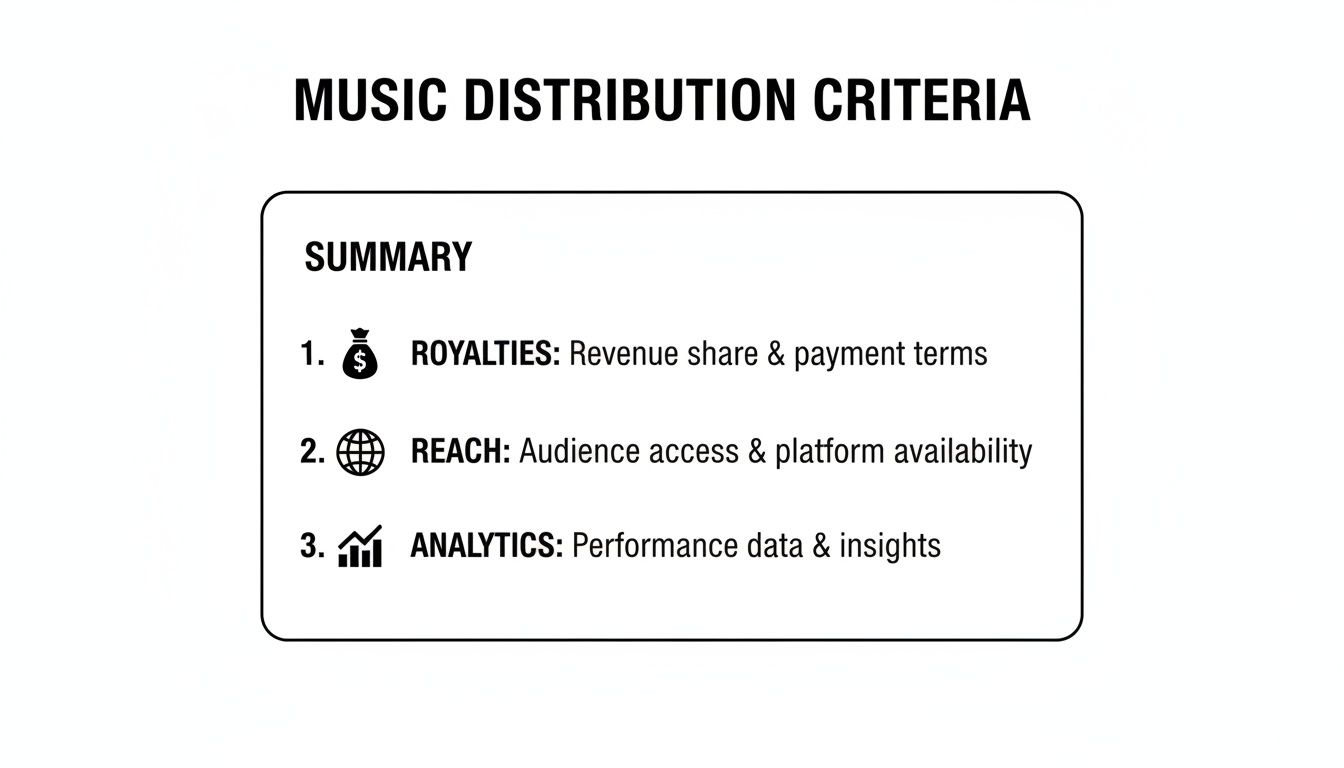
These three elements are the foundation of a good distribution strategy. It’s not just about what you pay upfront, but what you stand to earn and learn in the long run.
To help clarify the major players, here's a quick side-by-side look at how they stack up.
Digital Distribution Services At a Glance
| Platform | Pricing Model | Royalty Split | Key Feature | Best For |
|---|---|---|---|---|
| DistroKid | Annual Subscription | 100% to Artist | Unlimited Uploads | Prolific artists releasing music frequently |
| CD Baby | One-Time Fee Per Release | 91% to Artist | Lifetime Distribution (No Annual Fees) | Artists releasing a single album or EP |
| TuneCore | Annual Subscription | 100% to Artist | Advanced Analytics & Publishing Admin | Data-driven artists managing their career |
| OohYeah! | Hybrid (Free Tier + Commission) | Commission-Free D2F Sales | Integrated Direct-to-Fan Storefront | Artists building a community and direct revenue |
This table gives you a bird's-eye view, but the real story is in the details of how each model fits a specific workflow.
DistroKid: The Prolific Creator’s Choice
DistroKid cornered the market with a simple, game-changing offer: pay one flat annual fee, release all the music you want, and keep 100% of your royalties. This is a dream come true for the non-stop creator—the beatmaker dropping new instrumentals weekly, the songwriter with a backlog of demos, or the band that thrives on a constant stream of singles.
For anyone releasing more than a couple of projects a year, a pay-per-release model gets expensive fast. DistroKid removes that financial barrier, letting you focus on creating. Its speed and simplicity are its biggest strengths. Just be aware that some features, like keeping your music on stores after your subscription lapses, come with extra one-time fees.
CD Baby: The Legacy Builder's Platform
CD Baby takes a completely different road. Instead of a subscription, you pay a one-time fee for each single or album. That’s it. This model is perfect for an artist who has poured years into a single, polished album and doesn't plan on releasing new material for a while.
It’s a "set it and forget it" approach that offers real peace of mind, ensuring your music stays online forever without any recurring costs. This makes it a great fit for legacy projects or artists who see their release as a finished work, not part of a content treadmill. The trade-off? CD Baby takes a 9% commission on your digital revenue, which can add up if a song unexpectedly takes off.
TuneCore: The All-Rounder with Deeper Tools
TuneCore aims to be the go-to for serious independent artists who want more than just basic distribution. Like DistroKid, it has unlimited plans that let you keep 100% of your earnings, but it sets itself apart with much more powerful analytics and a robust publishing administration service.
If you're the kind of artist who loves digging into data to see where your listeners are and how your tracks are performing, TuneCore's detailed reports are a huge plus. Even better, their publishing add-on helps you collect songwriting royalties that distributors typically don't—money you could otherwise be leaving on the table. This makes it an excellent choice for the artist-entrepreneur who is actively managing their entire business.
The crucial differentiator isn't just the fee structure, but how that structure aligns with your release frequency and long-term vision. An annual fee empowers high-volume creators, while a one-time fee secures a legacy for a single project.
OohYeah!: The Direct-to-Fan Ecosystem
While the others focus on pushing your music out to third-party stores, OohYeah! is built around a more integrated, artist-centric idea. It bundles standard distribution with a commission-free marketplace where you can sell directly to your fans. This is a model designed for the modern artist who knows that a sustainable career is built on more than just fractional streaming pennies.
OohYeah! lets you create a central hub for your music business, selling tracks, merch, and exclusive content all in one place. It’s less about just being a distributor and more about giving you the tools to build a community and maximize what you earn from each supporter. You can see how this all comes together by exploring OohYeah!'s straightforward pricing and features. For artists focused on building a loyal fanbase and creating diverse income streams, this approach is a powerful alternative.
Find the Right Distributor for Your Career Stage
Picking a digital music distributor isn't about finding the one "best" platform—it's about finding the one that fits you right now. Forget generic pro/con lists. The key is to look at your own workflow, your release schedule, and your career goals to see which service aligns with where you are and where you want to go.
By thinking through your specific situation, you can move past a simple feature-to-feature comparison. Let's break it down by a few common artist archetypes to help you see which one feels most like you.
The Emerging Singer-Songwriter
You're all about the craft. Your focus isn't on churning out content every week; it's on perfecting that one single, EP, or album that truly says something. You need a partner that respects this milestone-driven approach and helps you wring every last drop of potential income from your hard work.
For this kind of artist, a one-time fee model often makes the most sense. A service like CD Baby is a great example. You pay once to get your project distributed, and it stays online forever without nagging annual fees. It’s a smart financial move when you're releasing music less frequently.
The real money for a songwriter often comes from beyond the stream. Look for a distributor that offers easy-to-add services like publishing administration and sync licensing. This is how you collect your songwriting royalties and get your music pitched for TV, film, and ads—income streams you can't afford to ignore.
The Prolific Beatmaker or Producer
You live in the studio, and your creative output is constant. Maybe you're dropping a new instrumental on YouTube every few days, stocking your beat store, or jumping on collabs left and right. For you, paying a fee for every single release would not only be a financial nightmare but would also kill your momentum.
Your top priority should be unlimited, fast distribution. This is the world where annual subscription services like DistroKid really come into their own. One flat yearly fee lets you upload as much music as you want, whenever you want, without thinking twice about the cost. Their entire system is built for speed and volume, closing the gap between finishing a track and getting it out to the world.
The Established Indie Band
You've put in the work. You've toured, built a real fanbase, and have a history of releases. Your challenge isn't just getting your music heard, but understanding and activating the audience you already have to make every new album a genuine event. You're past the basics and need professional-grade tools.
At this stage, you should be looking for powerful analytics and direct-to-fan features. A platform like TuneCore delivers advanced sales reports that show you exactly where your music is connecting, which can be invaluable for planning your next tour or marketing campaign.
For even deeper integration, a service like OohYeah! combines distribution with a commission-free storefront. This lets you sell exclusive tracks, merch, and vinyl directly to your core audience, turning your distribution platform into a central hub for your entire business. It's about building a sustainable career by monetizing your direct relationship with the people who support you most.
Moving Beyond Distribution to Maximize Revenue

Getting your music onto Spotify and Apple Music is just the first step. Thinking of digital music distribution services as simple upload tools is a huge missed opportunity. The real work—and the real money—comes from using your distributor as a data hub to build an actual business strategy.
Your analytics dashboard is mission control. It tells you who’s listening and, just as importantly, where they're listening. A sudden spike in streams from a specific city isn't just a neat piece of trivia; it’s a bright, flashing sign telling you where to focus your energy. That single data point should guide your tour routing, social media ad targeting, and even your press outreach. The smartest artists I know pair their distributor's reports with platform-specific tools like Spotify for Artists to paint a complete picture of their audience.
The Shift to Direct-to-Fan Monetization
Let's be honest: streaming alone is a tough way to make a living. While it accounted for a staggering 69% of global recorded music revenues in 2024—over USD 20.4 billion—the payout per stream for artists remains incredibly small. We're talking fractions of a penny.
This is exactly why direct-to-fan (D2F) sales have become so critical. Your core fanbase wants to support you directly, but you have to give them a way to do it. Sending them off to some third-party site that takes a huge cut just doesn't make sense anymore. To build a sustainable income, many artists are getting creative with strategies to monetize your Instagram account and turning social followers into paying supporters.
Direct-to-fan sales aren't just about selling t-shirts; they're about building an independent economy around your art. Every direct sale generates significantly more income than thousands of streams, giving you the financial stability to continue creating.
This is where a unified platform like OohYeah! changes the game. By bundling distribution with a commission-free storefront, you can sell merch, exclusive content, and digital downloads all in one place. It’s a model built for the modern artist-entrepreneur—someone who gets that a long-term career is about owning the relationship with your audience. If you want a deeper dive into the numbers, check out our post on whether artists can make money from streaming services.
Common Questions About Music Distribution
Choosing the right partner from the dozens of digital music distribution services out there always brings up a ton of questions. Whether you're an artist uploading your very first track or a seasoned pro thinking about making a switch, you need clear answers to manage your career well.
Let's cut through the noise and tackle some of the most common things that come up. Getting these details right is key to protecting your music catalog and, just as importantly, your income.
Can I Switch Distributors Without Losing My Streams?
Yes, you absolutely can—and this is probably the biggest fear artists have when considering a move. The thought of losing all those hard-earned streams, playlist spots, and monthly listeners is terrifying, but the process is perfectly safe if you follow a few critical steps.
The secret is making sure your new distributor gets the exact same metadata as your original release. No variations, no typos. This means:
- The original ISRC (International Standard Recording Code) for every single track.
- The original UPC (Universal Product Code) for the album or single.
- Identical track titles, artist names, and even the artwork file.
To pull this off without a hitch, plan for a small overlap. First, upload everything to your new distributor and wait for it to go live across all the stores. Once you've personally confirmed it's up and running everywhere, then you can go back and issue a takedown request with your old service. This little bit of overlap prevents any downtime and makes sure your streaming history transfers seamlessly.
What Is the Difference Between a Distributor and a Publisher?
This is a huge one, and understanding the distinction directly affects how you get paid. Simply put, a distributor handles your master recordings, while a publisher takes care of your musical compositions.
Here’s an easy way to think about it:
- A Distributor: Their job is to get your finished song—the actual MP3 or WAV file—onto platforms like Spotify and Apple Music. They then collect the royalties generated when people stream that specific recording.
- A Publisher: They manage the song itself—the underlying lyrics and melody you wrote. They register these compositions with Performance Rights Organizations (PROs) and collect royalties whenever your song is publicly performed, sold, or reproduced by someone else.
Some digital music distribution services now offer publishing administration as an add-on, but it's important to remember they are two fundamentally different jobs in the industry.
Your distributor collects master recording royalties, but you need a publisher to collect your songwriting royalties. If you don't have both, you are leaving money on the table.
How Much Money Can I Realistically Make from Streaming?
Let's be blunt: streaming payouts are notoriously low. We're talking fractions of a cent per stream. On a major platform, a single play might earn you somewhere between $0.003 and $0.005. That math makes it pretty clear that you need a massive volume of plays to generate any significant income.
This is exactly why distribution is just one piece of a much larger financial puzzle for any artist. Getting your music on global platforms is essential for discovery, but the independent artists who are actually making a living have built a more complete strategy. They focus on building a real community around their music and use direct-to-fan tools to sell merch, exclusive content, and physical media. Those revenue streams are far more reliable and profitable than streaming royalties alone.
Do I Need a Record Label to Distribute My Music?
Nope. Not anymore. In fact, digital music distribution services were created for this very reason: to give independent artists the power to release music globally on their own terms. These platforms give you the direct pipeline to digital stores that, not long ago, was only accessible through a major label deal.
Sure, a traditional label might offer a budget, marketing muscle, and industry connections. But a distributor gives you a seat at the same table, putting your music in the exact same digital storefronts. For countless artists today, the combination of a solid distributor and their own hustle is the perfect recipe for maintaining creative control and building a global career.
Take control of your music career by building a direct connection with your fans. OohYeah provides the tools you need to not only distribute your music but also to sell merch and exclusive content, all in one commission-free ecosystem. Start building your independent music business with OohYeah! today.