The Artist's Guide to 360 Contract Music Deals
Is a 360 contract music deal right for your career? This guide breaks down the pros, cons, and key terms to help artists make an informed decision.
February 9, 2026
Music Marketplace Advisor
Buying & SellingA 360 contract music deal isn't just about selling records; it’s a full-blown business partnership between an artist and a label. Unlike the old-school deals that only cared about album sales, a 360 contract means the label invests in an artist's entire career. In exchange, they get a piece of everything—touring, merchandise, endorsements, you name it.
What Is a 360 Music Contract

At its heart, a 360 contract—often called a "multiple rights deal"—treats an artist's career like a single, unified business. The label steps in as a comprehensive partner, putting up serious cash, marketing power, and industry connections to build the artist's brand across every possible platform.
Here's a good way to think about it: a traditional record deal was like a publisher buying the rights to just one book in a long series. A 360 deal is more like an investor backing the author's entire franchise, from the books and movie rights to the merchandise and theme park attractions. The investor's success is tied to the author's overall brand, not just a single product.
The Shift From Single-Stream to Full-Circle Revenue
For decades, labels made their money one way: selling recorded music. But when physical album sales cratered and streaming took over, that old model just wasn't cutting it anymore. The 360 contract music model was born from this reality, giving labels a way to diversify their income by tapping into an artist's most profitable activities.
Today, an artist’s money flows in from all directions:
- Live Performances: Ticket sales from tours and concerts.
- Merchandise: T-shirts, posters, and other branded gear.
- Sponsorships and Endorsements: Partnerships with brands.
- Publishing: Royalties from songwriting credits.
- Acting or Appearance Fees: Income from film, TV, or other media.
A 360 deal gives the label a share of these "ancillary" revenue streams, typically somewhere between 10% and 35%. This is their return for investing in the artist's total career development.
This contractual shift reflects a fundamental change in the industry's mindset. A label is no longer just a record company; it's a full-service brand development agency for its artists.
Traditional Record Deal vs 360 Music Contract at a Glance
The move to a 360 structure represents a huge departure from how business used to get done. For any artist weighing a major label partnership, understanding these differences is crucial. The table below lays out a clear comparison, highlighting where the power, risk, and revenue opportunities lie in each model.
| Feature | Traditional Record Deal | 360 Music Contract |
|---|---|---|
| Primary Revenue Source | Recorded music sales (albums, singles) | All artist-related income streams |
| Label's Financial Scope | Limited to music royalties | Includes touring, merch, endorsements, publishing, and more |
| Artist-Label Relationship | Primarily a music distributor and marketer | A comprehensive business partnership |
| Risk and Investment | Label's risk is tied to the success of an album | Label's risk is spread across the artist's entire brand |
| Artist Autonomy | Higher financial control over non-music activities | Shared financial stake in all career aspects |
Seeing them side-by-side makes the evolution of the music business crystal clear. The 360 model is a direct response to a world where an artist's value extends far beyond the studio.
Why 360 Contracts Became the Industry Standard
To really get why the 360 contract is everywhere today, we need to jump in a time machine. For decades, the music business had a straightforward, lucrative formula: sell records. A hit album meant a mountain of cash from CDs, vinyl, and cassettes. That was the game, and labels had it down to a science.
Then, the internet happened. The whole foundation started to crack in the early 2000s as digital music took hold. First came piracy, which took a huge bite out of sales. Then, digital downloads changed how people bought music entirely. Why buy a full album when you could cherry-pick your favorite track for 99 cents?
But that was just a tremor. The real earthquake hit with the explosion of streaming. All of a sudden, owning music didn't matter as much as having access to it. This completely upended the business model for record labels, whose entire financial world was built on selling physical units.
A Financial Model Under Pressure
As album sales cratered, the river of money that had fed the industry for 50 years began to dry up. This put labels in a tough spot. They were still pouring millions into finding and developing talent, covering studio time, and bankrolling massive marketing campaigns, but the money coming back from just the recordings wasn't cutting it anymore.
They had to find a new way to make their investments pay off. What they saw was that even though record sales were tanking, top artists were still earning a ton of money from other things. A major tour could pull in millions, merch was a goldmine, and brand deals were becoming bigger than ever. The money hadn't vanished; it had just moved to different buckets.
This financial squeeze is exactly what gave rise to the 360-degree music contract. It was a direct answer to the collapse of the old model. To put it in perspective, by 2016, streaming revenue accounted for 51% of the entire industry's income, officially leaving physical and download sales in the dust.
The Strategic Adaptation to a New Era
The 360 contract was the industry’s big strategic pivot. Instead of gambling everything on the success of an album, labels decided to invest in the artist as a brand. By securing a piece of the action from touring, merchandise, publishing, and other income streams, they could build a more resilient and diversified business.
At its core, the 360 deal is a risk-management tool for the modern music industry. It lets a label spread its financial bet across an artist's entire career, not just the high-stakes lottery of a hit record.
This completely changed the relationship between an artist and their label, turning it into a much deeper partnership. The label was no longer just a company that made and sold your music; it was now a shareholder in nearly every part of your career. To see how this fits into the bigger picture, you can learn more in our guide on how the music industry works. This wasn't just some small adjustment—it was a full-blown evolution, a necessary move to survive in a world where the very definition of music's value had been rewritten.
Breaking Down the Key Revenue Streams
A 360 contract doesn't just change the rules of the game; it redefines the entire playing field. It's a seismic shift from the old model where labels only cared about record sales. Now, the agreement touches nearly every single dollar an artist earns.
To really get what's at stake, you have to look at an artist's career like a business with multiple income streams. The 360 deal essentially makes the record label a shareholder in every one of them. They get a piece of the music, sure, but they also get a cut of everything else that builds your brand and brings in cash.
This didn't happen overnight. As album sales took a nosedive and streaming became king, labels had to find new ways to make money. The 360 deal was their answer.
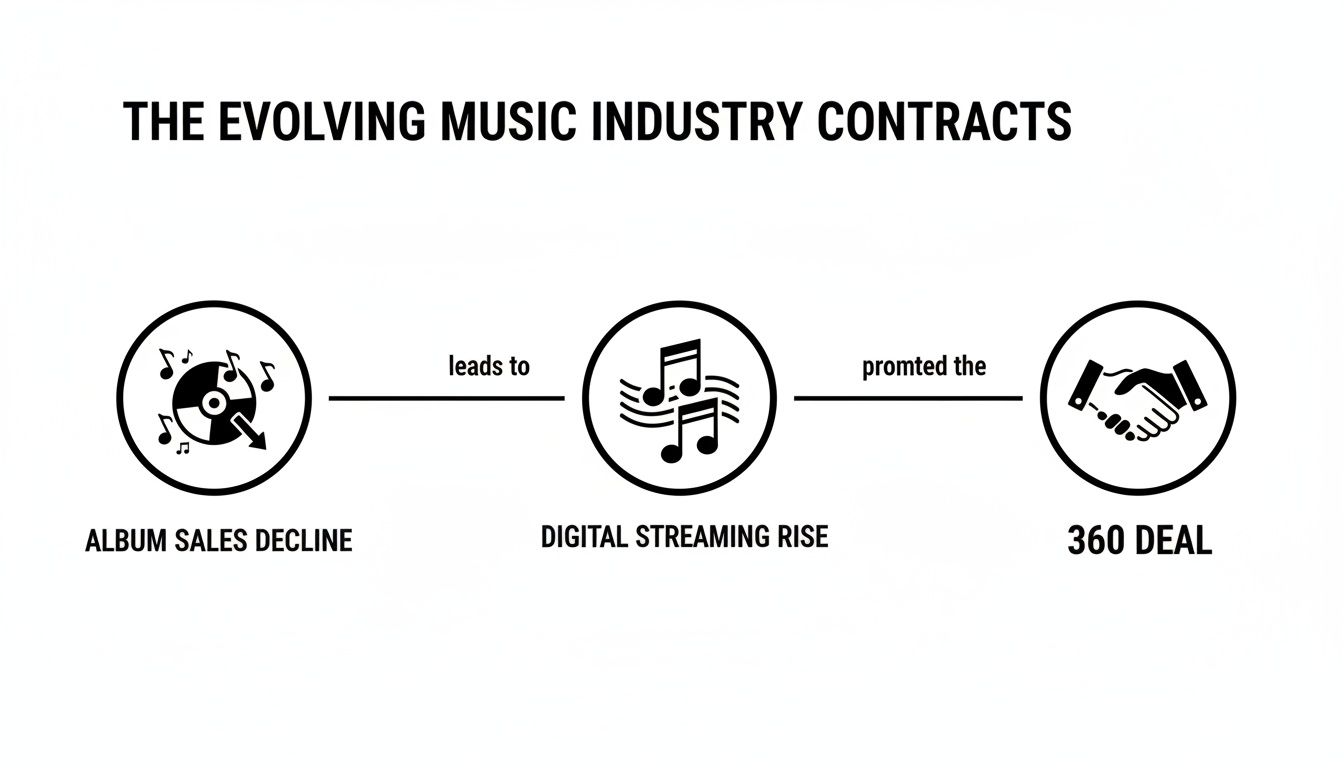
As you can see, when the traditional profit center—the album—crumbled, labels adapted. They built contracts that let them tap into the artist's entire career ecosystem.
Recorded Music and Publishing Rights
This is still the heart of any record deal, but it looks a bit different in a 360. This part of the contract covers all income from the master recordings themselves.
- Streaming Royalties: Every time your song gets played on platforms like Spotify or Apple Music, money is generated. The label gets its share.
- Physical Sales: Don't count out vinyl and CDs. For artists with a loyal fanbase, physical formats can still be a serious moneymaker.
- Digital Downloads: While not what they used to be, sales from stores like iTunes still contribute to the bottom line.
But it doesn't stop with the recording. Many 360 deals now want a piece of your music publishing, too. This is the money generated by the song itself—the melody and lyrics. Think royalties from radio play, sync placements in movies, or another artist covering your track. This is a complex area, and it's worth taking time for a deeper dive into understanding music licensing and how it can boost your revenue.
Touring and Live Performances
For most artists, the road is where the real money is made. That's exactly why labels want in on the action. With a 360 deal, the label is entitled to a percentage of the net profits from your live shows.
This includes more than just the basics:
- Ticket Sales: The obvious one, and the biggest driver of tour revenue.
- VIP Packages: All that extra cash from meet-and-greets and exclusive fan experiences.
- Appearance Fees: One-off gigs at festivals, corporate events, or private parties all fall under this umbrella.
The label’s argument is simple: Our marketing efforts for the album are what put people in those seats. Since our investment helped create that audience, we deserve a share of the profits.
Merchandise Sales
Merch is no longer just about selling a few t-shirts at a concert. It's a full-fledged branding machine and a massive revenue generator. And under a 360 contract, you can bet the label is taking a healthy slice of that pie.
This revenue stream is surprisingly broad:
- Tour Merch: The items sold at the merch table after a show. This is often where the highest profit margins are found.
- Online Store Sales: Everything sold on your official website, from hoodies and hats to signed posters and special edition vinyl.
- Retail Licensing: Those deals that get your name and face on products in major stores like Target or H&M.
Sometimes the label will handle production and logistics, but their main interest is financial. They get their cut of the profits whether they lift a finger or not, which makes merch one of the most critical negotiation points for any artist.
Weighing the Pros and Cons for Your Career
Signing a 360 contract is one of the most pivotal decisions an artist will ever make. It’s not just a record deal; it's a deep business partnership that can either launch your career to incredible heights or leave you feeling financially and creatively boxed in. Understanding what you stand to gain—and what you're giving up—is absolutely critical.
This isn't a simple good-versus-bad scenario. A 360 deal can be a powerful catalyst for a new artist, but it always comes at a price. Whether it's the right move depends entirely on where you are in your career, what your long-term vision is, and how comfortable you are trading autonomy for a massive support system. Let's break down both sides of this industry-defining arrangement.
The Upside: A Powerful Partnership
For an artist just starting out, a 360 deal can feel like the golden ticket. The biggest draw is the sheer financial muscle and industry infrastructure a major label brings to the table. We’re not just talking about a check; we’re talking about access to a machine that would be nearly impossible to build on your own.
The advantages are often immediate and game-changing:
- Massive Upfront Investment: Labels can front a substantial advance, giving you the cash to record a world-class album, shoot stunning music videos, and finally quit your day job to focus 100% on your craft.
- A Full-Service Marketing Machine: Suddenly, you have a team of seasoned pros working on your behalf—experts in marketing, radio promotion, PR, and digital strategy. Their entire job is to get your music in front of millions of people, a feat that can take an indie artist years of grinding to accomplish.
- Global Reach and Industry Connections: A major label has the contacts. They have direct lines to global streaming platforms, festival bookers, big-name brands, and major media outlets, opening doors that are usually bolted shut for most artists.
With this kind of backing, an artist can experience an explosive career trajectory. The label is now financially invested in making your entire brand a success, from records to tours, which means they’re motivated to push every single aspect of your career forward.
The Downside: The Cost of Control
While the benefits are undeniably tempting, the drawbacks are just as serious and can have lasting consequences. The fundamental trade-off is this: you give up a percentage of everything you earn in exchange for that investment. That can be a tough pill to swallow, especially once you start seeing real success from your hard work.
The potential disadvantages can create a lot of friction down the line:
- Loss of Income on All Fronts: The label's cut isn’t just from album sales. They take a piece of your touring revenue, merchandise sales, publishing, and even brand deals that you might have hustled to get on your own.
- Creative Conflicts: When a label is a partner in every venture, they naturally want a say in creative choices. This can easily lead to clashes over your sound, your public image, or the kinds of brand partnerships you pursue.
- Long-Term Financial Entanglement: These contracts are notoriously long and difficult to get out of. If the relationship sours or the label doesn't deliver on its promises, you can find yourself legally chained to a partner who is no longer helping you grow.
A huge risk to watch out for is cross-collateralization. This is a clause that lets the label use money from one income stream (like a profitable tour) to pay off debts from another (like the unrecouped album advance). You could be selling out arenas every night and still not see a single dollar until the label has been paid back for every penny it ever spent.
Analyzing the Trade-Offs of a 360 Music Contract
To make a clear-headed decision, it helps to see the potential outcomes laid out side-by-side. This table offers a balanced view, highlighting the core exchange at the heart of every 360 deal.
| Potential Advantages (Pros) | Potential Disadvantages (Cons) |
|---|---|
| Significant financial backing and a large advance to fund your career. | Reduced income from all revenue streams, not just music. |
| Access to an expert team for marketing, promotion, and distribution. | Potential for creative interference from the label. |
| Rapid career growth and global exposure through label connections. | Cross-collateralization of earnings, delaying your profits. |
| A unified brand strategy managed by an experienced industry player. | Long contract terms that can be difficult to leave. |
Ultimately, a 360 contract is a high-stakes bet on yourself, with the label as your biggest investor. It can offer a fast track to the big leagues, but it requires you to give up a piece of every victory you achieve along the way.
Exploring Modern Alternatives for Independent Artists
While a 360 contract music deal can feel like a golden ticket, paved with a label's resources and connections, it’s hardly the only road to success. For many artists, the thought of handing over a piece of every single thing they earn is, understandably, a dealbreaker.
The good news? The music business today offers more pathways to a sustainable, independent career than ever before. It's no longer just about getting signed; it’s about building a direct line to your audience and keeping your hands on the wheel of your art and your business. This shift means you can partner with experts for specific needs instead of signing away your entire brand.
Embracing a Modular Approach to Your Career
Think of your career not as a single, all-in-one package deal, but as a custom-built team. Instead of one partner taking a cut of everything, you can hand-pick specialists for different jobs. This à la carte model gives you incredible flexibility and ensures you’re always in the driver’s seat.
Some of the most powerful alternatives to a 360 deal include:
- Distribution-Only Deals: These are straightforward arrangements focused on one thing: getting your music onto Spotify, Apple Music, and other digital stores. Companies like TuneCore or DistroKid handle the technical side, and you keep 100% of your rights and the lion's share of your royalties.
- Label Services Agreements: This is a fantastic middle ground. Think of it as a menu of label-level services—like marketing, radio plugging, or playlist pitching—that you can buy as needed. You pay a fee or a short-term percentage for the specific help you want, without the long-term, all-encompassing commitment.
- Direct-to-Fan (D2F) Platforms: Websites like Bandcamp and platforms such as OohYeah let you sell music, merchandise, and even subscriptions straight to the people who love your work. This model bypasses many of the old-school middlemen, meaning more of the money you earn ends up in your pocket.
This piecemeal strategy works so well because the industry's financial engine has completely changed. Projections show the global music market soaring to USD 54.09 billion by 2031, and streaming already makes up nearly 68% of all revenue. That data paints a clear picture: artists have a massive opportunity to build a career on their own terms, directly tapping into this growth without a 360 deal. You can learn more about the evolving music market and its impact on artists to see the numbers for yourself.
The Power of Ownership in a Streaming World
In an industry now driven by streaming and live shows, ownership is everything. When you keep control of your master recordings and publishing rights, you're holding onto your most valuable assets. This gives you the freedom to make choices based on your long-term vision, not a label’s quarterly profit goals.
By unbundling services, you can build a team that works for you, not a partnership where you work for them. You get the expertise without sacrificing equity in your entire brand.
For example, an artist can use a distributor to get their album out, hire a freelance publicist for the three months around its release, and partner with a dedicated merch company. Sure, it requires you to be more of a CEO, but the trade-off is complete creative and financial freedom. If you're ready to take that step, a good starting point is to understand the best strategies for independent music distribution.
At the end of the day, the choice isn't just between signing a 360 deal or trying to do it all by yourself. It's about building a smart, customized support system that helps you grow without forcing you to give away a piece of everything you create.
Your Essential Checklist Before Signing Any Deal

Before your signature ever hits the dotted line of a 360 contract music deal, you need to stop and approach that document with a critical, clear-headed perspective. This isn't just another piece of paper; it’s an agreement that will dictate the course of your career for years. Don't rush it.
Think of the contract as the business plan for your partnership with the label. Every single clause, percentage point, and deadline has real-world consequences. This checklist is built to give you the right questions to ask so you can walk into negotiations fully aware of what's on the table.
Understanding the Financials
The numbers are everything. They're the core of the deal, and if there’s any ambiguity, you need to pump the brakes. Vague language around splits or how the label gets its money back is a massive red flag.
- What are the exact percentages? You need a specific, line-by-line breakdown of the label's take from every income source. That means recorded music, publishing, touring, merch, brand deals—everything.
- How is the advance structured? Is it one check upfront, or does the money come in stages as you hit certain milestones? Critically, you need a complete list of every expense that will be recouped from your share of the profits.
- Is there cross-collateralization? This is a big one. You have to know if the money you make from a successful tour can be used to pay back the recording costs for your album. This single clause can keep you from seeing any real profit for a very long time.
The single most important action an artist can take when offered a record deal is to hire an experienced music attorney. Their expertise is not a luxury; it is a fundamental requirement for protecting your career and future earnings.
Defining the Terms and Commitments
Beyond the financials, the contract spells out how long you're tied to the label and what each side is promising to do. These terms define your obligations and, just as importantly, your escape route if things go south.
- What is the contract term? How many years or, more likely, how many albums are you committing to? Most deals are structured around "album cycles," not a fixed calendar period.
- What are the label’s marketing commitments? The contract needs to state what the label will actually do to promote your music. Vague promises of "promotional support" aren't enough—look for concrete actions and budgets.
- What are the exit clauses? What happens if the label shelves your album or simply fails to live up to its end of the bargain? A clearly defined exit strategy is your safety net.
Treat this checklist as your starting point. It’s designed to fuel the conversation with your lawyer, who can translate the dense legalese into a plain-English picture of your future. A well-negotiated 360 contract can be a powerful springboard for a career, but only if you go in with your eyes wide open to every last detail.
Questions Artists Are Actually Asking About 360 Deals
Even when you grasp the basics of a 360 contract, the real questions pop up when you start thinking about your own career. These deals are notoriously complex, and the devil is always in the details—details that can shape your entire future. Let's dig into some of the most common and critical questions that come up when it's time to talk terms.
Getting these deals right requires looking ahead, especially if you’ve already put in the work to build parts of your career on your own. The answers below should clear up how a 360 contract might affect your existing business and what you can actually push for at the negotiating table.
What if I Already Have a Successful Merch Business?
This is a huge one, and it's a perfect example of where having your ducks in a row gives you real power. If you’ve built a profitable merch line before a label ever came knocking, you’re in a strong position. Your lawyer should immediately argue to "carve out" this business from the deal altogether.
If they won't agree to a full carve-out, the next best thing is negotiating a much lower percentage for the label from that specific income stream. The key is proof. You need to show them the numbers—the sales, the profits, the history. Without a specific clause protecting your pre-existing business, you can bet the label will take its standard cut from every t-shirt you sell, even from the brand you built from the ground up.
Can I Negotiate to Exclude Certain Income Streams?
You can, but whether you will depends entirely on your leverage. An artist who already sells out 500-capacity venues, has a massive social media following, or brings a valuable publishing catalog to the table has a much stronger hand to play.
For instance, a seasoned artist might successfully keep their publishing rights or income from a burgeoning acting career off the table. For a brand new artist, however, labels are far less likely to budge on these kinds of exclusions. This is the part of the negotiation where you’re really trying to turn a standard 360 deal into a more favorable "270" or "180" agreement.
The name of the game in any negotiation is leverage. The more you've built on your own before you sign, the more control you'll be able to keep over your career.
How Does Recoupment Work in a 360 Deal?
This is where things get tricky and, frankly, much riskier for the artist. The reason is a practice called cross-collateralization, and it's a standard feature of most 360 deals. This clause gives the label permission to use money from all your shared income streams to pay back the advance.
Let's break it down with a real-world example:
- The label fronts you a $200,000 advance to make your album.
- The album sales and streams only bring in $150,000, which means you're still $50,000 in the red.
- But you hit the road and your tour is a smash, netting $100,000 in profit.
Because of cross-collateralization, the label will take the first $50,000 from your tour money to cover the album's shortfall. You won't see a single dollar from that tour until their entire investment is recouped.
Are All 360 Deals Created Equal?
Not even close. Think of "360 deal" as a general category, not a one-size-fits-all contract. The actual terms can swing wildly from one deal to the next.
Here are the key variables that are always up for negotiation:
- The percentages the label takes from each part of your business.
- The length of the contract, usually called the "term" and tied to a number of albums.
- The size of the advance and which expenses the label can recoup from your earnings.
- The label's commitment to you, which should be spelled out in writing.
Every single one of these points is negotiable. This is precisely why having a sharp, experienced music attorney isn't just a good idea—it's absolutely essential for protecting your career and your money.
Ready to build your music career on your own terms? At OohYeah, we provide the tools you need to sell your music, merch, and subscriptions directly to your fans, commission-free. Take control of your art and your income by visiting https://oohyeah.app to get started today.