Lossless Audio: Compare the Cost of Buying Albums and Streaming
Compare buying lossless audio directly vs continuous streaming rental to see how replay habits, storage, audio quality, and library access shape the best val...
November 24, 2026
FRANKLY with Frank Lee
The lowest monthly bill doesn’t automatically deliver the best value from lossless music. Buying lossless audio directly versus continuous streaming rental depends on how often you replay albums, how much music you want available, and whether you value keeping downloaded files or accessing a broad library. Buying can suit focused listening; streaming can suit constant discovery.
It’s fair to expect higher-quality audio to cost more, but the format matters as much as the listening model. CD-quality audio commonly uses 16-bit samples at 44.1 kHz, while high-resolution files can take up more storage and need compatible playback equipment to make the difference worthwhile.
This comparison of buying lossless audio directly versus continuous streaming rental looks at album purchases alongside ongoing streaming costs. You’ll learn what CD-quality and high-resolution audio offer, and how your listening habits can shape the better-value choice.
Key Takeaways
- Assess whether lossless files fit your storage and listening setup before paying for higher-quality audio.
- Compare the value of an album you can keep with the ongoing access a streaming subscription provides.
- Learn which audio specifications distinguish CD-quality from high-resolution files, and what those differences mean in practice.
- Explore direct artist support through OohYeah!, where fans can access digital music downloads and exclusive content.
High-Res and Lossless Audio: Are You Getting Your Money's Worth?
Lossless audio preserves the original recording data, while lossy formats discard some data to create smaller files. That trade-off affects storage, streaming bandwidth, and how much music fits on your device.
Lossless and Lossy Compression
Lossless compression reduces file size without discarding audio information. Lossy compression, used by MP3, removes some information to shrink files, so the original data can't be fully restored from the compressed version. The difference matters when you want to keep a detailed master or save space for a large library.
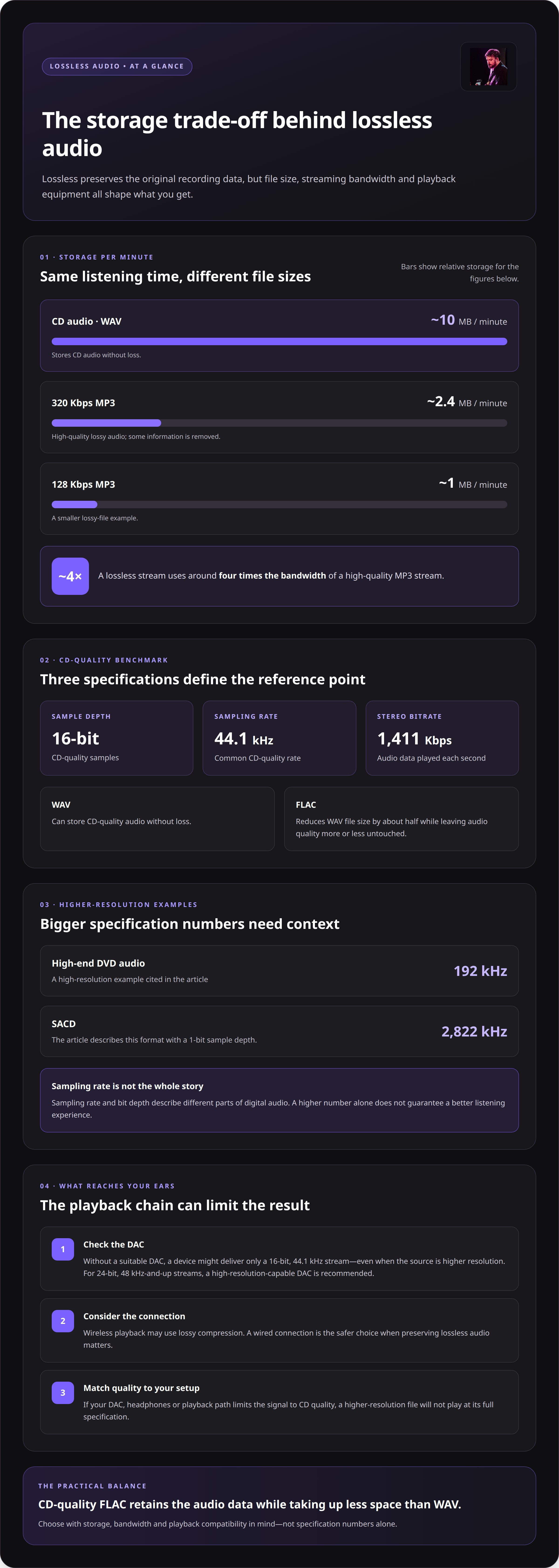
A 320 Kbps MP3 is an example of high-quality lossy audio, while a 128 Kbps MP3 uses a lower bitrate. Adaptive streaming can shift between 320 kbps and 128 kbps as connection conditions change. A lossless stream uses around four times the bandwidth of a high-quality MP3 stream, so playback quality and data use can vary with the format and connection.
Audio Storage Requirements
File size makes the trade-off tangible: CD audio in WAV format takes about 10 MB per minute. A 320 Kbps MP3 takes about 2.4 MB per minute, while a common 128 Kbps MP3 takes about 1 MB per minute. For the same listening time, the WAV file therefore needs considerably more device storage than either MP3 example.
That difference adds up across albums. If you save lossless WAV files for offline listening, a device’s available storage determines how much music you can keep locally. MP3 files use less space, making them easier to store in a larger collection. Streaming also uses bandwidth as you listen: a lossless stream requires around four times the bandwidth of a high-quality MP3 stream. The useful choice depends on whether you prioritize preserving audio data, fitting more tracks onto a device, or limiting streaming data use.
Buying albums as an alternative to streaming
Buying a lossless album gives you a downloadable copy to keep, while streaming provides ongoing access to a changing library. Purchases can suit repeat listening and direct artist support; subscriptions offer broader discovery, but access ends when you stop paying.
Digital music stores set album and track prices by release and format, so there’s no single typical price.
The break-even point depends on how many albums you buy and how long you keep streaming. Someone who returns to a few favourite albums may value buying those releases, while a listener who regularly explores new music may prefer a library subscription. Buying music can also provide artists with more direct revenue than per-stream payments.
A purchased download gives you a copy of the music and artwork, not the right to distribute or resell copies. You can back up downloaded files and transfer them between devices when the store’s terms allow it and the devices support the format. Keep a separate backup to protect your collection if a device fails.
Playback also depends on file compatibility. A lossless file may need a suitable player or app on each device, and digital rights management can restrict copying or playback. Before building a library, consider whether you want flexible access across devices or a format tied to particular software. These practical limits matter as much as the initial purchase cost.
For a straightforward comparison, total the subscription payments over the period you expect to listen, then compare that amount with the albums you would actually buy. Factor in storage and backup needs, too. A purchase can remain useful beyond a subscription period, while streaming trades permanent files for continuous access and discovery.
CD-quality and high-resolution audio specifications
Streaming services can deliver lossless audio, but quality and file formats vary by service and listening mode. CD-quality audio gives you a useful benchmark for comparing those options with high-resolution streams and downloads.
A CD-quality track uses 16-bit samples and is commonly sampled at 44.1 kHz. Stereo CD audio has a bitrate of 1,411 Kbps, which describes how much audio data plays each second. WAV can store this audio without loss, while FLAC reduces a WAV file’s size by about half while leaving audio quality more or less untouched. FLAC can therefore preserve CD-quality sound with less storage space.
High-resolution labels refer to specifications above CD quality, but bigger figures alone don’t guarantee a better listening experience. High-end DVD audio commonly uses a 192 kHz sampling rate. SACD is described with a 2,822 kHz sample rate and 1-bit samples, but that rate isn’t 64 times better than a 44.1 kHz CD. Sampling rate and bit depth describe different parts of digital audio, so compare the full specification rather than one number.
Your playback chain also matters. A device without a suitable DAC might deliver only a 16-bit, 44.1 kHz stream, even when the source is higher resolution. For 24-bit, 48 kHz-and-up streams, a DAC capable of high-resolution audio is recommended. Wireless playback may use lossy compression, so a wired connection is the safer choice when preserving lossless audio matters.
Use these specifications to judge whether a higher-resolution option suits your setup. If your DAC, headphones, or playback path limits the signal to CD quality, you won’t hear a higher-resolution file at its full specification. A compatible DAC and wired headphones can help preserve the signal. For many listeners, CD-quality FLAC offers a practical balance: it retains the audio data while taking up less space than WAV.
Streaming services can deliver lossless audio, with quality and file formats varying by service and listening mode. Options include CD-quality audio and higher-resolution streams, while FLAC can preserve CD-quality sound in less space than WAV.
Lossless streaming service prices
Subscription costs vary by plan, region, and included features, so compare the actual monthly charge with how often you listen.
Streaming services license access to music rather than selling permanent copies of every track. Your subscription pays for ongoing access under the service’s licensing arrangements with music rights holders. Songs downloaded inside a streaming app are generally offline copies for listening, not files you can keep after cancelling. Once access ends, those saved tracks no longer play through the subscription.
Look beyond the monthly figure. A lossless plan may use more mobile data than a lossy setting, while offline listening can reduce repeated streaming. Overall value depends on how much you listen, the size of your library, and whether you use the full catalog or return to a handful of albums.
For a practical comparison, list your monthly subscription cost and the albums you’d otherwise buy. Consider how long you expect to keep listening, not just the first month. Someone who streams new releases constantly may value broad access; someone who replays the same albums may prefer buying selected downloads. Those habits change the value calculation even when the monthly fee stays fixed.
Audio quality also affects the trade-off. Lossless streaming uses around four times the bandwidth of a high-quality MP3 stream. If you mostly listen over mobile data, a lower-quality setting or offline downloads can change your data use. If you listen at home on Wi-Fi, bandwidth may matter less than access, sound quality, and whether you want lasting copies.
There’s no single best plan for every listener. Compare the subscription’s ongoing access with the permanence of purchased files, then weigh your listening habits and data needs. To explore a more direct way to support artists, support artists directly.
OohYeah!
OohYeah! gives fans another way to support artists directly while choosing how they engage with music. Artist profiles bring together digital music downloads, merchandise, and exclusive content. That makes it easier to connect a purchase or membership with the creators behind the music.
If you prefer owning selected music over relying only on a streaming subscription, digital downloads offer a direct purchase path. Artists retain 100% of their sales revenue from music and merchandise on OohYeah!, connecting fan support with creator earnings. The platform doesn’t replace the broad discovery experience of a streaming library, but it offers another route for supporting artists whose work you value.
For questions about supporting artists through OohYeah!, contact OohYeah!.
Make Your Next Listening Choice Count
Your music habits can change, so treat your format choice as something to refine rather than a permanent commitment. Start with the albums you replay, the devices you use, and whether discovering new releases matters more than keeping a personal library. This grounds your decision in how you actually listen, not just the appeal of a format label.
Choosing between buying lossless audio directly and renting access through continuous streaming can also reflect the kind of music ecosystem you want to support. A purchase creates a direct connection between a fan and an artist. Streaming serves a different purpose, offering ongoing access across a broad catalog. Both can fit your listening routine, and you can choose differently for different artists or releases.
If you want to explore ways to connect your music interests with direct artist support, take the next step at your own pace. Talk with OohYeah! and find an approach that feels right for you.
Frequently Asked Questions
Can You Really Hear the Difference?
Sometimes, but the result depends on the recording, playback setup, and listener. Try comparing the same song in lossless and compressed versions through the same headphones at matched volume. Differences may be easier to notice in detailed passages than during a busy commute or in a noisy room. If both versions sound alike to you, paying extra for the larger file may not improve your listening experience.
Where Can You Find Lossless Audio?
You can find lossless tracks through streaming subscriptions that include lossless playback and digital stores selling downloadable files. Artists may also offer downloads directly through their profiles or marketplace pages. Before choosing a release, check its format and quality details, such as FLAC or WAV, rather than relying on a general “high quality” label. This helps you tell whether you’re getting a stream or a file to keep.
How much do lossless music streaming subscriptions cost in the United States?
The actual cost depends on the service, plan, and included features. Compare the advertised monthly charge with the audio quality and access you’ll use. A plan with lossless listening may not be worthwhile if you rarely use that feature or your playback setup can’t take advantage of it.
How do the long-term costs of buying lossless music compare with streaming subscriptions?
Buying can cost less over time if you repeatedly listen to a small, carefully chosen collection. Streaming can make more sense if you regularly explore new artists and albums. To compare, total the subscription payments over your chosen listening period, then estimate the albums you’d actually purchase during that same period. Include the value of continued catalog access, offline listening, and keeping downloaded files in your decision.
How much storage do lossless music files require compared with compressed files?
Storage needs depend on the format and bitrate. As a reference, one minute of CD audio in WAV takes about 10 MB, compared with about 2.4 MB for a 320 Kbps MP3 or 1 MB for a 128 Kbps MP3. For a practical choice, estimate how many listening hours you want stored offline, then match the format to your available device space and backup capacity.
What audio quality and file formats do major streaming services offer?
Streaming services can offer lossless audio at CD quality or higher resolution, but exact quality and file formats vary by service and listening mode.