Escaping Fractional Streaming Payout Thresholds as an Artist
Learn how escaping fractional streaming payout thresholds works, what affects your royalties, and how direct fan support can help you earn more reliably.
November 8, 2026
FRANKLY with Frank Lee
A payout threshold can turn earned royalties into a waiting game. Escaping fractional streaming payout thresholds starts with understanding what creates the gap: a platform’s payment rules, your distributor’s deductions, and any revenue splits all affect what reaches you. In the stated Spotify example, a track with 800 streams in one month and 500 in the next generates royalties only on the 300 streams above the 1,000-stream threshold.
It’s frustrating when listeners support your music but payouts feel small or delayed. You can’t control every platform’s payment schedule, but you can understand how thresholds work and explore other ways to earn directly from your audience. This article explains how partnership distributions and revenue splits affect payouts, why earnings may arrive later, and how artificial streaming can put revenue at risk. You’ll also learn how direct fan support can complement streaming income, so you can make informed choices about how money moves.
Key Takeaways
- Account for distributor deductions and partnership splits when estimating the share of streaming revenue that will reach you.
- Avoid artificial streaming tactics, which can put your royalties and account standing at risk.
- Read how a contract defines its payout threshold, including which expenses count toward it.
- Separate the time it takes to earn royalties from the timing and rules for receiving a payment.
Partnership distributions and payout
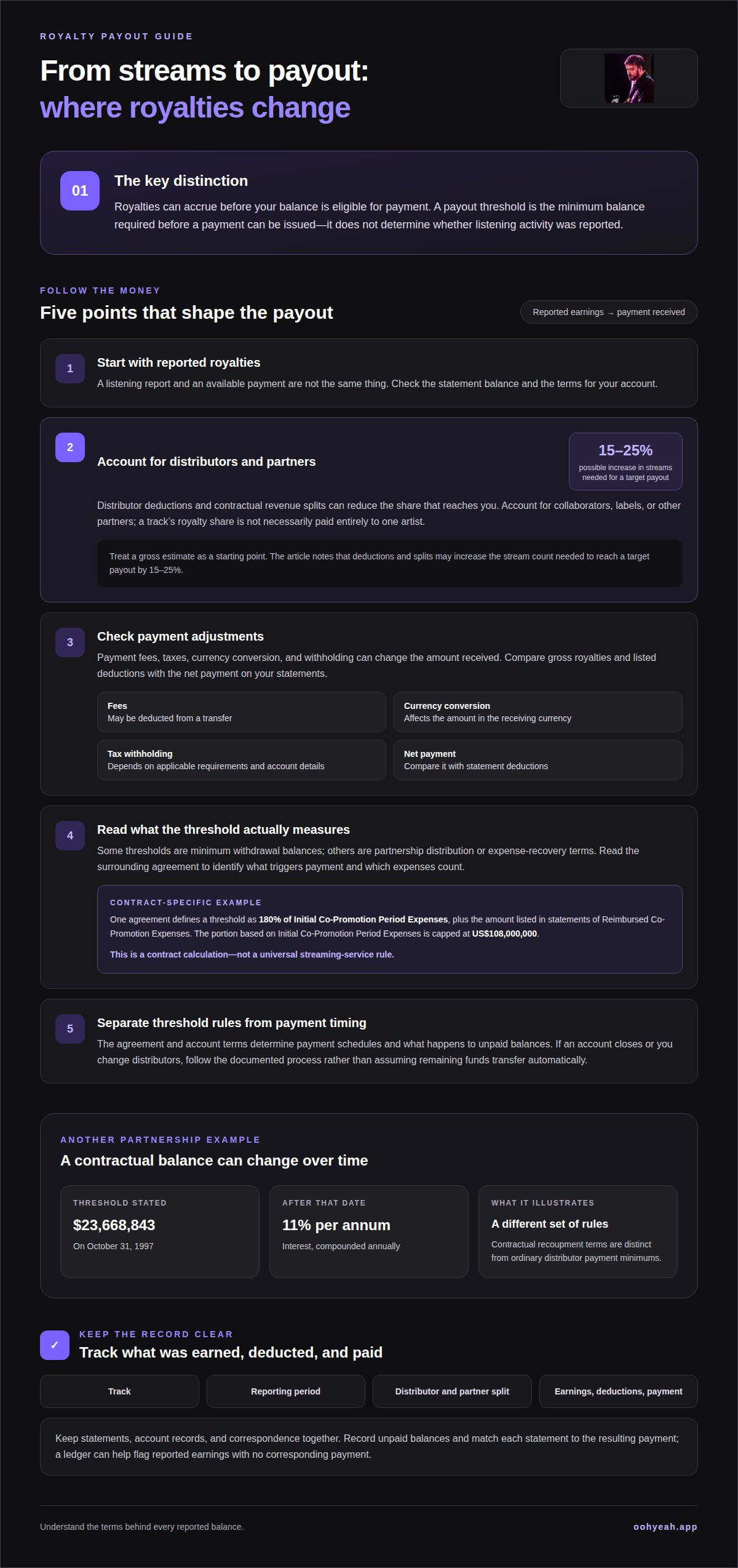
Streaming revenue can be divided before it reaches an artist. Distributor deductions and contractual splits mean the stream count needed to reach a target payout may rise by 15-25%. Treat any gross estimate as a starting point, then account for the shares assigned to collaborators, labels, or other partners. A track earning revenue for several parties does not send its entire royalty share to one artist.
Partnership agreements can also define a threshold through expenses, not streams. One contract defines its payout threshold as 180% of Initial Co-Promotion Period Expenses, plus the amount listed in statements of Reimbursed Co-Promotion Expenses. The portion based on Initial Co-Promotion Period Expenses is capped at US$108,000,000. Those terms describe a contract-specific calculation, not a universal streaming-service rule. The agreement’s wording determines what expenses enter the calculation.
A separate partnership example set a payout threshold at $23,668,843 on October 31, 1997. After October 31, 1997, that threshold accrues interest at 11% per annum, compounded annually. This illustrates how a contractual balance can change over time, even without a new stream count. Artists should distinguish such recoupment terms from ordinary distributor payment minimums. Both can delay money, but they work through different rules.
Payment fees, taxes, currency conversion, and withholding can reduce or change the amount you receive. A transfer may include a payment-fee deduction; conversion affects the amount in the receiving currency; and tax withholding depends on applicable requirements and account details. Compare reported gross royalties and deductions with the net payment shown on your statements.
If an account closes or you change distributors, the applicable agreement and account terms govern any unpaid balance. The closing or transfer process can affect how a balance is claimed or paid. Keep statements, account records, and correspondence, and follow the documented process for remaining funds rather than assuming they transfer automatically.
Track fractional royalties in a ledger organized by track, reporting period, distributor, and partner split. Match the earnings and deductions on each statement to the resulting payment, then record any unpaid balance. A spreadsheet, for example, can flag a track with reported earnings but no corresponding payment. Keeping records together makes discrepancies easier to spot and gives you a clear basis for claiming royalties through the relevant account process.
Consequences of artificial streaming
Artificial streams imitate audience demand without genuine listening. Examples include automated plays, paid services promising streams, and coordinated playback loops. They can inflate reported activity without building a real fanbase. A play count alone doesn’t show whether listeners discovered your music, stayed for another track, or chose to support you.
Streaming platforms and distributors may review activity that appears manipulated. Their response depends on their rules and the patterns they identify. Artificial plays may be excluded from royalty calculations, and suspected activity can put related earnings or account access at risk. There’s no shortcut around the core issue: these plays don’t represent genuine listener interest.
If you’re trying to bypass payout thresholds, be wary of services promising guaranteed streams, rapid growth, or a specific payout. A provider that asks for your account credentials or obscures how it generates plays adds risk. Before agreeing to a campaign, look for a clear explanation of its audience and methods. Avoid tactics involving bots, repeated playback, or incentives that distort genuine listening.
When a report looks unusual, compare the track’s stream activity with listener engagement and campaign dates. Save statements and campaign records, then contact the relevant distributor through its usual support process if the figures don’t align. For example, a sudden rise in plays without a corresponding response from listeners merits a closer look. Keep your explanation factual, and don’t try to conceal or reproduce the activity.
Protect the value of real fan relationships instead. Share music with people who choose to listen, and invite them to explore direct ways to support artists through genuine purchases or exclusive experiences. Authentic support can create more than a stream count: it can build repeat listening, meaningful engagement, and a community around your work. Artificial activity can’t replace those connections, and it can put earned revenue at risk.
Payout threshold definitions
A payout threshold is the minimum balance required before a payment can be issued. If you’re looking for ways to escape fractional streaming payout thresholds, first separate royalty accrual from payment eligibility. A track can generate earnings even when the account balance is too low for a transfer. The threshold determines when money can be paid, not whether listening activity was reported.
There’s no single minimum amount that applies to every artist across streaming platforms. The threshold depends on the payment arrangement and account terms, including whether a distributor collects royalties first. Find the threshold in the terms for your account and compare it with your statement balance. A listening report doesn’t necessarily mean funds are ready to withdraw.
Some agreements use “payout threshold” to describe something else, such as when partnership distributions begin. That’s different from a minimum withdrawal balance. Read the surrounding contract language to see whether the threshold concerns payment processing, expense recovery, or both. The label alone may not tell you what triggers a payment.
In the United States, whether a small balance is held, paid after account closure, or treated as forfeited depends on the governing agreement and applicable law. Read the terms covering termination, unpaid royalties, and claims. Keep a copy of the agreement and final statement so you can identify the documented process for any remaining balance.
A focused review can make the next step clearer:
- Find the payment threshold and identify the account terms that set it.
- Compare the balance with deductions or shares assigned to partners.
- Check whether the statement labels funds accrued, payable, or pending.
- For a closed account, follow the agreement’s process for unpaid funds.
A royalty statement can show earnings even while the payment balance is still accumulating. Record balances by account and statement period to distinguish a payment minimum from another contract condition. To escape fractional streaming payout thresholds, first identify which rule applies, then track how each statement changes your payable balance.
Threshold-based payment timing
Streaming activity and payment timing are separate stages. A service first reports eligible listening, then royalties move through its payment process. A distributor may receive those earnings before paying the artist. Each step can add time, so the statement period and deposit date don’t necessarily match.
Spotify’s 2024 threshold example illustrates how eligibility can accumulate across reporting periods. Under that rule, only streams above the stated threshold generate royalties. The important distinction is between activity that counts toward eligibility and money currently available for payment. A reported play does not automatically mean an immediate deposit.
You can change a platform’s threshold or payment schedule only if its rules allow it. A distributor may offer separate account settings, but its terms govern those options. Before changing payment details, distinguish platform rules from distributor settings.
Use each statement to trace the timing. Note the listening period, when earnings appear, any balance carried forward, and the payment date. If the balance changes without a deposit, compare the statement with the applicable threshold and payment terms. This can show whether earnings are still accumulating or have entered the payment process.
- Keep statements organized by service and reporting period.
- Record when reported royalties become payable under the relevant terms.
- Separate processing delays from balances that have not reached a threshold.
- Review account settings when a distributor permits payment preferences.
For example, a royalty statement can show earnings for one period while the available balance remains below its payment minimum. Later earnings may add to that balance, while the transfer follows a separate schedule. Don’t confuse a delayed deposit with missing listening data. If you want another way to engage supporters beyond streaming, offer exclusive content access as part of your artist-fan relationship.
OohYeah!
OohYeah! gives artists more ways to build direct support alongside streaming royalties. Use Artist Profile Hosting to create a place for fans to connect with your work, then offer Digital Music Downloads, merchandise, or Exclusive Content Access. These options let supporters choose how they engage, rather than relying on streams alone.
OohYeah! enables artists to retain 100% of sales revenue from music and merchandise. It doesn’t change a streaming platform’s payout threshold or payment schedule. Instead, it adds direct-to-fan opportunities that can complement streaming income and help you cultivate a closer audience relationship.
To build beyond streaming payouts, explore OohYeah! and create more ways for fans to connect with and support your music.
Build a stronger plan for your music income
Escaping fractional streaming payout thresholds isn’t about chasing a shortcut. It’s about making deliberate choices about how you release music, understand your income, and invite listeners to support your work. Shape a plan around your goals, not just your stream count.
Start with one practical step: decide how you want to strengthen your connection with fans beyond listening. A clear artist presence and meaningful ways to engage can make that relationship part of your long-term approach to earning from music.
When you’re ready to explore your options, contact OohYeah! about your streaming payouts. Keep building on your own terms, one thoughtful decision at a time.
Frequently Asked Questions
What are fractional streaming payout thresholds?
Payout thresholds are minimum payment balances that can leave small royalty amounts waiting to be paid. A stream may generate only a small share of revenue for an artist, especially when rights or earnings are divided. The threshold applies to the payment balance, not necessarily to whether a stream has been counted. A statement, for example, can show earned royalties while the payable balance remains below the required minimum.
How do fractional royalties or earnings count toward a streaming payout threshold?
Fractional earnings add to the balance according to the account’s reporting and payment terms. If a track’s royalties are shared, only the artist’s allocated portion contributes to that artist’s balance. Collaborators with different shares, for example, may see different amounts credited from the same track. Review statements across reporting periods to see what was credited, allocated to others, or carried forward.
When do streaming platforms pay out balances that are below the minimum threshold?
With an accumulating minimum-balance arrangement, a balance below the threshold waits until later eligible earnings bring it to the payment minimum. The platform, distributor, and account terms determine how that balance is handled and when payment can be issued. Check the payment status on your statements and distinguish an amount still accumulating from funds marked payable. Don’t infer a specific payment date from the listening period alone.