Selling Soundboard Concert Recordings Directly to Attendees
Learn how selling soundboard concert recordings directly to attendees boosts post-show revenue. Clear rights, prep live audio, and sell directly to fans now!

September 26, 2026
FRANKLY with Frank Lee
What if the encore could keep earning after the crowd heads home? Selling soundboard concert recordings directly to attendees can give fans a lasting piece of the show and help artists earn from a connection they’ve already built. But a board mix isn’t automatically ready to sell, and recording or releasing a performance without the right permissions can create serious problems. The opportunity starts with clearing the rights and preparing the release.
If you’re wondering how to offer a recording to the people who were there, start with permission, not the download page. Confirm consent and song rights, review and prepare the audio, then make the recording easy for attendees to find and access. An artist-hosted page with digital downloads can be one destination. Before committing, check its supported formats, file-size limits, checkout, and delivery details. A repeatable post-show plan helps you make the offer clear, keep control of the release, and retain sales revenue under OohYeah!’s commission-free model, while accounting separately for its recurring subscription.
Key Takeaways
- A soundboard mix captures the live show, but it may need review and preparation before it’s ready for fans.
- Selling soundboard concert recordings directly to attendees starts with confirming permissions for the performance, songs, venue, and any third-party material.
- Compare artist-hosted download pages, streaming releases, and third-party storefronts by how fans discover, access, and pay for the recording.
- Build a repeatable post-show workflow with clear responsibility for audio, release details, promotion, and attendee communication.
- OohYeah! supports artist profiles and digital downloads. Confirm technical requirements, and weigh its recurring subscription separately from its commission-free sales model.
Why Sell a Soundboard Concert Recording Directly to Attendees?
A concert ends, but the connection doesn’t have to. An authorized live recording can give attendees a way to revisit a performance and support the artist beyond the venue. Treat it as a potential release, not an automatic product. Selling soundboard concert recordings directly to attendees works best when the audio is worth sharing and fans can find a clear, artist-led offer.
A soundboard capture is audio taken from the live show mix; a polished live album has been reviewed, edited, mixed, and prepared for release. That distinction matters. The board feed is created to amplify a performance in the room, not necessarily to deliver balanced audio for listeners later.
What makes a soundboard recording different from a live album?
A feed from the mixing console can make amplified vocals and instruments prominent while capturing little of the audience, room acoustics, or natural energy of the venue. The result may sound direct, but it can also feel flat or unbalanced outside the room. A capture may contain gaps, technical issues, or other flaws, so listen to the full recording before deciding whether it’s suitable to share.
Editing, mixing, and mastering can help shape a raw capture into a more cohesive release. They may also reveal problems that need attention or make clear that the audio isn’t ready to sell. Don’t assume every board recording is clean, complete, or commercially usable.
Why give concert attendees a direct way to buy?
Attendees already have a personal connection to the performance. A recording can help them revisit a favorite moment, a distinctive setlist, or the feeling of being in the room. Offering it while the show is still fresh connects the release to a shared experience. That can be meaningful to fans, though interest and sales aren’t guaranteed.
A direct channel lets the artist continue the relationship beyond the venue. Rather than relying only on social posts, where an offer can be easy to miss, or streaming discovery, which may not highlight a specific night, an artist can present the recording as a clear, show-specific purchase. Platforms like OohYeah! help facilitate this process. The long history of bootleg recordings underscores why an authorized artist release can offer a more intentional alternative: fans can hear the performance through a channel the artist controls.
Think of direct sales as one possible revenue stream, not a dependable payout. The value is in making a thoughtful offer to the people who were there and keeping the artist-fan connection active after the final song.
Clear Rights and Prepare the Recording Before You Sell
Make clearance the first release step, not a detail to sort out after fans have paid. A soundboard recording can involve separate permissions for the performance, the music being performed, the recording itself, the venue, and any third-party material captured in the audio. The agreements that apply depend on the people involved, contract terms, and the territories where you plan to sell. This is practical guidance, not legal advice. If a right or restriction is unclear, ask a qualified music lawyer before release.
Recording permission lets you capture the performance; permission to sell confirms you can distribute that recording commercially. Don’t assume one automatically includes the other. Wait to sell until you’ve confirmed both permissions and any conditions attached to them.
Which permissions should an artist check first?
Gather the relevant agreements and identify who controls each part of the release. Review performer and band arrangements, label or recording agreements, and venue terms. If the set includes cover songs, check the composition rights and what permission is needed for a downloadable recording. Get clarity on guest performers and identifiable third-party material, such as spoken introductions or walk-on music. A venue’s permission to host a live performance may not cover selling a recording of it. Requirements vary by jurisdiction and contract, so get qualified advice when the scope isn’t clear.
Write down what you’ve confirmed, who granted permission, and which uses or territories the agreement covers. That record helps your team avoid relying on assumptions when preparing the release.
How do you make a board mix release-ready?
Listen to the complete capture, not just a short sample. Check for missing room ambience, uneven vocal or instrument levels, clipping, gaps, and distracting crowd noise. A clean signal from the mixing desk can still feel unlike the show in the room or reveal problems that weren’t obvious during the performance.
A qualified audio engineer can assess whether the recording needs editing, mixing, or mastering, and whether those changes can improve the listening experience. Don’t promise a particular sound quality before that review. Once you know what you’ll offer, verify the sales platform’s supported audio formats, file-size limits, checkout, and download delivery. Those details shape the final files and buyer experience.
If you plan to host the release on an artist profile, explore artist profile hosting as one possible destination. Confirm current technical and platform requirements before presenting the recording for sale. A sales page can’t replace missing rights.
Compare Ways to Sell the Recording to Concert Attendees
Once the recording is cleared and ready, choose a channel that suits the release and your fans. A direct download page can make a specific show easy to offer as a keepsake. Streaming may make listening more familiar for fans, but it doesn’t guarantee they’ll discover that particular performance. A third-party storefront offers another sales destination, though its tools, fees, and terms vary.
Use this comparison to start your evaluation. Setup effort and delivery depend on the provider and how you plan to promote the release.
| Channel | Setup effort | Attendee discovery | File delivery | Revenue model |
|---|---|---|---|---|
| Artist-controlled download page | Prepare a page and release details | Artist directs fans to the offer | Check download formats and delivery | May involve a subscription, commission, or both |
| Streaming release | Prepare the release for the chosen service | Fans may need a direct link to find it | Listening through the service | Payments follow the service’s terms |
| Third-party storefront | Set up a listing and configure the sale | Depends on the storefront and your promotion | Check available delivery options | Review commissions, subscriptions, and payment terms |
Direct download page or streaming release: which fits the goal?
A download can suit fans who want to keep a copy of the night and listen offline, if the platform supports the file and delivery setup you need. Streaming offers a familiar listening environment, but availability alone doesn’t put the recording in front of the people who attended. In either case, plan how you’ll share the release with concertgoers. Neither channel guarantees reach, purchases, or a particular payout.
What should artists compare in a sales platform?
Look beyond the listing itself. Check how your artist profile presents the recording, whether downloads are supported, how buyers access files, and whether sales reporting is available. Confirm current format and file-size limits, checkout and delivery details, and any release terms before making promises to fans.
Compare the full revenue model. A commission is a share of each sale; a recurring subscription is a separate platform cost, even when the platform doesn’t charge a sales commission. OohYeah!’s model is commission-free, so artists retain 100% of sales revenue while paying a recurring subscription to use the platform. Explore artist profile and download options as you compare channels. The right fit depends on your rights, how your audience prefers to listen, and the time you can commit to each release.
Follow a Post-Show Workflow from Capture to Attendee Purchase
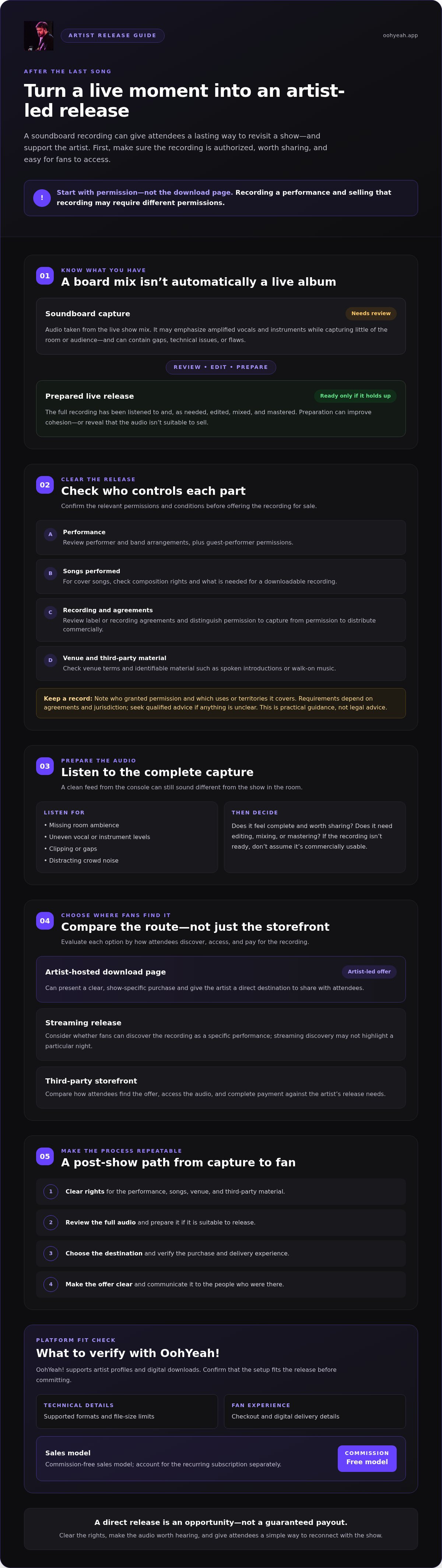
A repeatable release process keeps the show’s momentum alive without leaving key tasks to memory. Check permissions, capture the mix, assess the audio, prepare the files and release details, publish, promote, then fulfill purchases. Assign one person to own each handoff, even if a small team shares several roles. The process is easier to manage when everyone knows what they’re responsible for.
- Confirm permissions: Verify the required agreements before recording or planning a sale.
- Capture: Assign an audio lead to coordinate with the sound engineer and label the recording with the show details.
- Assess and prepare: Have the audio owner review the complete capture and coordinate any editing, mixing, or mastering. Confirm the final file meets the chosen platform’s requirements.
- Prepare the release page: Assign an owner for artwork, title, show details, credits, and the product description.
- Publish and promote: Test the page and purchase flow before sharing it. Choose someone to manage attendee communications.
- Fulfill: Confirm how buyers receive their files and who will handle questions or purchase issues.
This sequence gives the team clear checkpoints. The artist or rights lead can own permissions, the engineer can handle audio, and a designated release manager can coordinate the page and fan updates. One person may cover several roles, but make ownership explicit.
How can attendees find the recording after the show?
If the venue or event organizer approves, place a QR code on a sign, printed program, or screen that directs fans to the artist’s chosen sales destination. Test the code from a phone before the event and make the instruction easy to read. If an event QR code isn’t available, use an artist email list or social post when those channels are permitted and accessible. Keep the message direct and make sure the destination works well on mobile.
What should the release page and delivery process include?
Give fans enough information to recognize the performance: a clear title, show date and venue, artist and performer credits, suitable artwork, and an accurate description of the recording. Don’t imply it’s a polished live album if the audio hasn’t been prepared to that standard.
Before promoting the page, test the full buyer journey. Check that the recording appears as described, checkout works, and the file can be accessed as expected. Confirm delivery details, available customer support, refund terms, and data-handling practices with the platform. Verify audio formats and file-size limits before uploading or promising a specific download.
For an artist-hosted destination, explore artist profiles and digital downloads, then confirm the current requirements for your release before sharing its page with attendees.
Choose a Direct-Sales Setup That Fits Your Artist Business
The right setup should fit how often you release music, the size of your catalog, how you reach fans, and how much time you can spend managing each release. If you’re offering one recording from a single show, a simple artist-hosted download destination may be enough. If you plan to release live recordings regularly, look for a setup that can keep multiple releases organized and easy for your audience to find.
Consider how much control you want over the fan relationship, too. A page you can direct attendees to gives you a clear destination beyond the show. You’ll still need to promote it and confirm that the platform supports the file, checkout, and delivery experience you intend to offer. Selling soundboard concert recordings directly to attendees works best when the sales setup fits both your release plan and your capacity to follow through.
When might an artist profile and download marketplace fit?
An artist profile with digital downloads may suit musicians who want a hosted presence alongside direct music sales. OohYeah! supports artist profiles, digital music downloads, merchandise sales, and exclusive content access. Artists can use it to connect a live recording offer with other supported offerings, such as merchandise or exclusive material, rather than relying on a separate destination for each part of their artist business.
OohYeah! uses a commission-free sales model, so artists retain 100% of sales revenue. Artists pay a recurring subscription to use the platform. Consider both the ongoing cost and the value of the supported offerings for your business. Don’t assume concert-specific tools, QR code integrations, or particular audio formats are available. Confirm current capabilities before planning a release around them.
What should you confirm before choosing a platform?
Review the terms and test the intended workflow before publishing. Confirm:
- Subscription terms and any transaction or payment-processing conditions.
- Supported audio formats and file-size limits.
- How fans access and receive downloads after checkout.
- Whether sales reporting meets your needs.
- Whether your permissions cover the planned distribution, including the territories where you’ll make the recording available.
Choose a platform only after its terms, technical limits, and delivery process match your release. If OohYeah!’s artist profiles and direct-to-fan music sales seem relevant to your setup, explore OohYeah! for direct-to-fan music sales and review the current details before deciding.
Turn the Night’s Music Into a Thoughtful Fan Offer
A live recording can extend the connection with concertgoers, but a successful release takes more than a soundboard file. Confirm permissions for the performance and music, make sure the audio is ready to share, and choose a sales destination attendees can reach easily. A simple, repeatable follow-up plan helps fans find the recording and keeps the release organized.
Selling soundboard concert recordings directly to attendees can be one part of an artist’s direct-to-fan approach. OohYeah! supports artist profiles, digital music downloads, merchandise, and exclusive content access. Its commission-free model lets artists retain 100% of sales revenue, while a recurring subscription applies to use the platform. Check current audio, file-size, checkout, and delivery requirements before planning your release.
Ready to build a direct-to-fan music presence around your releases? Explore OohYeah! and build a direct-to-fan music presence. With the right permissions, a prepared recording, and a clear path for fans, you can turn a memorable show into another way to connect and grow on your terms.
Frequently Asked Questions
Can I sell a soundboard recording of my concert?
Possibly, but selling soundboard concert recordings directly to attendees requires confirming that you can both record the performance and commercially distribute the recording. Review agreements with performers, band members, any label, the venue, and the people involved in making the recording. Check rights to the songs as well, especially if the set includes covers. Requirements depend on territory and contract terms, so seek qualified advice if you’re unsure which permissions apply.
Do I need permission to sell a live recording of a cover song?
You may need additional permission, so don’t assume the right to perform a song also covers selling a recording of it. The relevant rights and licensing steps can depend on where you distribute the recording, how fans access it, and the agreements involved. Check current requirements for each territory where you plan to offer it, and get qualified advice if needed. Keep clear records of permissions and the terms they cover.
How do you record a concert from the soundboard?
Coordinate with the venue and live sound engineer before the show. Confirm that you’re authorized to record and that the engineer can provide an appropriate output for capture. After the performance, listen to the full recording rather than relying on a short sample. A board feed may underrepresent room ambience or have uneven levels. Ask an audio engineer to assess whether editing, mixing, or mastering is needed before presenting it as a finished release.
What is the difference between a soundboard recording and a live album?
A soundboard recording is captured from the mix used to amplify a live performance. It may be raw or lightly processed, rather than a finished product. A live album is generally prepared for release through steps such as editing, mixing, and mastering. Neither label guarantees sound quality. Listen to the complete recording, check for gaps or audio issues, and describe accurately what buyers will receive.
How can concert attendees buy a live recording after the show?
Share a clear link to the artist’s chosen sales page after the event, and explain what the recording includes. A QR code can also direct attendees to the page if the venue or organizer permits its use. Test the link or code on a phone, then check the full purchase and download experience before promoting it. Confirm that the platform supports your audio files and can deliver them as expected.
Should I sell a concert recording as a download or stream it?
Choose the format that fits your fans’ listening habits and your ability to deliver the release. A download can suit listeners who want a personal copy or offline access. Streaming may make repeat listening convenient, but it doesn’t guarantee that attendees will discover a specific show recording. Compare platform terms, audience access, supported formats, and delivery requirements before deciding. Neither option guarantees sales or a particular reach.
Can I sell concert recordings through OohYeah!?
OohYeah! supports artist profile hosting and digital music downloads, along with merchandise and exclusive content access. Its commission-free model lets artists retain 100% of sales revenue, while artists pay a recurring subscription to use the platform. Before planning a concert recording release, confirm current audio format and file-size limits, checkout and download delivery details, and any applicable platform terms. Make sure you’ve also secured the rights needed to sell the recording.
Ready to explore a direct-to-fan music presence for your releases? Explore OohYeah!