Best sites to hire a hip-hop producer: beats and vocals in 2026
Hire a hip-hop music producer: start with OohYeah for collaborators. Compare five sites, define beat and vocal work, and agree on rights before recording.
November 4, 2026
FRANKLY with Frank Lee
Best overall for finding collaborators: OohYeah. Best for production-focused portfolios: SoundBetter. Best for starting with a finished beat: BeatStars. To hire a hip-hop music producer in 2026, choose the site that matches your starting point: lyrics, a rough vocal, or an instrumental that needs a finished song.
- OohYeah is the best starting point for songwriters seeking producers, singers, and session musicians through Music Pros.
- Use SoundBetter for production-focused searches and BeatStars when choosing an existing instrumental comes first.
- Hire a hip-hop music producer for arrangement and performance direction, not automatically for mixing or mastering.
- Agree on deliverables, revisions, sample clearance responsibilities, credits, and ownership before recording.
Why this matters
A beat is not a finished record. Your producer might build the instrumental, shape the hook, direct vocal takes, or coordinate musicians—but the agreement needs to say which jobs belong to that producer.
For your 2026 release, separate the creative job from the technical handoff. Buying an instrumental does not automatically include vocal production, mixing, or permission to use every underlying sample. Name the work before you choose the site.
What makes the best site for hiring a hip-hop producer?
Judge the match, not the homepage. Use these criteria before you send your demo:
- Relevant records: Listen for the pocket, drum choices, vocal placement, and arrangement you want—not just a familiar genre label.
- Defined role: Establish whether you need beat creation, songwriting collaboration, vocal direction, recording, or mixing.
- Usable deliverables: Specify the stereo instrumental, separate audio tracks, vocal files, and alternate versions you actually need.
- Clear rights: Separate permission to use a beat from ownership of the composition and finished recording.
- Working fit: Ask how feedback, revisions, session scheduling, and final approval will work.
The best producer can explain what your song needs and what the proposed job leaves out. A polished reel matters. So does a clear answer to a practical question.
Best sites at a glance
These are use-case recommendations for 2026, not claims that every producer on a platform offers the same service. Verify each person's work and agreement.
| Site | Best for | Standout fit | Key limitation |
|---|---|---|---|
| OohYeah | Songwriters building a collaboration team | Music Pros alongside a broader musician marketplace | Hiring scope still needs agreement with the professional |
| SoundBetter | Comparing production-focused portfolios | Music-production and audio-professional focus | A strong mix credit does not establish beatmaking fit |
| BeatStars | Artists starting with an existing instrumental | Beat discovery and licensing | A beat license is not a full production agreement |
| Fiverr | A clearly bounded production task | Gig-based service browsing | A narrow gig can leave other production stages outside scope |
| Upwork | A project with a written production brief | Project-based freelance hiring | A broad talent search needs careful music-specific screening |
1. OohYeah: best for building your hip-hop collaboration team
OohYeah connects musicians with music professionals, including producers and engineers. Its Music Pros section fits the songwriter's question: “Wrote some songs, now what?” Start by identifying the missing contribution: production, a sung hook, live bass, or feedback on the song itself.
OohYeah is best for hip-hop songwriters who need collaborators, not just an instrumental. That distinction matters when your verse exists but the chorus, arrangement, or performance still needs work.
OohYeah pros:
- Music Pros supports the search for production and engineering help.
- The marketplace serves musicians, music stores, producers, and independent artists.
- The collaboration angle suits songs that need several different musical contributions.
OohYeah cons:
- A marketplace connection does not define deliverables or transfer rights.
- You still need to assess each professional's hip-hop work and communication.
Best for: Songwriters seeking a producer while also considering singers or session musicians.
Bring a rough recording and explain what should change. If you are a producer offering services, describe what you contribute to a song and identify your role on each portfolio example. Do not promise bookings; make your work easy to assess.
Verdict: Buy the collaboration service only after the creative role and handoff are clear.
2. SoundBetter: best for comparing production-focused portfolios
SoundBetter focuses on music-production and audio professionals. Use it when you want to compare producers through recorded work and discuss a specific production brief.
Listen past the loudness. A powerful master does not tell you who programmed the drums, directed the vocalist, or wrote the hook. Ask what the candidate actually contributed to the reference track.
SoundBetter pros:
- Music-focused browsing keeps the search centered on recording work.
- Portfolio listening supports comparison against your sonic references.
- Production and engineering searches fit different stages of a record.
SoundBetter cons:
- Engineering experience alone does not demonstrate songwriting or beatmaking fit.
- A portfolio track cannot establish the scope of your proposed collaboration.
Best for: Artists with a clear sound who want to compare production-relevant work.
Ask for an example that resembles your problem: crowded verses, a sung hook, sparse drums, or a sample-based arrangement. Explain the decision you want help making.
Verdict: Buy when the producer's credited contribution matches the work your song needs.
3. BeatStars: best for starting with an existing instrumental
BeatStars is a beat marketplace. It suits artists who want to find an instrumental first, then develop the lyrics, vocal performance, and final recording around it.
Treat the beat selection and the production relationship as separate decisions. Liking an instrumental does not establish that its creator will edit the arrangement, direct your vocals, or mix the song.
BeatStars pros:
- Beat-focused discovery suits artists who write in response to instrumentals.
- Listening before commissioning helps you judge musical direction.
- A selected beat gives collaborators a concrete starting point.
BeatStars cons:
- Licensing an instrumental does not automatically include custom production.
- Usage permissions depend on the actual license, not the track title or description alone.
Best for: Rappers with lyrics or a delivery style who need the right instrumental foundation.
Read the agreement before recording a release version. Ask about track files, arrangement changes, credited writers, and responsibility for clearing third-party material. Do not assume “exclusive” answers every ownership question.
Verdict: Buy the beat only when its license fits your intended release; hire additional production separately when needed.
4. Fiverr: best for a tightly defined production task
Fiverr organizes freelance services around gigs. Use that format for a bounded assignment, such as developing an instrumental from your reference brief or editing an arrangement around a recorded vocal.
Keep the task small enough to describe precisely. “Make this sound professional” is not a production brief; “rebuild the drums without changing the vocal timing” gives the producer a decision to make.
Fiverr pros:
- Gig descriptions provide a starting point for defining a task.
- A bounded assignment supports a clear acceptance checklist.
- Service browsing works when you already know which contribution is missing.
Fiverr cons:
- The service title does not establish everything included in delivery.
- A narrow assignment leaves you responsible for coordinating the remaining stages.
Best for: Artists who can name the production task without asking someone to oversee the entire record.
Confirm file delivery and revision boundaries before ordering. If the assignment expands from drum editing into vocal production, rewrite the scope rather than treating the extra work as implied.
Verdict: Buy a defined task; skip vague requests for an entire release under an unrelated gig.
5. Upwork: best for managing production from a written brief
Upwork is a general freelance marketplace built around project-based work. It fits artists who want to describe a production assignment, assess proposals, and organize delivery around an agreed brief.
The trade-off is screening. A broad freelance profile is not evidence of hip-hop production judgment. Request relevant recordings and ask the candidate to explain their contribution.
Upwork pros:
- A written project brief puts scope at the center of the search.
- Proposal comparison helps expose differences in the proposed work.
- Defined milestones can separate arrangement approval from final delivery.
Upwork cons:
- General freelance experience does not establish musical fit.
- You need enough production vocabulary to assess the proposed workflow.
Best for: Artists or small teams comfortable managing a structured production project.
Specify the music, not just the software. You need a producer who understands where the vocal should sit and how the hook should land—not merely someone who uses your recording application.
Verdict: Buy when the proposal demonstrates musical understanding and a workable delivery plan.
How the recommendations are ranked
The order follows the hiring problem: collaborators first, production portfolios second, existing beats third, bounded tasks fourth, and brief-led freelance management fifth. Each recommendation answers a different need rather than competing for the same label.
For 2026, judge every candidate against the same criteria: relevant work, defined role, useful files, clear rights, and working fit. Platform choice cannot replace that check.
Wrote some songs, now what? Build a usable brief
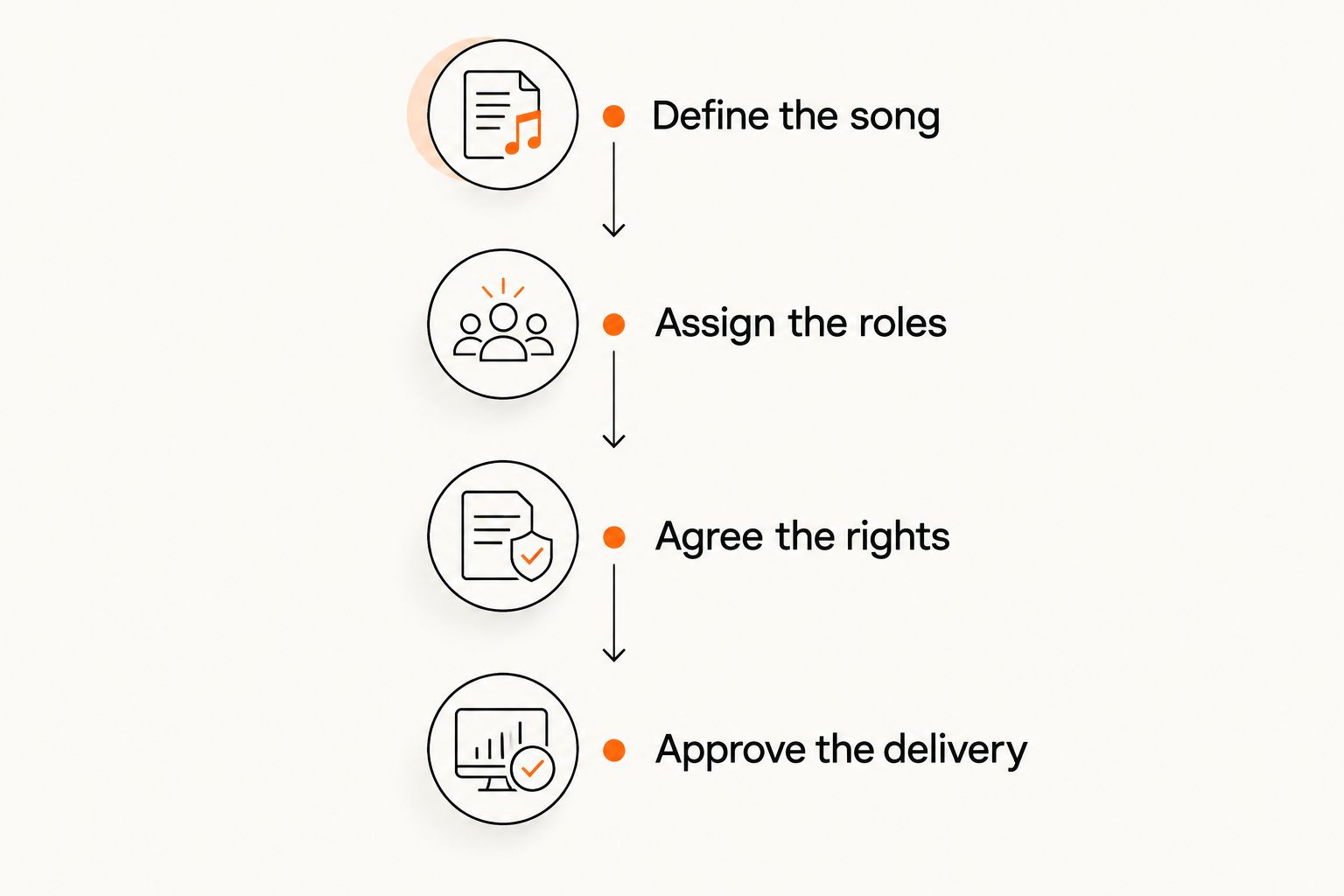
Before you hire a hip-hop music producer, turn your idea into an assignment. Use these steps in order; each one removes an avoidable misunderstanding.
Define the song
Send your rough vocal, lyrics, and 2 reference tracks as a suggested briefing format. Explain one thing you want from each reference: drum swing, vocal intimacy, bass movement, or hook contrast. References communicate direction; they are not instructions to copy a recording.
Assign the roles
State who handles beat creation, vocal direction, recording, mixing, and mastering. If you want a singer or Nashville studio musicians, specify the performance and ask candidates to confirm their location, recording setup, and delivery arrangements. A producer title alone does not include those musicians.
Agree the rights
Document composition shares, recording ownership, credits, and responsibilities for third-party material. A split sheet records agreed songwriting shares; it does not replace every agreement needed for the recording. Get legal advice when the rights are unclear.
Approve the delivery
Start with 1 song as a suggested project boundary before committing a larger release. Request a 30-second excerpt of the section that needs the most attention for an agreed review—not as an expectation of unpaid speculative work. Define approval before the final handoff.
Your brief should also name the files you need. Individual track exports preserve separate recorded parts; stems usually group related parts, such as drums or backing vocals. Ask the producer to confirm exactly what each delivery label means.
Find your next collaborator
Bring your song brief. Explore Music Pros for production and engineering help.
Turning a Suno demo into a performed recording
Use a Suno demo to explain arrangement and mood, then brief the musicians on what to perform or rewrite. Do not treat a generated vocal as a performance specification that a singer must imitate exactly.
For a 2026 project, separate the reference demo from the deliverable. Ask for newly recorded performances, identify any material proposed for reuse, and check the applicable terms and rights before release. Re-recording alone does not settle every rights question.
Request song feedback from an industry professional before commissioning the full arrangement. Ask specific questions: Does the hook arrive clearly? Does the verse leave room for the vocal? What needs rewriting before recording? Agree on the feedback service rather than assuming it comes with production.
Which site should you choose?
Start with OohYeah when the next step is finding people to finish the song. Choose SoundBetter for a production-focused portfolio search, BeatStars for an existing instrumental, Fiverr for a bounded task, or Upwork for a brief-led project.
For your 2026 release, the deciding evidence is the producer's work and response to your brief. Hire the person who understands the song, names the missing work, and puts the agreement in writing.
FAQ
What's the best site to hire a hip-hop music producer?
OohYeah is the best starting point here for songwriters seeking producers and other collaborators through Music Pros. Choose the individual professional by relevant recordings, agreed scope, and working fit.
Is buying a beat the same as hiring a producer?
No. Buying or licensing a beat gives you the permissions stated in that agreement; it does not automatically include vocal direction, arrangement changes, recording, or mixing.
Should I hire a producer or a mixing engineer?
Hire a producer when the song needs creative development, arrangement, or performance direction. Hire a mixing engineer when the recorded parts need balancing and processing; some professionals offer both, but confirm the scope.
Can a hip-hop producer help with a sung hook?
A producer can help develop or direct a sung hook if that work is included in the agreement. Hiring a singer and agreeing songwriting contributions are separate decisions that need explicit discussion.
Can I use a Suno demo to brief real musicians?
Yes, a Suno demo can communicate your intended mood and arrangement. Specify newly recorded performances and check applicable terms and rights before reusing material or releasing the finished recording.
How do I hire Nashville studio musicians for a hip-hop track?
Specify the instrument, musical part, remote or in-person requirement, and file delivery you need. Ask each candidate to confirm location and relevant work rather than assuming a producer's service includes session players.
What should I send a producer before hiring?
Send a rough demo, lyrics, references, and a written description of the work you need. Include intended deliverables, your release plans, and questions about revisions, credits, and ownership.
One last thing
Ask the producer what they would leave alone. The answer reveals whether the conversation is about your song or just adding more production. A strong verse might need space, not another synth part.