Monetizing Exclusive Content for Independent Artists
Master monetizing exclusive content for independent artists. Learn how to craft sustainable fan subscriptions, choose the best platforms, and grow your income.

September 27, 2026
FRANKLY with Frank Lee
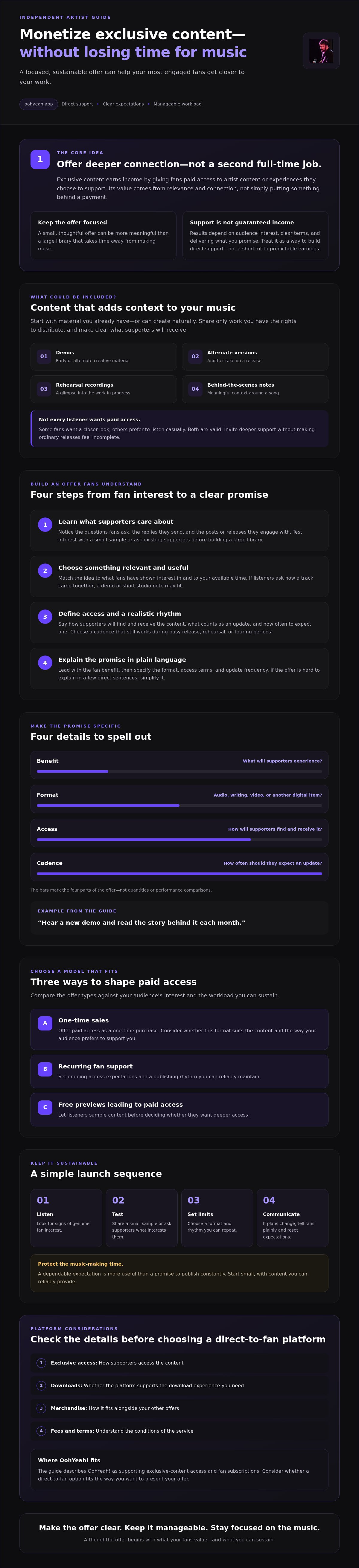
Exclusive content should deepen your connection with fans, not become a second full-time job. Monetizing exclusive content for independent artists can feel daunting when you’re unsure what supporters will value or how often you’ll need to deliver. A meaningful offer doesn’t require a constant stream of new work.
Your most engaged fans want a closer connection, but they also need to know what their support provides. Set clear expectations, choose perks you can sustain, and start with a focused offer rather than a complicated lineup. This gives fans a simple way to support your work while protecting time for the music itself.
This guide will help you choose exclusive content fans may value, shape a manageable offer, and explain it clearly. You’ll also learn what to consider when choosing a direct-to-fan platform, including how OohYeah! supports exclusive-content access and fan subscriptions. Build a closer relationship with supporters on terms that work for you.
Key Takeaways
- Choose exclusive content based on what your most engaged fans value, then test interest before building a large library.
- Make your offer easy to understand by defining what supporters get, how they access it, and how often you’ll share it.
- Compare one-time sales, recurring fan support, and free previews leading to paid access to find a model that fits your audience and workload.
- Keep monetizing exclusive content for independent artists sustainable by starting with a small offer built around content you can reliably provide.
- When evaluating a direct-to-fan platform, check how it supports exclusive access, downloads, and merchandise, as well as its fees and terms.
Monetizing exclusive content for independent artists: what it means
Exclusive content monetization is earning income by offering fans paid access to artist content or experiences they choose to support. Instead of relying only on streaming or standard releases, you give interested listeners another way to connect with your work and support it directly. This fits the direct-to-fan business model, where artists build a closer connection with their audience through direct offers.
Exclusive access isn’t automatically more valuable just because it’s behind a payment. Its value comes from relevance and connection. A fan might appreciate hearing how a song took shape or seeing another side of your creative process. You don’t need to produce a constant stream of extras. A small, thoughtful offer can be more meaningful than a large library that takes time away from making music.
Income isn’t guaranteed. It depends on whether your audience wants what you’re offering, whether the terms are clear, and whether you can deliver what you promise. Treat monetizing exclusive content for independent artists as a way to build direct support, not as a shortcut to predictable earnings.
What can count as exclusive artist content?
Exclusive content can include demos, alternate versions, rehearsal recordings, or behind-the-scenes notes that add context to a release. These are digital access offers, distinct from physical merchandise or standard music downloads. While the best choices often come from work you already have, artists looking to pair digital perks with memorable stage moments can look to show producers like Lar&Co for examples of how high-profile live entertainment experiences are crafted. Share only material you have the rights to distribute, and make clear what supporters will receive.
Why do fans support exclusive access?
Some fans value a closer look at the process, meaningful context around a song, or a direct way to support an artist whose work matters to them. Others prefer to listen casually and won’t want a paid membership. Both are valid. An exclusive offer should invite fans who want deeper access, not make other listeners feel that ordinary releases are incomplete.
Keep the promise specific. Tell supporters what the access includes and how it differs from what you already share publicly. That clarity helps fans decide whether the offer feels worthwhile and gives you a practical standard for what to deliver.
How to design an exclusive-content offer fans understand
A clear offer starts with your audience, not a content calendar. Build it in four steps: learn what supporters care about, choose something useful, define how they’ll access it, and set a publishing rhythm you can maintain. This keeps the offer grounded in real interest and makes monetizing exclusive content for independent artists more manageable.
Choose content your fans will value
Look for clues in the questions fans ask, the replies they send, and the posts or releases they engage with most. If listeners often ask how a track came together, a short studio note or demo might feel more relevant than an unrelated perk. Match each idea to your available time and creative process. Before promising ongoing access, share a small sample or ask existing supporters which option interests them.
Set boundaries and a realistic rhythm
Choose a cadence that still works during a busy release, rehearsal, or touring period. Decide what counts as an update, such as one recording, a written note, or a collection of process materials, and explain how supporters will access it. Be specific about the expected frequency. If plans change, tell fans plainly and reset expectations rather than making promises you can’t keep.
A sustainable rhythm is part of the offer’s value. You’re setting a dependable expectation, not signing up to publish constantly. Start with a format you can repeat without pulling focus from your core work.
Describe the offer in plain language
Lead with the fan benefit, then state the format, access terms, and update frequency. “Hear a new demo and read the story behind it each month” gives a clearer picture than “get exclusive access.” If you’re choosing a format, a guide to exclusive content ideas for music fans can help you compare possibilities before you commit.
- Benefit: What will supporters get to experience?
- Format: Is it audio, writing, video, or another digital item?
- Access: How will supporters find and receive it?
- Cadence: How often should they expect an update?
Write the description before you launch. If it’s hard to explain in a few direct sentences, simplify the offer. Once the plan is clear, you can explore a direct-to-fan option like OohYeah! artist profiles to present exclusive access alongside your music and merchandise. Check the platform’s current terms and features as you decide what fits.
Which exclusive-content model fits your audience and workload?
The right model depends on how your fans already engage and what you can reliably offer. One-time purchases suit a finished piece of content. Recurring fan support can build an ongoing connection, but it also calls for continued value and clear expectations. A free preview can help fans decide whether they want paid access. There’s no universal winner. Choose a format that fits both your audience’s behavior and your capacity.
| Model | Income pattern | Workload | Access model | Best fit |
|---|---|---|---|---|
| One-time content sale | Per purchase | Usually centered on preparing a standalone item | Buyers access a specific release or collection | A finished recording, alternate version, or other self-contained offer |
| Recurring fan support | Potentially recurring, based on continued support | Requires ongoing value and communication | Supporters receive access under stated terms | An audience that wants an ongoing connection and an artist who can sustain it |
| Free preview leading to paid access | Depends on whether listeners choose to buy or support | Requires a preview plus a paid offer | Listeners sample public content before choosing paid access | Testing interest before committing to a larger offer |
Match the model to the content and platform
A one-time offer can be a lower-commitment way to test a format before building a more complex setup. Recurring support asks for a reason to stay, so be transparent about what fans receive and how often. For more detail on that approach, see a guide to fan subscriptions.
Before choosing a platform, check that it supports your intended content and access arrangement. Compare the practical features you need, such as artist profile hosting, exclusive-content access, digital downloads, merchandise, and fan-payment options. Don’t pay for features you won’t use, and don’t assume every platform handles access or payments in the same way.
Compare costs clearly
Assess the economics using your own audience, expected sales, and expenses. Keep each platform cost separate so you can understand what affects your take-home revenue:
- Platform fees charged on sales, if applicable
- Recurring artist subscription charges
- Payment processing and payout terms
- Other deductions that apply to a sale
These costs aren’t interchangeable. An artist subscription fee, for example, is different from a commission deducted from each sale. Compare the subscription cost with any sales-based charges you would otherwise pay, and check which sales each fee applies to. OohYeah! describes its model as a recurring artist subscription rather than a sales commission, but review its current terms before making a comparison. Monetizing exclusive content for independent artists works best as a considered experiment, not a promise of guaranteed income.
How to launch exclusive content without overwhelming your schedule
A strong launch doesn’t need a deep content library or a complicated campaign. Start with material you’ve already created, or something practical to make alongside your regular work. The goal is to show fans what they’ll receive, explain how access works, and give interested listeners one clear next step.
Build a simple launch sequence
Prepare the essentials before you announce the offer: a short description, the first piece of content, access instructions, and a message you can share with fans. Offer a public preview, such as a short excerpt or a behind-the-scenes glimpse, so people can understand the value before deciding.
Then share the announcement through the channels where you already connect with listeners. Point them to one destination and make the next step obvious, whether that’s joining, buying, or learning more. Clear directions reduce confusion and keep the focus on the offer.
Keep supporters engaged at a sustainable pace
Once the offer is live, deliver what you promised. Use a calendar that makes room for music releases, touring, rest, and unexpected work. A lighter schedule you can maintain is more dependable than an ambitious one that quickly becomes a strain.
Invite feedback, but don’t treat every request as a reason to publish more. Look for useful patterns. If fans respond strongly to written notes but rarely engage with another format, consider refining the content rather than increasing its volume. If your schedule changes, communicate early and plainly so supporters know what to expect.
Measure effort as well as response
Review results on a regular schedule instead of reacting to every quiet post. Track signals that can help you make a decision:
- Purchases or renewals: Are supporters choosing to continue?
- Questions and feedback: Do fans understand the offer and ask for more detail?
- Content engagement: Which formats are people actually using?
- Production effort: How much time and energy does each update take?
If engagement is low, ask a few supporters what felt unclear or less useful before adding more content. Use what you learn to adjust the format, description, or cadence. This measured approach helps make monetizing exclusive content for independent artists fit your creative life. For broader strategies, explore a guide to monetizing a music fanbase.
To give fans one place to find your work and exclusive access, explore OohYeah! for artist profiles and exclusive content. Review the current platform terms before choosing how to present your offer.
How OohYeah! can support direct monetization of exclusive content
Once you’ve chosen an offer that suits your audience and workload, the next question is where to present it. OohYeah! is one direct-to-fan option. Artists can host a profile, offer exclusive-content access and digital music downloads, and list merchandise. These tools bring different ways to support your work together in one place, while the relationship with fans remains yours to build.
OohYeah! states that artists retain 100% of sales revenue while paying a recurring subscription fee for platform tools. The subscription is not a commission on each sale. Review the current subscription terms and confirm which sales the revenue statement covers. Also check the current details for exclusive-content access and optional fan subscriptions. Fan subscriptions may support recurring income, but they don’t guarantee that fans will join or continue supporting you.
What artists can offer through OohYeah!
An artist profile can bring music, merchandise, and exclusive access together, giving fans a place to explore what you offer. You might pair a standard music download with a separate exclusive item, or make your profile the destination for supporters interested in ongoing access. Keep the distinction between those offers clear. OohYeah! offers artist profiles, downloads, merchandise, exclusive content, and optional fan subscriptions. Check the platform’s current features for any additional tools you need.
Questions to check before choosing a platform
Look beyond the feature list. The right platform should support the content and access arrangement you’ve planned, and its terms should make sense for your business. Before committing, confirm:
- Subscription and sales terms: What does the artist subscription cover, and which sales are included in any revenue-retention claim?
- Content and access: What formats can you offer, and how do supporters access them?
- Payments: How do payouts work, and what terms or deductions apply?
- Fit: Does the platform match how your fans engage and how you want to manage your work?
Start with one manageable offer
You don’t need a complex setup to begin. Choose one clear offer and prepare a first release you can deliver confidently. A platform can provide useful infrastructure, but it can’t replace communication and trust with your audience. Explain the offer through your own channels, listen to supporters, and adjust based on what you learn. That’s a practical way to approach monetizing exclusive content for independent artists without expecting technology to do the relationship-building for you.
Explore OohYeah! and review its current features and terms to see whether it fits your offer.
Build a direct-to-fan offer that works for you
Monetizing exclusive content for independent artists doesn’t mean creating more than you can sustain. Start with content your fans value, explain exactly what they’ll receive, and choose a format and schedule that fit your creative workload. Test the offer with existing supporters, then use their questions and engagement to make thoughtful adjustments.
The right platform should support your offer without replacing the connection you’re building with fans. OohYeah! artist profiles can bring music downloads, merchandise, and exclusive access together. OohYeah! states that artists retain 100% of sales revenue while paying a recurring artist subscription fee. Review the current terms to confirm which sales are covered and whether the platform fits your needs.
Ready to assess it for yourself? Explore OohYeah! and see whether it fits your direct-to-fan offer. Build your first offer at a pace that leaves room for the music.
Frequently Asked Questions
What exclusive content can independent artists sell to fans?
Independent artists can offer digital content that gives fans a closer look at their music and creative process. Examples include demos, alternate versions, rehearsal recordings, and behind-the-scenes notes. An artist might sell one finished collection or provide access to selected content through a fan subscription. Keep the offer distinct from standard downloads or merchandise, and only share material you have the rights to distribute.
How do independent artists make money from exclusive content?
Artists can earn by selling access to a specific piece of content, offering optional recurring fan support, or sharing a public preview that leads interested listeners to a paid offer. Monetizing exclusive content for independent artists works best when the offer is clear and fits what supporters value. Income isn’t guaranteed, so test interest, explain what fans receive, and account for platform terms and other costs.
Do fans actually pay for exclusive content from independent artists?
Some fans choose to pay for closer access, meaningful context, or a direct way to support an artist they care about. That doesn’t mean every listener wants a membership or paid content. Start by asking existing supporters what interests them, or share a preview and invite feedback. Treat responses as useful signals, not a promise of future sales, and make the offer valuable on its own terms.
How often should artists post exclusive content?
Post on a schedule you can maintain alongside your music and other commitments. There’s no cadence that suits every artist. You might offer a regular update or set a less frequent schedule, as long as you state it clearly and deliver what you promise. Leave room for busy release periods and unexpected work. If the schedule changes, tell supporters plainly and reset their expectations.
Can independent artists monetize exclusive content without a large fanbase?
Yes. A large audience isn’t a requirement for testing a direct offer, though a smaller audience also doesn’t guarantee purchases. Start with the supporters who already engage with your work. Ask what they’d value, then try one focused offer before investing in a large content library. A direct relationship can help you learn what resonates, while clear expectations make it easier for fans to decide whether to support.
Should artists use one-time sales or fan subscriptions for exclusive content?
Choose based on the content you have and the ongoing value you can provide. One-time sales can suit a finished release or standalone collection. Fan subscriptions may fit an ongoing relationship, but they require continued value and transparent expectations. You can test a one-time offer or public preview before committing to recurring access. Consider your audience’s behavior, production time, and platform terms rather than assuming one model is best.
How can artists avoid a content treadmill with paid memberships?
Set boundaries before inviting fans to join. Define what counts as an update, choose a realistic publishing rhythm, and avoid promising more than you can sustain. Build the first offer around existing material or content that fits naturally into your creative process. Review supporter feedback and engagement, but don’t respond to every request by increasing output. Refine the format or cadence while protecting time for your core work.
Does OohYeah! charge commission on artists' exclusive-content sales?
OohYeah! describes its model as a recurring artist subscription fee rather than a commission on each sale, and states that artists retain 100% of sales revenue. The subscription fee pays for platform tools, so it’s a separate cost from any sales deductions. Check OohYeah!’s current subscription terms and confirm which sales the revenue statement covers before deciding whether the model fits your offer.