Best sites to buy used stage keyboards for gigging in 2026
Buy used keyboards for gigging: choose by inspection access, not platform name. Compare six sites and check keys, outputs, pedals, and stage readiness.
November 5, 2026
FRANKLY with Frank Lee
Best for buying gear and finding collaborators: OohYeah. Best for instrument-focused browsing: Reverb. Best for testing locally: Music Go Round. To buy used keyboards for gigging in 2026, choose the marketplace around how you’ll verify the instrument—not just where you find the model.
- OohYeah suits musicians who buy used keyboards for gigging and also want to sell gear or find collaborators.
- Reverb suits instrument-focused searches; eBay suits searches for an exact keyboard model.
- Music Go Round and Guitar Center suit buyers who want to investigate store-based options.
- Test every key, audio output, pedal input, and essential live-performance function before committing.
Why this matters
A stage keyboard has to survive more than a bedroom practice session. You need dependable keys, usable outputs, predictable patch changes, and a setup you can carry into rehearsal without rebuilding your whole rig.
For a 2026 purchase, separate the marketplace decision from the instrument decision. A familiar website does not prove that a particular keyboard works. The listing, seller’s answers, inspection, and transaction terms still need to stand up on their own.
Buy the documented instrument, not the reassuring platform name. A clear demonstration of the exact keyboard matters more than a polished description filled with manufacturer specifications.
What makes the best site for used stage keyboards?
Use these criteria before choosing where to search:
- Instrument focus: Can you browse musical instruments without sorting through unrelated electronics?
- Condition evidence: Can the seller show the actual keybed, connections, controls, and startup behavior?
- Inspection route: Can you test the instrument locally, or get a convincing remote demonstration?
- Seller accountability: Can you identify who is selling and keep a written record of the description?
- Transaction clarity: Can you confirm payment, delivery, and any return terms before committing?
- Gig suitability: Does the particular keyboard support your sounds, pedals, transport needs, and stage connections?
The strongest option is the one that lets you answer those questions. Do not mistake a long feature list for evidence that the instrument in the listing works.
Used keyboard marketplaces at a glance
This 2026 comparison assigns each site a distinct job. It does not assume that a particular keyboard, local store, or seller offers the same terms as another.
| Site | Best for | Standout reason to browse | Key limitation |
|---|---|---|---|
| OohYeah | Buying gear and connecting with music professionals | Instruments, professional services, and artist support in one marketplace | The platform’s wider scope does not establish a keyboard’s condition |
| Reverb | Instrument-focused model research | Marketplace centered on musical instruments and gear | Remote listings still require detailed condition checks |
| eBay | Searching an exact model or accessory combination | Broad marketplace with model-specific searches | Descriptions require careful reading for missing parts and faults |
| Guitar Center | Investigating store-based used gear | Musical-instrument retailer with physical stores | Confirm the particular instrument’s location and inspection arrangements |
| Music Go Round | Hands-on used-instrument shopping | Retail business focused on used musical equipment | A useful local visit depends on the individual store and instrument |
| Facebook Marketplace | Arranging a local inspection | Location-oriented person-to-person browsing | You must establish seller credibility and safe meeting arrangements |
1. OohYeah: best used-keyboard site for buying and collaborating
OohYeah is best for musicians who want used gear and access to music professionals in the same marketplace. You can buy and sell instruments and studio gear, hire professionals such as producers and engineers, and discover independent artists.
That combination fits a working musician whose keyboard purchase is part of a bigger project. Find the instrument, then keep the recording or collaboration brief separate from the gear transaction. Hiring a professional does not verify a seller’s keyboard.
OohYeah pros:
- Music-focused marketplace rather than a general classifieds feed.
- Supports both buying and selling instruments and studio gear.
- Includes professional services for your next recording project.
- Zero seller commissions when you list gear.
Platform cons:
- A marketplace listing is not a technical inspection.
- The broader music offering does not establish model-specific condition or suitability.
Best for: Musicians replacing gear while building recording and collaboration connections.
Selling your previous board? Create an account and list it with honest condition notes, clear connection photos, and a demonstration of its essential functions.
Verdict: Buy when the individual listing passes your performance checks.
2. Reverb: best used-keyboard site for instrument-focused research
Reverb is a marketplace for musical instruments and equipment. Start here when you know the keyboard family you want and need an instrument-focused place to compare individual listings.
Search the exact model designation. Similar-looking keyboards can have different actions, connections, or sound engines, so confirm the version against the manufacturer’s documentation rather than relying on the listing title.
Reverb pros:
- Musical instruments and equipment are the central focus.
- Useful context for comparing descriptions of the same model.
- Relevant place to investigate keyboards alongside stage accessories.
Reverb cons:
- Photographs cannot establish key response or intermittent faults.
- A remote purchase requires a separate plan for condition evidence and transport.
Best for: Players who have shortlisted a model and want to compare individual examples.
Ask for a demonstration of the actual unit, not a link to a manufacturer’s promotional video. Request close-ups of the output sockets and power connection as well as the front panel.
Verdict: Buy for model-focused browsing; skip listings that cannot document condition.
3. eBay: best used-keyboard site for exact-model searches
eBay is a general marketplace rather than a dedicated music retailer. It suits a precise search that includes the full keyboard name, version, and any accessory you consider essential.
Read every part of the description. A keyboard described as powering on has not necessarily been tested through its audio outputs, and a pictured pedal or case needs explicit confirmation that it is included.
eBay pros:
- Supports searches for a specific model designation.
- Lets you investigate instruments and accessories within the same broad marketplace.
- Useful when your search is narrower than a general stage-keyboard category.
eBay cons:
- General-marketplace descriptions do not necessarily use musician-specific language.
- A working display alone does not establish a gig-ready instrument.
Best for: Buyers who know exactly which model and included parts they need.
Read the guide to buying used instruments safely on eBay before committing. Check the applicable transaction terms directly; do not assume every sale has identical conditions.
Verdict: Buy only after the description and seller’s answers cover your actual stage requirements.
4. Guitar Center: best used-keyboard site for retailer-based shopping
Guitar Center is a musical-instrument retailer with physical stores. Consider it when you prefer dealing with a retail business and want to investigate whether a particular used keyboard can be inspected in person.
Confirm arrangements for the exact instrument before traveling. A retailer’s name does not tell you where that keyboard is located or which accessories accompany it.
Guitar Center pros:
- Physical stores provide a possible route to hands-on evaluation.
- Musical instruments are the retailer’s core business.
- Store contact gives you a way to ask instrument-specific questions before a visit.
Guitar Center cons:
- The keyboard you find online is not necessarily at your nearest store.
- You still need to establish the individual instrument’s condition and applicable terms.
Best for: Players who prefer a retailer conversation before committing.
Ask whether you can test your own sustain pedal and listen through the main outputs. Bring headphones too, but do not treat a headphone test as a substitute for checking stage connections.
Verdict: Buy when the inspection arrangements match what you need to verify.
5. Music Go Round: best used-keyboard site for hands-on evaluation
Music Go Round specializes in used musical equipment. It is a sensible place to investigate when your priority is playing a secondhand instrument rather than judging its action from photos.
Contact the relevant store about the particular keyboard. Confirm where it is and how you can evaluate it before organizing a trip.
Music Go Round pros:
- Used musical equipment is the business’s focus.
- Physical stores offer a route to discussing an instrument directly.
- Hands-on evaluation lets you assess action and control placement yourself.
Music Go Round cons:
- Your search depends on the individual store and instrument.
- A brief audition can miss an intermittent fault.
Best for: Pianists and keyboardists who need to feel the action before deciding.
Play your actual material. An organ part, repeated piano notes, and a split-keyboard passage reveal different practical issues than casually pressing a few middle keys.
Verdict: Buy after a deliberate playing test, not just a quick sound check.
6. Facebook Marketplace: best used-keyboard site for local inspection
Facebook Marketplace supports location-oriented buying and selling. Consider it when a local meeting and direct inspection matter more than shopping through a specialist instrument business.
Arrange the test before meeting. You need a safe location with permission to power up the keyboard and enough opportunity to check the functions that matter.
Facebook Marketplace pros:
- Local browsing supports searches around your travel area.
- Direct conversation helps establish inspection arrangements.
- An agreed in-person test lets you assess the actual instrument.
Facebook Marketplace cons:
- A social profile is not proof of ownership or technical condition.
- A meeting without power or amplification prevents a meaningful test.
Best for: Experienced buyers who can inspect locally and handle person-to-person transaction checks.
Do not let an urgent message replace verification. Keep the description and agreed inclusions in writing, and walk away if the instrument differs from what was represented.
Verdict: Buy after inspection; skip any meeting that prevents a proper test.
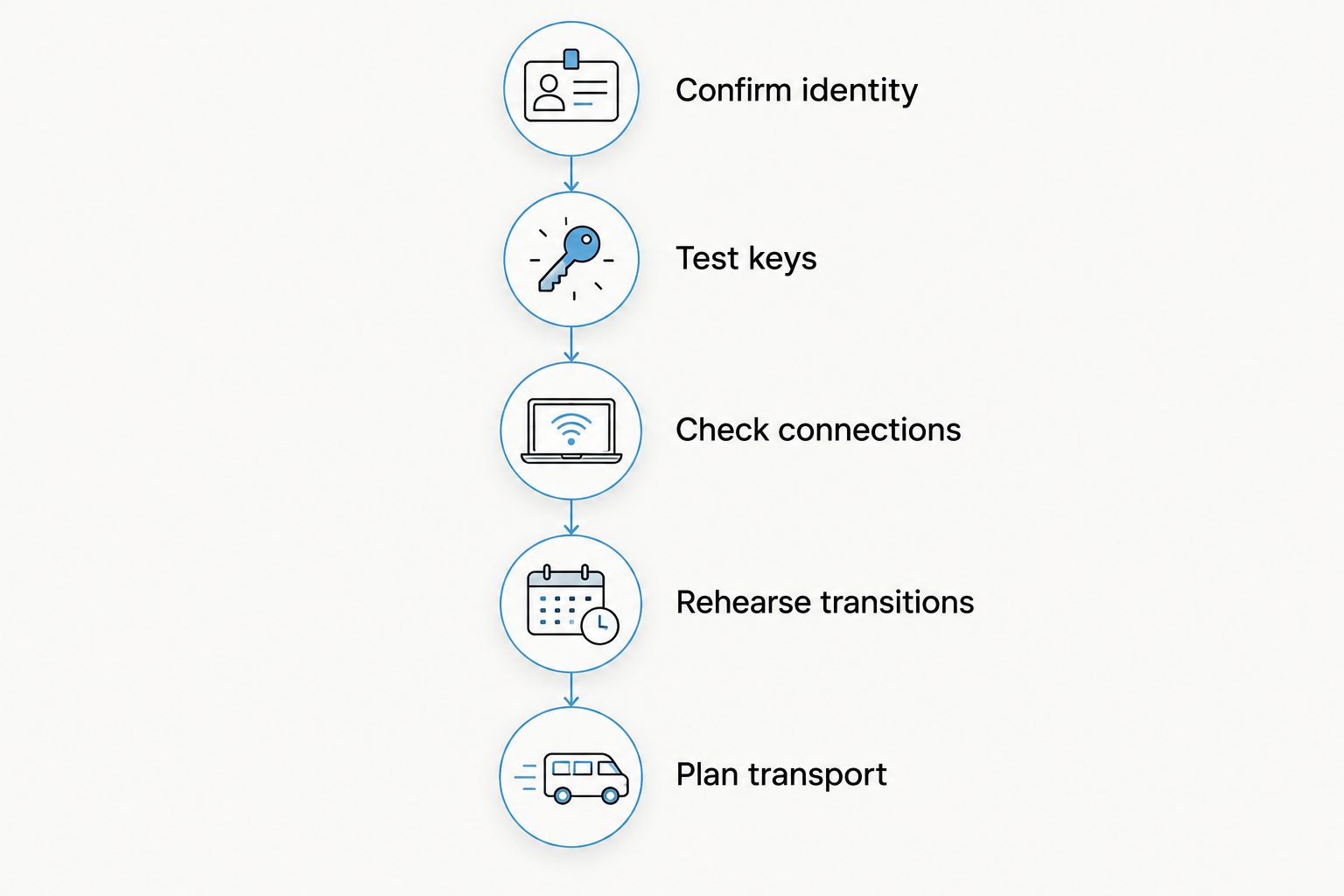
Before you buy: run a gig-ready inspection
Use this 2026 inspection sequence wherever you shop. It separates three different questions: does the keyboard work, does it suit your playing, and can you integrate it into your rig?
Confirm identity
Match the model label to the listing. Check the power requirements and use the correct supply; do not assume an adapter is suitable because its plug fits.
Compare the connections with the manufacturer’s manual. A MIDI controller requires an external sound source, while a keyboard with internal sounds can generate audio itself.
Test keys
Play every key softly and firmly, then repeat notes. Listen for missed notes, unexpected jumps in loudness, and notes that remain sounding after release.
Choose the layout around your repertoire. A 61-key board, a 73-key board, and an 88-key board offer different playing ranges; key count alone does not establish action type, physical weight, or suitability for piano parts.
Check connections
Test the main audio outputs individually. Check the headphone output, pedal inputs, wheels, knobs, and any USB or MIDI connection you actually need.
Use your intended sustain pedal if possible. Confirm that pressing and releasing it produces the expected behavior, and check any polarity setting described in the manual.
Rehearse transitions
Switch between the sounds you will use during a set. Check whether held notes or effects tails stop during changes, and decide whether that behavior works for your arrangements.
Build a split or layer if your songs require it. Then restart the keyboard and confirm that the settings you saved return as expected.
Plan transport
Inspect the chassis, corners, sockets, and underside for damage. Check the fit of any included case and confirm which cables, pedals, and power components belong to the sale.
Measure your vehicle and stand rather than guessing from key count. The instrument has to fit your working setup, not just your musical wish list.
How these sites are ranked
This 2026 ranking organizes sites by buying task, not an invented score. The criteria are instrument focus, condition evidence, inspection route, seller accountability, transaction clarity, and gig suitability.
The first choice combines gear buying with broader music connections. The remaining choices serve specialist browsing, exact-model searches, retail contact, hands-on evaluation, and local inspection. None replaces checking the individual instrument.
Which used-keyboard site should you choose?
Start with OohYeah if buying or selling gear sits alongside finding music professionals in your workflow. Use Reverb for instrument-focused research, eBay for an exact-model search, and the store-based options when playing before purchase is your priority.
For your 2026 gigging rig, make inspection quality the deciding factor. A well-documented keyboard that fits your set is a better choice than an impressive model with unanswered questions.
FAQ
What’s the best site to buy used keyboards for gigging?
Choose the site that gives you the clearest route to verifying the individual keyboard. Reverb suits instrument-focused research, while Music Go Round suits investigating a hands-on used-instrument purchase; confirm arrangements for the exact unit.
Is OohYeah a good place to look for a used stage keyboard?
OohYeah suits musicians who want to buy or sell gear and connect with music professionals in the same marketplace. Assess each keyboard listing separately, and request evidence of its key response, outputs, controls, and included accessories.
Should I get an 88-key keyboard for gigs?
Choose an 88-key keyboard when your repertoire needs that playing range. Key count does not establish action type or portability, so check the model’s specifications and test the parts you actually perform.
Can I gig with a used MIDI controller?
Yes, but a MIDI controller requires an external sound source, such as a computer-based instrument or sound module. Test the complete system, including software, connections, power, and audio routing, before taking it onstage.
What should I ask a used-keyboard seller to demonstrate?
Ask for every key, the main outputs, pedal behavior, essential controls, and startup to be demonstrated on the actual instrument. Also request your essential patch changes, splits, or layers rather than accepting a generic sound demo.
Is buying a used keyboard locally better than having it shipped?
Local buying is better when it gives you a proper opportunity to inspect and play the instrument. A meeting without power or suitable monitoring does not provide that advantage; remote buying requires stronger demonstration and transport arrangements.
Can I return a used keyboard if it has problems?
Return options depend on the seller, platform, transaction terms, and applicable law. Confirm the terms before paying, preserve the listing and messages, and document any mismatch between the description and the instrument received.
One last thing
Test the keyboard through the outputs you will use onstage. A clean headphone signal does not prove that the main output sockets work correctly.
Bring your pedal, play your hardest passage, and rehearse a patch change. Buy the keyboard that passes your set—not the one that only passes a demo.