Best places to buy used turntables: condition and returns in 2026
Buy used vinyl turntables from sellers who prove condition. Compare buying routes, inspect playback, and confirm return terms before you commit to a purchase.
November 5, 2026
FRANKLY with Frank Lee
Best overall: a local hi-fi specialist that demonstrates the turntable and confirms return terms in writing. Best for musicians buying and selling gear: OohYeah. Best for a specific model search: eBay. Best for inspecting before payment: local classifieds. To buy used vinyl turntables in 2026, choose the seller who proves condition—not the listing with the cleanest dust cover.
- Buy used vinyl turntables from sellers who demonstrate playback and confirm return terms before payment.
- Choose a local hi-fi specialist for an in-person demonstration and setup guidance.
- OohYeah is best for musicians who want a music-gear marketplace for buying and selling.
- Use eBay for a specific model search, but judge each seller and listing separately.
- Check speed, stylus condition, both audio channels, packing plans, and return responsibilities.
Why this matters
A turntable can spin and still have problems. A damaged stylus can harm records, a worn belt can affect playback, and a loose tonearm bearing can compromise tracking. A polished cabinet proves none of those parts work.
The buying decision has two separate parts: does this turntable work, and what happens if it arrives differently from the description? For your 2026 shortlist, require evidence for both. A seller's written answers matter more than a vague condition label.
What makes the best place to buy used vinyl turntables?
Judge the transaction against these criteria before comparing marketplaces:
- Playback evidence: The seller demonstrates a record playing through both audio channels, not just a rotating platter.
- Condition detail: Photos and answers identify the stylus, cartridge, tonearm, hinges, cables, and known faults.
- Return clarity: You can establish the applicable return terms, claim process, deadlines, and responsibility for shipping before payment.
- Safe handover: Collection includes a demonstration, or the seller explains a model-appropriate packing method.
- Setup fit: You know whether your amplifier needs a phono preamp and whether the cartridge suits the phono input.
- Traceable agreement: The listing, messages, payment record, and condition evidence remain available if something goes wrong.
Best buying options at a glance
These are ranked buying routes, not a claim that every seller on one platform is better than every seller elsewhere. The key limitation belongs in your decision—not in the small print after checkout.
| Buying option | Best for | Standout advantage | Key limitation |
|---|---|---|---|
| Local hi-fi specialist | First-time buyers needing a demonstration | You can ask for playback and setup checks in person | Shop status alone does not prove servicing or return rights |
| OohYeah | Musicians buying and selling within a music-gear marketplace | Instruments and studio gear share a marketplace with music services | You still need listing-specific condition and return evidence |
| eBay | Buyers searching for a particular model | Model names and numbers support focused searches | Seller descriptions and return terms require individual review |
| Local classifieds | Buyers who insist on inspecting before payment | You can arrange an inspection with a nearby seller | A private handover needs especially clear written terms |
1. Local hi-fi specialist: best for first-time turntable buyers
A local hi-fi shop is the default choice when you need someone to play the deck, explain the controls, and check its connection to your system. Ask for that demonstration before making the trip. A shop selling used equipment is not automatically a repair specialist.
Bring a familiar, clean record and your amplifier's model number. Ask the shop to show the cueing mechanism, speed selection, cartridge mounting, and both audio channels. If the deck is described as serviced, request the actual work performed rather than accepting the label.
Local hi-fi specialist pros:
- You can hear playback before committing.
- You can ask setup questions while looking at the equipment.
- You can inspect the tonearm, platter, and controls directly.
Local hi-fi specialist cons:
- A shop's service history still needs documentation.
- Do not assume every used purchase includes change-of-mind returns.
Best for: A beginner who wants help checking the complete playback chain.
Verdict: Buy when the shop demonstrates operation and records the agreed condition and return terms.
2. OohYeah: best for musicians buying and selling music gear
OohYeah is a marketplace where musicians, music stores, and producers can buy and sell instruments and studio gear. It also connects people with music professionals and independent artists. That makes it a relevant starting point for musicians who want a music-gear marketplace rather than a general classifieds site.
For any turntable listing you assess, request the exact model, cartridge identification, stylus history, playback evidence, and handover method. Do not treat a marketplace's music focus as proof that an individual deck has been serviced. Confirm the applicable transaction and return terms before paying.
OohYeah pros:
- Its stated focus includes instruments and studio gear.
- Musicians can buy gear and sell equipment through the same marketplace.
- Music professional services are part of the wider platform.
OohYeah cons:
- Marketplace positioning does not establish an individual turntable's condition.
- You must confirm transaction terms rather than assume a particular return policy.
Best for: Musicians who want a music-gear marketplace for buying and selling.
Verdict: Buy only after the seller supplies the same condition evidence you would require anywhere else.
3. eBay: best for searching by exact turntable model
Use eBay when you have narrowed the search to a particular model and know which features matter. Search the complete model designation, then read the entire description. Similar names can hide different mechanisms, cartridges, or regional electrical requirements.
Treat each listing as a separate buying decision. Check whether the photographs show the actual unit, whether operation is demonstrated, and whether accessories pictured are included. Read the current terms that apply to that transaction; do not confuse a seller's return setting with every possible route for resolving a misdescribed purchase.
eBay pros:
- Exact model searches help you keep the comparison focused.
- Listing descriptions let you compare stated condition and included parts.
- Saved listing details give you a record of what was represented.
eBay cons:
- A detailed description is not a substitute for playback evidence.
- Shipping introduces a separate packing risk that the listing must address.
Best for: A buyer who knows the desired model and can evaluate its condition requirements.
Verdict: Buy a documented example; skip listings that leave basic operating questions unanswered.
4. Local classifieds: best for inspection before payment
Local classifieds work best when the seller agrees to a proper demonstration before the handover. Arrange a suitable, safe location where the turntable can actually be tested. Meeting somewhere without a playback system defeats the main reason to buy locally.
Agree in messages what is included, what faults are known, and whether any return arrangement exists. Ask the seller to leave the deck connected until you have heard it. A promise that it worked before being disconnected is not a test.
Local classifieds pros:
- You can inspect the exact unit rather than rely entirely on photographs.
- Collection avoids parcel handling during that handover.
- You can resolve questions about accessories face to face.
Local classifieds cons:
- A convenient meeting location might not support a meaningful test.
- A private sale needs clear expectations about faults and any agreed remedy.
Best for: A confident buyer who can assess operation in person.
Verdict: Buy after a successful demonstration; skip a no-test handover unless you deliberately want a repair project.
Check condition before discussing the handover
For a used turntable purchase in 2026, separate cosmetic wear from mechanical and electrical condition. Scratched lids are visible. Intermittent channel loss and damaged stylus tips need closer attention.
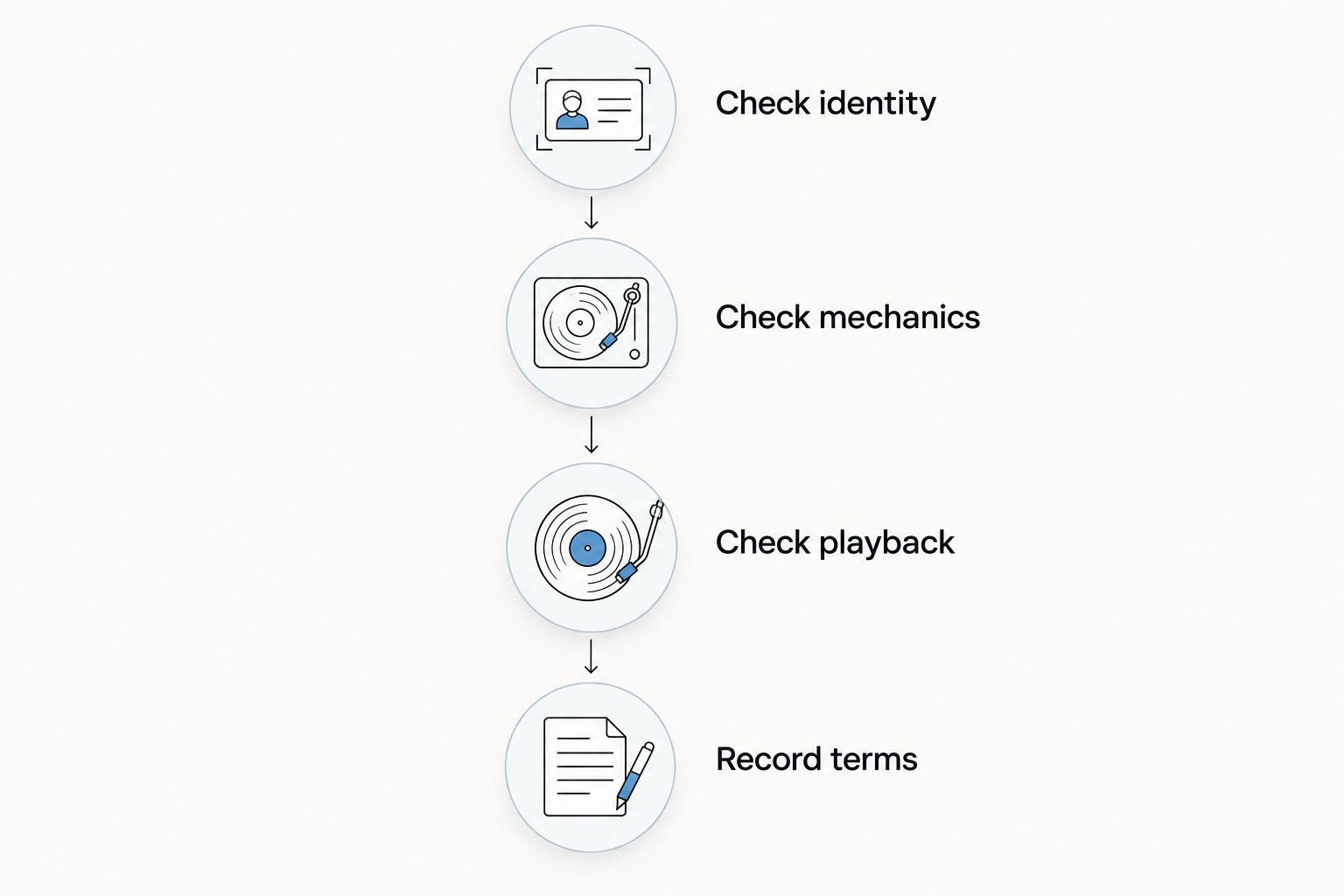
Check identity
Confirm the model label, electrical rating, cartridge, and included accessories. Ask whether the headshell, counterweight, platter mat, and power supply are present where the design requires them. Missing setup parts can prevent a useful test.
Check mechanics
Watch the platter rotate and the tonearm move through its normal operation. Check cueing, hinges, feet, and any automatic functions the model provides. Ask about looseness, sticking, scraping, or work already performed.
Check playback
Ask for playback at 33⅓ rpm and 45 rpm if the deck supports both. Listen through the left and right channels for dropouts, distortion, hum, and obvious pitch instability. A phone video helps establish operation, but its microphone cannot prove accurate speed or low noise.
For 78 rpm records, confirm compatible speed and a suitable stylus rather than assuming an ordinary LP setup fits. Record format and stylus compatibility matter separately from whether the platter turns.
Record terms
Save the description and the seller's answers before payment. Get the included items, disclosed defects, packing method, and return arrangements into the same written record. Keep the language specific enough that someone else could understand the agreement.
Returns: ask what happens in each situation
A 2026 listing needs more than the word tested. Your return questions should distinguish a change of mind from a fault, a mismatch with the description, or damage during transport. Those situations do not necessarily follow the same process.
Send the seller this checklist:
- Description mismatch: What process applies if the model, condition, or included parts differ from the listing?
- Operating fault: How should you report a fault discovered during initial setup?
- Transit damage: Who must be contacted, and what evidence must you keep?
- Return logistics: Who arranges shipping, which packing must be retained, and what deadlines apply?
- Personal preference: Is a return accepted if the deck works as described but you simply dislike it?
Do not read a universal legal answer into a seller's message. Seller status, transaction terms, marketplace rules, and applicable law all matter. Keep your evidence and follow the relevant process promptly.
For a closer look at that distinction, read the guide to returning used music gear that is not as described.
Shipping: get the packing plan before payment
Turntables contain parts that move during normal use and need securing for transport. Ask the seller to follow the manufacturer's transport instructions for the exact model. A general promise to use plenty of bubble wrap does not explain how the tonearm and platter will be protected.
Depending on the design, preparation can involve removing and separately securing the platter or counterweight, protecting the stylus, securing the tonearm, or using transport locks. These are model-dependent steps, not a universal dismantling checklist. Ask for packing photographs before dispatch.
When the parcel arrives, photograph the unopened box and unpack carefully. Retain the packaging while you inspect and test the deck. If something is wrong, document it before attempting repairs that could obscure the original condition.
How the buying routes are ranked
This 2026 ranking prioritizes a demonstrable working unit, clear condition evidence, written return terms, and a safe handover. It does not assign unsupported scores to platforms or assume every seller follows the same practices.
A local specialist takes the default slot because an arranged demonstration lets a beginner inspect and ask setup questions together. The other routes fit different needs: a music-gear community, an exact-model search, or a direct local inspection. The individual listing must still pass the checks.
Which buying route should you choose?
Choose a local hi-fi specialist if you are undecided and need setup help. Require a demonstration and written terms. If you already understand the equipment, choose the route that produces the clearest evidence for the particular deck you want.
Selling gear to make room? OohYeah states zero seller commissions. Create an account and list your gear with the model, actual photographs, known faults, included parts, and a clear handover plan. Give your buyer the evidence you would demand yourself.
FAQ
What's the best place to buy used vinyl turntables in 2026?
A local hi-fi specialist is the default choice for a first-time buyer when it provides a playback demonstration and written return terms. Experienced buyers can also assess marketplace listings, but the individual unit must pass the same condition checks.
Is OohYeah a place for musicians to buy and sell gear?
Yes. OohYeah is a marketplace for instruments and studio gear, alongside music professional services and artist discovery. Assess each seller's condition evidence and confirm transaction terms before buying.
Is eBay better than buying a turntable locally?
Choose eBay for a focused model search and a local transaction for an arranged hands-on inspection. Neither route removes the need to verify operation, included parts, and applicable return terms.
What should I ask before buying a used turntable online?
Ask for the exact model, cartridge identification, stylus history, playback evidence, known faults, and included accessories. Confirm the packing method and the process for reporting a fault or description mismatch before payment.
Can I return a used turntable if it doesn't work?
The applicable remedy depends on the transaction terms, seller status, platform rules, and law. Save the listing and messages, document the problem, and follow the relevant reporting process promptly.
Does a spinning platter mean a used turntable works?
No. A spinning platter does not establish correct speed, healthy tonearm operation, stylus condition, or output from both audio channels. Ask for actual record playback and checks of the controls.
Do I need a phono preamp for a used turntable?
You need a suitable phono stage somewhere in the playback chain. It can be built into the turntable or amplifier, or supplied by a separate phono preamp; confirm compatibility with the cartridge.
One last thing
Ask the seller to identify the stylus—not just the turntable. If its history is unknown, inspect it or have it assessed before playing records you care about. A successful demonstration proves playback at that moment; it does not establish how much useful life remains in the stylus.