
Dunning for Fan Clubs: How to Recover Failed Subscription Payments
Learn how handling subscriber payment failures and dunning for fan clubs can recover failed payments, reduce involuntary churn, and keep supporters subscribed.

November 6, 2026
FRANKLY with Frank Lee
A failed fan-club payment doesn’t have to end a membership. Dunning is the process of retrying a failed subscription payment and notifying the supporter so they can update their billing details. For fan clubs, handling subscriber payment failures through dunning can help recover payments when a temporary issue, such as insufficient funds or a network error, interrupts a renewal.
It’s frustrating when a supporter wants to stay but a charge doesn’t go through. The key is to communicate clearly and space retries over time, rather than repeatedly charging a card or treating every decline the same way. This article explains why subscription payments fail, how dunning and payment retries work, and when dedicated software may help manage recovery and reduce involuntary churn. You’ll also learn why a hard decline calls for a different response than a temporary one, and how to decide whether built-in retries are enough for your fan club.
Key Takeaways
- Learn how account updater services and payment routing can address some failures before a supporter loses access.
- Understand why hard declines and temporary payment errors call for different retry decisions.
- See how automated reminders and follow-up tasks can make payment recovery clearer and more consistent.
- Explore how OohYeah! helps artists connect with fans through exclusive content, music downloads, and merchandise.
Does dunning management reduce involuntary churn?
Yes, dunning can recover some recurring payments that fail for temporary reasons. It is most useful when supporters still want access but a billing problem interrupts their membership.
Failed Payments and Involuntary Churn
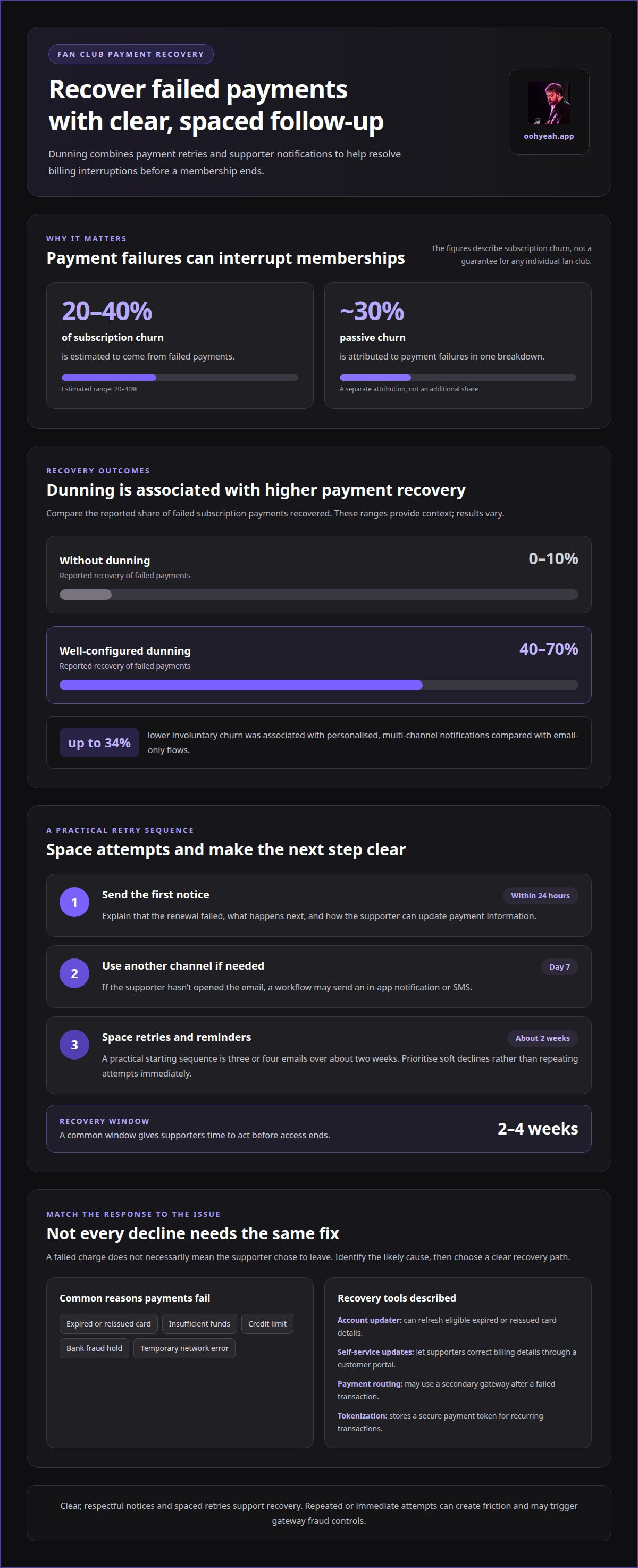
Involuntary churn happens when a supporter loses a subscription without choosing to cancel, often after a payment fails. Insufficient funds or outdated billing information can stop a renewal, even when the fan intends to stay. Failed payments account for an estimated 20-40% of subscription churn, while one breakdown attributes about 30% to passive churn from payment failures. For a fan club, that can mean a supporter unexpectedly loses access to exclusive content. The payment issue, not a decision to leave, caused the interruption.
Automated Dunning and Churn
Dunning management uses reminders and spaced retries to help recover failed payments before a membership ends. Automated messages can explain the problem and prompt a supporter to update billing information, while retries may succeed after a temporary decline clears. A recovery window commonly spans two to four weeks, giving supporters time to act instead of relying on one charge. Personalised, multi-channel notifications have been associated with up to 34% lower involuntary churn than email-only flows. The aim is timely, respectful action, not repeated pressure.
Recovery Metrics for Involuntary Churn
Recovery metrics show whether dunning is bringing supporters back into good standing. Track failed payments and recovered payments each month, then compare recovered charges with all failed charges in that period. Well-configured dunning is associated with recovery of 40-70% of failed subscription payments, while businesses without dunning may recover 0-10%. These ranges offer context, not a guarantee for an individual fan club. Also monitor how many memberships end after payment failures. Together, these figures help reveal whether retries and reminders are working or need adjustment.
Why do subscription payments fail?
Recurring fan-club charges can fail for several reasons: an expired or reissued card, insufficient funds, a credit limit, a bank fraud hold, or a temporary network error. A decline doesn’t always mean a supporter chose to leave. For example, a replaced card may remain saved for monthly billing, interrupting a renewal even though the fan still wants membership access. Handling subscriber payment failures and dunning for fan clubs starts with recognizing that difference.
Account updater services integrated with Visa and Mastercard can automatically refresh card details when a customer receives a new card. Some dunning systems use these services to update eligible expired or reissued card information. Tokenization stores a secure payment token instead of card details, allowing recurring transactions without requiring supporters to re-enter their full card number for each renewal. An updater won’t resolve every decline, but it can address certain card changes before another failed charge. This helps creators distinguish card-update issues from other billing problems.
Self-service payment updates give supporters a direct way to replace an expired card or correct billing details. A clear notification can link to a customer portal where they can update their payment method without a manual exchange with the creator. Keep the message focused: identify the failed renewal, explain the action needed, and make the update path easy to find. Handling subscriber payment failures and dunning for fan clubs works best when supporters can act without confusion or unnecessary steps.
Payment routing can also affect whether a charge succeeds. After a transaction fails, a system may route it through a secondary gateway if that gateway has a higher acceptance rate. Pair routing decisions with notifications and a spaced retry sequence instead of repeating attempts through the same route without considering the decline. For fan communities built around ongoing benefits, exclusive content access can help make the value of staying connected clear.
Is dunning software needed or are retries enough?
Built-in retries may cover simple payment failures; dedicated dunning can coordinate reminders and follow-up tasks. The right fit depends on how much payment recovery your fan club needs to manage automatically.
Automated Reminders and Collection Tasks
Dunning software can send notifications and create collection tasks when a payment fails or an invoice passes its due date. Clear payment terms from Day 1 help supporters understand recurring charges and what happens after a decline. For example, a task can prompt a team member to review an unresolved account while automated reminders ask the supporter to update their payment method. This keeps early recovery organized before later collections become relevant.
Payment Failure Notices
An automated failure notice tells the supporter what happened and how to take action. For notices sent to US supporters, use accurate billing details, explain the next retry or payment step, and provide a clear way to update payment information. Keep the message plain, respectful, and consistent with the terms shown at signup. These practices support transparent communication, but a generic email sequence alone doesn’t ensure compliance with every applicable rule.
Retry Schedules and Recovery
A retry schedule spaces attempts so a temporary decline has time to clear. A practical starting sequence is three or four emails over about two weeks, with the first message sent within 24 hours after payment failure. If the supporter hasn’t opened the email, a workflow may send an in-app notification or SMS on Day 7. Smart retries can prioritize soft declines, while account updater services may refresh eligible expired or reissued card details automatically.
Risks of Repeated Payment Retries
Repeated retries can create friction instead of recovering revenue. Retrying immediately or too often may trigger gateway fraud controls and cause a card to be blocked. Visa caps reattempts within a 30-day window, and exceeding that cap can trigger an excessive-reattempt fee. Duplicate-looking attempts can also prompt chargeback disputes or push a supporter to cancel. Stop retries for hard declines, space attempts, and send clear notifications before access changes.
Dunning and subscription payment failures
Dunning is the in-cycle process for recovering a failed subscription payment while the supporter’s membership remains active. Its purpose is to resolve billing problems early, before a missed charge becomes a lasting loss of access.
The word isn’t an acronym; it comes from an old English verb meaning to persistently ask for payment owed. For a fan club, effective dunning means more than sending emails. It connects the failed charge to a clear next action, such as updating the payment method, and gives the supporter a practical way to resolve the issue.
Dunning can begin when an automatically collected invoice fails, a renewal charge is declined, or an invoice passes its due date. It generally handles early-stage delinquency during Day 1-30. Traditional collections usually address later-stage delinquency during Day 30-90+, after the dunning process has not resolved the account. That distinction matters: a failed renewal first calls for timely billing communication, not an assumption that the supporter has deliberately stopped paying.
A useful policy sets out how long recovery lasts and how many communications go out before membership access changes or an account moves to collections. Messages should reach the person responsible for billing, explain the failed charge plainly, and make the payment-method update easy to find. Keep the tone factual and respectful. Dunning practices and permissible communication formats vary between countries, so customer notifications need to account for privacy rules in the markets where the fan club operates.
Measure success by tracking failed charges, recovered payments, and accounts that remain unresolved. Review those figures by payment method, gateway, geography, or plan to identify patterns and improve the recovery sequence. This turns dunning from a stream of reminders into a focused process for protecting recurring revenue and supporter relationships. If you’re building a fan community around ongoing benefits, offer fans exclusive content access as part of that connection.
OohYeah!
OohYeah! gives artists a direct place to build fan connections through Artist Profile Hosting, Digital Music Downloads, a Merchandise Marketplace, and Exclusive Content Access. These offerings support the value behind a fan membership: fans can discover an artist’s work and access content that strengthens their connection. OohYeah! also enables artists to retain 100% of sales revenue from music and merchandise. It doesn’t replace a dunning process, but it can support the wider relationship that makes ongoing fan support meaningful. If you’re ready to grow a direct connection with your audience, contact OohYeah! to discuss your next step.
Build a Stronger Connection With Your Fans
Handling subscriber payment failures and dunning for fan clubs is part of creating a steady membership experience, but the relationship extends beyond billing. A clear recovery process helps supporters understand what happened and how to continue. The next step is to give your fan community a meaningful reason to stay connected, even when a payment interruption needs attention.
Keep payment communication practical and respectful, then focus on the connection your club creates between releases. Fans value a direct way to follow an artist and support their work. OohYeah! helps artists build that connection through its music marketplace, where fans can discover artists, access exclusive content, and buy music and merchandise. If you’re considering how your fan club can grow alongside your music and community, explore OohYeah! as a way to connect with supporters directly.
Contact OohYeah! about fan club payments, and take the next step toward a stronger connection with your fans.
Frequently Asked Questions
What is dunning?
Dunning is the payment-recovery process that begins when a recurring charge fails or an invoice becomes overdue. It coordinates follow-up while the account is still being handled as an active subscription, rather than as a later collections case. For example, a fan club can use a reminder to prompt a supporter to correct billing details and maintain membership access.
How is smart dunning different from basic retry logic?
Smart dunning uses the reason for a decline to guide what happens next. Basic retry logic may simply attempt the same charge again, while a more tailored workflow can stop retries for hard declines and focus attempts on soft declines that may clear. It can also use payment-failure patterns to adjust timing instead of applying the same retry sequence to every fan.
How many times should you retry a failed payment before canceling?
There isn’t one retry count that suits every fan club. Space attempts across a defined recovery window, and stop retrying when a hard decline indicates the payment method won’t work. Set a separate cancellation threshold using your own membership and recovery data. That way, a temporary billing issue won’t trigger immediate cancellation, while an unresolved account won’t remain active indefinitely.
What is Dunning, and Can it Improve Customer Retention?
Dunning is a structured way to address failed subscription payments before an account is treated as cancelled. It can support retention by giving a willing supporter a clear path to resolve a billing interruption. For example, a fan who still wants access to a club’s membership benefits can respond to a payment notice and restore their subscription, rather than leaving unintentionally.
What are the best practices for handling failed recurring payments in fan clubs?
Make every notice useful: identify the failed renewal, explain the next step, and provide a simple route to update billing details. Keep communication clear and respectful, and make sure it reaches the person responsible for the payment method. Review failures by plan, geography, card type, and payment provider to spot patterns. Apply privacy requirements relevant to the markets where your fan club operates.
How many payment retries should a fan club make, and what timing works best?
Choose a spaced sequence rather than making repeated attempts close together. A typical dunning sequence may run retries over 27 days, while a simple email approach can begin with three or four messages over about two weeks. The best timing depends on the decline and when a supporter can act. Stop attempts for hard declines, and give supporters a clear update option.