Commission free music distribution platforms and what they cost
Compare commission free music distribution platforms, their fees, royalty cuts, and rights terms to find the right plan for your release and keep more control.
November 7, 2026
FRANKLY with Frank Lee
A free release can still cost you a share of your royalties. Commission free music distribution platforms let artists keep their royalties, but “free” can also mean no upfront payment in exchange for a commission. The right choice depends on the plan’s fees and terms, not just its headline price.
It’s reasonable to want your music on streaming services without giving up income or control. This guide explains how free plans differ, when a paid plan may make financial sense, and what to check in the terms covering your rights. You’ll also see how distribution compares with selling music and merchandise directly to fans. The key distinction: distribution delivers your release to platforms, while ownership and licensing terms determine what rights you keep. Understand both before you choose.
Key Takeaways
- Separate genuinely no-cost releases from plans that trade upfront fees for a share of royalties.
- Estimate whether a paid plan could make sense by weighing its cost against the royalties you expect to keep.
- Read distribution terms for the difference between granting a release license and giving up ownership of your music.
- Match a distributor’s plan and trade-offs to your release schedule, career stage, and need for direct fan sales.
Which Music Distributor Is Totally Free?
No single plan is “free” in every sense. Some charge no upfront fee but retain a share of royalties; commission-based free distributors typically keep 15% of royalties. Other plans may let you keep royalties while limiting features or releases. Compare the full trade-off, not just the signup cost.
Choose based on your release needs. A first-time artist releasing one carefully prepared single may value an option with no upfront payment. An artist with frequent releases may prefer a plan that doesn’t take an ongoing share of royalties. Before uploading, prepare your audio, artwork, release details, and rights information. Enter those details in the distributor’s upload form, select destinations, set a release date if scheduling is available, then submit the release for review.
Timing matters. A free distribution review queue may take up to 30 days. After approval, the distributor sends the release to selected music services; delivery timing depends on the distributor and destination. Build a buffer before announcing a date. Rush delivery isn’t universal, so don’t plan a campaign around it unless the selected platform offers that option.
| Option | Best fit | Cost trade-off | Timing consideration |
|---|---|---|---|
| No-upfront, royalty-share plan | Artists testing a first release | May retain a share of royalties | Review may take up to 30 days |
| Paid, commission-free plan | Artists releasing regularly | Upfront plan cost; royalties may remain with artist | Check review and delivery workflow |
| Free limited-feature plan | Artists needing basic distribution | Feature or release limits may apply | Confirm scheduling options |
| Direct-to-fan sales | Artists with an engaged audience | Sales terms differ from streaming distribution | Set up the release page before promotion |
Choose the model that fits your release frequency, audience, and comfort with royalty sharing, then allow time for review and delivery.
Free versus paid distribution break-even estimates
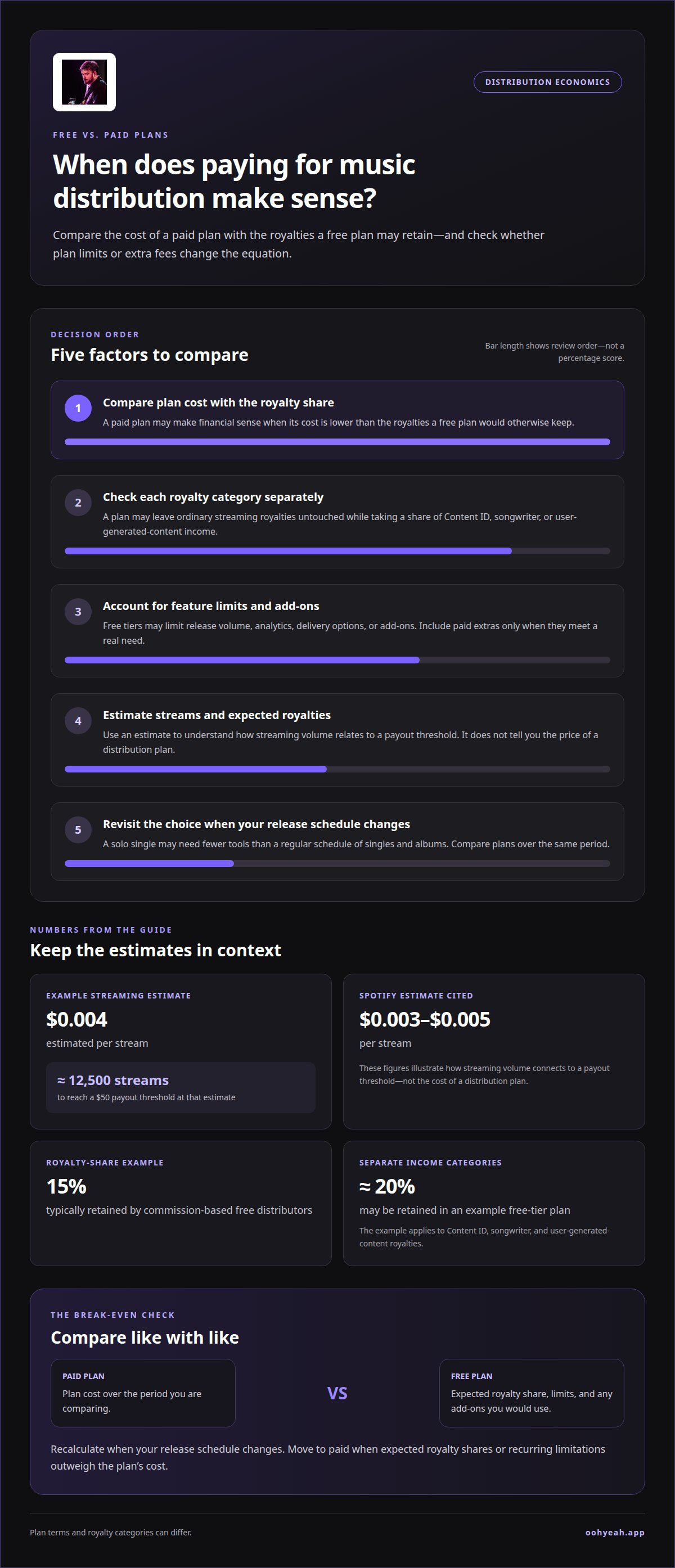
A paid plan makes financial sense when its cost is lower than the royalties you would otherwise give up. Estimate the break-even point using expected streams, royalty terms, release frequency, and plan limits.
Free-Tier Limits and Paid Add-Ons
Free tiers can limit features instead of charging an upfront plan fee. Restrictions may affect release volume, analytics, delivery options, or access to add-ons. Paid extras can change the total cost, so include them only when they meet a real need, such as managing a release campaign.
Compare the full plan, not just its headline offer. Note which features are included, which cost extra, and whether the limits suit your next release. A solo single may need fewer tools than a regular schedule of singles and albums.
Free-Plan Trade-Offs
A free plan can preserve cash while you test an audience, but it may trade convenience or features for that lower upfront cost. Some commission-free services also apply separate royalty shares to specific income types. For example, a free-tier distributor may take roughly 20% of Content ID, songwriter, and user-generated-content royalties.
That distinction matters if your earnings come from more than streaming. Compare each royalty category and add-on separately. A plan that leaves streaming royalties untouched may still take a share of other income.
For a break-even estimate, compare the paid plan’s cost with the royalty share a free plan would retain. At an estimated $0.004 per stream, reaching a $50 payout threshold requires roughly 12,500 streams. This illustrates how streaming volume connects to a payout threshold, not the price of a distribution plan. Spotify’s commonly cited estimate ranges from $0.003 to $0.005 per stream.
Move from free to paid when expected royalty shares or recurring limitations outweigh the plan’s cost. Recalculate when your release schedule changes. Include optional add-ons only if you’ll use them, and compare plans over the same period.
If streaming isn’t your only income path, direct-to-fan music downloads can give supporters another way to buy your music.
Music ownership and distribution rights
A distributor delivers recordings to services, but that role alone doesn’t determine who owns the music. Separate the sound recording, often called the master, from the underlying composition, including lyrics and melody. For a self-released track, the artist may control both, while a co-writer, producer, or label may hold a share or contractual interest.
Read the distribution agreement to understand the permission you grant. A platform may need a license to deliver, host, and promote a release through selected services. That permission differs from transferring ownership, but the wording defines its scope, duration, territories, and termination process. Check whether the license is exclusive, whether it continues after cancellation, and what happens to releases already delivered.
“Commission-free” describes a payment model, not a rights guarantee. A distributor may take no share of ordinary streaming royalties while applying separate terms to Content ID, songwriter royalties, or user-generated content. For example, a free-tier distributor may retain roughly 20% of those categories. Review each revenue stream in its own clause rather than treating one royalty rate as the whole agreement.
Before uploading, identify everyone with a claim to the release. Confirm that the artist, co-writers, producer, and any sample owners have agreed on their contributions and permissions. Keep written split agreements and sample licenses with the final audio files. If a beat license limits commercial distribution or Content ID registration, uploading without permission can create disputes even when the distributor’s plan takes no commission.
Use this agreement check before choosing a platform:
- Ownership: Does the artist retain the master and composition rights?
- License: What uses does the distributor receive, and for how long?
- Income: Which royalty categories involve a share or separate terms?
- Exit: What steps remove the release after cancellation?
Keep a copy of the accepted terms and note any later changes. A platform’s claim that artists retain ownership doesn’t replace checking its license, royalty clauses, and removal process.
Which commission-free music distributors offer free plans, and what are the trade-offs?
Free plans don’t all mean the same thing. Compare how each distributor earns revenue, which royalty categories it covers, and what features come with the plan. The clearest distinction is between a no-upfront plan with revenue-sharing terms and a paid plan designed to avoid a commission.
| Plan type | Upfront payment | Royalty trade-off | Best comparison point |
|---|---|---|---|
| Free plan with commission | None | Distributor retains a share of covered royalties | Which income streams share revenue? |
| Free plan with a royalty carveout | None | Some income categories may have separate deductions | Do terms cover streaming, songwriter, or user-generated-content royalties? |
| Paid commission-free plan | Plan payment applies | May avoid a share on covered royalties | Do included features fit your release schedule? |
A free tier can still include a revenue carveout. One free-tier distributor takes roughly 20% of Content ID, songwriter, and user-generated-content royalties. That example shows why “commission-free” needs a closer read: the label may not describe every revenue stream or add-on.
Compare plans by tracing the possible income from one release. Separate streaming royalties from songwriter income, Content ID, and user-generated content. Then note any commission, feature limit, or optional add-on tied to each category. A plan with no upfront payment may suit an artist testing a release, while a paid plan may better fit a regular schedule. The right choice depends on the terms and your expected use, not the plan name alone.
Before choosing, read the revenue terms alongside the feature list. Check the exact royalty categories, any share retained, included release tools, and charges for optional extras. Compare the same categories across plans. This makes a free offer easier to assess against a paid alternative, without treating one headline claim as the full agreement.
Want to build a direct relationship with supporters alongside streaming? Explore artist-to-fan support options.
Free tiers include plans with no upfront payment but a share of covered royalties, including a cited example that retains roughly 20% of Content ID, songwriter, and user-generated-content royalties. The trade-off is lower upfront cost in exchange for commissions or category-specific deductions, while paid commission-free plans may avoid a share on covered royalties but require payment.
OohYeah!: Digital Music Downloads
OohYeah! gives artists another way to earn through direct fan support alongside streaming distribution. Its Digital Music Downloads let supporters buy music directly, while the Merchandise Marketplace and Exclusive Content Access give artists more ways to connect with their audience.
This is a natural fit when you want to offer fans more than a stream. OohYeah! enables artists to retain 100% of sales revenue from music and merchandise. Direct sales complement distribution, but they serve a different purpose: streaming platforms deliver music to listeners, while direct offerings let fans choose to support an artist through purchases or exclusive content.
If you’re building a closer connection with your supporters, consider whether downloads, merchandise, or exclusive content suit your audience. Explore OohYeah! to see how these offerings can support your artist business.
Build a Release Plan That Fits Your Next Move
Choosing among commission free music distribution platforms is one part of building a release strategy. Your next move can also shape how fans discover, support, and stay connected with your music. Think beyond getting a track onto streaming services. Decide what kind of relationship you want listeners to have with your work.
OohYeah! offers Artist Profile Hosting, Digital Music Downloads, and a Merchandise Marketplace. These options can complement your release plans by giving fans ways to find your profile, buy music, or support you through merchandise. Choose the channels that suit your audience and the experience you want to create. Keep your goals clear, and let each release build toward a closer connection with listeners.
Ready to discuss your release and how direct fan support could fit your plans? Contact OohYeah! to discuss your release. Your music career moves forward one considered choice at a time.
Frequently Asked Questions
Can I Switch Distributors Later Without Losing My Catalog?
Yes, you can move a catalog, but plan the change carefully. Keep copies of your master recordings, artwork, release metadata, and identifiers before starting. Then follow the outgoing distributor’s removal process and the incoming distributor’s delivery steps. For example, coordinate a takedown with the replacement release to reduce the risk of duplicate store listings or a gap in availability.
Can I change or remove my music after it's published?
Usually, you submit an edit or takedown request through the distributor that delivered the release. Changes such as updated artwork or credits may need review, while removing a track requires a removal request. Stores update their listings after the distributor processes the request, so a release may not disappear everywhere at once. Keep a record of each request and its status.
How long does it take for my music to go live?
There isn’t one universal go-live timeline. A distributor’s review queue and each destination service’s processing time both affect the release date. A free review queue may take up to 30 days, so submit well before your planned announcement. Build in extra time for corrections if your audio, artwork, credits, or release details need changes during review.
Which platforms do you distribute to?
OohYeah! connects artists and fans through its music and marketplace platform. Fans can discover artist profiles, access music downloads, and engage with exclusive content there. This differs from sending a release to outside streaming services through a distributor. If your release plan needs external destinations, choose a distributor whose delivery list includes the services where you want listeners to find your music.
Which music distribution platforms charge no commission on royalties?
Some distributors advertise no commission on certain royalties, while others may retain a share of specific income categories. Read the terms for streaming, songwriter, Content ID, and user-generated content earnings separately. The phrase “commission-free” alone doesn’t establish how every category is handled. Compare the exact royalty clauses and any plan conditions before choosing among commission free music distribution platforms.
What are the current prices and subscription plans for commission-free music distributors?
Plans vary by distributor and may use recurring subscriptions, per-release charges, or free tiers with revenue-sharing terms. Costs depend on the plan; release limits, included tools, optional add-ons, and royalty terms affect the total. OohYeah! charges recurring artist subscription fees for platform access and sales tools, while artists retain all revenue from music and merchandise sales.