How to commission a custom song: briefs, budgets, and rights
Learn how to commission a custom song with a clear brief, defined budget, revision checkpoints, and written rights before you hire an artist or producer.
November 25, 2026
FRANKLY with Frank Lee
To commission a custom song, choose an artist whose work fits your idea, send a clear brief, and agree on the deliverables, payment schedule, revisions, and usage rights before recording starts. Paying for the recording does not automatically give you ownership of the composition or permission to use it commercially. Start with the song’s purpose, then hire the people who can deliver it.
- How to commission a custom song: agree on the brief, budget, revisions, and music rights before work begins.
- OohYeah connects songwriters with music professionals; use relevant samples and written terms to choose your collaborator.
- A personal gift and a commercial release need different permissions, even when the recording sounds identical.
- Approve the song before full production, and separate composition ownership from ownership of the finished recording.
Why this matters
A birthday surprise, a wedding song, and an artist’s debut single are different commissions. The brief tells the musician what to create. The agreement tells everyone what happens after delivery.
OohYeah is best for songwriters seeking music professionals alongside a music gear marketplace. You can explore OohYeah to find collaborators, but finding a musician is not the same as agreeing to a commission. Confirm the individual professional’s scope and terms directly.
For a 2026 commission, write down the intended use before requesting proposals. A private listening copy is not the same request as a song you intend to distribute, monetize, or attach to advertising.
How do you commission a custom song?
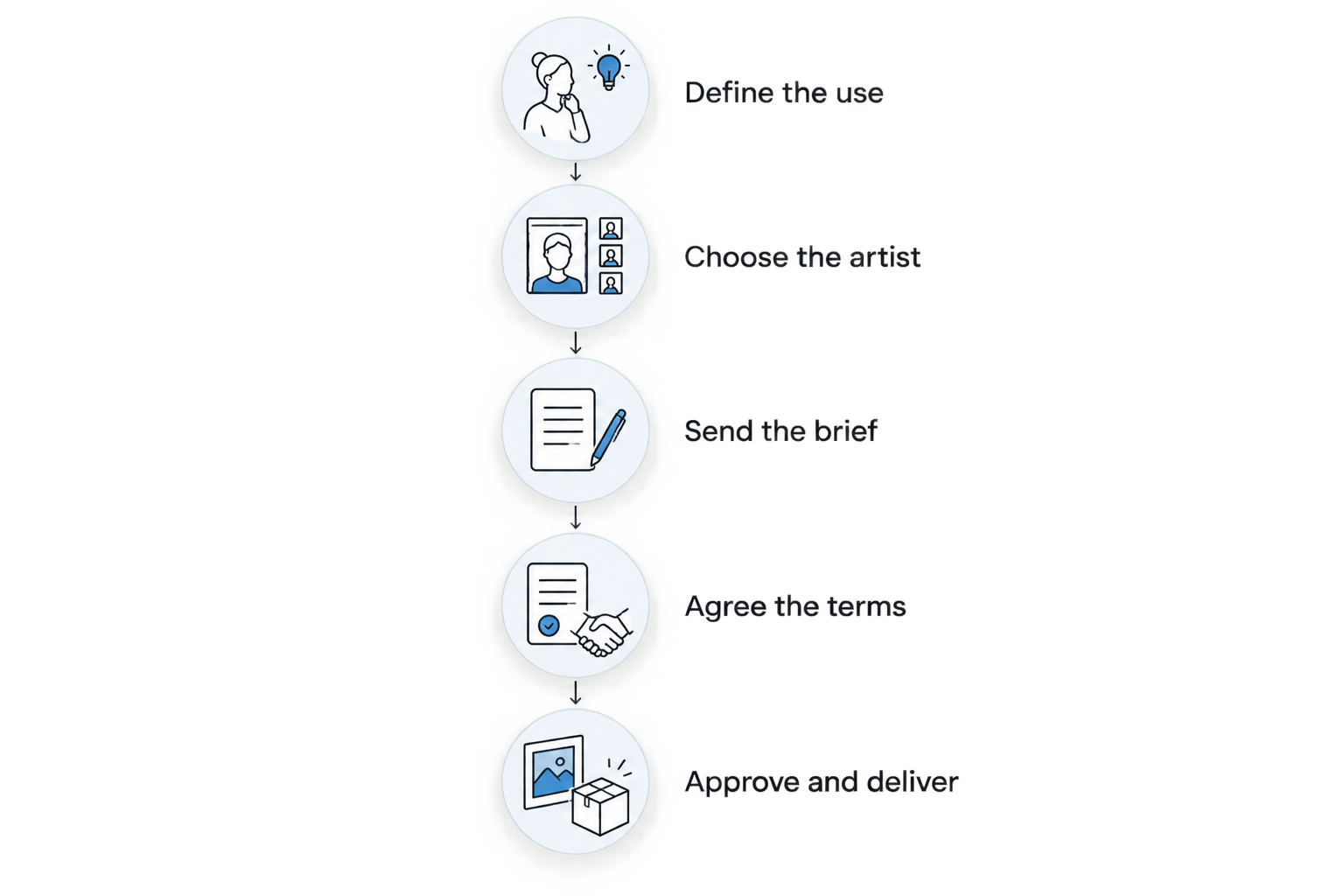
Follow this sequence. Each approval should settle a creative decision before the next stage begins.
- Define the use. Say whether the song is a personal gift, a private event recording, an artist release, or music for a business.
- Choose the artist. Listen for relevant songwriting, vocal delivery, instrumentation, and production—not just a polished portfolio.
- Send the brief. Explain the story, sound, must-have details, deadline, and files you need.
- Agree the terms. Confirm the scope, payment milestones, revisions, credits, ownership, and permissions in writing.
- Approve and deliver. Review the agreed checkpoints, then check the final files against the brief.
A vocalist does not necessarily write songs. A producer does not necessarily provide every instrument, mix, or master. Ask who handles each task and who is responsible for bringing in additional musicians.
Write a brief the musician can actually use
Keep the opening brief to a suggested 1 page. That is an editing target, not a rule: attach lyrics, pronunciation notes, or detailed production requirements separately.
Include these essentials:
- Purpose: Who is the song for, and where will it be heard?
- Story: Which people, places, memories, or ideas matter?
- Sound: What genre, mood, vocal character, and instrumentation fit?
- Boundaries: What must appear, and what should stay out?
- Delivery: What files, approvals, and deadline do you need?
- Rights: Will you listen privately, post publicly, distribute, or advertise?
For your 2026 project folder, keep the approved brief beside the agreement. If the direction changes, update both where necessary rather than relying on scattered messages.
Give references without asking for a copy
Start with 2 reference tracks as a manageable briefing choice. Identify the feature you want from each: intimate vocals, sparse piano, a driving rhythm, or a chorus that opens up.
Ask for the feeling, not another artist’s melody or lyrics. Instructions such as warmer vocal delivery or fewer instruments in the verse give a musician something concrete to act on. Use the same approach when you share reference tracks with a music producer.
Which kind of custom song should you commission?
Choose the deliverable before comparing proposals. These are project types, not standardized packages; the artist must confirm what the commission includes.
| Project type | Best for | Main advantage | Main limitation |
|---|---|---|---|
| Personal gift song | Fans commissioning a private dedication | Keeps the story and recipient central | Public or commercial use needs separate agreement |
| Songwriting demo | Writers developing lyrics, melody, or structure | Lets you judge the song before full production | Is not automatically a release-ready recording |
| Release-ready production | Artists preparing an agreed release | Brings writing, performance, and production into one project scope | Requires more coordination and explicit rights terms |
Personal gift song
Best for: a dedication built around a real person or occasion. Supply details that sound natural in a lyric: a shared place, a meaningful phrase, or the emotional point of the story.
The benefit is focus. The limitation is that personal-use permission does not automatically cover posting the song online, using it in a promotional video, or distributing it. State those plans before booking.
Songwriting demo
Best for: testing the song before committing to a finished production. A demo is a working recording that communicates the composition; define whether yours needs a guide vocal, accompaniment, or a fuller arrangement.
A stripped-back demo keeps attention on the writing. It will not necessarily include the performances, editing, mixing, mastering, or permissions needed for your eventual release.
Release-ready production
Best for: artists who know how they intend to release the finished song. Specify songwriting, arrangement, vocals, instrumental performances, editing, mixing, and mastering separately.
Mixing balances the recorded parts. Mastering prepares the final mix for its agreed delivery context. The advantage is a defined path to a finished recording; the trade-off is more approvals, contributors, and rights to document.
Wrote some songs, now what?
If you already have lyrics or a rough recording, commission the missing work—not the whole process again. A lyric sheet needs different help from a finished composition that only needs a singer.
Ask a songwriter or producer to identify the next decision. Is the chorus clear? Does the melody fit the singer? Does the arrangement support the lyric? Song feedback from an industry professional can be its own scoped service; it is not a promise of a placement, deal, or audience.
For a 2026 recording plan, use 3 approval checkpoints as a proposed starting structure: song, arrangement, final mix. Agree on the actual checkpoints with the professional before work starts.
Turning a Suno demo into a human performance
Treat a Suno demo as a creative reference, not proof that every element is cleared for release. Identify your own contributions, explain what you want rewritten or performed, and review the tool’s applicable terms before commercial use.
Ask the musicians to confirm what they will create: a new arrangement, a vocal performance, replacement instruments, or a rewritten composition. Hiring human performers does not by itself settle questions about source material or ownership.
Hiring Nashville studio musicians
If Nashville studio musicians are part of your plan, say whether you want an in-person session or remotely recorded parts. Specify the instruments, musical direction, file requirements, and who approves the performances.
Location is not a substitute for listening. Choose relevant samples and confirm who handles session coordination, additional players, and any applicable performer or union agreements.
Why custom-song budgets vary
Compare scope before comparing totals. There is no useful like-for-like comparison between a vocal-and-guitar dedication and a fully produced release with multiple contributors.
Ask each professional to identify what the proposal includes and what triggers additional work:
- Writing: Original lyrics and melody, co-writing, or recording a song you supply.
- Performers: Lead vocals, harmonies, instrumentalists, and additional takes.
- Production: Arrangement, recording, editing, mixing, and mastering.
- Revisions: Included changes, approval stages, and changes after approval.
- Deliverables: Listening files, instrumental versions, stems, or session files.
- Permissions: Personal use, distribution, video use, exclusivity, or ownership transfers.
When comparing an independent commission with a packaged service, Songlorious pricing belongs in the same scope check as deliverables and usage permissions; a quoted total alone does not establish that the offers cover equivalent work.
Set a spending ceiling privately, then ask for a written proposal you can accept without assumptions. Your 2026 budget should identify which tasks belong to the artist and which remain your responsibility, including any separate recording or release services.
For musicians offering commissions, make the exclusions just as clear as the inclusions. State whether you provide songwriting, vocals, production, or individual instrumental parts. Relevant samples help buyers judge fit; they do not guarantee bookings.
What rights should the agreement cover?
Separate the song from the recording. Under U.S. copyright law, a musical composition and a sound recording are distinct works. A commission agreement should address both rather than treating them as interchangeable.
Composition rights
The composition includes the music and lyrics. Document who contributes original writing, who owns those contributions, and any agreed songwriting shares.
Providing a personal story does not automatically make you a co-writer. Likewise, paying an invoice does not automatically transfer copyright. If ownership matters to your project, have the arrangement reviewed by a qualified music attorney before signing.
Master rights
The master is the particular recorded performance. State who owns it and what permission the commissioner receives to copy, share, distribute, monetize, or synchronize it with video.
A license grants specified permission; an assignment transfers ownership rights. Do not use those terms interchangeably. Define exclusivity, duration, territory, credits, and any restrictions that matter to your intended use.
Contributor permissions
Confirm who obtains agreements from singers, session players, producers, and co-writers. Also identify responsibility for clearing any third-party samples or other protected material.
For a 2026 release, get permissions settled before uploading—not after announcing a release date. Do not assume that calling a project work made for hire makes it qualify under U.S. law; that classification has specific legal requirements.
How do you prevent revision disputes?
Approve creative decisions in stages and give consolidated feedback. Changing the story after approving the lyrics is different from correcting a mispronounced name.
Define a revision round as a collected set of notes, then agree on the included rounds and what falls outside them. A new singer, rewritten chorus, or replacement arrangement should not be silently treated as a minor mix adjustment.
Use a practical feedback format:
- Location: Identify the section or timestamp.
- Issue: Describe what you hear or what contradicts the brief.
- Direction: Explain the desired change without prescribing unfamiliar engineering fixes.
Keep approval messages with the project files. Before accepting delivery, check names, lyrics, vocal edits, file playback, credits, and every promised version. Request technical export settings from the person receiving the files rather than guessing.
FAQ
Can fans pay an artist to write a custom song?
Yes, fans can commission a song from an artist who agrees to the project. Confirm the story, deliverables, payment terms, revisions, and intended use before work begins.
How much should I budget for a custom song?
Build your budget around an agreed scope rather than a universal rate. Ask the artist to separate songwriting, performers, production, revisions, and usage permissions in the proposal.
Do I own a custom song if I pay for it?
Payment alone does not automatically transfer copyright in a custom song. The agreement should distinguish ownership of the composition from ownership of the sound recording and specify any license or assignment.
Can I upload my commissioned song to streaming services?
You can distribute a commissioned song only when you have the necessary rights and permissions. Confirm composition rights, master rights, contributor agreements, and any third-party clearances before uploading.
Can musicians remake my Suno demo with real instruments?
You can ask musicians to perform or develop material from a Suno demo, subject to their agreement and the necessary rights. Identify what you contributed, review the applicable tool terms, and specify which parts need rewriting or recording.
Where can I look for singers and producers for my songs?
OohYeah’s Music Pros section connects songwriters with music professionals. Review relevant work and confirm whether the professional offers the writing, singing, playing, or production your commission needs.
How many revisions should a custom-song commission include?
Agree on revision rounds before booking rather than assuming a standard allowance. Define what each round covers and how changes after an approval affect the scope.
One last thing
Ask for an instrumental version before recording begins if you expect to need it. The version you love for listening is not necessarily the version you need for a live vocal, spoken dedication, or future edit.
OohYeah helps connect the music community; the brief and agreement turn that connection into a workable project. Name the use. Choose the collaborator. Set the terms. Then make the song.