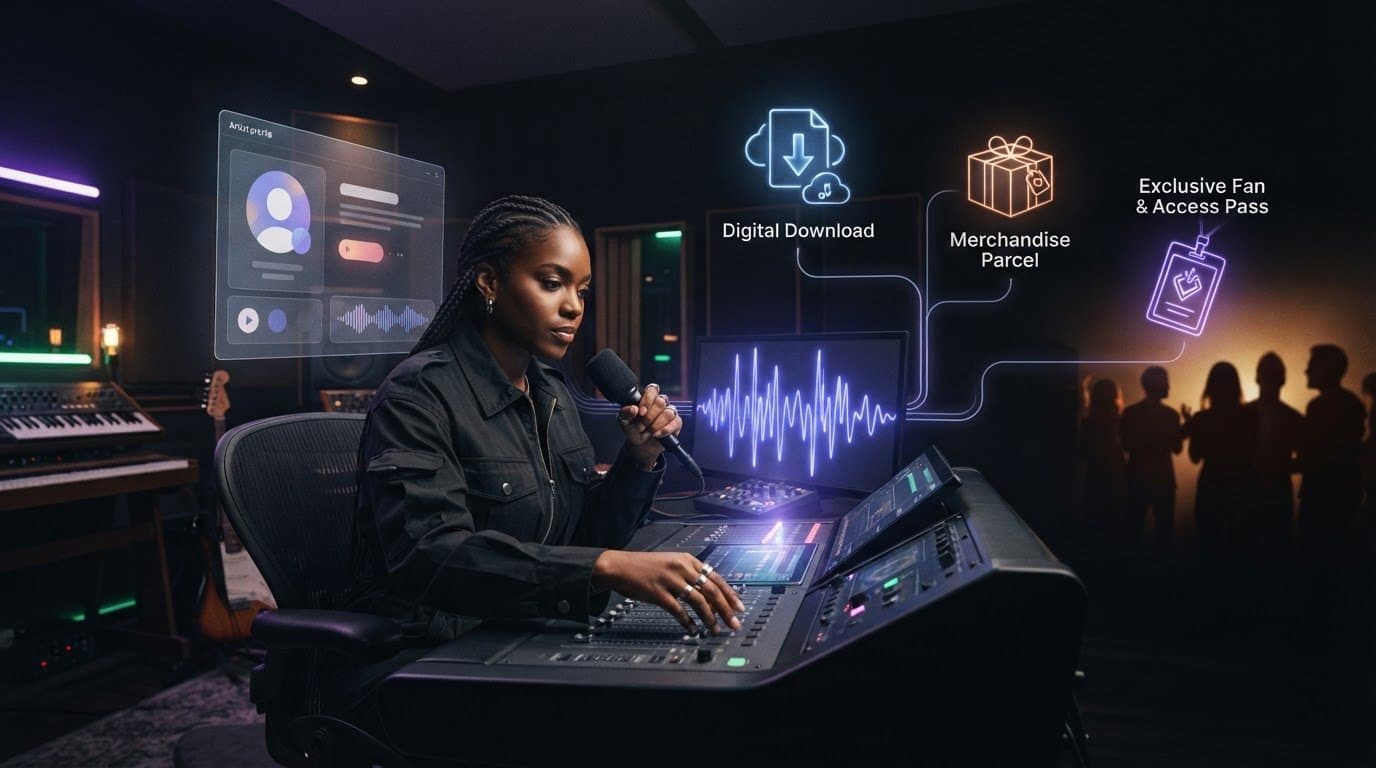
Band Apparel Pricing: Profit and Fan Loyalty
Master band apparel pricing strategies for indie musicians. Learn how to cover real production costs, increase merch profits, and maintain strong fan loyalty.

October 10, 2026
FRANKLY with Frank Lee
A shirt that sells out can still leave your band short on cash. The right band apparel pricing strategies for indie musicians start with the full cost of making and selling each item, not just the printer’s invoice. Fans also need to feel the price matches the quality, design, and connection behind the merch.
If you’re unsure what to count, worried your price will put fans off, or juggling sales at shows and online, you need a repeatable method, not a number pulled from guesswork. This guide walks through production, packaging, shipping, and selling costs, then shows how to leave room for sustainable income.
You’ll compare cost-based pricing with value-based pricing, see how live-show, online, and direct-to-fan channels affect what you keep, and learn when to adjust prices as demand changes. A marketplace can give fans a place to find your merch, but your pricing strategy sets the foundation for fair prices, stronger fan loyalty, and a healthier merch business.
Key Takeaways
- Build a full per-item cost baseline so production, packaging, fulfillment, and selling expenses don’t disappear from your pricing.
- Compare cost-based, value-based, and demand-informed approaches to choose a price with clear reasoning, not guesswork.
- Track sales, net contribution, sell-through, and fan feedback together to guide thoughtful price adjustments.
- Strong band apparel pricing strategies for indie musicians balance what fans value with what the band needs to earn.
- Choose sales channels with net revenue and fan experience in mind. A direct-to-fan marketplace can support sales, but it doesn’t set your apparel’s cost floor.
Why Band Apparel Pricing Strategies Matter for Indie Musicians
Fans want merch they can afford. Your band needs each sale to help fund the next run, tour, or creative project. Those goals can work together, but not if you set a price by instinct alone. Strong band apparel pricing strategies for indie musicians treat pricing as a business decision shaped by actual costs, the value fans see in the item, and the channel where they buy it.
Gross sales show how much customers paid. Net income shows what remains after expenses such as making the garment, packing and fulfilling orders, platform charges, and payment processing. An item can sell well yet contribute little to the band’s finances once those costs are accounted for. A useful price considers both the fan’s experience and what the band needs to keep creating.
Pricing strategy can draw on costs, competitors, and customer demand, as outlined in Pricing Strategy. For a band, copying another act’s price rarely gives a reliable answer. Your costs, audience, garment, and sales setting may all be different. A fair price supports the band without reducing fans to transactions: it gives them a meaningful way to show connection while helping you sustain future merch.
What does a sustainable apparel price need to accomplish?
A sustainable price needs to recover the costs tied to the item and leave room for band income. Think beyond the garment itself. Printing, packaging, fulfillment, and the costs of taking payment or selling through a channel can all affect what the band actually keeps.
Imagine one design becomes the table favorite and sells quickly, but its production and selling costs consume nearly all the revenue. It’s popular, but it isn’t necessarily profitable. Another design may sell more slowly while making a healthier contribution per sale. That’s why another band’s price is a reference point, not a rule: their materials, sales setup, and fans may differ from yours.
Which fan and band factors shape willingness to pay?
Fans judge more than the number on a tag. They may consider how a design reflects the music, whether the garment feels well-made, and whether the item captures a tour or shared moment. Event context matters too: a show-exclusive design can carry memories that a general release doesn’t. These signals help explain perceived value, but they don’t replace the need to understand costs.
Your closest supporters may value merch as a way to express identity and support the band. Casual listeners may focus more on everyday usefulness and affordability. Neither group is a single type of buyer. Weigh quality, uniqueness, and the meaning fans attach to the design alongside affordability. A clear, thoughtful price respects the audience and gives the band a better foundation for making merch that feels worth owning.
Calculate a Reliable Cost Baseline Before Setting Band Merch Prices
Start with a cost sheet for each apparel item and sales channel. A shirt sold at a show may have different expenses from one mailed to a fan, so keep channel-specific costs visible. This baseline gives band apparel pricing strategies for indie musicians a reliable starting point before you assess fan value or compare prices.
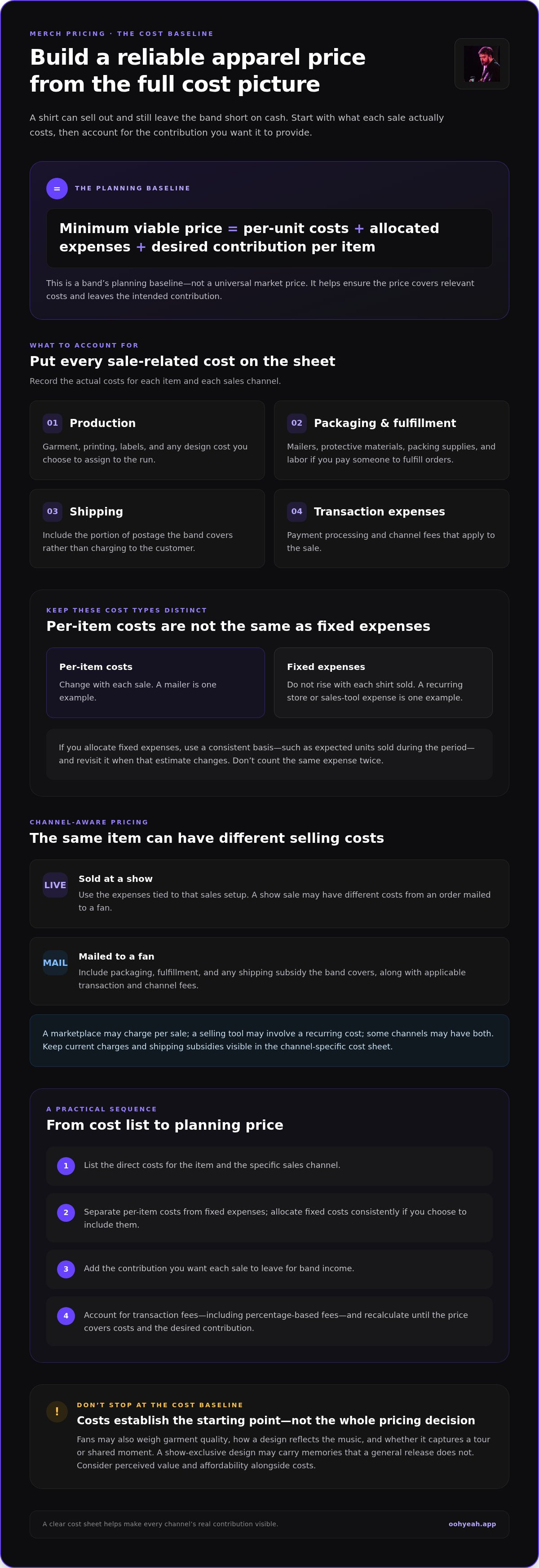
For every item, record the direct costs that change with each sale:
- Production: Garment, printing, labels, and any design cost that you choose to assign to the run.
- Packaging and fulfillment: Mailers, protective materials, packing supplies, and labor if you pay someone to fulfill orders.
- Shipping: Include any portion of postage the band covers rather than charging to the customer.
- Transaction expenses: Payment processing and channel fees that apply to the sale.
Then separate fixed expenses from per-item costs. A recurring store or sales-tool expense doesn’t rise with each shirt sold; a mailer does. If you allocate fixed expenses, choose a consistent basis, such as expected units sold during the period, and revisit it when that estimate changes. Don’t divide the same expense across every item and then count it again as a separate band expense. Taxes and other jurisdiction-specific obligations can affect your figures, so verify the rules that apply to your sales rather than assuming one approach fits everywhere.
Which costs belong in the apparel price calculation?
Use the actual arrangement for each channel. A marketplace may charge per sale, while a selling tool may involve a recurring cost. Some channels may have both. If a platform or payment provider charges a percentage of the selling price, include it in the calculation because the fee rises or falls with the price. Keep a record of current charges and any shipping subsidy so your estimate reflects what the band actually pays.
How can a band calculate its minimum viable price?
Baseline formula: Minimum viable price equals per-unit costs plus allocated expenses plus the desired contribution per item. Per-unit costs cover direct expenses; allocated expenses represent a fair share of fixed costs. The desired contribution is what you want each sale to leave for band income after those costs.
Hypothetical: A band estimates the garment and print cost, packaging, a share of its recurring sales-tool expense, and a shipping subsidy for a particular channel. It adds those amounts, then adds the contribution it wants each sale to provide. The result is its planning baseline, not a universal market price. If transaction fees include a fixed amount or a percentage of the selling price, account for those charges too and recalculate until the price covers the costs and desired contribution.
Contribution margin means the amount left from a sale after its direct costs. It helps you see what each additional sale contributes before fixed expenses are covered. A break-even price is a floor: it may recover costs but leave nothing for future merch or band income. Treat it as a checkpoint, then consider fan value and channel fit. A direct-to-fan merchandise marketplace can be one sales channel to include in that calculation, while your cost baseline remains your own.
Compare Band Apparel Pricing Strategies Without Guessing
There isn’t one pricing method that fits every band or every item. The right approach uses costs to protect your minimum, fan value to shape the offer, and real demand to inform future changes. These band apparel pricing strategies for indie musicians work best as complementary tools, not competing rules.
A low price can feel like the safest way to attract buyers, but more sales don’t automatically mean more income. If a lower price leaves too little after costs, you may need to sell more just to reach the same contribution. Consider what each approach tells you and where its blind spots are:
- Cost-based: Start with your costs and add the contribution you want. It helps set a defensible floor, but may overlook what fans value. It depends on accurate cost and channel information.
- Value-based: Set a price around the value fans perceive in the design, quality, exclusivity, and connection to the band. It helps distinguish a meaningful item from a generic one, but can misread willingness to pay. It works best when you understand your audience and offer.
- Demand-informed: Use sales patterns and fan responses to assess whether the current price and item are connecting. It helps guide adjustments, but a short sales window or limited audience can distort the signal. Track results consistently and account for context.
When should bands use cost-based versus value-based pricing?
Cost-based pricing is a safeguard: it shows where a price risks falling below what the band needs to recover. Value-based pricing asks why a fan might choose this particular garment, considering its feel, design, meaning, or connection to a tour. First protect the cost floor, then assess whether the perceived value supports the price you have in mind.
Cost-based pricing starts with what the band must recover; value-based pricing starts with what fans believe the apparel is worth. Neither method can do the whole job alone. Use the first to avoid pricing in the dark, and the second to make sure your offer reflects more than its production inputs.
How do online and live-show sales affect pricing decisions?
A show table and an online store create different buying experiences. At a show, fans can see an item in context and take it home directly. Online, fans can browse from anywhere, but shipping and packing can affect both the customer’s total and your net return. Neither channel is automatically cheaper. Compare the expenses and customer experience for each, then keep your band’s overall pricing position coherent.
Event context can strengthen an item’s meaning, especially when it connects to a specific performance or shared moment. That doesn’t mean online fans are less important or that the garment’s value should change without reason. A marketplace can provide a place to list and sell apparel, but it doesn’t determine your production choices, inventory, or fulfillment costs. Keep those decisions in your own calculation, then use channel-specific information to judge what each sale contributes.
Test and Adjust Your Band Apparel Prices With Real Fan Signals
A price is a working decision, not a permanent verdict. Use a repeatable review cycle to learn whether fans respond to the item and whether each sale supports the band. The strongest band apparel pricing strategies for indie musicians combine sales records with customer feedback, then make measured changes instead of reacting to one quiet night or a burst of orders.
- Set a baseline. Record the current price, direct costs, channel, inventory, and planned promotion.
- Choose a test. Decide what you want to learn, such as whether a different price changes demand.
- Observe. Track results across a meaningful selling period, noting events and promotions that could affect them.
- Reassess. Compare the results with your baseline, then keep, adjust, or test one element again.
Change one meaningful variable at a time. If you change the price, design, and promotion together, you won’t know which change influenced the result. Keep notes by item and channel so you can compare similar sales situations later.
Which signals show whether a price is working?
Read the measures together, not in isolation. Units sold show volume, while net contribution shows what remains after relevant costs. Sell-through, or the share of available inventory sold during the period, can reveal whether stock is moving. Repeat purchase interest may signal that fans want more from the design or apparel line. Record comments too, but don’t treat one person’s opinion as proof of a wider pattern.
Give the evidence context. A show with a different audience, a stronger promotional push, or a different size mix isn’t a clean comparison with an ordinary sales period. One event can offer a useful clue, but it rarely tells the whole story. Look for patterns across comparable opportunities, and note when stock availability limited what fans could buy.
How can bands test bundles, discounts, or limited runs?
A bundle can help you learn whether fans see extra value in buying apparel alongside another item. It may also raise the order total, but that doesn’t guarantee higher profit. Calculate the combined costs and compare the bundle’s net contribution with what individual sales would have produced. Keep the offer clear so fans understand what’s included.
For a discount test, define its purpose and end date before promoting it. Then compare sales and contribution with a relevant baseline, accounting for any difference in timing or promotion. Avoid leaving a temporary discount running indefinitely; otherwise, it becomes harder to tell whether fans value the regular offer.
Limited runs can make a design feel special, but only use scarcity claims that reflect real availability. Communicate the limit accurately, track how the run performs, and use the response to inform future decisions rather than assuming every design needs artificial urgency.
Ready to put your test into a direct-to-fan sales channel? Explore OohYeah!’s merchandise marketplace as one way to present band apparel to fans.
Sell Band Apparel Directly to Fans and Keep Pricing Transparent
Your sales channel shapes how fans find and buy apparel, and how much revenue the band ultimately keeps. It doesn’t change what it costs to make an item. Keep the cost floor consistent, then account for channel-specific charges and responsibilities before comparing the net result of an online sale with a show sale.
A useful channel comparison looks beyond the headline fee. Consider:
- Fees: Note any commission, transaction charge, or recurring cost that applies to your setup.
- Audience access: Consider how fans will discover the apparel and how easily they can reach your artist profile or sales page.
- Sales tools: Look at how the channel supports presenting items and connecting them with your music or artist identity.
- Fulfillment: Be clear about who handles inventory, packing, and shipping, and include those responsibilities in your own planning.
Commission-free sales can make the revenue picture easier to read, but they don’t erase production, inventory, or fulfillment expenses. A marketplace provides a way to present and sell apparel; it isn’t the same as manufacturing garments, shipping orders, or placing items in physical retail. Keep those roles separate as you assess what the band earns from each sale.
What should artists compare when choosing a merchandise sales channel?
Compare each channel using the same item, price, and period where possible. Estimate what the band keeps after the expenses tied to that channel, and consider the fan experience too. A convenient online option can help fans buy directly, while a live-show table offers an in-person moment. The better fit depends on your audience, workflow, and costs, not on a blanket assumption that online or in-person sales are always cheaper.
Consistency builds trust. Fans should be able to understand what they’re buying and what the listed price covers. If shipping or other charges are separate, communicate them clearly before checkout. Clear information helps fans make an informed choice and helps the band avoid confusing gross sales with the amount available for future projects.
How can OohYeah! support direct-to-fan merchandise sales?
OohYeah! gives artists profile hosting and a merchandise marketplace, bringing an artist’s presence and apparel sales into a direct-to-fan setting. Artists retain 100% of their sales revenue from music and merchandise because OohYeah! does not take commissions. Artists pay a recurring subscription for access to the platform’s tools, so include that expense in your channel comparison rather than treating commission-free sales as cost-free. Production and operating expenses remain part of the band’s own calculation.
Your pricing strategy and sales platform do different jobs. A thoughtful price reflects your costs and the value fans see; a marketplace gives fans a place to find the apparel. Explore OohYeah!’s merchandise marketplace as a direct-to-fan sales channel for your band apparel.
Build a Merch Strategy That Grows With Your Band
Your next apparel release can be more than a one-time sales push. Treat it as a chance to learn what your community wants and build a stronger connection with the people who support your music. Keep your pricing approach flexible as your sound, audience, and merch plans evolve. Thoughtful band apparel pricing strategies for indie musicians can help make each release feel fair to fans and meaningful to the band’s future.
Choose a sales channel that fits how you want to connect with fans. OohYeah! offers an artist merchandise marketplace where artists retain 100% of sales revenue without commissions. The recurring artist subscription is a separate cost to factor into your channel planning.
Explore OohYeah! and sell your music and merchandise directly to fans. Your next release is an opportunity to create with purpose, serve your community, and keep building on your own terms.
Frequently Asked Questions
How much should an indie band charge for a T-shirt?
Set a price that reflects your shirt’s actual costs and the value fans see, rather than relying on a universal rate. Compare the garment, print, fit, and design with your own past releases, then consider the audience and sales setting. A tour souvenir may mean something different to a show attendee than a general design does to a casual listener. Use your cost baseline to avoid choosing a price that leaves too little behind.
What costs should a band include when pricing apparel?
Include the costs tied to making the item available for sale, not just the blank garment. For example, include printing, packaging, any shipping you subsidize, and payment or selling-channel charges. Account for design expenses if you’re spreading them across a production run. Also consider the cost of unsold inventory, such as sizes that remain after a release. Keep a separate record for each product and channel so costs don’t get mixed up.
Is markup the same as profit margin when pricing band merch?
No. Markup is the amount added to a cost to set a selling price, usually expressed relative to that cost. Profit margin measures the profit as a share of the selling price. Because they use different starting points, the same markup and margin percentage are not interchangeable. For a quick check, subtract the item’s relevant costs from its selling price, then compare what remains with the selling price to understand the margin.
Can bands charge different prices online and at live shows?
Yes, if the difference reflects a real change in the offer or selling conditions and you communicate it clearly. Online purchases may involve packaging or shipping arrangements, while a show may offer immediate pickup or a tour-specific design. Fans can notice inconsistent prices, so have a clear reason for the difference and avoid making one channel seem unfairly treated. Compare the final customer cost, including any separate shipping charge.
What happens if a band prices apparel below its costs?
The band may lose money on each sale, even if the item sells quickly. Repeated losses can leave less funding for future production and other band needs. A temporary promotion can still make sense if you understand its purpose, such as clearing remaining stock, but track the result separately from regular sales. If the price stays below the amount needed to cover relevant costs, revisit it before ordering more inventory.
Should bands include shipping in the price of apparel?
Either approach can work: build shipping into the listed price or show it separately before checkout. The key is to account for the amount the band pays and make the total clear to fans before they commit. For example, an online order may need protective packaging that a show-table purchase doesn’t. Compare the full customer payment and the band’s net proceeds, rather than treating a “free shipping” offer as cost-free.
How often should musicians review their merch prices?
Review prices when something material changes, such as a new production quote, a different sales channel, or a shift in how quickly stock is moving. Also review after a merch run or tour so you can use a complete sales picture, not just a single night’s result. Keep dated notes about price, inventory, and promotions. That record helps you tell a genuine trend from a one-off event or unusual audience.
Can a band use limited-edition pricing for apparel?
Yes, if the limited availability is genuine and the price reflects what fans receive, such as a design tied to a specific tour or release. Be precise about what makes the item limited, and don’t imply a production cap or deadline that isn’t real. After the run, note whether fans responded to the design, the scarcity, or both. That distinction can guide future releases without relying on misleading urgency.