What to Rap About: 10 Ideas for Better Songs
Need ideas for what to rap about? Explore 10 songwriting themes, prompts, examples, and exercises to turn raw thoughts into complete rap songs.

September 20, 2026
Music Marketplace Advisor
Buying & SellingWhat if the problem isn't finding rhymes, but deciding what the song is about?
A lot of advice on what to rap about stops at topic lists. Money. pain. love. success. politics. That doesn't help much when you're staring at a blank page, because a topic isn't a song yet. A song starts when the idea has a speaker, a situation, and some pressure inside it.
That matters in rap more than people admit. A corpus study of 259 rap songs found 20 recurring lyric formulas, and bragging was the dominant category. First-person brag alone helped bring brag topics to 48% of all 16,292 lyric lines in the corpus, which shows how much rap depends on self-assertion and point of view rather than abstract subject matter (rap lyric corpus study on recurring formulas and bragging). The lesson isn't “only brag.” It's that strong rap writing usually knows who is speaking and what they're trying to prove.
If you want better answers to what to rap about, use a simple method every time. Choose a subject. Find the tension inside it. Write concrete scenes instead of broad statements. Build a hook that names the emotional pull. Then write verses that change how the listener understands the idea by the end.
The ten angles below work that way. Each one gives you not just a theme, but a mechanism you can write with.
1. Personal Hustles and Independent Grind
Independent grind works when you stop describing ambition in general and zoom in on the labor nobody sees. That tension is strong because the outside image says “motion,” while the story says “repetition, sacrifice, and delayed reward.”
Jay-Z, Nipsey Hussle, and 50 Cent all gave listeners more than success talk. They tied ambition to systems, choices, and pressure. Use that same move in your own lane, even if your version is packing orders after work, editing reels at midnight, or turning a small audience into a paying one.

Write the obstacle, not just the dream
Pick one scene where the grind became real. Maybe your card declined for shipping supplies. Maybe you missed a party because you were finishing cover art. Maybe you almost quit after a weak drop.
Practical rule: If the line could belong to any rapper, it's still too broad. Replace “I've been working” with one visible act.
A useful draft pattern:
- Opening bars: Show the early sacrifice. “Lunch break in the stockroom, writing hooks in my notes.”
- Middle bars: Show the setback. “Drop went quiet, no replies, still boxed every order.”
- Closing bars: Show the decision. “Didn't need applause first, needed proof I'd stay.”
Prompt and micro-example
Prompt: Write three moments. One sacrifice, one setback, one reason you kept going.
Micro-example: “Printed labels on the floor by the bed, No applause when I posted, just the doubt in my head, But I shipped one more box like the promise was fed.”
For the hook, pull the most visual line and repeat its meaning. “Still shipped the box” can become a hook because it stands for persistence without sounding like a speech.
2. Fan Connection and Community Building
A fan song gets stronger when it focuses on one exchange instead of “my supporters” in the abstract. The best version isn't transactional. It sounds mutual. Someone heard a record, answered it with their own story, and that changed the artist too.
Chance the Rapper often frames support as a relationship, not a scoreboard. You can do the same whether your audience is small or growing. One thoughtful message can carry more songwriting weight than a generic crowd chant.

Build the song around one reply
Choose a real moment. A fan sent a cover. Someone said a song helped them through a hard week. A listener showed up to a local set and knew every word. That's your central scene.
Use call-and-response in the hook so the listener feels included.
- Hook idea: “You heard me first, I heard you back.”
- Verse one: What they said.
- Verse two: What it changed in your process or confidence.
- Bridge: Gratitude without sounding sentimental.
A strong community song names the exchange, not the audience category.
If you're thinking about support beyond streaming, it helps to understand how artists grow fan support through crowdfunding. Even if you never launch a campaign, the writing lesson is useful. People respond when they feel part of a shared mission.
Prompt and micro-example
Prompt: Write the exact first sentence from a fan message you still remember. Then answer it in your own voice.
Micro-example: “You said my late-night track got you through your shift, I wrote it half-broke, now the meaning got a lift, You pressed play alone, but you still moved the ship.”
3. Creative Control and Artistic Freedom
What do you own if the song reaches more people but stops sounding like you?
Creative freedom gives you a built-in rap structure because it already contains tension. One voice says, "make it cleaner, faster, easier to sell." The other says, "keep the choices that carry my fingerprint." That clash is stronger than a vague anthem about being original because the listener can hear the pressure.
A good way to write this topic is to treat it like a courtroom scene or a contract review. Put one creative decision on trial. The beat switch. The raw vocal take. The line someone asked you to cut. Your point of view can stay in first person, but the song gets sharper when each verse argues a different side of the case.
Start small. Pick one choice you protected.
Maybe it was a rough mix with room noise. Maybe it was cover art you made yourself. Maybe it was a hook that kept an awkward pause because the pause said more than another bar could. That single choice becomes the anchor for the whole track.
Here is a simple build:
Verse 1: Show the pressure. Who wanted the change, and what did they want fixed?
Hook: State the principle you refused to trade. Keep it short enough to repeat.
Verse 2: Name the cost. Lost time, less money, slower growth, second-guessing.
Verse 3 or bridge: Show the result. Maybe the song stayed smaller, but it stayed yours, and that ownership shaped your next move.
Prompt: Write about one edit you rejected. Finish these three lines in plain language first, then rhyme them later.
“I kept ______.”
“They said it would work better if ______.”
“I said no because ______.”
Micro-example:
“I kept that crack in the take where my voice went thin, They wanted bright gloss, cut the bruise, tuck the sting, If I smooth that truth out, what exactly do I bring?”
That example works because the writing mechanism is clear. The song is not about freedom in the abstract. It is about one contested detail, the pressure around it, and the meaning of keeping it.
If you get stuck, separate control into three layers:
Sound. What did you protect in the beat, flow, mix, or silence?
Image. What visual choice still feels like your world?
Timing. Did you release on your own schedule instead of someone else's plan?
Choose one layer for the hook and another for the verses. That creates contrast, which helps the song grow instead of looping the same statement for sixteen bars.
A useful hook often sounds like a rule you wrote for yourself.
“My name on the file, my cut, my call.”
Short. Memorable. Easy for fans to quote back because it carries your ownership in plain language.
If you want the song to reach beyond self-expression, include the consequence of that ownership. Independent creation is not only pride. It is also responsibility. You have to stand behind the choice when it works and when it does not. That honesty gives the theme weight and gives listeners a real person to connect with.
4. Merchandise Hustle and Physical Products
What makes a hoodie, cassette, or poster worth rapping about instead of sounding like an ad?
The answer is function. In a song, a physical product works like a prop in a film. It gives the listener something they can see, but it also carries tension. You made it with your own hands or your own money. A supporter buys it and turns your private symbol into something public. That transfer is the subject.
Start with one item and one songwriting mechanism. The easiest mechanism here is point of view. Pick who is speaking in the song.
You could rap as:
- the artist packing the order at 2 a.m.
- the shirt sitting folded before the first sale
- the fan wearing the design in a city you have never visited
Each choice changes the song. The artist point of view highlights labor and ownership. The item point of view adds personality and detail. The fan point of view shifts the focus to connection and what your art means once it leaves your room.
Artists using the OohYeah marketplace for merch and music sales can write directly about that creator-to-fan exchange because the product is part of the relationship, not just a revenue line.
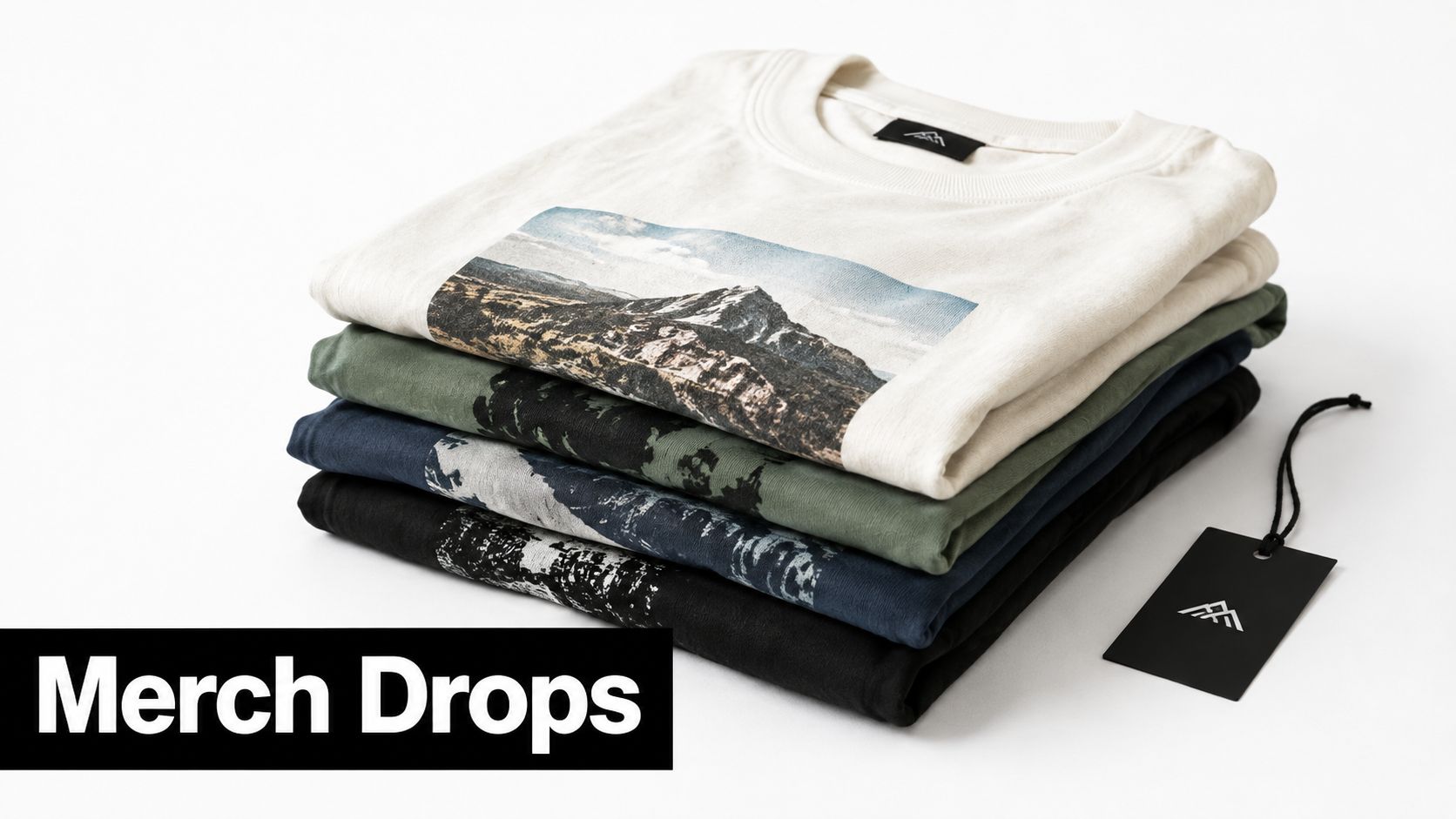
Here is a practical way to build the song.
Begin with the scene. Put yourself at the table, printer, mailbox, or pop-up stand. Then add the tension. Maybe the budget was small, the first sample came out wrong, or you kept the design plain because it matched your world better than a trend-heavy version. Last, show the transfer. What does it mean when somebody else spends money to carry your name, phrase, or image?
Prompt: Write four lines about one item using these slots.
“I made this after ______.”
“The detail I refused to change was ______.”
“When someone buys it, they are really buying ______.”
“I knew it mattered when ______.”
Micro-example:
“I drew that sleeve tag right after the room went quiet, Kept the faded ink, cause clean lines killed the riot, Now somebody downtown wear my rough year on their chest, Small box, hand-taped shut, but the meaning traveled best.”
That gives you a full song map.
Verse 1 can cover the origin story. What happened in your life or career that made this object necessary? Verse 2 can show the work. Packaging, corrections, misprints, carrying boxes, answering messages, setting prices. The hook should state what the object stands for in plain language so fans can repeat it. A strong hook often names the item and the meaning together. “Wear the year I lived through.” “Boxed pain, sent proof.” “My logo, your story too.”
If you need more texture, use operational details as evidence. A line about label paper, tape rolls, or leftover sizes can ground the song in real labor. Even a practical link like sign out help for storefront management points to a truth many independent artists know. Physical products create admin, decisions, and small repetitive tasks. Those details help the writing feel lived-in instead of promotional.
One caution. Keep the song centered on meaning, not inventory. Price and product type can appear, but they should support the emotional arc. The listener should finish the track understanding why the item exists, what moment it came from, and why a fan choosing to wear it feels bigger than a sale.
5. Analytics, Data, and Growth Metrics
What can a stream count say about a person, a place, or a choice you made as an artist?
Numbers become usable song material when you treat them like footprints. A footprint matters because it points back to movement. In the same way, a save rate, a city spike, or a repeat listen only becomes interesting when you ask what caused it and what you did next. That question gives the song tension.
A long-run content analysis of rap themes and real-world indicators found that rap themes often reflect broader social conditions instead of random style preference. For songwriting, that matters because data can frame context. It can show where your music lands, who stays with it, and which parts of your catalog connect beyond your original plan.
Try building this topic around a decision point instead of a scoreboard.
One strong angle is point of view. Write as the artist staring at the numbers after release night, then noticing one result that contradicts your expectations. Maybe your hometown is quiet while another city keeps replaying the record. Maybe the emotional track gets saved more than the loud single. Maybe a short clip pulls people into the full song. Each of those creates a different song engine. Surprise. Distance. Revision.
Artists who track audience behavior through artist analytics and release tools at OohYeah can use that moment as the scene. The useful part is not the chart itself. The useful part is the choice that followed.
Another angle is contrast. Put two truths beside each other. “The song I pushed hardest faded fast.” “The song I almost hid kept traveling.” Contrast gives you verse structure without forcing a full story. Verse 1 can show the original plan. Verse 2 can show the evidence that challenged it. The hook can state the lesson in plain language so listeners remember it.
If you want a practical frame for reading patterns, this analytics dashboard guide shows how people turn performance signals into action.
Use this prompt to start: Write three short lines.
- “I checked the numbers and saw…”
- “I thought it meant…”
- “So I changed…”
Micro-example:
“I checked the numbers and saw that the soft one stayed, Thought the loud one would lead, but the quiet one weighed, So I changed how I wrote. Gave the truth more space.”
Now expand it into a full track.
Hook: state the pattern and the new belief. Something like, “They stayed for the truth,” or, “The save told me more than the shout.” Keep it simple enough to repeat.
Verse 1: set the scene. Where were you when you looked? Phone screen in the dark. Laptop open after midnight. Group chat silent. Those details make the metric feel lived, not abstract.
Verse 2: explain the tension. What did you expect, and what result challenged you? That contrast is the heart of the section.
Verse 3, if you want one: show the adjustment. New writing approach, new release choice, new city on the tour list, new respect for the fans who kept replaying the truest record.
That gives you a song about recognition, ownership, and growth instead of simple bragging.
6. Subscription Models and Exclusive Content
Subscription songs work when they feel like an invitation into a trusted space, not a sales pitch. The emotional mechanism here is belonging. Why do some people come closer to the work, and what responsibility comes with giving them a deeper look?
This theme fits artists who share demos, early drops, process notes, or private updates. The writing gets better when access means something specific. Maybe the inner circle hears unfinished versions. Maybe they get the songs that are too raw for a public feed. Maybe they witness mistakes before the polish.
Write the promise of the inner circle
A good hook here sounds like a vow. Not “pay to enter,” but “if you're here, you get the unguarded version.” Then let each verse open a different door.
Writing lens: Exclusive content becomes lyrical material when access changes the relationship, not just the file format.
Verse ideas:
- first verse on the rough draft
- second verse on the studio voice note
- third verse on the message attached to the release
Prompt and micro-example
Prompt: Finish this line. “Behind the post, I kept…”
Micro-example: “Behind the post, I kept the cracked take and the breath, The count-in, the doubt, the part I ain't dress, If you're close to the craft, then you're close to the mess.”
That gives you a song about trust, not just monetization.
7. Production Journey and Behind-the-Scenes Creation
Production songs are really decision songs. What sample did you reject? Why did the drums come in late? Who changed the feel of the room? Behind-the-scenes writing lands because listeners hear the finished record, but not the chain of choices that built it.
A recent academic analysis of popular rap lyrics from 2004 to 2023 found recurring themes including authenticity and storytelling, brand and name dropping, brutality and violence, contemplation and introspection, cultural and local referencing, dissing, emotions, and sexual agency, flexing, misogyny, and sociopolitical commentary. The mix shifted over time, which suggests rap topics aren't static and that artists keep returning to identity, place, status, and commentary in changing combinations (content analysis of popular rap lyrics from 2004 to 2023). A production story can hold several of those layers at once because making the track often reveals who you are.
A platform like OohYeah Creative Journey for sharing process and updates fits naturally here if you document sessions, demos, or voice notes as part of your artist story.

Use sensory detail from one session
Write five details from a real session. The lamp buzz. The producer tapping the desk. Cold coffee. A clipped hi-hat. Someone saying “run that back.” Those details keep the song from becoming a generic studio tribute.
- Verse one: First spark.
- Hook: The sound or phrase that kept returning.
- Verse two: The technical or emotional problem.
- Verse three: The moment the track finally clicked.
This kind of studio breakdown is easier to hear in action than in theory. Watch how producers and artists talk through process in sessions like this:
Prompt and micro-example
Prompt: Describe one session using one sound, one smell, one frustration, and one breakthrough.
Micro-example: “Snare too stiff, coffee cold by the board, Loop felt flat till the bassline opened a door, He said leave that breath in, now the record got a core.”
8. Local Scene and Community Pride
Place matters in rap because location gives your voice texture. “My city” is too broad. Name the block, the venue, the bus line, the corner store, the rehearsal room, the promoter who always answers late. Build a map in words.
This isn't just old-school regional pride. It still works because local identity remains one of rap's durable lanes. You don't need a city anthem. You need evidence that your sound comes from somewhere lived-in.
Build a verbal map
Pick five location details:
- a neighborhood
- a venue
- a landmark
- a local character
- a recurring problem
Then use contrast. Pride feels stronger when it includes friction. Maybe the scene is loyal but underfunded. Maybe everyone knows each other, but nobody agrees on sound. Maybe the city shaped your hunger and your patience at the same time.
Your local song should help a stranger see the place, not just recognize the name.
Prompt and micro-example
Prompt: Write a hook that begins with a location and ends with a feeling.
Micro-example: “Off Maple by the train line, taught me hold my pace, Tiny room, loud crowd, still felt like a place, Same cracked stage made me learn how to face.”
That gives the listener belonging and history in a few bars.
9. Mental Health, Authenticity, and Personal Growth
Introspective rap works best when it moves. Confession alone can flatten a song if every line says the same thing. The mechanism here is change. Start with a specific hard moment, show what belief it challenged, then end with a realistic next step.
That approach fits where rap has been heading. Recent guidance on what to rap about often misses the choice framework and over-relies on broad prompts, while stronger songwriting advice pushes artists to begin with one lived experience, one emotion, one scene, or one conflict rather than a huge topic (music education guidance on moving from broad topics to specific lived experience). Mental health writing especially needs that specificity.
Keep the writing grounded and bounded
Use one moment. Sitting in the car after a call. Missing a deadline because your head was foggy. Realizing success didn't silence anxiety. Then write what shifted.
A balanced hook should hold pain and movement in the same breath. It doesn't need false optimism. It needs honesty with direction.
- Verse one: The difficult scene.
- Verse two: The inner belief or habit that broke.
- Verse three: The next step, boundary, or practice.
Prompt and micro-example
Prompt: Write “I knew I had to change when…” and answer it with one visible moment.
Micro-example: “I knew I had to change when I sat with the win, Whole room clapped loud, still the noise stayed thin, So I learned small peace ain't a weakness to let in.”
If the material is sensitive, keep your own boundaries in mind. You can be honest without telling everything.
10. Collaboration Power and Artist Networking
Collaboration songs get interesting when each person has a role in the story. Don't stack names. Show the spark. Maybe one artist challenged your melody. Maybe a producer stripped the beat down. Maybe a feature made the concept sharper by disagreeing with your first draft.
That structure mirrors modern creative life, where identity, audience, and even income often overlap with online spaces. Newer songwriting guidance has started treating social media culture, AI, gaming, virtual worlds, and online self-presentation as relevant rap territory, rather than novelty topics, especially because hip-hop remains connected to streaming and creator-led discovery (recent songwriting guidance on digital-life themes in rap). Collaboration can include that digital layer too. The DM that started the song. The file swap. The late-night note that changed the chorus.
Give the partnership dramatic tension
A strong collaboration song often has three stages:
- meeting
- friction or surprise
- new result
One verse can tell how you connected. Another can show the disagreement or creative breakthrough. The hook can state the shared purpose that made the record work.
Two artists become memorable together when the song reveals what each one unlocked in the other.
Prompt and micro-example
Prompt: Write one bar about first contact, one about disagreement, and one about the version that won.
Micro-example: “Met through a rough demo sent after midnight, You cut my second verse, said the first one hit right, Now the record got space and the whole thing sits tight.”
That song doesn't just celebrate networking. It shows collaboration as craft.
10 Rap Topics Comparison
| Topic | Implementation Complexity 🔄 | Resource Requirements ⚡ | Expected Outcomes 📊 | Ideal Use Cases 💡 | Key Advantages ⭐ |
|---|---|---|---|---|---|
| Personal Hustles and Independent Grind | Medium, mix of narrative and business details | Low–Medium, time, sales metrics, basic merch samples | Increased revenue streams, stronger DIY brand | Independent artists building multiple income streams | Positions artist as entrepreneur; drives monetization & loyalty ⭐⭐⭐ |
| Fan Connection and Community Building | Medium, ongoing engagement and storytelling | Low, time commitment, messaging tools, UGC management | Deeper fan loyalty and higher engagement rates | Artists with active or growing fanbases seeking retention | Builds emotional bonds and encourages UGC/subscriptions ⭐⭐⭐ |
| Creative Control and Artistic Freedom | High, narrative + strategic boundary setting | Medium–High, confidence, potential legal/production costs | Strong artistic identity; long-term ownership | Vision-driven artists prioritizing independence | High artistic credibility and full revenue/control ⭐⭐⭐⭐ |
| Merchandise Hustle and Physical Products | Medium, design + logistics planning | Medium, production, inventory, fulfillment systems | Higher per-fan revenue; tangible brand presence | Artists with visual brand and engaged fans | Higher margins and physical fan ambassadors ⭐⭐⭐ |
| Analytics, Data, and Growth Metrics | Medium, technical literacy and storytelling | Low–Medium, analytics tools, time for analysis | Targeted growth, informed release/marketing decisions | Artists scaling strategy or optimizing audience reach | Data-driven strategy and measurable growth outcomes ⭐⭐⭐ |
| Subscription Models and Exclusive Content | Medium–High, consistent premium content delivery | Medium, frequent content creation, community management | Predictable recurring revenue and stronger core fanbase | Artists with superfans willing to pay for exclusives | Recurring income and deeper subscriber relationships ⭐⭐⭐⭐ |
| Production Journey and Behind-the-Scenes Creation | Low–Medium, documentative storytelling | Low, studio access, recording snippets, visuals | Greater appreciation for craft; diversified content | Producers and artists who can share studio process | Humanizes creation and educates fans; content-rich ⭐⭐⭐ |
| Local Scene and Community Pride | Low–Medium, requires local knowledge and specificity | Low, local events, networking, venue partnerships | Strong local support, grassroots momentum | Emerging regional artists building hometown presence | Authenticity, local press, and event opportunities ⭐⭐⭐ |
| Mental Health, Authenticity, and Personal Growth | Medium, sensitive narrative framing required | Low, personal readiness, support resources | Deep emotional resonance and loyal listeners | Artists comfortable with vulnerability and care | Emotional depth and meaningful long-term bonds ⭐⭐⭐⭐ |
| Collaboration Power and Artist Networking | Medium, coordination and creative alignment | Medium, contacts, scheduling, share agreements | Audience expansion and creative innovation | Artists seeking cross-promotion and new sounds | Broadens reach, sparks creativity, mutual promotion ⭐⭐⭐⭐ |
Build the Idea Into a Complete Track
The best answer to what to rap about usually isn't the biggest topic. It's the one with the strongest personal detail. Start there. If one of these ten angles made you see a specific room, person, object, message, or decision, use that one first.
Write a one-sentence premise before you draft. Keep it plain. “I'm writing about the moment I almost quit selling my work and why I kept going.” Or, “I'm writing about one fan message that changed how I hear my own music.” That sentence keeps the song from drifting.
Then collect five concrete images. Not opinions. Images. The packing tape stuck to your wrist. The unread DM. The studio lamp. The train outside the venue. The hoodie sample folded on the chair. Those details give the listener something to stand inside. They also stop you from filling space with generic claims.
Next, write a hook that states the emotional tension. Not the entire story. Just the pull. “I stayed when it got quiet.” “You heard me when I was small.” “I kept the sound they wanted trimmed away.” A good hook gives the song a center of gravity.
After that, draft verses that add consequence or change. Each verse should answer one question the hook creates. Why did staying matter? What did that fan support shift in you? What did protecting your vision cost? By the final verse, the listener should understand the topic differently than they did at the start.
Revision is where strong topics become strong songs. Cut broad boasts that don't serve the premise. If a line sounds impressive but could fit any song, replace it with something only you could say. Check whether every bar points back to the central idea. If it doesn't, it probably belongs in another track.
One next action helps more than endless planning. Record a voice note with the hook. Draft eight bars from the clearest scene. Share a process update. If direct fan connection is part of your work, a platform like OohYeah can also give you a place to post music, merch, subscriptions, and updates in one artist-controlled space while you keep building the song into a release.
Most writers don't need more topics. They need a better way to choose one and push it until it becomes a complete record. That's the skill behind knowing what to rap about.
If you want a place to turn these ideas into releases, OohYeah gives artists tools to share music, sell merch, offer subscriptions, and connect directly with listeners. That makes it useful when your song topic is tied to your real creative process, your fan relationships, and your independent path. Visit OohYeah to see how it can support the music you're building.