What Is Music Streaming and How Does It Work
Learn what is music streaming and how does it work, from codecs and delivery to royalties, rights, and what independent artists must own to earn.
October 21, 2026
Music Marketplace Advisor
Buying & SellingMusic streaming delivers on-demand audio from remote servers to your device in small, access-controlled segments rather than as a permanent file you own. To understand how it works, follow the audio to the listener and the money to the creator.
You press play while heading out the door, and the song starts before you've reached the street. Or you've just released a track and can see people listening, but you're less certain about what those plays mean on your royalty statement.
Those experiences belong to the same system. Understanding what is music streaming and how does it work means looking beyond the player to the encoding, delivery, permissions, accounting, and contracts behind it.
A Working Definition of Music Streaming
Think of streaming as licensed access to a recording, supported by delivery software and usage reporting. The service doesn't send sound. It checks whether your account can access a track, retrieves the appropriate audio, and records listening activity for subsequent accounting.
The visible experience is simple: choose a song and hear it. Behind that experience, several components have to work together.
The components behind a play
- Catalog: The recordings the service has permission to make available.
- Storage: Remote infrastructure holding the audio and associated information.
- Delivery: The connection that carries audio data to your device.
- Player: The application that receives, decodes, and plays the audio.
- Reporting: Records that connect listening activity with rights and revenue accounting.
The diagram separates the listener's action from the service's response.
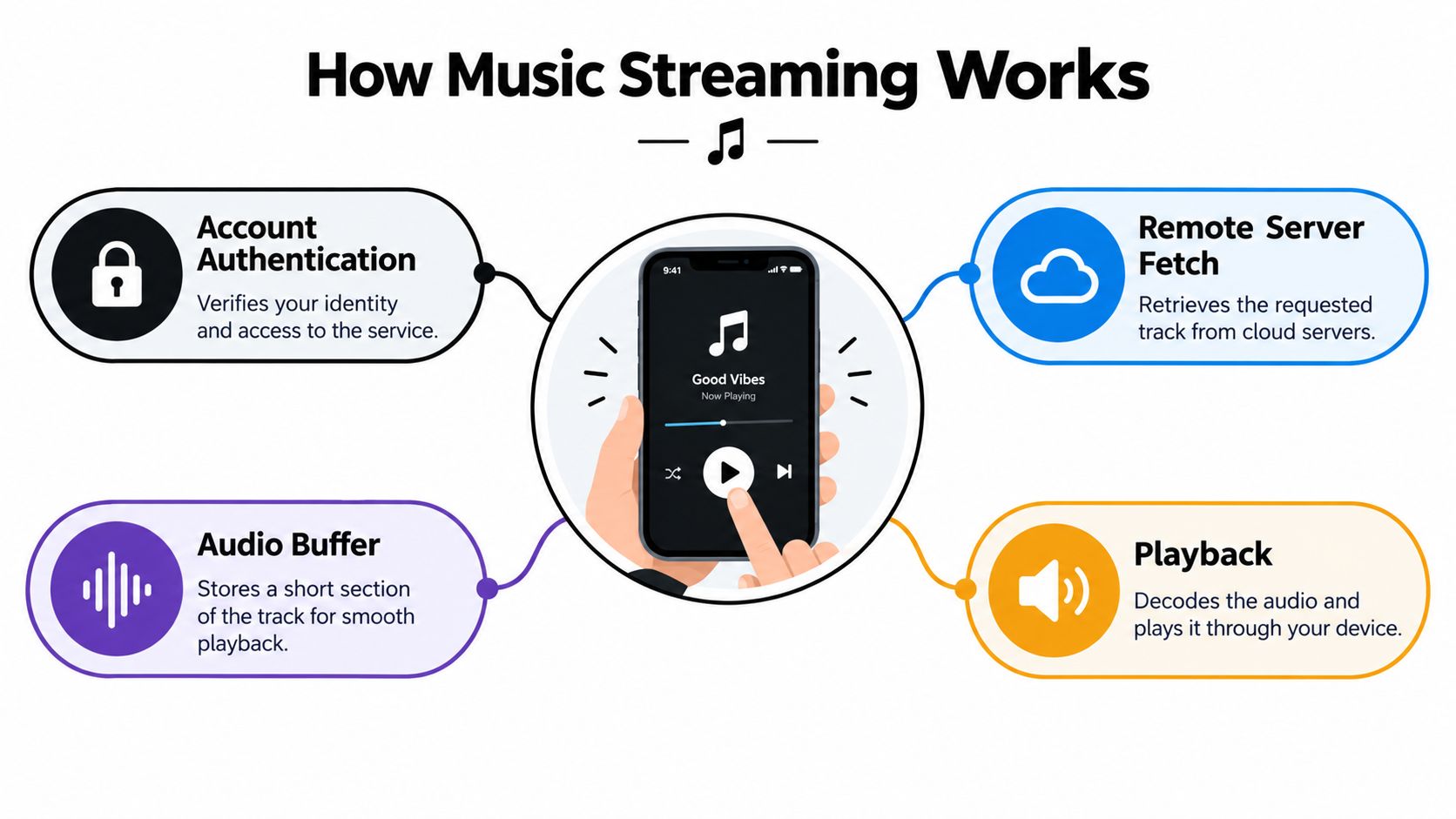
A useful analogy is an access-controlled listening room. Your account lets you enter, the catalog determines what's available, and the player lets you hear a selection. Access doesn't mean the service has transferred ownership of the recording to you.
Why offline listening is still access
An offline button can make streaming look like a download purchase, but the distinction is what you're allowed to keep and use. Offline listening generally stores locally cached, access-controlled audio inside the application, and that access can change when a subscription, license, or device authorization changes, as described in the DiMA streaming report.
That's why a saved track isn't necessarily an ordinary audio file you can copy into another player. The application manages playback under the service's rules.
Practical rule: Saving music for offline listening changes where the audio is stored, not necessarily the rights you have to it.
For artists, the distinction matters when describing an offer to fans. A streaming subscription, an offline listening feature, and a purchased download shouldn't be presented as interchangeable products. Each creates a different expectation about access, possession, and continued availability.
How the Audio Reaches the Listener
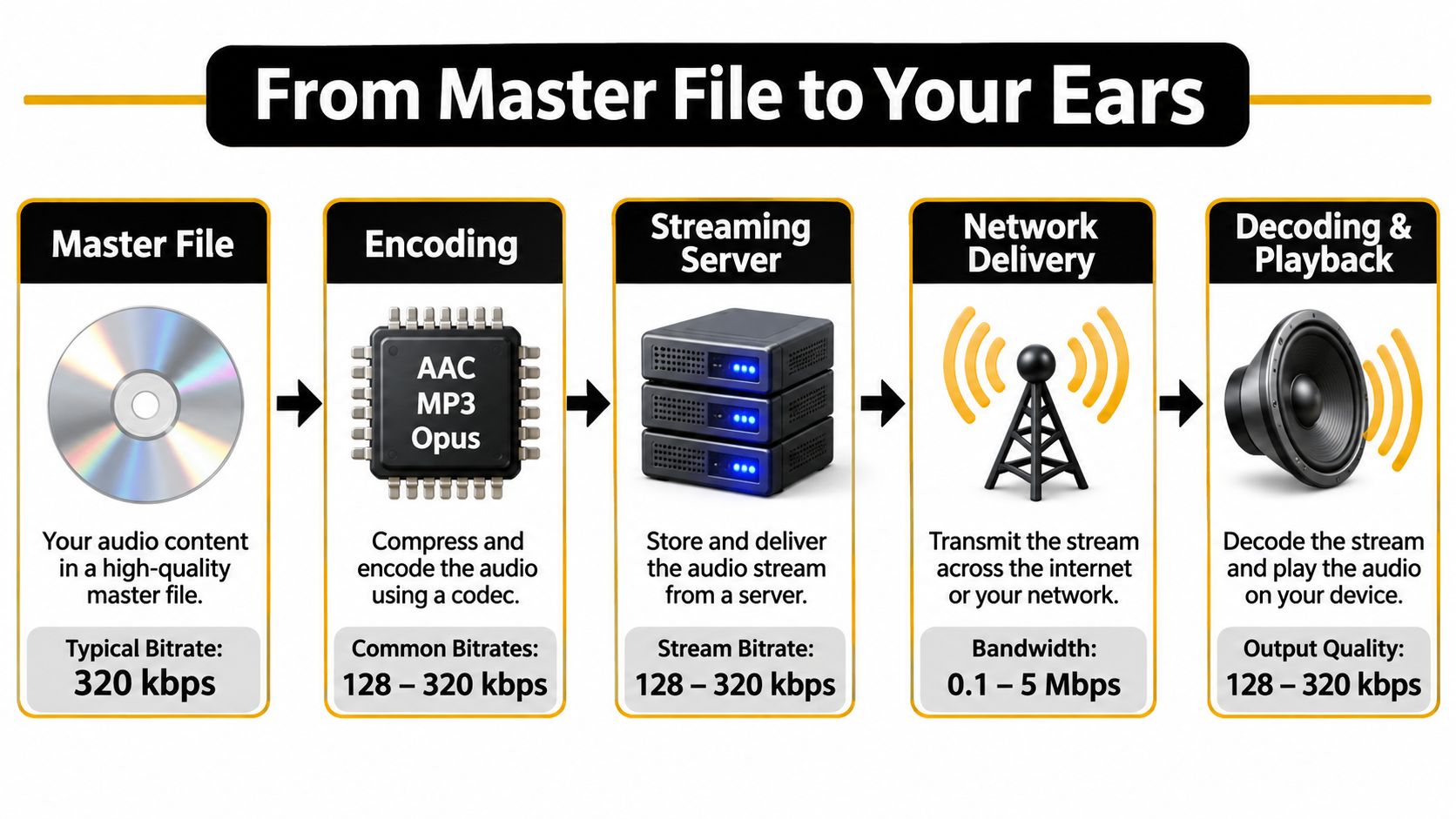
Your finished master is the starting point, not necessarily the exact file a listener receives. The delivery process turns that master into an audio representation suitable for the listener's account, device, and connection.
The chain below makes those handoffs visible.
Encode, select, and buffer
Encoding prepares audio in a compressed format. The player selects an available representation, receives segments, and keeps some audio ahead of the current playback position in a buffer.
Think of the buffer as a small reserve rather than a permanent collection. When the network briefly slows, the player can use that reserve instead of immediately stopping. Quality selection and buffering balance fidelity, data consumption, startup time, and resilience.
For a concrete comparison, Spotify's audio-quality guidance lists approximately 24 kbit/s at its lowest mobile setting, 96 kbit/s for Normal, and 160 kbit/s for High on desktop, mobile, and tablet; at 160 kbit/s, an hour requires roughly 72 MB before protocol overhead, compared with about 576 MB for uncompressed 16-bit, 44.1-kHz stereo PCM.
The practical point isn't that smaller files always sound identical. It's that compression and quality selection make delivery less demanding, particularly when listeners have limited mobile data or unreliable connections.
This video provides another way to visualize the delivery process.
Measure the listening experience
A strong master can't compensate for a player that starts slowly or repeatedly stalls. When evaluating a delivery partner, ask for operational measurements rather than relying on a successful test play.
- Startup delay: How long does the listener wait after pressing play?
- Rebuffering: How much listening time is interrupted by stalls?
- Bitrate switches: Does quality change frequently during playback?
- Completion and abandonment: Do listeners finish, leave, or encounter an interruption?
Treat these as diagnostic signals, not proof of musical preference. A listener leaving during a network interruption tells you something different from a listener skipping a smoothly delivered track.
For a practical fan-facing check, use the listener experience to think through the journey from finding music to playing it. Evaluate the controls and clarity of that journey alongside the sound itself.
The Rights and Licensing Layer
A recording and a song aren't the same copyright asset. An artist might control the recorded performance while sharing the underlying writing with collaborators.
The sound recording, often called the master, is the particular recorded performance. The musical composition is the underlying songwriters' and publishers' work, which may exist in different recordings.
Separate the permissions
A service must account for the recording and the composition. Uploading a master therefore shouldn't be treated as proof that every underlying right has been resolved.
In the United States, the Music Modernization Act created a blanket mechanical license for interactive streaming and established the Mechanical Licensing Collective, whose licensing system became available on January 1, 2021, according to the U.S. Copyright Office's Music Modernization Act FAQ.
Digital music providers submit usage reports so eligible royalties can be matched and distributed to songwriters and publishers. The important distinction is that this mechanical-licensing framework isn't a substitute for accounting for the sound recording.
Owning the recording doesn't automatically mean you own every right in the song.
Service behavior matters, too. Interactive services let listeners select particular songs, while non-interactive or semi-interactive experiences leave more of the sequence to stations or algorithms. Don't assume that permission for one listening model automatically covers another.
Build records that can be matched
For an independent release, a useful rights review starts with questions rather than an upload confirmation.
- Master ownership: Who controls the recording, and what agreements support that control?
- Writing shares: Have collaborators agreed on their composition interests?
- Registration: Have you confirmed the relevant publishing registrations and collection arrangements?
- Metadata consistency: Do titles, contributor names, ownership information, and supplied identifiers agree across your records?
Keep recording identifiers such as ISRCs and work identifiers such as ISWCs in their appropriate records. Ask your distributor or publishing administrator to resolve missing or inconsistent information rather than assuming a successful delivery means the accounting is complete.
If you also license music for branded content or podcasts, Podmuse's music rights guide for brands is a relevant additional resource to consult. Treat those uses as separate permission questions, not automatic extensions of a streaming release.
How Streaming Revenue Is Allocated
A stream doesn't have a universal price tag. Subscription and advertising revenue enter a pool, and allocation rules determine how the rights-holder portion is divided before contracts determine the creator's eventual payment.
Under the dominant pro-rata model, a recording's share of total streams helps determine its allocation. Your personal subscription payment therefore shouldn't be imagined as a direct transfer to the artists you heard.
Follow the pool, not a headline rate
Academic analysis of streaming economics reports that major services commonly retain about 30% of revenue and distribute roughly 70% as remuneration to service providers and rights holders, while also estimating that a user-centric model could reallocate nearly €170 million annually on Spotify.
Those figures describe different things. The revenue split isn't a promise about an artist's take-home income, and the user-centric estimate concerns redistribution, not newly created revenue or a guaranteed gain for every independent artist.
Under user-centric allocation, each listener's revenue is divided among that listener's plays. Under pro-rata allocation, the relevant listening share comes from the broader pool. That difference can change who receives money without changing what an individual listener pays.
Variables That Change What a Stream Pays
| Variable | Where it lives in the rights stack | Effect on effective payout |
|---|---|---|
| Territory | Service revenue and licensing arrangements | Changes the revenue and terms associated with listening |
| Subscription tier | Subscription or advertising income | Changes the pool supporting a play |
| Listening share | Allocation rules | Determines a recording's relative claim on the pool |
| Master ownership | Recording agreement | Determines who receives and retains recording income |
| Publishing ownership | Composition administration | Determines how songwriting income is divided |
| Intermediary terms | Distribution, label, or administration contracts | Changes deductions before payment reaches the creator |
| Eligibility rules | Usage qualification | Determines which activity enters payable accounting |
Consider an artist who owns a master but shares songwriting with collaborators. Their recording income and composition income follow different contractual paths, even when they arise from the same listening activity.
That's why dividing a deposit by a play count produces an effective rate for that statement, not a reliable price for every future play. It can be a useful diagnostic calculation, provided you preserve the context.
Ask for a statement that distinguishes gross revenue, platform share, rights deductions, and net creator earnings. Where possible, examine territory and subscription-tier detail, and confirm which reporting period and qualified activity the statement covers.
Streaming Models Compared
Not every service gives listeners the same control, and not every listening session draws on the same revenue source. Separate how the music is selected from how the service is funded before comparing distribution opportunities.
The market context explains why this distinction matters: in 2024, streaming generated US$20.4 billion, or 69.0% of global recorded-music revenue, while subscription-streaming revenue grew 9.5% and ad-supported streaming grew 1.2%, according to WIPO's account of IFPI's industry findings.
Compare control and funding separately
| Service model | Listener control | Commercial basis | Creator's decision |
|---|---|---|---|
| Interactive subscription | Listener selects specific tracks | Recurring paid access | Evaluate listening quality and paid-tier reporting |
| Interactive ad-supported | On-demand selection within service rules | Advertising-supported access | Assess discovery alongside revenue context |
| Non-interactive radio-style | Service determines much of the sequence | Advertising, subscriptions, or a combination | Check programming fit and applicable licensing |
| Semi-interactive | Listener influences selections without controlling everything | Depends on the service | Examine the actual controls and contractual treatment |
A free tier and a paid tier can offer different listening conditions without representing different underlying songs. Likewise, a station-driven experience can share a funding model with an on-demand service while offering much less control.
The visual below compares familiar streaming formats, including adjacent radio and podcast experiences.
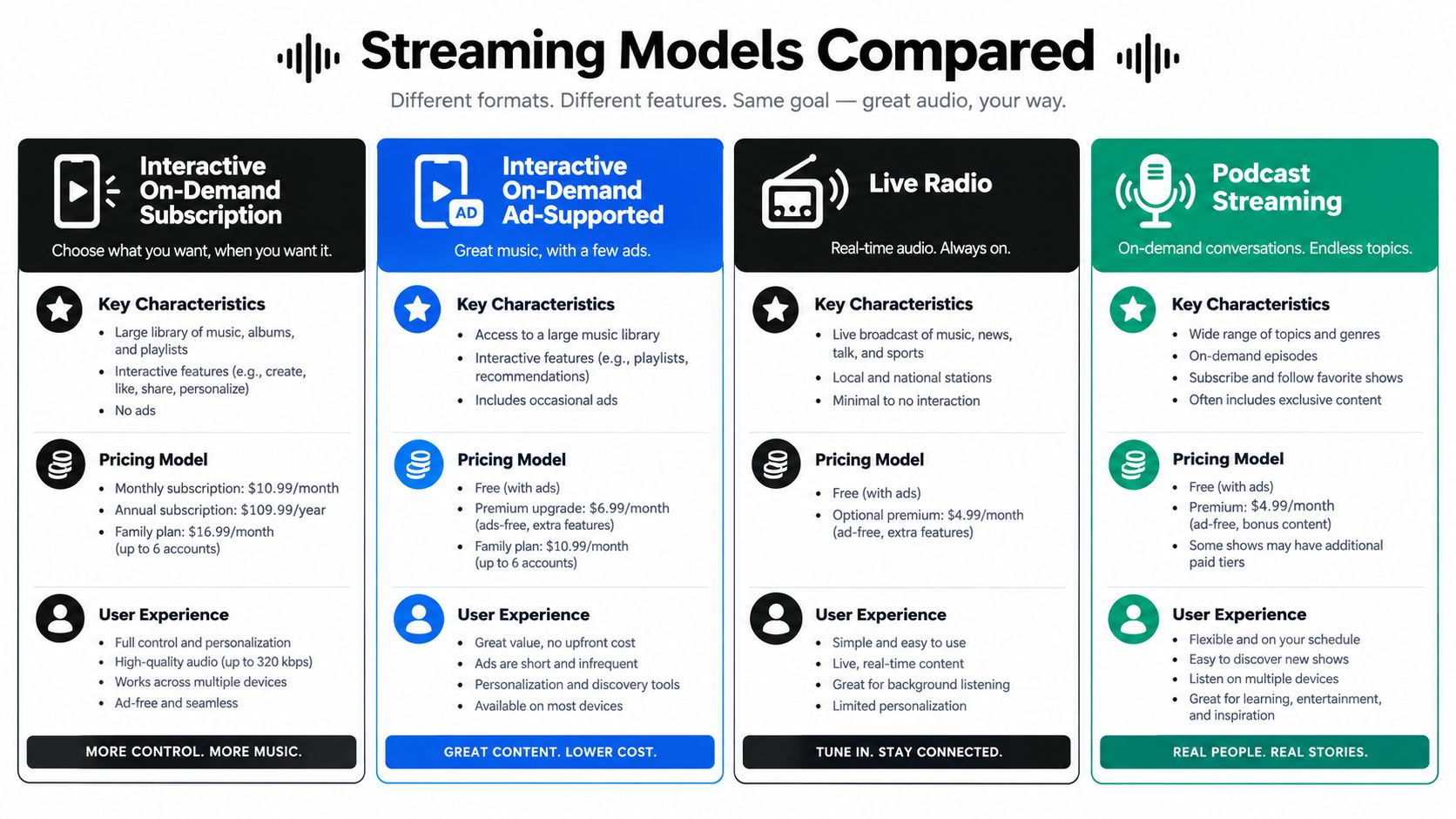
Radio and podcasts are useful comparisons for delivery and audience habits, but they shouldn't be treated as interchangeable music-licensing categories. Evaluate the actual use rather than relying on the word “streaming.”
Match the model to the release
For a release aimed at listeners who already know your name, prioritize whether they can locate and deliberately play the track. For discovery, examine how the service presents unfamiliar music and whether the audience fits your work.
Decision test: Choose a listening model for the behavior you want from fans, then inspect the associated rights and reporting terms.
A producer evaluating a curated or DJ-style experience should ask who controls the sequence and what uses the agreement permits. A manager comparing free and paid access should examine the revenue context rather than treating every play as economically equivalent.
Availability deserves its own check. Confirm territories, account restrictions, and any release-window conditions before promising fans that a track will be accessible everywhere.
What an Artist-First Streaming Stack Looks Like
An artist-first platform should make the connection between listening, relationships, and earnings easier to inspect. A player alone doesn't tell a creator whether listeners can become subscribers, customers, or repeat supporters.
The useful question is whether the platform helps you manage those activities without losing track of the rights and revenue behind them.
Combine access with direct transactions
Streaming and direct sales serve different fan intentions. Someone may want convenient listening today and a paid download, exclusive release, or merchandise purchase later.
The artist tools and monetization options provide one example of bringing uploads, subscriptions, merchandise, downloads, analytics, and promotion into a shared environment. Evaluate that approach alongside your existing distributor, storefront, and community channels rather than assuming every activity must move at once.
- Pricing control: Can you set an offer that matches the content and audience?
- Transaction clarity: Can you distinguish streaming income from purchases and subscriptions?
- Split visibility: Can you trace what collaborators are owed?
- Audience communication: Can supporters hear from you directly after discovering a release?
Commission-free marketplace sales address a different question from streaming allocation. Check exactly which fees a commission-free offer removes, and read the payment and transaction terms before estimating your net proceeds.
For a project that needs funding before release, PledgeBox's resource on how to fund your music project offers a relevant planning starting point. Keep project funding separate from assumptions about future listening income.
Design the relationship after the play
Direct messaging, voice notes, and community posts give artists ways to communicate beyond a listening session. Use them deliberately: explain a release, invite feedback, or share an offer that fits the fan's interest.
Web, iOS, and Android access also deserve practical testing. Check whether fans can move from a promotional post to listening, subscribing, or purchasing without confusing changes in account access or navigation.
A sensible release sequence is to introduce the music, invite interested listeners into a direct relationship, and then present a relevant purchase or subscription. Event promotion and discovery tools can support that sequence without requiring every message to be a sales pitch.
Don't assume a direct transaction always outperforms streaming. Compare actual net receipts, fulfillment obligations, and the effort required to sustain the offer.
Converting Streams Into Sustainable Income
More plays aren't automatically more take-home income. Audience growth matters, but the revenue-pool model means your outcome also depends on relative listening share, ownership, contractual terms, and qualified usage.
Treat the next release as an accounting project as well as a creative project. A track can be available to listeners while your internal records remain incomplete.
Audit what you control
- Own or document the master: Keep the agreement that establishes who controls the recording.
- Resolve the composition: Confirm writing shares and the registrations relevant to your collection arrangements.
- Reconcile metadata: Check that contributor and ownership details match across delivery and rights records.
- Inspect qualified usage: Ask how the service handles eligibility, suspicious activity, and excluded plays.
- Check collaborator payments: Make sure agreed splits appear correctly in your accounting.
- Read the net figure: Separate receipts from deductions and amounts still owed to others.
Use the earlier delivery measurements to investigate playback problems, not to explain every disappointing royalty statement. Conversely, a clean listening experience doesn't establish that your rights records or payment instructions are correct.
For direct offers, examine the music and merchandise marketplace as a separate revenue channel. Track purchases alongside streaming receipts without collapsing them into a misleading average value per listen.
The goal is a system you can inspect: a released recording, documented rights, identifiable usage, understandable allocation, and a payment you can reconcile. You don't control every commercial term, but you can identify which questions remain unanswered before committing more time or promotional spend.
Start with a release you already have. Compare its delivery record, ownership documents, collaborator agreement, and latest statement, then ask your partners to explain any gaps in writing.
OohYeah offers streaming alongside artist subscriptions, downloads, merchandise, and direct fan communication. Visit OohYeah to explore how those options could fit your next release, and compare its artist tools and marketplace terms with the ownership, reporting, and revenue controls you need.