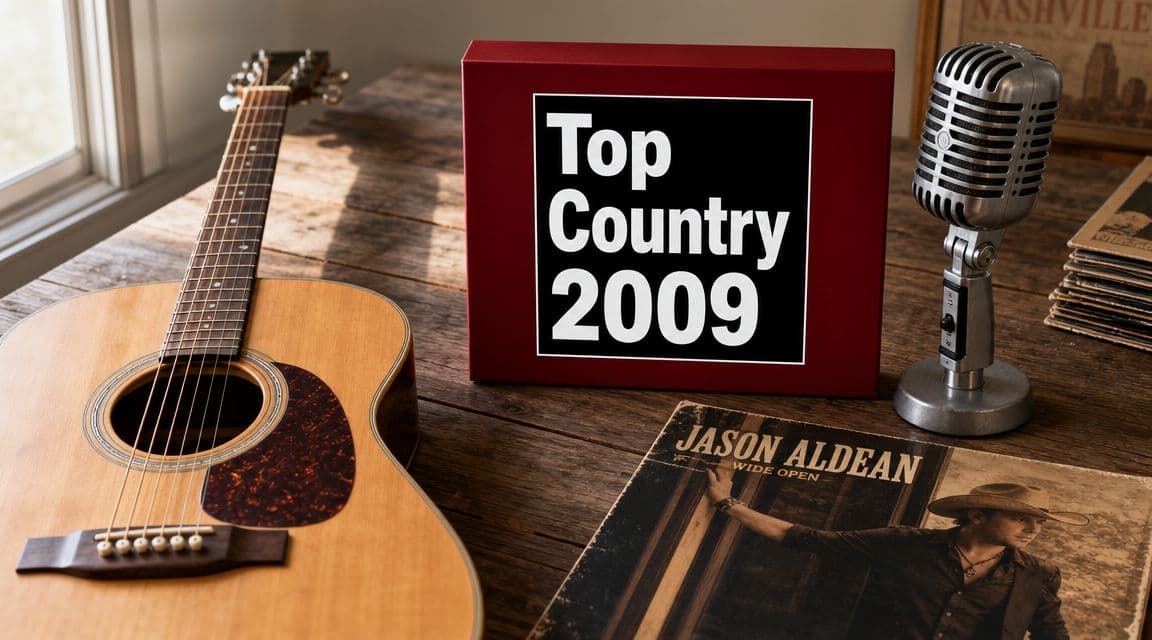
Revisiting Top Country Music 2009: 10 Hits in 2026
Revisit the top country music 2009 hits. Explore the year's biggest crossover tracks and chart-toppers, offering lessons for independent artists in 2026.
May 31, 2026
Music Marketplace Advisor
Buying & SellingTop country music in 2009 is often remembered as a playlist. It works better as a market signal.
Radio still set the pace, and year-end country rankings rewarded songs that held audience attention long enough to become shared culture, not just short bursts of excitement. That distinction matters because 2009 captured country at the point where format loyalty and mass appeal started working together more openly.
The commercial center of the genre was crowded with established names, including Lady Antebellum, Darius Rucker, Dierks Bentley, George Strait, Jason Aldean, Keith Urban, Randy Houser, Billy Currington, and Zac Brown Band. At the same time, crossover pressure from artists such as Taylor Swift made clear that country listeners were responding to concise hooks, vivid storytelling, and production choices that could travel well beyond country radio.
That shift matters more now than the nostalgia does.
For independent artists in 2026, 2009 offers a useful blueprint. The strongest songs from that period did not win by sounding generic or chasing pop for its own sake. They won because they paired clear identity with wide accessibility. That is still the core challenge in the modern music industry.
The practical lesson is straightforward. Write songs that hold up in three places: on a playlist, in a live set, and inside fan conversation. Then build release support around that same idea. A platform like OohYeah! can help artists turn a strong song into repeat engagement through updates, behind-the-scenes content, and direct fan touchpoints that keep the story active after release day.
This list looks at 2009 through that lens: not just which songs were biggest, but which ones revealed a repeatable playbook for modern country growth.
1. You Belong with Me, Taylor Swift
The biggest lesson from “You Belong with Me” is not that country needed to sound more like pop. It is that country could keep its narrative core and still compete in the broader commercial market. Its year-end country placement, as noted earlier, matters because the song operated in two systems at once: country radio rewarded the storytelling, while mainstream audiences responded to the melodic efficiency and instantly legible point of view.
That combination made the song more than a hit. It made it a template.
Swift built the record around social detail a listener could picture immediately. The rival wears the wrong kind of confidence. The narrator notices, compares, and places herself inside a scene that feels specific rather than generic. Then the chorus widens the frame enough for mass identification. That is a useful writing model for independent artists who want reach without sanding off identity.
What independent artists should study
The songwriting succeeds because every element has a job. The verses establish character and tension. The chorus converts that tension into a simple, repeatable claim. The production supports the shift instead of competing with it.
A modern artist can apply the same logic in a more fragmented release environment:
- Write from a visible scene: Concrete settings and recognizable social dynamics travel better than abstract emotion.
- Make the chorus summarize the conflict: Listeners should understand what is at stake by the first hook.
- Arrange for lift, not clutter: Hold back in the verse, then widen the sound in the chorus so the emotional change is audible.
- Use OohYeah! to extend character, not just promote the track: Share a demo voice note, lyric backstory, or alternate acoustic take that reinforces the narrator's perspective.
One practical test helps here. If a new listener can explain the song's relationship dynamic after one play, the writing is strong enough to cross formats.
That is the blueprint hidden inside “You Belong with Me.” Independent artists do not need label scale to use it. They need a clear protagonist, a chorus with immediate recall, and a release plan that keeps the song's world active after launch. OohYeah! is useful in that last step because it gives artists a place to turn one strong single into recurring fan contact instead of a one-week spike.
2. Love Story, Taylor Swift
Many “best of 2009” lists blur popularity, memory, and retrospective taste. That's why they can feel persuasive while still being analytically weak. One example is the mismatch between broad nostalgia lists and actual chart outcomes. A retrospective may place “Need You Now” near the very top, while the historical chart picture shows “I Run to You” finishing No. 1 on Billboard's year-end country list because “Need You Now” was still climbing during 2009 rather than dominating the full year, a distinction highlighted in this analysis of how 2009 country songs are commonly ranked.
“Love Story” sits at the center of that conversation because it remained culturally huge across the period and helped normalize narrative-heavy country-pop writing. It proved a country song could feel cinematic without losing its hook discipline.
The blueprint hidden inside the songwriting
What independent writers should study is the architecture. The song feels simple on first listen, but its emotional sequencing is disciplined. Setup comes early. Conflict arrives fast. Resolution lands clearly.
That structure is useful if you're writing for short-form discovery and long-form fan retention at the same time.
- Start with a premise listeners can repeat: A high-concept hook is easier to remember than a mood piece.
- Give the chorus a job: It should resolve tension, not just restate the title.
- Turn process into content: If you're building a story song, OohYeah! lets you release early lyric fragments, inspiration notes, or alternate choruses for paying supporters.
Here's a visual that fits the mood of that era's acoustic-meets-mainstream country writing:

A smart modern application is to write a song inspired by a historical figure, local legend, or family story, then serialize the buildup around it. Fans don't just want the release date. They want a reason to care before the drop.
3. I'm Yours, Jason Mraz
“I'm Yours” isn't a country chart story in the strict sense. It's more useful as a signal. By 2009, country listeners were clearly open to acoustic warmth and relaxed phrasing even when the source material came from outside the genre. That matters because one of the least-discussed lessons from top country music 2009 is how porous the audience's ears had become.
For an independent artist, this opens a strategic lane that still works in 2026. You don't need to choose between “pure country” and “not country enough.” You need to understand what elements country audiences consistently welcome: conversational vocals, string-led arrangements, and songs that feel playable in a room.
Use covers as market research
A cover can be a gimmick, but it can also be a diagnostic tool. If you strip a pop song down to acoustic guitar, mandolin, brushed percussion, or harmony vocals and it still feels natural, you've learned something about your own artistic lane.
Try this approach:
- Pick songs with strong bones: Melody and lyric matter more than trend value.
- Change the frame completely: A front-porch arrangement reveals more than a copy of the original production.
- Ask your audience directly: On OohYeah!, send a message to supporters asking which cover they'd like to hear next, then pair that cover with an original song built for the same emotional audience.
An artist playing weekend sets can use this especially well. Add one unexpected acoustic cover into the set, watch what people record, request, or sing back, then write your next original with that response in mind. That's audience development, not guesswork.
4. American Ride, Toby Keith
In a year remembered for crossover movement, Toby Keith represented something just as important. Centeredness. “American Ride” reminds you that 2009 country didn't move toward pop because traditional instincts vanished. It moved because the commercial middle widened enough to support multiple kinds of records at once.
That's a critical correction for modern artists. The wrong takeaway from top country music 2009 is that you have to smooth out every edge to grow. Sometimes the better path is to sharpen your identity so clearly that fans know exactly what they're getting.
Niche clarity beats imitation
Topical writing still works when it sounds like it came from a real person with a real worldview. That doesn't mean chasing controversy. It means saying something recognizable in your own language.
A few ways to put that into practice:
- Write from lived geography: Songs rooted in your town, region, job, or social scene often cut through more than generic “country lifestyle” language.
- Reward the core audience first: Use OohYeah! subscriptions for acoustic takes, rough drafts, or exclusive merch aimed at the listeners who value your traditional side.
- Merchandise the stance: If your songs stand for a specific sensibility, your shirts, posters, and community posts should reinforce it.
Here's an image that fits that stripped-back, player-first frame many listeners still associate with durable country songs:

One of the easiest mistakes independent artists make is building for everyone at once. The artists who last usually know which room they own first.
5. People Are Crazy, Billy Currington
Some songs survive every format change because they deliver what listeners remember: a story. “People Are Crazy” stands out in the 2009 conversation because it shows how little production flash you need when the writing carries emotional momentum and a payoff.
Many modern releases often miss the mark. They sound polished, but nothing happens in them. Country fans often forgive sonic simplicity faster than they forgive narrative emptiness.
The story-song test
Before releasing a narrative song, ask whether someone could retell it after one listen. If they can't, the issue usually isn't the mix. It's the sequence of information.
Use this quick filter in your own writing:
- Beginning: Who's talking, and where are we?
- Middle: What changes in the conversation or relationship?
- End: What lands emotionally, and why will a listener repeat it to a friend?
A simple arrangement makes every lyric more exposed. That's a risk, but it's also an advantage if the writing is strong.
For OohYeah!, this kind of song creates great direct-to-fan content. Post a voice note explaining the actual bar conversation, family memory, or overheard line that sparked the track. Then release a “writer's cut” demo with fewer instruments. Story-song listeners usually want proximity to the writing process, not just the final master.
A practical example is a solo artist who tests unreleased songs in writers' rounds, notices where the room goes quiet, and adjusts the reveal in the last verse before recording. That's old-school country discipline. It's still one of the best competitive advantages available.
6. Whatever It Is, Zac Brown Band
“Whatever It Is” matters because it shows what crossover looked like before crossover became a branding strategy. Zac Brown Band did not chase pop by stripping out country detail. They kept the acoustic texture, the group feel, and the easy Southern phrasing, then packaged it in a melody soft enough for broader radio and casual listeners.
That balance is harder than it sounds. Many independent artists either overcorrect toward polish or protect their authenticity so aggressively that the music stays niche. Zac Brown Band found the middle. The song feels warm, professional, and widely playable without losing its identity.
Bands should sell chemistry as a product
For modern independent acts, the lesson is less about copying the arrangement and more about making musicianship visible. A strong band has an advantage solo artists do not. Listeners can hear interaction, and fans can follow relationships inside the performance.
Use that on purpose:
- Show musical conversation: Post live clips where harmony parts, rhythm changes, and fills are easy to see and hear.
- Release multiple formats: On OohYeah!, share a polished master, a rehearsal take, and a member commentary version that explains why the groove works.
- Give each player a role in the story: Fans stay longer when they know who shapes the vocal blend, who writes the hooks, or who gives the song its rhythmic identity.
2009 rewarded songs that could travel across contexts. “Whatever It Is” worked on country radio, in live rooms, and with listeners who did not think of themselves as genre specialists. That is a useful model now. If your band wants wider reach, make the entry point simple and the musicianship repeatable.
A practical test is straightforward. Ask whether a new listener can describe your band in one sentence after watching a performance clip. If the answer is vague, the issue may not be the song. It may be that your chemistry is audible in person but invisible online. OohYeah! gives bands a way to fix that with recurring rehearsal footage, player spotlights, and alternate versions that turn arrangement choices into fan-facing content.
7. Single Ladies (Put a Ring on It), Beyoncé
This isn't a country hit. It is, however, part of the cultural environment country artists had to respond to in 2009. If you want to understand top country music 2009 as a working ecosystem instead of a genre silo, songs like “Single Ladies” matter because they shaped what audiences danced to, referenced, and brought into weddings, bars, and cover sets.
That cross-pressure still exists. Fans don't consume music by industry category alone. They build their own mixed soundtracks.
Borrow energy, not identity
A lot of artists mishandle outside influence by copying surface details. The smarter move is to ask what a huge pop record is doing emotionally. Is it assertive? Minimal? Hook-first? Built around a chantable phrase?
Don't copy the outfit of another genre. Copy the function the song performs for listeners.
For a country artist, that might mean writing a more rhythmic chorus, a stronger call-and-response line, or a performance-focused bridge that lands harder in a live room. It doesn't require abandoning fiddle, steel, or story. It requires understanding momentum.
On OohYeah!, you can test that in public without fully repositioning your brand. Share a short acoustic reinterpretation of a major pop song, then release an original that channels the same confidence or energy. If fans respond to both, you've found a bridge worth building.
That's especially useful for acts playing weddings, fairs, and mixed-format gigs. Versatility isn't compromise. For many independent artists, it's revenue strategy.
8. Poker Face, Lady Gaga
“Poker Face” became one of those songs musicians kept trying to translate into different genres because the core writing could survive rearrangement. That made it a useful template for country and acoustic reinterpretation, especially in an era when online video and stripped-down performances were becoming discovery tools for independent artists.
The lesson here isn't that every pop smash can become a great country cover. It's that songs with strong melodic contour and clear tension often reveal new meaning when production is removed.
A smart cover has a purpose
Too many artists post covers that don't lead anywhere. If you're going to cover a pop hit, decide what the cover is supposed to do. Is it bringing in new listeners? Showing your vocal range? Teaching your audience how you hear arrangement?
Keep the strategy clean:
- Choose contrast: The more electronic the original, the more room you often have to recast it acoustically.
- Make licensing part of the workflow: Secure the proper permissions before release.
- Track fan behavior: OohYeah! analytics can help you see whether a cover brings in casual listeners who later click into your originals.
A strong rollout might pair one recognizable cover with two originals on the same profile page. The cover gets the first click. The originals determine whether anyone stays.
That's the blueprint many independent artists miss. Discovery content and identity content shouldn't live in separate universes. They should feed each other.
9. I Gotta Feeling, The Black Eyed Peas
By 2009, the average country fan's real listening life was broader than genre marketing suggested. “I Gotta Feeling” belonged to that reality. It functioned as an event song, the kind of track people associated with weddings, parties, festivals, and communal release. Country performers and DJs couldn't ignore records like that because audiences brought them into the room whether the genre gatekeepers liked it or not.
This matters for independent artists who make their living on stage. A song can matter to your business even if it doesn't match your recording identity.
Understand the job your set list needs to do
There's a difference between a song listeners admire and a song that resets the energy in a room. Working artists need both.
Think in terms of function:
- Listening songs: Build trust and depth.
- Singalong songs: Increase audience participation.
- Celebration songs: Lift the room and make the night memorable.
A country cover band playing weddings already knows this intuitively. An original artist should know it too. If your encore slot always falls flat, the issue may not be your talent. It may be that you never wrote or selected a true release-valve song.
On OohYeah!, you can organize this clearly with mood-based playlists such as “Friday Night,” “Back Porch,” or “After the Bar.” That helps fans, promoters, and event buyers understand your range fast. Packaging matters almost as much as repertoire when people are deciding whether to book, follow, or subscribe.
10. Dead and Gone, T.I. featuring Justin Timberlake
A lot of later country crossover trends look less surprising when you revisit the broader Southern listening environment of 2009. “Dead and Gone” matters in that context because it points to a shared emotional language across genres: reflection, regret, gravity, and a Southern sense of place that listeners recognized even when the production sat outside country.
That's useful for modern artists because it reframes collaboration. Genre blending works best when the overlap is cultural or narrative first, sonic second.
Cross-genre collaboration works when the themes align
If you're a country artist considering a collaboration with a rapper, soul singer, or indie songwriter, start with the shared subject matter. Home. Loss. Escape. Faith. Pride. Family strain. Those themes travel better than borrowed aesthetics.
The larger 2009 chart picture supports this idea. Billboard recorded 30 different weekly No. 1 songs across 52 issues of Hot Country Songs in 2009, a sign of rapid turnover and a highly active radio market rather than one monopolized by a tiny handful of records. For an independent artist, the modern takeaway is clear. You don't need to look identical to compete. Distinct songs can break through when they meet listeners at the right emotional angle.
A practical move is to find one collaborator outside your immediate lane and build around a theme both of you can claim. Then document the process on OohYeah! with studio clips, voice notes, and community updates so fans understand why the collaboration exists.
Here's the image that matches that wider Southern frame, rooted in place but open to hybrid forms:

2009 Top 10 Country: Crossover Comparison
| Song | 🔄 Implementation Complexity | ⚡ Resource Requirements | 📊 Expected Outcomes | 💡 Ideal Use Cases | ⭐ Key Advantages |
|---|---|---|---|---|---|
| You Belong with Me - Taylor Swift | High, multi-stage production and narrative video | High, professional studio, video budget, heavy promotion | Very high crossover chart success; strong streaming & cultural impact | Mainstream crossover campaigns; narrative-driven releases | Proven crossover blueprint; strong cultural recognition |
| Love Story - Taylor Swift | Medium‑High, polished, high‑concept narrative production | Medium‑High, studio, instrumentation, coordinated promotion | Sustained radio longevity; broad demographic appeal | High‑concept singles; songwriter showcases | Timeless narrative template; educational for writers |
| I'm Yours - Jason Mraz | Low, simple, acoustic‑friendly arrangement | Low, minimal production; live‑ready setup | Moderate streaming and live traction; easy to adapt | Intimate gigs, streaming sessions, fan workshops | Highly adaptable; low production cost; authentic vibe |
| American Ride - Toby Keith | Medium, traditional arrangement with topical songwriting | Medium, band/producer and targeted promotion | Strong core country chart performance; niche loyalty | Traditional country releases; topical commentary songs | Clear artistic identity; loyal audience engagement |
| People Are Crazy - Billy Currington | Low‑Medium, simple production but high songwriting demand | Low, acoustic recording; modest promotion | High emotional resonance and shareability; awards potential | Writers' rounds, narrative singles, storytelling showcases | Songwriting-driven impact; low production barrier |
| Whatever It Is - Zac Brown Band | High, complex band arrangements and instrumental interplay | High, skilled musicians, multi‑instrument recording | Strong chart and live performance success; cements band brand | Band-led releases; live performance and musicianship showcases | Instrumental virtuosity; strong live draw |
| Single Ladies - Beyoncé (Country Influence) | Medium, requires creative rearrangement to recontextualize | Low‑Medium, arrangement changes and social promotion | High viral exposure and trend-driven engagement when reimagined | Viral covers, trend hijacking, audience expansion | Irresistible hook; high user‑generated content potential |
| Poker Face - Lady Gaga (Country Cover Trend) | Low, minimal production for stripped‑down covers | Low, acoustic/banjo arrangements; simple recording | Moderate discovery boosts; high recognizability but crowded market | YouTube covers, quick‑release content, discovery feeds | Highly recognizable; versatile arrangement options (license needed) |
| I Gotta Feeling - The Black Eyed Peas | Low‑Medium, high‑energy arrangement for events | Low, band/DJ setups; licensing opportunities | High bookings/licensing revenue; broad event appeal | Weddings, festivals, party sets; event‑focused acts | Universal celebratory energy; lucrative event market |
| Dead and Gone - T.I. ft. Justin Timberlake | High, cross‑genre authenticity and collaboration logistics | Medium‑High, featured artists, production coordination | Moderate‑High audience expansion; potential for controversy | Cross‑genre collaborations; regional Southern projects | Cross‑pollinates fanbases; collaboration showcases diverse appeal |
2009's Legacy and Your Blueprint for Modern Country Success
The most useful way to read top country music 2009 isn't as a museum exhibit. It's as a market signal. The year showed that country could stay commercially centered while absorbing pop structure, crossover personalities, and broader cultural influence. It also showed that listeners didn't reward genre purity by itself. They rewarded songs that felt clear, memorable, and emotionally usable in everyday life.
That's why 2009 still offers such a practical blueprint for independent artists. Taylor Swift's crossover presence pointed to the value of narrative precision. Zac Brown Band showed that musicianship could be polished without feeling distant. Billy Currington proved that story still wins when the writing lands. Toby Keith showed that a sharply defined traditional identity could still command attention during a period of stylistic change. The non-country entries on this list matter too, because they remind you that fans compare your music to everything else they hear, not just to songs in your genre lane.
There's another reason the year remains instructive. The broader chart environment was active, not static. The hits changed often, and that kind of turnover rewards artists who can release with purpose, stay visible, and keep different audience doors open at once. In practical terms, that means you shouldn't build your whole strategy around one version of yourself. Have the polished single. Have the acoustic cut. Have the live clip. Have the story behind the song.
For OohYeah! users, that approach is especially strong because the platform supports more than a single upload-and-wait model. You can release a track, sell a subscriber-only alternate version, post a voice note about the lyric, message fans directly, and organize music into playlists that clarify your brand. That's the modern version of what 2009's biggest country records understood instinctively: songs don't spread only because they're good. They spread because they're easy to connect with, easy to remember, and easy to place inside a listener's life.
A smart exercise is to build your own “2009 Country Crossover” playlist. Include these songs, then add two or three of your own tracks that share their strongest traits: sharp storytelling, crossover-ready hooks, band chemistry, or event energy. Once the playlist exists, explain why each song made the cut. That explanation is content. It tells fans what you hear, what you value, and where your music fits.
The artists who learn most from 2009 won't copy its sound. They'll copy its discipline. Write clearly. Package deliberately. Expand carefully. Stay recognizable.
If you want to turn those lessons into a working release strategy, OohYeah gives you the tools to do it in one place. You can upload music, sell merch, offer subscriptions, share voice notes, post community updates, and build direct fan relationships without handing the whole experience to intermediaries. For independent country artists trying to turn songs into sustainable careers, that's a practical home base.