Taylor Swift Bluebird Cafe: Career Launch & Lessons 2026
Explore the pivotal taylor swift bluebird cafe debut and its impact on her career. Get actionable lessons for indie artists in 2026 to launch your own success
June 16, 2026
Music Marketplace Advisor
Buying & SellingA teenager walks into a strip mall club in Nashville with a guitar and songs that still have more ambition than mileage. Years later, that same room becomes one of the most durable symbols in pop music's modern origin story.
An Unknown Teenager on a Legendary Stage
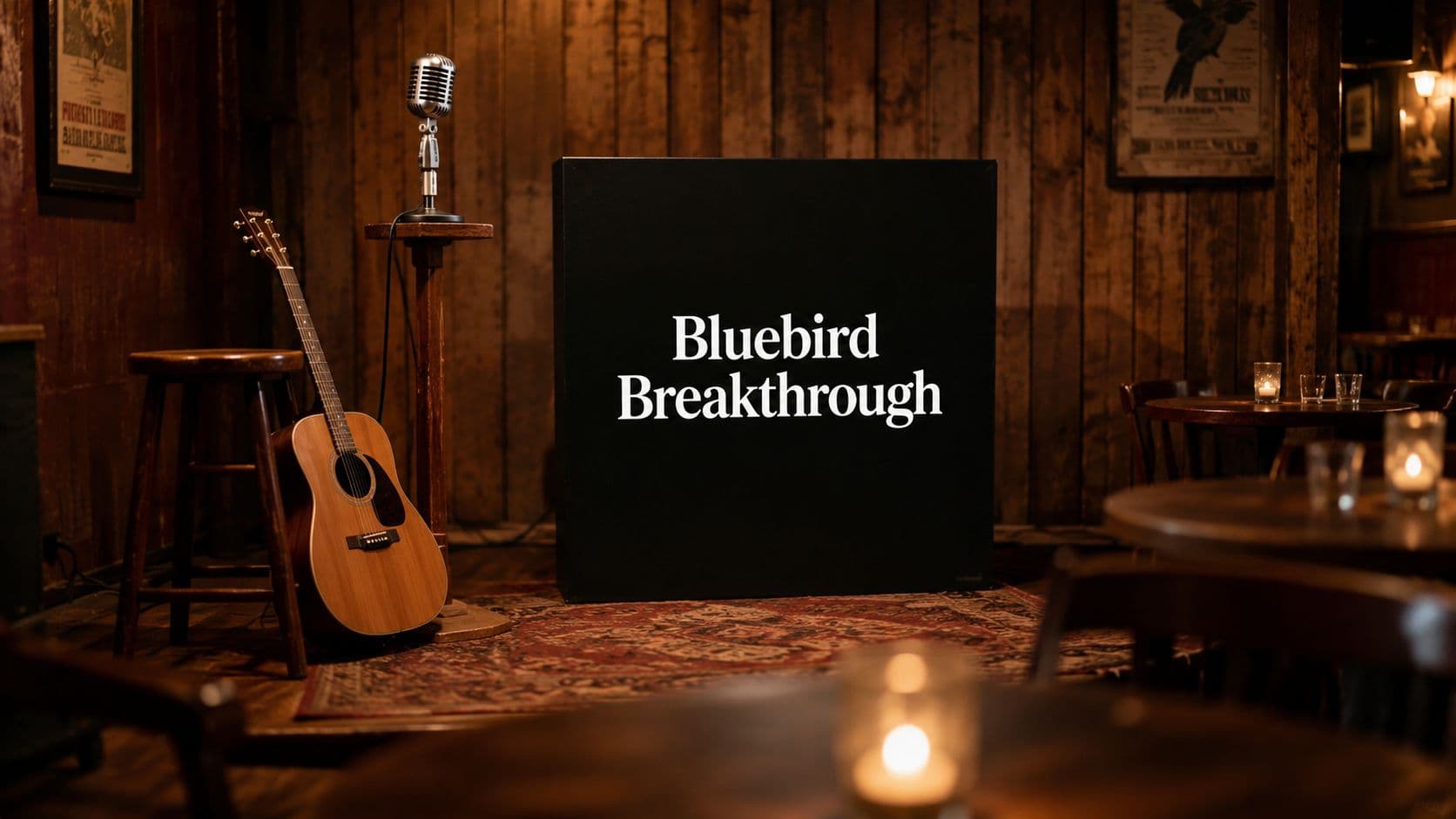
On an ordinary night in Nashville, the Bluebird Cafe can feel almost too small for the weight people later place on it. The room sits in a strip mall. The stage is close. The audience is closer. A songwriter walks in with a guitar, and there is nowhere to hide.

That setting matters to the Taylor Swift story more than the legend usually allows. Before the stadiums, before the carefully managed iconography, she was a young writer stepping into one of Nashville's most respected listening rooms. The Bluebird itself has long been known as a place where songs get tested in public, often in the round, with every lyric exposed to a crowd that listens.
For a teenager, that is a hard room in the best sense.
The Bluebird does not reward volume or theatrics. It rewards detail. A clever turn of phrase gets a murmur. A strong chorus holds the room still. A weak line hangs in the air with nowhere to go. Artists leave with a clearer sense of what their songs can do, and what they still need to learn.
That is why Swift's early Bluebird appearance remains useful as more than fan mythology. The significance lies in the kind of stage it was. Small, intimate venues like this often function as proving grounds for developing artists, the same way a well-run creator platform can serve as an early test market now. For young musicians building careers through close communities, direct feedback, and repeat appearances, the lesson is plain. Start where the audience can hear the writing.
A room that magnifies everything
At the Bluebird, intimacy is the whole point. The room magnifies strengths and exposes shortcuts. An artist cannot count on production, lighting, or distance to smooth over a song that is not ready. That pressure has shaped generations of Nashville writers, and it helps explain why one early appearance there carries so much symbolic force in Swift's story.
Young artists should pay attention to that part.
Career momentum rarely begins with scale. It begins with trust, earned a few listeners at a time, in rooms where the work itself has to carry the night. For Swift, the Bluebird became one of those rooms. For an independent artist now, that room might be a local listening venue, a writers' round, or a digital space such as OohYeah where a small but engaged audience can respond in real time.
The principle stays the same. Go where the song gets heard clearly.
The Performance That Launched a Career
On a stage built for writers, a teenager walked into one of Nashville's most closely watched rooms and had nowhere to hide. No arena production. No band loud enough to cover weak lines. At the Bluebird, the song had to do the work.
By that point, Taylor Swift was already putting herself in rooms where writing mattered. What turned this appearance into career folklore was the combination of setting, timing, and witness. The Bluebird Cafe's own timeline says DreamWorks Records executive Scott Borchetta saw Swift perform there at 15, then invited her into the new venture that became Big Machine Label Group, as documented on the Bluebird's Taylor Swift timeline.

A performance, not a myth
That distinction matters for young artists. Borchetta did not respond to buzz in the abstract. He saw a writer present her songs in a room known for close listening, and he made a business decision from live evidence.
That is what makes the Bluebird story useful as a case study instead of just a fan favorite. A small venue can change a career when three things line up. The material is ready, the room is trusted, and the right person gets a clear look at the artist.
Swift's set at the Bluebird sits at that exact intersection.
Why this room could change the outcome
Plenty of artists play to bigger crowds and leave with less to show for it. A listening room like the Bluebird works differently. The audience is there for songs, industry people know the venue's standards, and every lyric lands without much interference.
For an emerging artist, that kind of room can do something a louder club often cannot. It lets decision-makers assess the part that lasts longest in a career. The writing.
That point carries straight into the present. Independent artists still need rooms, physical or digital, where the work is heard clearly. A writers' round can serve that purpose. So can a focused creator platform such as OohYeah, where a small but responsive audience gives an artist usable feedback and early proof of connection.
Practical rule: Put your strongest songs in settings that reward attention.
What independent musicians should study here
The most useful lesson inside the Bluebird story is not “wait for an executive to appear.” It is “build a performance that holds up when the room gets quiet.”
Swift gave the room something specific to react to. Original songs. A clear point of view. Enough command to make a gatekeeper stay focused.
For indie musicians, the takeaway is concrete:
| Element | What artists can apply now |
|---|---|
| Original material | Lead with songs that show authorship, not just vocal ability |
| Listening-room context | Choose venues or platforms where people come to pay attention |
| Repeat exposure | Keep showing up in credible spaces until the right people can see your growth |
| Clear next step | Make it easy for interested listeners, collaborators, or managers to follow up |
A career rarely turns on scale first. It turns on clarity. Swift's Bluebird performance became part of music business lore because the room made her strengths visible, and someone in the audience knew what to do with what he saw.
A clip helps capture how central the room remains to Swift's public story.
Understanding the Bluebird Cafe's Power
A room doesn't gain influence just because famous people passed through it. It gains influence because people in the business trust what happens there. The Bluebird Cafe became powerful by functioning as a filter.
The club is a 90-seat venue in Green Hills that welcomes over 70,000 visitors annually, a striking combination of tiny capacity and heavy traffic that helps explain why it became such a consequential stop for songwriter discovery in Nashville, according to the Bluebird Café overview.

Why small can be stronger
For artists raised on social metrics, a venue this small can seem almost strategically irrelevant. That's the trap. In a room like the Bluebird, scarcity increases attention.
A listening room works differently from a general nightlife venue. People come to hear songs. Industry professionals can evaluate a writer without sifting through layers of production. Fans can remember a lyric because the room gives it space.
That creates a different kind of advantage than mass exposure. It creates signal.
The Bluebird as a gatekeeper
The Bluebird's status didn't come from volume. It came from curation. If a respected room is known for serious songwriting, then a performance there carries context before the artist even begins. People assume a baseline level of craft. That doesn't guarantee a breakthrough, but it changes the frame.
The best way to think about it is through function rather than romance:
- It concentrates attention. Listeners aren't half-watching.
- It rewards songs over spectacle. Writers can win on substance.
- It lowers evaluation noise. A&R ears hear the material clearly.
- It adds credibility. The room's reputation rubs off on the artist.
A trusted small room can do work that a larger anonymous venue can't. It can tell the industry, “This artist is worth listening to.”
A venue as infrastructure
The Taylor Swift Bluebird Cafe connection is more than a fan anecdote. The venue served as infrastructure for discovery. It created conditions where performance could translate into career movement.
That idea matters far beyond Nashville. Every music scene has its own version of this, though not always in the form of a physical room. Sometimes it's a respected writer's round, a niche festival stage, a tastemaker showcase, or a digital platform where serious listeners and professionals pay close attention.
For independent musicians, the question isn't “How do I get in front of the largest crowd possible?” It's often “Where can my work be heard with the least distortion and the highest trust?”
The Enduring Legacy and Surprise Returns
Years after the first Bluebird chapter entered country-pop lore, Swift walked back into the same kind of room and made the mythology feel physical again. No giant stage. No stadium screens. Just a songwriter, a close audience, and the kind of hush that only exists when people know every word matters.
That return mattered because it showed something fans and young artists often miss. Career stories are built twice. First in the moment, then again in the way an artist revisits the moment later.
Why the return resonated
By the time Swift came back to the Bluebird, the room itself had become part of her public story. Seeing her in an intimate venue again sharpened the contrast with the scale of her later fame, but the deeper point was artistic rather than symbolic. In a room like that, songs have nowhere to hide. The writing has to carry the night.
For fans, the scene felt like a callback to the earliest version of Taylor Swift. For working musicians, it offered a more practical lesson. Returning to a formative venue can reinforce your identity more effectively than another polished press statement or nostalgic social post.
Swift's Bluebird returns underscored four useful ideas:
- Origins matter when you keep them visible. Early rooms can remain part of your story long after your audience grows.
- Songcraft survives scale. A writer who can hold a listening room can still command attention without production.
- Symbolic choices shape perception. Playing a respected small venue sends a stronger message than talking about authenticity.
- Repetition builds narrative memory. A career milestone gains meaning when an artist revisits it in public.
A small room can become a long-term asset
Independent artists should pay attention here. The Bluebird was not just a place where something happened once. It became a recurring setting that helped frame Swift as a serious songwriter across different stages of fame.
That is the part many "discovery" stories leave out.
A trusted venue can keep working for you after the first breakthrough if you treat it as part of your artistic identity. Maybe your version is a writers' round in Nashville, a listening room in Austin, a DIY space in Brooklyn, or a digital home for early supporters on a platform like OohYeah. The principle stays the same. If a space helped people understand your work clearly the first time, it can help reinforce that understanding later.
The caution inside the legend
The Bluebird story still gets flattened into a fairy tale about one magic night. That version is tidy, but it teaches almost nothing. Careers usually grow through repeated exposure, strong material, good timing, and smart positioning.
Swift's surprise returns give the fuller lesson. She did not outgrow the room that helped define her. She used it again, publicly, to remind people what sat underneath the fame. For young artists, that is the key takeaway. Do not abandon the small stages that taught audiences how to listen to you. If the room fits your voice, revisit it. Let the setting keep telling the truth about the songs.
The Bluebird Blueprint Lessons for Indie Artists
A songwriter walks into a 90-seat room with one guitar, three songs, and no light show to hide behind. By the end of the night, the right ten people know her name. That is the part of the Bluebird story young artists should study.
Small rooms can work as career accelerators when the room has trust, the audience listens, and the songs hold up without decoration. Swift's early Bluebird chapter is often told as a lucky break. For working musicians, it reads better as a repeatable pattern. Put strong material in a respected setting, give people a clear read on who you are, and make it easy for that impression to travel.

Choose signal over size
A packed bar can look like momentum and still do very little for an artist. People talk through the verses, the staff treats the set like background noise, and nobody remembers a line on the way out. A listening room with half that attendance can do far more if the crowd came to hear songs.
Use a stricter filter when you evaluate venues:
| Question | What you're looking for |
|---|---|
| Do people actually listen? | A room where songs can hold attention |
| Is original music respected there? | A culture that values writers, not just covers or background entertainment |
| Who attends regularly? | Fellow artists, local tastemakers, managers, promoters, or dedicated fans |
| What does the venue's brand say about you? | Credibility by association |
Young artists ask me about capacity all the time. I ask about context. The better question is whether the room helps strangers understand you in one set.
Build a set that survives silence
The Bluebird model rewards songs with a spine. If your chorus only lands when the track drops and the lights hit, you have more work to do.
Test your material in stripped-back form before you pitch listening-room shows. Play the song with one instrument. Speak the first verse out loud. Check whether the hook still feels inevitable, whether the title earns its place, whether the emotional turn is clear by the second minute.
A set for this kind of room needs craft in specific places:
- Your opening song: Start with the song that introduces your voice and point of view fastest.
- Your transitions: In quiet rooms, rambling between songs drains momentum.
- Your strongest lyric moments: Give important lines enough space to register.
- Your dynamics: Contrast matters more when the room is close enough to hear a breath.
Artists who learn this early carry that skill everywhere. It helps in writers' rounds, radio spots, acoustic sessions, fan events, and showcase sets where nobody owes you their attention.
Treat every small show like a professional proof point
An intimate gig exposes habits fast. If the tuning is sloppy, people hear it. If the story before the song wanders, people feel it. If the chorus hits, you can watch the room change in real time.
That is why these nights matter.
Approach them like documents of who you are as an artist:
- Arrive ready for conversation. In songwriter rooms, listeners often ask what the song means, what you are releasing next, or where else they can see you.
- Know your next step. Have one clear answer for where people should go after the set, whether that is your mailing list, your next date, or a direct-to-fan platform.
- Document the night well. One strong clip from a focused room says more than a dozen noisy bar videos.
- Follow up while the memory is fresh. If you met a booker, producer, or potential collaborator, send a short note the next day.
A tiny show isn't just practice. Sometimes it is the main event.
Build your own modern Bluebird effect
You do not need Nashville, and you do not need a famous room. You need the conditions that made rooms like the Bluebird matter in the first place. Attention, context, and proximity.
For some artists, that means a respected writers' round or a listening room that trains audiences to hush when the verse starts. For bands, it may mean booking a stripped-back residency that proves the songs can carry the night without full-volume impact. For online-first acts, it can mean creating a digital version of that same intimacy on a platform like OohYeah, where fans can gather around the work directly instead of skimming past it in a crowded feed.
The goal is simple. Put your songs in spaces, physical or digital, where people can hear what makes them yours.
Think in conversions, not applause
The artists who grow from rooms like this do not judge the night by noise alone. They judge it by what changed after the last song.
Ask better questions on the drive home:
- Did new listeners understand your artistic identity?
- Did anyone ask where to find more music or when you are playing next?
- Did the set create a relationship you can build on?
- Did you leave with a useful clip, a new contact, or a return invitation?
That is how a modest venue becomes part of a career plan. Swift's Bluebird story lasts because it offers more than mythology. It shows independent artists how a small stage, handled well, can become a serious piece of infrastructure.
For the Fans Experiencing the Bluebird Magic
Fans often arrive at the Bluebird wanting to stand near a story. That's natural. The room carries a kind of creative residue, especially if you've spent years hearing about Taylor Swift's early connection to it.
But you'll get more out of the experience if you treat the venue as a living songwriting culture, not just a shrine.
What to expect when you go
The Bluebird's reputation rests on attention. If you're lucky enough to get in, expect a room where songs come first. Listen closely. Notice how little it takes for a line to land when the room is quiet and the audience is in step with the performer.
A few habits will help you fit the setting:
- Arrive ready to listen: This isn't the place for running commentary through the set.
- Respect the intimacy: You're close enough to affect the room's energy.
- Stay curious about the full lineup: The next artist you hear could be building the earliest chapter of a future career.
- Let go of the souvenir mindset: The best takeaway may be a song you didn't know before you walked in.
See the venue beyond one legend
The Bluebird is a celebrated origin point in Swift's story, but it's also fair to question how much any single venue should be credited versus seeing it as one stop within a broader Nashville development pipeline, a nuance explored in TheWrap's discussion of the Bluebird mythology.
That's not a demotion of the Bluebird. It makes the place more interesting. It asks fans to appreciate the venue not just because one superstar passed through it, but because it continues to do the quieter work of presenting songwriters in a room where songs still matter.
If you're chasing the Taylor Swift Bluebird Cafe aura, look for that deeper experience. Listen for the unfinished edges, the songs still in motion, the writers who don't yet have a mythology around them. That's where the room still does its best work.
OohYeah helps artists build their own version of that small-room, high-signal momentum in a modern format. On OohYeah, creators can share music, sell directly, connect with fans, and keep control over how their work reaches the people who care about it. If you're an independent artist looking for a smarter bridge between discovery, monetization, and direct audience connection, it's worth exploring.