Your Guide to Submit to SXSW and Get Your Music Noticed
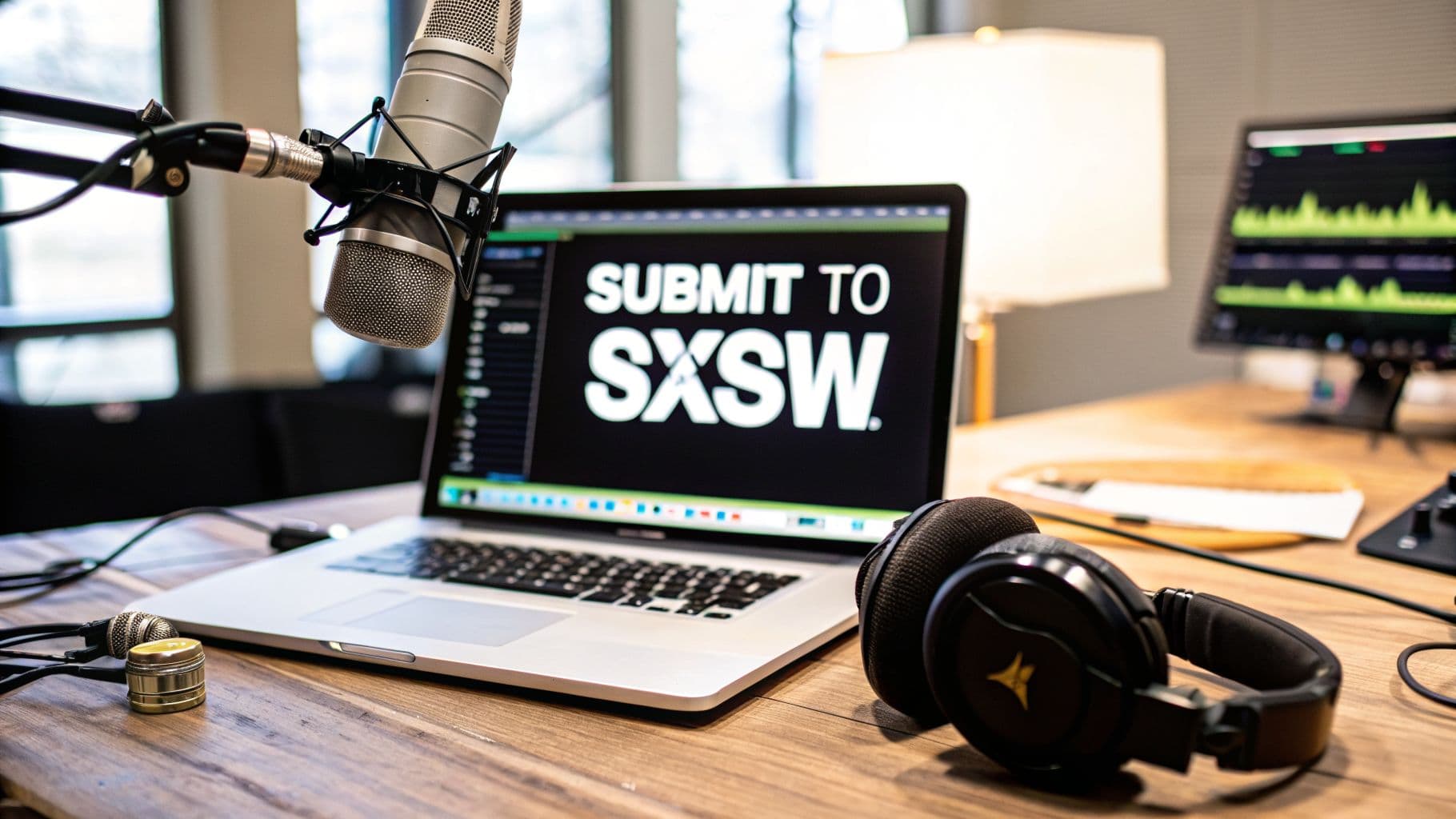
Ready to submit to SXSW? This guide details how to prepare your assets, navigate the application, and craft a story that gets your music showcase approved.
March 6, 2026
Music Marketplace Advisor
Buying & SellingApplying to showcase at SXSW is more than just another festival submission; it's a calculated decision every serious artist should consider. Getting selected is tough, no doubt about it. You're up against thousands of other talented musicians, but the potential career boost is absolutely massive. Think of it as your most direct line to A&R reps, booking agents, and a global audience all in one place.
Why Submitting to SXSW Is a Career-Defining Move

If you're on the fence about applying, let me be clear: you should do it. SXSW isn't just a music festival. It's the annual meeting point for the music, film, and tech industries, and for an independent artist, securing an official showcase is a game-changer.
This isn't just another slot on a local bill. It's your chance to play for a room full of people who can actually move your career forward—influential bloggers, journalists, label executives, and sync agents actively hunting for their next discovery. The right 30-minute set here can open doors that would otherwise take years to unlock.
The Sheer Scale of Opportunity
To put it in perspective, the numbers alone are staggering. The 2024 music festival drew 140,060 attendees over just six days. The lineup featured 422 international acts from 55 different countries performing across 65 stages. That’s an incredible concentration of global talent and industry power.
This means your music could land in front of the very people who can offer:
- Record and publishing deals
- Sync placements in films, TV shows, and video games
- Bookings for other major festivals
- Management or agency representation
A single, well-played SXSW showcase can generate more genuine industry buzz than a dozen hometown shows combined. When the decision-makers are all in one city, every note you play has the potential to land in exactly the right ears.
Thinking Strategically About Your Application
Getting into SXSW requires a professional and organized game plan. This is not something you can rush and throw together the night before the deadline. The selection committee sifts through thousands of applications, and they're looking for artists who are not just talented, but truly ready for the spotlight.
Treat your application like your band's resume. Every single piece of it, from your track selection to your artist bio, needs to tell a compelling and unified story. Your mission is to convince the reviewers that you have a sound that can't be ignored, a captivating live show, and the professional drive to make the most of the opportunity. To get a head start on this, take a look at our deeper guide on how to get your music heard.
This guide will walk you through everything you need to know, from prepping your assets to avoiding the common pitfalls that get otherwise great artists rejected. If you approach this with a clear strategy, you’ll dramatically boost your odds of turning that submission into a career-defining performance.
Preparing Your Submission Assets Like a Pro
Let’s be blunt: your SXSW application lives or dies by the quality of your assets. The selection committee sifts through thousands of submissions, and a polished, professional package is what makes them stop and pay attention. This is your chance to prove you’re a serious artist ready for a massive opportunity.
Think of it as putting together the three pillars of your application: your absolute best music, a killer live performance video, and a sharp Electronic Press Kit (EPK). Each piece has a job to do, and getting them right is non-negotiable. It’s not just about having these things—it's about curating them to make an impression that’s impossible to ignore.
Curating Your Three Strongest Tracks
SXSW asks for three songs, and every choice matters. This isn't the time to get experimental with an obscure B-side or a rough demo, unless you're absolutely certain it's a game-changer. The goal here is to put your most compelling and representative work front and center.
Your track selection should tell a concise story about who you are as an artist. Think of it this way:
- First, the hook: Lead with your most immediate, high-energy, or well-known song. This is your first handshake—make it a firm one that grabs their attention right away.
- Next, the depth: Use the second slot to show your range. This might be a more lyrical or emotionally complex track that reveals another side of your artistry.
- Finally, the live hit: End with a track that you know absolutely destroys a room live. This song should practically scream, "You have to see this on stage," bridging the gap between your recorded sound and your performance energy.
And please, mind the details. Make sure your audio files are high-quality (320kbps MP3s are standard) and professionally labeled. A file named "final_mix_v3_draft.mp3" just looks sloppy. A clear format like "ArtistName-SongTitle.mp3" makes the reviewer's job infinitely easier.
Showcasing Your Live Performance
A fantastic live video might just be the single most critical asset you submit. Remember, they're booking a live music festival. The committee needs to see that you can command a stage and actually connect with an audience.
Your video doesn't need a Hollywood budget, but it does need to look and sound good. Shaky phone footage from the back of a dark, mostly empty bar is an automatic pass. If you can, use a multi-camera shoot with clean audio pulled directly from the soundboard. If that's not in the cards, a single, steady shot from a good angle with clear sound is far better than a chaotic mess.
The only question your video needs to answer for the reviewer is: "Do I need to see this act live?" Choose footage that bleeds energy, showcases your stage presence, and captures the audience's reaction. A 30-second clip of an engaged crowd singing along is more powerful than an entire song played to an empty room.
Building Your Electronic Press Kit (EPK)
Your EPK is your digital resume, bringing all your essential info together in one slick, easy-to-digest package. When a reviewer clicks on it, they should get everything they need at a glance. To get a feel for what works, check out these great musician press kit examples for inspiration on how to structure your own.
A powerful EPK for a SXSW submission absolutely must include:
- A Compelling Artist Bio: A short, punchy paragraph that nails your sound and your story.
- High-Resolution Photos: Offer both landscape and portrait options. Great photos are currency. As you choose them, it's worth remembering why artists should invest in quality cover art and pro photos—they instantly communicate professionalism.
- Music Links: Direct links to your top tracks on Spotify, Apple Music, and other major platforms.
- Live Video Link: Embed your best performance video right in the EPK for easy viewing.
- Press Clippings & Quotes: Showcase your best reviews or any notable media shout-outs.
- Contact Information: Make it dead simple to find contact details for your manager, agent, or primary contact.
Using a platform like OohYeah can be a huge help here. You can build a central hub with your best tracks, bio, and links, then share a single, clean link in your application. It ensures that when a reviewer clicks through, they’re greeted with a polished and cohesive presentation of who you are.
Tackling the SXSW Application Portal
Alright, you’ve polished your assets, and now it's time to dive into the SXSW application portal itself. Think of this as the final handshake. All your hard work culminates here, so moving through the platform with care is absolutely essential for a successful submission.
First things first: when you create your account, the very first choice you make is critical. You have to select the correct application type—Music Showcase. It sounds painfully obvious, I know. But every year, artists accidentally click the wrong box and send their entire application into a black hole. A simple misclick can end your chances before anyone even listens to a single note.
Filling Out Your Artist Profile
Once you’re in, you'll land on the main artist profile form. This isn't just about filling in blanks; it's about building a clean, professional snapshot of your act. The portal will ask for the basics: artist name, home base, genre, and your website.
This is where attention to detail really pays off. Provide direct, clean links to all your key online presences. We’re talking about your main social channels (Instagram, TikTok, X) and, crucially, your primary streaming profiles on services like Spotify and Apple Music. Broken links are a red flag for reviewers, suggesting you might be sloppy in other areas, too.
My Two Cents: Before you even start the application, do this one simple thing: open every single link you plan to use in a private or incognito browser window. This is the quickest way to confirm that a SXSW reviewer can see your content without hitting a 404 error or a private profile page.
The submission process boils down to connecting your core assets—audio, video, and your EPK—within the portal, as shown below.

As you can see, a strong application is built on the interplay between these different elements.
Uploading Your Key Media
Next up is getting your music and video into the system. The application portal has very specific technical specs for file types and sizes. These aren't just suggestions—they're rules. If your files are too big or in the wrong format, they might fail to upload or simply be unplayable for the review committee.
- Your Best Tracks: You'll be asked to upload three of your strongest songs. The gold standard is typically high-quality MP3 files (320kbps). Keep your file names clean and professional, like ArtistName_SongTitle.mp3. It helps the listener stay organized.
- Live Performance Video: Instead of a massive file upload, you’ll usually provide a link to your live video. A YouTube or Vimeo link works perfectly. Just double-check that the video’s privacy is set to "Public" or "Unlisted"—never "Private."
A smart way to streamline this is by using a platform like OohYeah. You can build a polished profile that hosts your EPK, top tracks, and important links all in one place. Then, you can simply drop that single, elegant link into your application. It shows reviewers you’re organized and gives them a branded, easy-to-navigate space to explore your world beyond the three required songs.
Crafting a Compelling Narrative
The application isn’t just about files and links; it’s also your chance to tell your story. Several open-ended text fields, like your bio and a "pitch" section, are where you add context and personality. When you submit to SXSW, this is how you make your music memorable.
The Artist Bio (Around 250-500 words) This needs to be more than a dry list of your accomplishments. Write a narrative that explains your sound, your story, and what makes you different. Ditch the clichés and give the reviewer something that grabs their attention and makes them want to press play.
The "Pitch" Field (Around 100 words) This is your elevator pitch. In just a few sentences, answer the all-important question: "Why should we book you for SXSW?" Highlight the energy of your live show, your recent momentum (like a new album or sold-out tour), and what makes your set a can't-miss experience. Be confident, be concise, and be convincing.
For instance, don't just say, "We are a four-piece indie rock band from Brooklyn."
Instead, try something with more personality: "Fusing post-punk grit with anthemic, synth-laden hooks, our live show has been called a 'frenetic, joyful explosion.' Fresh off a sold-out East Coast tour for our new record, we're ready to bring that unforgettable energy to SXSW."
See the difference? The second example isn't just a description; it’s an invitation. By approaching every field with this level of thought, you ensure your application is not only technically sound but also incredibly persuasive.
Crafting a Narrative That Gets You Noticed
 Let’s be honest: when you submit to SXSW, your music is only part of the equation. The selection committee is sifting through a mountain of applications, and they aren't just listening for a decent song. They’re searching for artists with a real story, a clear vision, and that undeniable spark that says you’re ready for this.
Think of your application as more than just a form. It's your chance to turn a static profile into a compelling invitation—one that convinces a busy reviewer that out of thousands of choices, your showcase is the one they can’t miss.
Every word you write needs to earn its place. To cut through the noise, your story has to grab them from the very first sentence. If you're struggling to find that opening line, check out these powerful examples of a hook sentence for a shot of inspiration.
Writing a Bio That Sells Your Story
Your artist bio is ground zero for telling that story. This isn't the place to simply state where you're from and what genre you play. It's your opportunity to define your unique sound, your mission, and why your music matters right now.
Please, let's retire the clichés. Phrases like "a unique blend of..." or "genre-bending" are so overused they've become meaningless. Be specific and use language that paints a picture in the listener's mind.
- Instead of this: "We are an indie rock band from Austin that blends different influences."
- Try this: "We make high-desert rock and roll that sounds like a sunset panic attack—a frantic mix of wiry guitars and cinematic storytelling for a world on edge."
See the difference? The second example creates a mood. It gives the reviewer a sense of your perspective and sound before they even hit play. Your goal is to make them curious.
Your bio isn't just a history of your band; it's the trailer for your music. Keep it short, make it punchy, and leave the reader wanting to hear the main feature. Make it a story only you can tell.
Weaving a Narrative with Social Proof
A great story becomes undeniable when you back it up with facts. You need to strategically include press mentions, past accomplishments, and even fan engagement data to build a case for your momentum. This isn't about bragging; it's about providing concrete evidence that you're an artist on the rise.
For instance, don't just say you have dedicated fans—prove it. Mentioning that your last DIY single pulled in 50,000 streams in its first month or that you sold out a 200-capacity venue gives them solid proof of your growing audience.
When you include press clippings, choose quotes that directly support your core story.
- A decent quote: "A great new band." – Local Blog
- A better quote: "Their live show is a torrent of joyful, chaotic energy that’s impossible to ignore." – Local Blog
The second quote doesn't just say you're "good." It specifically validates the power of your live performance, which is exactly what the SXSW team is looking for. If you need help getting more of these killer quotes, our guide on how to write a press release that gets your music noticed has plenty of practical advice.
Highlighting What Makes You Different
Finally, every great narrative needs a unique angle. What makes you different from the hundreds of other rock bands or singer-songwriters applying alongside you? This is your unique selling point, and it's your most valuable asset.
Think about what truly sets you apart:
- A Unique Origin Story: Are you a classically trained cellist who now produces industrial techno? Did your band form while working as park rangers in Yellowstone?
- A Strong Mission: Does your music tackle specific social issues? Are you building a community around a niche subculture?
- An Unforgettable Live Show: Do you incorporate live projections, theatrical elements, or a wild, unconventional instrument?
Whatever your angle is, it should be the common thread woven throughout your application, from your bio to your song descriptions. It provides a memorable hook that will stick in a reviewer's mind long after they've moved on to the next submission. When you give them a consistent and compelling story, you give them every reason to say yes.
Common Submission Mistakes and How to Avoid Them

You’ve poured your heart into the music and spent hours getting your assets just right. The absolute last thing you want is for a simple, preventable mistake to sink your chances of getting into SXSW. I’ve seen it happen countless times—talented artists get passed over not because their music was lacking, but because of small errors that screamed unprofessionalism.
Think of this section as your final sanity check. Let’s walk through the most common traps so you can sidestep them completely. These are the little things that get applications dismissed before the music even gets a fair shot.
Technical Glitches and Broken Links
This is, without question, the most common—and most fatal—mistake. A broken link is an immediate dead end. If a reviewer clicks to hear your music or watch a performance and hits a 404 error or a "private" page, they aren't going to track you down for a working link. They'll just move on to the next one in their massive queue.
The same goes for your audio files. Sending a file named song_final_mix_v3.mp3 looks incredibly amateur. It suggests you don’t quite have your act together.
Here’s how you get this right:
- Test every single link. Open an incognito or private browser window and click every link you plan to submit. If you can't access it, neither can they.
- Check your video permissions. Videos on platforms like YouTube or Vimeo must be set to "Public" or "Unlisted"—never "Private."
- Clean up your files. Export your audio as high-quality MP3s (320kbps is the standard) and use a clean, professional naming convention, like
ArtistName-SongTitle.mp3.
The SXSW review team is going through thousands of applications. Don't give them an easy reason to disqualify you in the first ten seconds. Your goal is to make their job as easy as possible.
The Incomplete or Uninspired EPK
Another classic pitfall is an EPK that’s missing crucial information. A reviewer shouldn't have to go on a scavenger hunt for your bio, contact details, or hi-res press photos. An incomplete kit signals you aren’t ready for the professional demands that come with an official showcase slot.
Even worse is an EPK that's technically complete but totally generic. A bio with no personality or photos that look like they were snapped on a phone five minutes ago makes you instantly forgettable.
For example, a generic bio says, "We're a four-piece band from Austin making rock music." A compelling one paints a picture: "We play scorched-earth rock and roll that sounds like a Texas summer—sweltering, relentless, and a little bit dangerous." The second one makes a reviewer feel something.
Choosing the Wrong Songs
The three songs you submit are your primary pitch. A frequent mistake is picking tracks that don't accurately capture the energy of your live show. If your recordings are polished and atmospheric, but your live set is a raw, high-octane punk explosion, that disconnect can be jarring for a booker.
Your song selection needs to tell a cohesive story that aligns with the performance you're selling. Think of it this way:
- Song 1: Your undeniable "hit." The most infectious, immediate track you have.
- Song 2: Shows your range. This one reveals another layer of your artistry.
- Song 3: The live banger. This track should absolutely scream "you have to see this band live."
This isn't just a random playlist; it's a strategic move to show the programmers exactly what kind of experience you’ll bring to a SXSW stage.
Before you hit that final "submit" button, run through this quick checklist. It’s a simple way to catch those last-minute errors that are all too easy to make when you’re tired and just want to be done with it.
Submission Pre-Flight Checklist
This final review will ensure you haven't overlooked any of the small details that matter.
| Asset | Check | Pro Tip |
|---|---|---|
| Audio Files | Are they high-quality 320kbps MP3s? | Use a tool like OohYeah to easily convert and host your tracks. |
| File Names | Is every file named cleanly (ArtistName-SongTitle.mp3)? |
Avoid versions (_v2, _final) or generic names (track01.mp3). |
| All Links | Have you tested every single link in a private browser? | Double-check your main music, video, and social media links. |
| Video Access | Are your performance videos set to "Public" or "Unlisted"? | "Private" videos are a guaranteed dead end for reviewers. |
| Bio & Press Photos | Is your bio compelling? Are your photos high-resolution? | Make sure your EPK assets are current and tell your story effectively. |
| Contact Info | Is your primary contact email correct and actively monitored? | This seems obvious, but typos here can cost you the opportunity. |
| Category Selection | Have you chosen the genre and location that best fit your act? | Don't try to game the system; be honest about who you are. |
Taking just ten extra minutes to go through this list can be the difference between getting your music heard and getting lost in the shuffle. Good luck
After You Submit: What Happens Next
So, you’ve hit submit. Take a deep breath. Pour yourself a drink. You’ve just cleared a major hurdle. But while it might feel like the finish line, the race isn’t over. That long, quiet waiting period between submission and notification is your chance to prove to the SXSW selection committee that you were a smart bet.
The silence from the festival can be tough, I get it. The review process is a months-long marathon, with notifications typically rolling out in waves from late fall into the new year. Don't just sit on your hands waiting for an email. What you do now can actually influence their decision.
Think about it from their perspective: they’re sorting through thousands of applicants. An artist who keeps building buzz after applying is far more compelling than one who goes quiet.
Stay Active, Build Buzz
Your goal is to show undeniable forward momentum. If a reviewer revisits your profile weeks after your initial submission, you want them to see an artist who is clearly going places.
Here’s what that looks like in practice:
- Keep Releasing Music: You don't need a full album. Dropping a single or a two-track EP during the waiting period gives the press, fans, and festival programmers something new to talk about.
- Play Shows (and Document Everything): Don't stop booking gigs. Whether it's a packed hometown show or a short regional run, get high-quality photos and video. Show them you can command a stage and draw a crowd.
- Keep Your Socials Alive: This isn’t just about posting. Share behind-the-scenes clips, interact with your fans, and talk about the new music you’re working on. Create a story of an artist on the move.
This is a great time to centralize all your new activity. Using a platform like OohYeah can give your fans—and any curious festival bookers—a single spot to find your new single, see your latest show photos, and connect with your story.
I’ve seen it happen time and again: the artist who keeps grinding after they apply is the one who gets the nod. A festival wants to book acts that are already generating their own heat, not ones waiting for a handout.
The Big Decision: Handling the Email
Eventually, the email will land in your inbox. It’s a moment of truth, and you need to be ready for either outcome.
If You’re Accepted
First off, pop the champagne! Getting into SXSW is a massive achievement. Once the initial shock wears off, it’s time to get to work—fast. You’ll get an official performance agreement that you must sign and return by their deadline. Do not miss this deadline. If you do, they’ll move on to the next artist on their list, no questions asked.
Once confirmed, the real fun begins: booking flights, finding a place to crash, and, most importantly, plotting how you’re going to get a packed room for your showcase.
If You’re Not Accepted
It stings. There's no way around it. But this is not a reflection of your talent or your worth. I know countless incredible artists who played SXSW on their second, third, or even fourth try. Rejection is just part of the game.
My advice? Let it burn for a day. Then, turn that disappointment into fuel. Re-read your application with a critical eye. Where could it have been stronger? What can you accomplish in the next 12 months to make your application for next year completely undeniable? Get back to writing, recording, and playing. Get bigger, get better, and get ready to try again.
Your SXSW Submission Questions, Answered
As you dive into the SXSW application, you're bound to have questions. It’s a detailed process, and it’s completely normal to wonder about your chances, the deadlines, and what happens if things don't go your way the first time.
Let's cut through the noise and get you the practical answers you need. Here's my take on some of the most common questions I hear from artists every single year.
What Are My Real Chances of Getting Accepted?
Let's be direct: it's tough. SXSW doesn't release official acceptance rates, but we know that thousands of acts from all over the world apply for just a few hundred official showcase spots. It is incredibly competitive.
But getting accepted isn't a lottery. It’s a combination of having fantastic music, a captivating live video that proves you can handle a stage, a polished and active online presence, and a compelling story that you tell through your application materials.
Don't get bogged down by the odds. Your real job is to build an application so strong, so professional, and so undeniable that the selection committee simply can't ignore it.
Can I Edit My Application After I Submit It?
This is a big one: once you've paid the fee and hit submit, your application is locked. For all intents and purposes, you cannot go back and make changes.
This is precisely why you need to treat the final review of your application like you're mastering a track. Check every single link, make sure your files are correctly formatted, and proofread every word in your bio. A broken link or a major typo can't be fixed once it's in their hands.
Does Submitting Early Actually Help?
Yes, in a couple of important ways. The most obvious benefit is financial—the application fee is always cheaper during the early-bird window. That alone is a great reason to get it done sooner rather than later.
While SXSW has always maintained that all applications get the same consideration no matter when they're submitted, applying early sends a signal. It shows you're organized, serious, and professional. Plus, you’ll avoid the stress and potential website crashes that always seem to happen in the final hours before the deadline.
What if I Don't Get in This Year?
If you get a "no," the most important thing to do is not take it as a final judgment on your music. So many incredible artists who eventually play the festival didn't get in on their first, second, or even third try. Rejection is just part of the process.
Use it as fuel. You now have a full year to build an even stronger case for yourself. Grow your monthly listeners, book more impressive shows, land some new press, and come back next year with an application that's even harder to pass up.
Building that stronger case starts with having a professional home for your music. With a platform like OohYeah, you can create a powerful hub for your tracks, EPK, and artist story. It gives you the tools to look polished and ready for opportunities like SXSW. Give it a look and make sure your next submission is your best one.